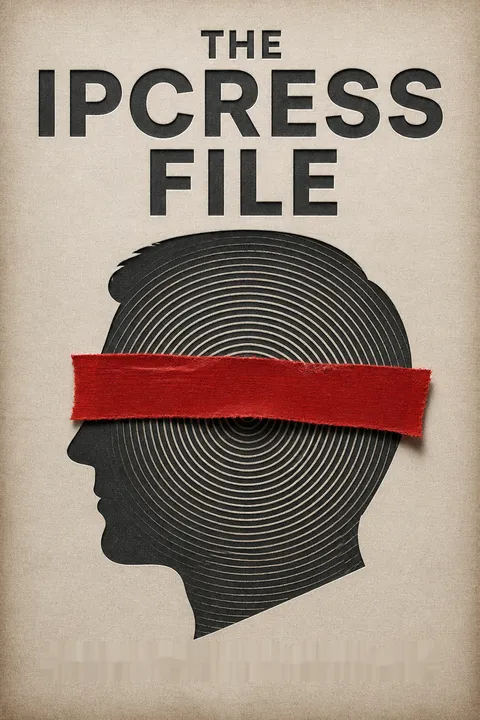


Plot Summary
Prologue
The narrator1 is summoned to brief a Minister of Defence, who wants his personal account rather than a paper trail. Asked to begin with his first meeting with Jay,2 the elusive broker of people and secrets,2 he warns that the case is difficult to tell in order.
His account begins instead with the job that brought them together: eight senior scientists have vanished, and his new employer wants one of them recovered before he is taken abroad.
The frame makes official secrecy part of the story’s structure. A dossier would promise a stable sequence, but the narrator tells the Minister that the case resists tidy explanation because its evidence has been manipulated by people inside the system. The Minister’s preference for a personal version also exposes the gap between public accountability and private power: he needs enough information to manage questions, not necessarily to understand the machinery beneath them. The narrator’s dry, practical manner becomes an alternative record, preserving the human costs that official files can disguise.
A Job Without Instructions
After nearly three years in Military Intelligence, Harry1 leaves the Army and joins W.O.O.C.(P), a small Cabinet-directed intelligence unit led by Dalby.3 The transfer strips away his old service identity and places him among civilian offices, surveillance films, and files that other departments would rather keep to themselves.
Dalby3 explains that eight top-cleared specialists have disappeared in six and a half weeks, including biochemists whose knowledge could be dangerous in foreign hands.
He believes the disappearances are tied to Jay,2 a Polish-born fixer2 who arranges clandestine movement across borders. Harry’s1 first assignment is bluntly commercial: offer Jay2 up to eighteen thousand pounds for the safe return of the latest missing scientist,9 Raven,9 and pay only after delivery.
Harry enters the story not through a grand patriotic calling but through a transfer, an expense allowance, and an assignment he is not sure he can perform. That bureaucratic modesty matters: the novel locates espionage in the workaday systems of forms, surveillance, and interdepartmental rivalry. Dalby treats the missing scientist as both a person to recover and leverage against the Home Office. Harry’s unease, beneath his jokes, marks the difference between being trained to obey and being asked to improvise inside an operation whose rules are deliberately unstated.
The Glass-Floored Club
Harry1 approaches Jay2 in a Soho coffee-house, where Jay’s associate10 Housemartin10 watches him before taking him to a strip club. A cigarette girl18 quietly warns Harry1 away, but he climbs upstairs and discovers an observation room overlooking a hidden gambling hall.
Through glass panels in the floor, he sees Raven9 lying unconscious on a table. Before Harry1 can reach him, Housemartin10 lifts Raven9 and carries him through another exit. Harry1 smashes through the glass after them, lands in the gambling room, and escapes a police raid through a kitchen alley.
Only later, in a café, does he find a boxed hypodermic syringe in his pocket. The warning and syringe suggest that someone tried to stop him, or frame him, while the missing Raven9 remains in Jay’s2 hands.
The club turns looking into a dangerous substitute for knowing. Harry has spent weeks studying Jay on film, yet the moment he enters Jay’s world, surveillance gives him only a view through glass and leaves him unable to intervene. His escape is physical and improvised, but the syringe makes the apparent success feel contaminated. The scene also introduces the novel’s governing problem: evidence can be planted, identities can be staged, and an observer can be made to look like a participant. Harry’s instinct to keep moving saves him from immediate arrest, while his lack of context keeps him vulnerable.
Fire on the Lebanon Road
W.O.O.C.(P) sends Harry1 to Beirut under a changed identity, with a concealed revolver and a sticky bomb hidden in his luggage. At night in the mountains, he and Dalby3 wait for a Pontiac carrying Raven9 toward Syria. Dalby3 throws the bomb, disables the car, and pulls the drugged scientist9 from the wreck.
A second vehicle appears, later identified as U.S. Navy intelligence, and Harry1 uses another bomb against it. The burned cars leave him sickened by the smell and by the fact that he has killed people whose purpose he did not know. Dalby3 gives Raven9 morphine and moves him to a secluded villa. A helicopter piloted by Adem13 then carries Raven9 toward a British destroyer, taking him out of Jay’s2 immediate reach.
The recovery is a tactical victory with a moral cost that Harry cannot file away as simply necessary. He has been told to retrieve Raven unharmed, yet the operation makes him kill unseen opponents and rely on a cover-up involving burned clothing and wreckage. Dalby’s calm command style makes violence seem administratively manageable, while Harry’s nausea registers the body’s refusal to accept that fiction. The episode also complicates the idea of national allegiance: the second car belongs to an allied service, not the enemy. In this world, secrecy can make friendly forces indistinguishable from hostile ones until after the shooting.
Patterns in the Missing
Back in London, Harry1 receives Jay’s2 history: a career that crossed Polish, German, Communist, American, and British intelligence circles, leaving no clear answer about whom he truly serves. Dalby3 believes Jay2 trades people and information for money, but doubts he could manage the much larger pattern now emerging.
Captain Carswell7 and Sergeant Murray8 analyze disappearances among Britain’s most valuable security-cleared specialists. Their statistics reveal unusual clusters, recurring absences from certain areas, and links to private meetings that do not look like ordinary conferences.
Dalby3 leaves Harry1 in temporary command of W.O.O.C.(P), telling him to read the files rather than offering a full explanation. Harry1 keeps Carswell’s7 work active, though he suspects the older statistician7 may be building patterns from noise.
Carswell’s method asks the intelligence service to notice what it does not yet know how to name. His patterns are initially easy to dismiss because each individual detail, illness, political history, or meeting, has an ordinary explanation. Harry’s skepticism is rational, but it also reflects a culture that privileges dramatic operations over patient inference. Meanwhile, Jay’s history dissolves the reassuring categories of defector and loyal agent. The section establishes that information itself is not the only commodity at stake: the people who possess it can be moved, altered, and made to serve whoever controls their circumstances.
The House Above the Tank
A call from Scotland Yard reports that Housemartin10 has been arrested after a traffic incident while disguised as a police inspector. Harry1 reaches Shoreditch to find him stripped and dead in his cell, killed before he can be questioned.
A constable’s local knowledge points Harry1 toward a secluded house on Acacia Drive. The coordinated search finds ordinary rooms below and, above a removed staircase, a concealed complex of bare cells, scrubbed equipment, and blocked windows.
In one room, investigators recover a water tank, a harness, and pieces of a recording device. The house has been emptied in haste, but its architecture suggests that the missing specialists were not simply hidden there. Someone had prepared a place to isolate and systematically weaken them.
The house converts an abstract pattern of missing people into a material environment. Its concealed upper floor makes coercion architectural: victims could be cut off from ordinary time, contact, and orientation without leaving a conventional prison. Housemartin’s death prevents the simplest kind of explanation, a confession, and forces Harry to read spaces and objects instead. The evidence is powerful but incomplete, which mirrors the difficulty of investigating psychological coercion: the wounds may not be visible, and the apparatus can be removed. Harry’s authority grows just as his certainty shrinks.
The Tape and the Warning
Ross,5 Harry’s1 prickly former superior, offers to sell him a sensitive file on Egyptian intelligence, hoping Harry1 will use his broader budget to fund a faltering operation. Harry1 refuses rather than reward Ross’s5 attempt to monetize information gathered at public expense.
At a War Office screening, Harry1 sees rough footage of unidentified men; later, Scotland Yard’s Keightley gives him a recording recovered from the Acacia Drive house, a muddle of voices and cries that confirms the site was used to manipulate people. Jean Tonnesen,4 a multilingual operative recently returned from Macao,4 becomes Harry’s assistant.4 When he sees Jay2 and Dalby3 together in Soho, their meeting unsettles the assumptions on which he has been running the case.
This section places two kinds of professional compromise side by side. Ross is willing to turn a government file into a private bargaining chip, while Harry draws a line, however narrow, around the public purpose of intelligence work. The recording then makes the investigation’s subject audible but not intelligible: suffering survives in the evidence without explaining who caused it. Jean’s arrival offers Harry a capable partner, yet his glimpse of Dalby with Jay destabilizes even his closest working relationship. Trust becomes less a feeling than a provisional judgment repeatedly tested against conduct.
The Atoll’s Hidden Signal
Dalby3 takes Harry1 and Jean4 to Tokwe Atoll, where American scientists are preparing a powerful experimental nuclear test. Harry1 learns from CIA officer Skip Henderson15 that discoveries across a wide range of laboratories are reaching an unknown recipient almost immediately.
At the test site, Harry1 notices that security is unusually tight and that personnel seem to be watching him as much as the machinery. On the shot tower, his old friend Barney Barnes,12 now serving under another name, confronts him with a warning: British and American authorities suspect Harry1 of treason, and Dalby3 may be involved in the effort to expose or eliminate him. Barney12 gives him a small pistol and ammunition, risking his own position to offer Harry1 a chance to survive.
Tokwe enlarges the case from missing specialists to a breach in the infrastructure of scientific knowledge. The scale of the test makes secrecy feel physically immense, yet the decisive information arrives through a private warning between old friends. Barney’s intervention matters because Harry cannot verify it through official channels without walking into the trap those channels may contain. His friendship with Barney is not sentimental decoration; it is an alternative intelligence network built on remembered character. The gun Barney provides is less a promise of force than a small interval of choice in a system designed to remove it.
The Bunker’s Neutron Plan
Jean4 takes Harry1 to an abandoned Japanese blockhouse, where they find a concealed cache: a television tube, electronic parts, a machine pistol, and a Russian note referring to a neutron weapon. She explains that Dalby3 had visited the site and that he believes Harry1 may be working for the KGB. Harry1 insists that the suspicion makes no sense, but he cannot be sure how far the plot reaches.
At a garden party, Dalby3 quietly admits that the accusation was deliberately encouraged to make a senior suspect reveal himself by trying to harm Harry.1 The explanation does not settle the matter. Instead, it confirms that Harry1 has been used as bait, while Jean’s4 choice to share the bunker evidence binds her more closely to him.
The bunker makes the past an active hiding place: wartime debris shelters a modern device meant to transmit images from a secret weapons test. Its contents connect old military infrastructure to a new technology of surveillance, while the Russian note tempts Harry toward a simple enemy attribution. Dalby’s bait explanation complicates that reading. The danger is not only that Harry may be falsely accused, but that his actions can be engineered to validate the accusation. Jean’s decision to involve him is therefore an act of judgment under uncertainty, not proof that either of them has reached safety.
The Test Turns on Harry
Two coded messages reach Harry1 at the Tokwe party, one offering an escape route and another warning him to beware. Before he can act, he learns that Barney12 has died when a generator truck went off the road. Dalby3 drives toward the shot island; Harry1 follows, but a roadblock stops him while the test is underway. The night erupts in blinding light, and a search helicopter finds Harry1 beside his car.
Investigators discover a dead American sentry in a high-voltage tower and arrest Harry1 for sabotage and murder. During interrogation, the Brigadier16 shows him evidence suggesting that a hidden transmitter sent images of the test to a submarine. The planted clues make Harry1 look guilty, while Dalby3 is already beyond his reach.
The test’s detonation collapses several kinds of uncertainty into one accusation. Harry loses Barney, the friend who could have helped interpret the danger, just before the machinery of the state closes around him. The coded messages offer competing forms of rescue, but neither can be tested in time. The dead sentry and the transmitter turn physical evidence into a story about Harry, even though the reader knows how readily such evidence can be staged. This is the novel’s sharpest demonstration of institutional power: an official account becomes persuasive not because it is true, but because its makers control the scene.
A Prison Built in London
After days of brutal questioning in a brightly lit American security room, Harry1 is drugged and told he will be deported to Hungary. He wakes in a cell where guards force him to repeat phrases, deny him food, and distort his sense of time. A supposed British Embassy official offers no real help, and Harry1 gradually understands that the transfer and prison may be another performance.
On the thirty-fifth day, he knocks out an elderly guard, creates an electrical short to distract the house, and climbs over a garden wall. A resident identifies the neighborhood as Wood Green, not Hungary. Harry1 reaches Charlie Cavendish,11 an old friend of his dead wartime companion,11 who hides and feeds him while helping check Carswell’s7 identity.
The captivity attacks Harry’s ability to trust his own perceptions before it attacks his body. The invented Hungarian setting is especially effective because it makes geography itself unreliable: the prison’s apparent distance from home is another instrument of isolation. Harry survives by treating small inconsistencies as evidence and by recognizing that humiliation can be part of the method, not a reason to surrender judgment. His escape is neither a clean victory nor a return to normal life. It restores a limited capacity to act, while leaving him injured, uncertain, and dependent on an old friendship.
Jay Behind the Window
After Charlie11 searches for Carswell7 and finds no credible service record, Harry1 prepares to approach Dalby3 alone. He returns to Charlie’s11 flat and finds him murdered, apparently mistaken for Harry1 because he had worn Harry’s1 light-blue raincoat. Fleeing police attention, Harry1 visits Dalby’s3 country home and sees Dalby,3 a Chinese-looking operative, Murray,8 and Jay2 together.
Murray8 intercepts Harry1 outside and reveals that he is a senior intelligence officer working for Ross,5 not the ordinary sergeant8 Harry1 knew. Harry1 follows Jay2 to London, where armed men capture him. Jay2 receives him in his kitchen, explains that the missing specialists were conditioned to serve Jay2 personally, and allows Ross5 and police to take him into custody.
Charlie’s death gives the conspiracy an intimate cost: a garment borrowed for shelter makes a friend into a substitute target. Harry’s grief cannot pause the investigation, because the murder also proves that Jay’s network remains active. The sight of Jay with Dalby transforms suspicion into an unmistakable rupture, while Murray’s revealed identity shows how thoroughly Harry’s relationships have been arranged around hidden roles. Jay’s willingness to receive Ross’s officers is not a simple confession or redemption. He remains a calculating broker, but the operation can no longer remain invisible.
The File Stays Open
Ross’s5 operation takes Dalby3 and the network into custody, while Harry1 learns that Carswell’s patterns had identified the conditioning program’s patients and methods. The program, called IPCRESS, used isolation, induced illness, drugs, and psychological pressure to make specialists dependent on Jay.2
Jay2 is paid to work in a new intelligence unit shared by Ross5 and Harry,1 while the damaged Raven9 and Carswell7 remain crucial witnesses. Dalby3 later dies in a high-speed car crash.
Harry1 recovers his overdue pay, sends help to Adem13 and Alf Keating, and resumes work with Jean,4 who repairs his trousers. Yet the identity of Henry, the person who warned Jay,2 remains unresolved. The case closes operationally, not completely, and Harry1 keeps the slim file for a future inquiry.
The resolution refuses the comfort of a total purge. The conditioning network is exposed and its leaders are contained, but the system’s most valuable asset, Jay, is absorbed back into intelligence work because his knowledge remains useful. This is not a clean moral settlement; it is the familiar bargain by which institutions convert dangerous expertise into managed service. Harry’s return to ordinary office details, pay claims, favors, and Jean’s mending restores texture without erasing what happened. The Henry file preserves the remaining uncertainty as an obligation. In Deighton’s world, closure is often a folder placed within reach, not a final answer.
Epilogue
After briefing the Minister, Harry1 drives to a house near Staines and gives the elderly guard who held him at Wood Green cash and forged British passports. The man is preparing to leave, and Harry1 understands the payment as insurance for a future need, not an act of forgiveness.
The guard boards a plane for Prague. His departure leaves Harry1 with one more compromised connection to protect, and confirms that even the enemy’s custodians can become part of an intelligence officer’s network.
The epilogue quietly overturns the clean division between captor and captive. Harry compensates the old guard not because the imprisonment was harmless, but because survival has taught him to preserve useful human connections wherever they can be found. The forged passports extend the book’s recurring traffic in manufactured identities, now used to help someone escape rather than to ensnare him. This is a deliberately uneasy ending: the guard is neither absolved nor simply discarded, and Harry’s kindness remains entangled with strategy. His private insurance policy mirrors the state’s own habits of turning people into contingencies.
Analysis
The Ipcress File treats espionage as a crisis of interpretation. Harry1 rarely lacks information altogether; instead, he receives too much evidence whose provenance cannot be trusted. A planted syringe, a dead man in a police cell, a statistical cluster, a recording of unseen suffering, and fingerprints on a transmitter each invite a conclusion while concealing who arranged the conditions under which that conclusion appears. The plot therefore makes the detective’s central task epistemic: Harry1 must distinguish what an artifact proves from what its handler wants it to prove.
The novel’s bureaucratic detail is not background decoration. Files, expense claims, personnel cards, security clearances, and interdepartmental rivalries determine who can see a fact and who is permitted to act on it. Institutions that claim to protect the state compete for jurisdiction, conceal failures, and sometimes preserve useful criminals rather than resolve the moral problem they create. Jay’s2 eventual incorporation into intelligence work makes this logic explicit. The service condemns his trade in people, then hires his expertise when it becomes useful.
IPCRESS also gives psychological coercion a distinctly material form. Hunger, sleep disruption, temperature, isolation, and repeated exercises attack the body’s ability to sustain a stable account of reality. Harry1 survives not through invulnerability but by noticing small contradictions and accepting help from people he has learned to judge individually. Friendship, especially with Charlie,11 Barney,12 and Jean,4 offers a counterweight to institutional manipulation, but it is never wholly safe or outside politics.
Harry’s1 humor is both a method and a defense. It punctures authority, buys time, and keeps him from surrendering his interpretive independence. Yet the novel does not pretend that wit dissolves trauma: he vomits after the Lebanon ambush, endures physical collapse, and must rebuild trust after captivity. The unresolved Henry file and the surviving intelligence network deny a total victory. Harry1 can expose a conspiracy, but he cannot make secrecy itself disappear. The book’s hard lesson is that vigilance is necessary, though it never becomes certainty.
Review Summary
The Ipcress File receives mixed reviews, with readers praising its gritty, realistic portrayal of espionage as a stark contrast to James Bond's glamour. Many appreciate Deighton's sharp writing, working-class protagonist, and cynical wit, though the deliberately confusing plot frustrates numerous reviewers. Some consider it a groundbreaking classic that established the modern spy thriller genre, while others find it dated, convoluted, and difficult to follow. The film adaptation starring Michael Caine is frequently cited as potentially superior to the book. Readers often invoke Kingsley Amis's advice to stop worrying about understanding everything and simply enjoy the atmospheric writing.
People Also Read

Characters
Harry
The skeptical field officerHarry is an observant, self-mocking intelligence officer whose practical intelligence is sharpened by distrust of official certainty. He notices the torn briefcase, the wrong detail in a cover story, and the way people behave when they think no one is watching. His humor protects him from pomp and fear, but it can also conceal how deeply violence affects him. He dislikes being managed through rank or ceremony and prefers evidence he can test himself. His loyalties emerge less as slogans than as obligations to particular people, including colleagues and old friends. He is most effective when he admits what he does not know, then keeps moving.
Jay
The human commodities brokerJay is a cultivated, patient fixer who has survived repeated political changes by adapting faster than the governments around him. He treats information, specialists, and access as marketable assets, and his manner can make monstrous transactions seem like ordinary business. His confidence comes from reading people’s appetites and from believing that loyalty can be engineered or purchased. Jay is not driven by a single public doctrine so much as by money, influence, and the pleasure of remaining indispensable. His polished habits, elaborate covers, and deliberate courtesy make him difficult to reduce to a conventional villain, even when his actions place people in danger.
Dalby
The elegant intelligence chiefDalby leads W.O.O.C.(P) with charm, tactical imagination, and an appetite for decisions that other departments avoid. He can be both a generous sponsor and a manipulative commander, treating rank as less important than whether someone can contribute. His humor and relaxed style soften the force of his authority, while his readiness to use unconventional methods makes him a magnetic but difficult figure to assess. Dalby values competence and control, and he expects subordinates to keep pace with his leaps of reasoning. Harry’s1 relationship with him is built on sharp banter and professional dependence, which makes Dalby’s confidence especially hard to separate from the institution he commands.
Jean Tonnesen
The multilingual new partnerJean is a trained operative with wide linguistic ability, disciplined observation, and experience in demanding overseas postings. She can listen without appearing to, and she reads a room before deciding how much of herself to reveal. Her calm manner is not passivity: she makes independent judgments, follows leads Harry1 might miss, and expects to be treated as a professional rather than as an assistant in name alone. Her attraction to Harry1 grows alongside the danger of their work, creating a tension between intimacy and operational caution. Jean’s defining strength is not glamour but composure under uncertainty, especially when institutional loyalties become difficult to trust.
Ross
The prickly Army superiorRoss is a career military intelligence officer who values procedure, information control, and the authority of established channels. His relationship with Harry1 is marked by mutual irritation and rigid courtesy, which masks a long history of professional dependence. He can be financially anxious and socially conventional, yet his strategic instincts are sharper than Harry1 initially credits. Ross dislikes being challenged, but he understands that intelligence work often demands decisions outside comfortable rules. His guarded manner makes sincerity hard to read, and his dealings with Harry1 repeatedly turn on the difference between loyalty to a person and loyalty to a service.
Alice
The watchful office gatekeeperAlice manages the daily machinery of W.O.O.C.(P): files, messages, personnel checks, and the small procedural details that keep sensitive work from collapsing. Her sour expressions and precise habits conceal formidable judgment. She understands more about people than she lets on, and she warns Harry1 that candor can be dangerous in his line of work. Their exchanges are often comic, but she is never merely an office foil. Alice’s steadiness gives the department continuity when its leaders are absent, and her loyalty is expressed through competence rather than emotional display.
Captain Carswell
The patient statisticianCarswell is an older officer who found purpose in statistical work after rejecting the military life expected of him. He approaches data with the patience of someone who knows that patterns only emerge after tedious counting. His cautious temperament and unshowy persistence contrast with the impatience of action-oriented intelligence officers. Carswell does not force a theory onto his figures; he offers provisional results and waits for evidence to strengthen them. His partnership with Sergeant Murray8 gives his work practical reach, while his personal history explains why he values disciplined observation over rank or prestige.
Sergeant Murray
Carswell’s capable assistantMurray is physically imposing, intellectually curious, and unusually effective at translating plans into action. His interests range from political writing to Georgian architecture, and he has little patience for the social performance of peacetime military life. He works with Carswell7 on the statistics and proves capable in field situations, where his confidence can surprise Harry1. Murray keeps his own counsel and does not fit the deferential image Harry1 initially assigns to a sergeant. His reserved manner makes him difficult to place, but his competence earns Harry’s1 respect.
Raven
The missing biochemistRaven is a senior biochemist whose specialized knowledge makes him valuable to competing intelligence services. Before his disappearance, his professional importance is more visible to the institutions tracking him than his private character. When Harry1 encounters him, Raven is physically vulnerable and dependent on others to decide where he will be taken. His presence gives the early investigation a concrete human stake: the case is not only about the loss of secrets but about a person removed from his life and work. The code name reflects how little the investigators initially know about him.
Housemartin
Jay’s polished associateHousemartin is Jay’s2 imposing, carefully dressed partner in the early surveillance and recovery attempt. He is physically strong, socially smooth, and attentive to the people around him, making him an effective escort and guard. Harry1 sees him first through surveillance footage and later in person, where his presence turns the club into a genuine operational threat. Housemartin’s polished appearance is part of his usefulness: he can pass through respectable spaces while doing dangerous work. He represents the professional discipline surrounding Jay’s2 operations.
Charlie Cavendish
Harry’s trusted old allyCharlie is a gentle, bookish intelligence contact whose modest home is crowded with books, music, and memories of his son Reg. Harry1 trusts him because Charlie is discreet without being cold and helpful without demanding explanations. His friendship with Harry1 was built through wartime loss and years of private visits, not formal service ties. Charlie knows how to check obscure records and when not to ask what those records will be used for. His loyalty is practical and deeply personal, making him one of the few people to whom Harry1 can turn without first calculating rank.
Barney Barnes
Harry’s endangered American friendBarney is a tall, charismatic American officer who has known Harry1 through earlier intelligence work. His humor and warmth sit alongside a strong instinct for institutional injustice, and he pays attention to who is being watched or pushed aside. At Tokwe, his position gives him access to the test project while also putting him under scrutiny. Barney’s friendship with Harry1 rests on frankness rather than ceremony. He is willing to take personal risks when he believes a colleague is being judged without fair evidence.
Adem
The Lebanese intelligence hostAdem is an elderly Lebanese intelligence contact with a vast regional network and a deep affection for the natural world. He can arrange transport, information, and a safe house, yet he also spends time watching animals without hunting or photographing them. His independence makes him valuable to Dalby3, though the relationship is built on unequal power and carefully managed favors. Adem’s hospitality gives Harry1 a brief experience of a life not wholly organized around surveillance. His loyalty is practical, but it does not erase his own interests or private sensibility.
Dr. Painter
The intelligence psychiatristPainter is an Army medical officer and psychiatrist whose expertise is used in the handling of captives and damaged witnesses. His clinical manner can seem cold in the field, but his professional role requires him to distinguish physical survival from psychological recovery. He is part of the operation that brings Raven9 out of immediate danger and later helps assess the consequences of coercive treatment. Painter represents the uneasy participation of medicine in intelligence work, where knowledge intended to heal can also be applied to weaken or control.
Skip Henderson
The guarded CIA officerSkip is an experienced CIA officer who once built trust with Harry1 through humor and an easy, sociable manner. At Tokwe he is more guarded, constrained by the scale of the scientific leak and by the controls placed around him. His history includes difficult service that has left him wary of what institutions demand from their people. Harry1 recognizes the change in him, even when Skip cannot speak freely. Their friendship survives in small gestures, but the distance between them shows how security pressures can alter even familiar relationships.
The Brigadier
Tokwe’s security commanderThe American brigadier oversees security at Tokwe and conducts Harry’s1 interrogation after the test disaster. He is blunt, observant, and more humane than the system he serves, offering food and conversation even while Harry1 remains a suspect. His authority gives him access to evidence and explanations that Harry1 lacks. The Brigadier believes in procedure, but he is sufficiently perceptive to recognize that a skilled investigator may be more complicated than a dossier suggests. His presence keeps the American side of the case from becoming a single, faceless antagonist.
Chico
The eager young clerkChico is a privileged, sociable young intelligence employee whose enthusiasm often outruns his discretion. He operates film equipment, handles errands, and tries to turn his connections into a place within the organization. His cheerful manner makes him easy to underestimate, though his access to information can put him in danger. Harry1 finds him irritating but does not regard him as malicious. Chico’s need for approval and belonging makes him vulnerable to people who know how to flatter or redirect him.
The cigarette girl
The club’s quiet warningThe cigarette girl works the strip-club audience and uses a brief private moment to warn Harry1 away from the upstairs rooms. Her position lets her observe the club’s movements without attracting the attention given to its more powerful patrons. She is practical, alert, and willing to risk a small intervention, though she cannot control what Harry1 does next. Her warning plants uncertainty about who is protecting whom and establishes that information may arrive from people whom the official investigation barely notices.
Plot Devices
The IPCRESS conditioning program
Turns minds into channelsIPCRESS is the name given to a coordinated process for breaking down selected specialists through isolation, physical weakness, induced fever, drugs, and psychological pressure. The techniques make subjects easier to influence and can leave them apparently functioning while their loyalties have been redirected. The empty upper floor on Acacia Drive, its water tank, harness, and recording equipment provide the first physical clues. Carswell’s statistical patterns later help connect apparently unrelated patients and locations. The program turns the central mystery from missing people into a question of what has been done to them and who can command what they know.
Carswell’s statistical clusters
Finds patterns in absenceCarswell7 and Sergeant Murray8 use records of high-clearance specialists to identify abnormal concentrations, disappearances, illnesses, and meetings. No single clue proves a conspiracy, and Harry1 initially doubts whether the results mean anything. Their work becomes a counterweight to intuition and surveillance, helping connect private facilities with the people targeted for conditioning. The method matters because the operation is designed to hide inside ordinary administrative records. By counting what appears unrelated, Carswell7 gives the investigation a way to see a structure that no witness can describe from inside it.
False identities and papers
Make every name provisionalHarry’s1 papers are changed when he joins W.O.O.C.(P), and throughout the case agents rely on assumed names, passports, code names, forged credentials, and carefully planted identities. These documents allow people to cross borders and enter restricted spaces, but they also make it difficult to know who a person is or which service they represent. The same machinery can protect an operative, frame one, or help someone escape. The device gives the novel a practical account of espionage as identity management, where a name is less a stable fact than a tool controlled by whoever holds the file.
The Tokwe transmitter
Turns evidence into a frameA concealed high-speed television transmitter is used to relay images of the Tokwe test, while its radio and compass components link it to the surrounding surveillance system. Equipment hidden in a wartime blockhouse foreshadows the device before the test disaster. After the explosion, the transmitter’s presence, the dead sentry, and Harry’s1 location are arranged into evidence against him. The device is both a technical instrument and a narrative trap: whoever controls its placement can make a sabotage story appear to prove itself. Its discovery matters because Harry’s1 fingerprints and proximity are treated as conclusive even though the circumstances have been manipulated.
Coded personal messages
Make friendship an escape routeHarry1 receives warnings through coded cables from old contacts, including a French intelligence figure and Charlie Cavendish11, who embeds a literary reference in an ordinary message. The senders cannot explain the danger directly without exposing themselves, so shared histories and private knowledge carry the meaning. These messages show how agents build networks beyond formal chains of command. They can offer money, warning, or a place to meet, but they cannot guarantee safety. Their function is emotional as well as practical: when institutions become suspect, personal memory may be the only channel Harry1 can still test.
Secret File Series
Download PDF
Download EPUB
.epub digital book format is ideal for reading ebooks on phones, tablets, and e-readers.








