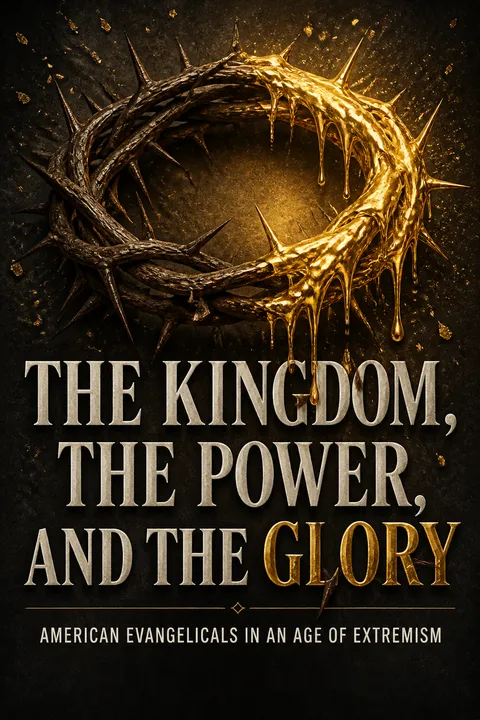


Key Takeaways
Keep national loyalty subordinate to the faith it claims to serve.
A funeral becomes a test. Tim Alberta begins with his father’s death. At the funeral, some churchgoers challenged Alberta over his criticism of Donald Trump, and a longtime elder accused him of betraying God and country. His father’s successor at Cornerstone Church, Chris Winans, offered a stark diagnosis: some evangelicals had made America an object of worship. That clash anchors the book’s argument: Christians may make political choices, but must not give a nation, party, or leader their deepest allegiance.
Faith sets the order. The book’s title points to the Christian belief that ultimate kingdom, power, and glory belong to God, not human institutions. Alberta calls it idolatry when temporary political goods become ultimate commitments. His argument is not that Christians must avoid politics, but that political choices should answer to their faith rather than redefine it.
What’s striking is how a family funeral reveals a larger institutional problem: political identity can become so central that it eclipses ordinary obligations of grief and care. Social identity research helps explain the mechanism. When group membership feels threatened, criticism of a leader can register as an attack on the group itself. That does not make political commitment inherently idolatrous; civic life matters. The useful test is whether loyalty remains conditional, open to moral scrutiny, and capable of recognizing opponents as neighbors.
Notice how the Moral Majority fused evangelical identity with partisan belonging.
A label changes meaning. Evangelical once named a broad Protestant tradition, but its boundaries were never precise. Historian David Bebbington’s quadrilateral describes four common features: the Bible’s authority, emphasis on Christ’s saving death, personal conversion, and active sharing of faith. Alberta traces how the label increasingly became shorthand for white, conservative Republican identity, especially after the Moral Majority mobilized religious voters in the late 1970s.
A coalition takes shape. Jerry Falwell had once preached that pastors should focus on winning converts, not entering politics. Facing financial trouble at Liberty University and sensing an opening in national politics, he repackaged the school with patriotic branding, then helped build a political alliance across religious groups. The Moral Majority’s success made a loose religious identity useful as a partisan organizing tool.
This history shows how political movements can reshape religious categories without changing their formal doctrine. A coalition can provide belonging and influence, but it can also make a label carry assumptions that its theology does not require. The distinction matters because people often mistake a group’s most visible political behavior for the beliefs of every member. Alberta’s account is strongest when it shows this transformation as a gradual institutional incentive, not a sudden conversion of all evangelicals into identical voters.
Treat American success as a blessing, not a covenant.
A nation is not Israel. Winans argues that the United States is not the biblical covenant nation of Israel. Christian nationalism, as used in the book, fuses Christian identity with national belonging and political power, often treating America as specially chosen by God. That belief can turn gratitude for a country into a perceived entitlement to rule it.
The church reveals its loyalties. Winans recalled how Cornerstone gave military personnel standing ovations in the sanctuary, while visiting missionaries received a much smaller acknowledgment. He did not oppose military service; he questioned what the contrast said about the congregation’s deepest allegiances. Alberta also describes his father’s patriotism as a source of genuine care and service, but one that sometimes blurred the boundary between love of country and religious duty.
The distinction between gratitude and entitlement is useful well beyond religion. Nations can inspire real solidarity and public service, yet sacred language can make ordinary political preferences seem beyond debate. That shift discourages compromise and makes dissent look like betrayal. A caveat is important: patriotic attachment is not automatically nationalism, and religious citizens need not withdraw from civic life. The question is whether national pride remains compatible with humility, pluralism, and honest criticism of one’s own country.
When fear dominates, Christians excuse conduct they once called disqualifying.
The standards moved. In a survey cited by Alberta, 30 percent of white evangelicals in 2011 said an immoral politician could still perform public duties with integrity. When the same question was asked in 2016, 72 percent said yes. The change came as many voters felt that Christianity and America were under siege, making political victory seem more urgent than a candidate’s character.
Access had a price. Robert Jeffress stayed closely aligned with Trump, defending him through controversies that once would have violated evangelical moral tests. The alliance brought Jeffress greater access, attention, and church growth, but he later acknowledged that his political role may have compromised his religious mission. The book’s point is not that every Trump voter shared the same motive, but that fear made exceptions easier to justify.
Threat perception narrows moral attention. In political psychology, people under pressure often give greater weight to immediate group protection than to consistent standards. That helps explain why the same behavior can look intolerable in an opponent and excusable in an ally. Still, the survey does not prove fear was the only cause of changing views. Policy priorities, party loyalty, and distrust of media also mattered. The insight is about the danger of allowing urgency to erase the very principles a movement claims to defend.
Winning laws cannot do the church’s work of forming people.
A policy is not a disciple. Russell Moore argued that the church’s political victories had not prevented a sharp decline in Christian identification: the share of Americans identifying as Christian fell from 90 percent in 1991 to 63 percent in 2021. He treated the figures as evidence of a weakened public witness, not proof that politics alone caused the decline.
The pro-life example. Evangelicals celebrated the end of Roe v. Wade, but the legal victory did not settle public attitudes or ensure support for pregnant women and children. Alberta argues that legislation can matter, yet cannot replace the slower work of service, persuasion, and community care. A cause that is presented as protecting life becomes less convincing when its supporters neglect vulnerable people after the political fight is over.
The distinction between policy outcomes and character formation is crucial. Laws can protect people and shape incentives, but they cannot create trust, compassion, or durable moral agreement by themselves. Movements become brittle when they treat electoral success as proof of cultural conversion. The reverse caution also matters: community service is not a substitute for public policy where legal protections are needed. Alberta’s strongest point is that political action should be one instrument within a wider ethic, not a replacement for it.
Verify political claims before they harden into religious doctrine.
Rumors gained a pulpit. At FloodGate Church in Michigan, pastor Bill Bolin used Sunday services to repeat claims about vaccines, election fraud, and government plots. One post asserted that more votes had been counted than there were registered voters, despite Census Bureau data showing otherwise. Bolin later acknowledged the numbers were wrong and removed the post, but the church’s political commentary had already shaped how members interpreted events.
The feedback loop. Alberta describes a circular information system: congregants trusted a pastor who cited partisan websites, while those same websites circulated claims from the pastor and his audience. Political ideas thus acquired religious authority without being carefully checked. The book challenges pastors to teach scripture and discernment deeply enough that members can assess claims, rather than treating partisan commentary as a substitute for theology.
This is an information problem as much as a doctrinal one. Repetition inside a trusted community can make a claim feel verified even when its only sources are other members of the same network. Media literacy is therefore not a secular add-on to religious formation; it is part of responsible truth-telling. At the same time, pastors cannot fact-check every claim in real time. The more durable intervention is to establish norms: correct errors publicly, distinguish uncertainty from fact, and reward correction rather than certainty.
Publish the truth when protecting institutions means abandoning victims.
Secrecy protected leaders. Rachael Denhollander, an attorney and survivor of Larry Nassar’s abuse, helped expose how Southern Baptist leaders mishandled abuse allegations. In 2022, delegates approved a plan for Ministry Check, a database intended to help churches identify people credibly accused of abuse. The proposal followed years of survivor testimony, investigative reporting, and resistance from denominational officials.
Accountability can rebuild trust. Denhollander also advised Broadmoor Baptist Church after a former youth pastor was accused of abusing a congregant. The church publicly described the allegation, affirmed its credibility after review, and offered routes for survivors to seek help. Alberta reports that the church initially lost members but later grew. The larger lesson is that protecting an institution’s reputation through silence can deepen the damage it hopes to contain.
Institutional trust depends less on claims of virtue than on visible procedures for handling failure. In organizational ethics, independent review, clear reporting channels, and protection from retaliation help prevent power from policing itself. Such measures can be uncomfortable, especially in communities built on personal trust, but that discomfort is not evidence of disloyalty. Nor does transparency mean every allegation should be treated as proven. Fair process must protect both complainants and the accused while refusing to let reputation outrank safety.
Make love of enemies visible, especially to people outside the church.
Public behavior teaches. At a Wheaton College conference, theologian John Dickson argued that Christianity’s reputation was suffering because people increasingly saw it as harmful, not merely self-righteous. Speakers urged Christians to respond to hostility with humility and care, drawing on the example of early believers who endured imprisonment without abandoning their message or their compassion.
A witness has an audience. Alberta contrasts that posture with church events where opponents were called demons, traitors, or enemies of God. These performances may energize insiders, but they make the faith harder for outsiders to approach. The book’s challenge is practical: show care to people who disagree, serve those who are vulnerable, and avoid making contempt the most visible expression of Christian conviction.
Visible conduct is a form of communication. People infer a group’s values less from its mission statement than from how it treats those with little power or social standing. This is why kindness can carry more persuasive force than a polished argument. Yet love of enemies should not become a demand that victims tolerate abuse or that communities avoid confronting injustice. The more demanding version combines compassion with truthful boundaries: oppose harmful behavior without turning the person responsible into a subhuman enemy.
Do not call lost status persecution, or fear will govern faith.
Two kinds of threat. Alberta contrasts actual persecution of Christians in places such as China with claims that American churches faced imminent state repression. Robert Jeffress warned that marginalization could lead to a process resembling Nazi Germany, though the legal cases he cited did not support that comparison. A 2017 survey found that white evangelicals alone, among the groups discussed, were more likely to believe Christians faced greater discrimination than Muslims.
The language has consequences. Cyril Hovorun’s account of Russia shows how religious identity can be harnessed to justify political aggression. He distinguishes civil religion, a voluntary set of patriotic rituals and symbols, from political religion, an ideology imposed by the state. The comparison is not an equation between America and Russia; it is a warning that persecution narratives can make political opponents appear existentially dangerous.
Comparative politics helps clarify why the language of siege matters: perceived threat can legitimize exceptional measures before actual coercion exists. But the distinction should not flatten genuine religious-liberty disputes. Governments can burden minority practices, and those cases deserve precise legal scrutiny. The discipline is to name the specific harm, establish evidence, and avoid borrowing the imagery of totalitarian persecution when the facts do not warrant it. Accurate threat assessment protects both civil liberties and public credibility.
Build churches around lifelong formation, not a campaign to control culture.
A different scoreboard. In the epilogue, Cornerstone pastor Chris Winans draws on James Carse’s distinction between finite and infinite games. A finite game has fixed rules and ends with a winner and loser. An infinite game keeps changing participants and conditions, with the aim of continuing and growing. Winans applies the contrast to church life: winning a culture-war contest is finite; forming people in the likeness of Christ is ongoing.
A practical alternative. Winans’s church recovered after a wave of departures, then began emphasizing outreach and formation rather than partisan allegiance. Separately, Russell Moore, David French, and Curtis Chang created The After Party, a small-group curriculum focused on how Christians should engage politics, including humility, truth, and mercy. Both efforts offer a model beyond simply choosing silence or combat.
The game metaphor shifts attention from outcomes that can be counted quickly to practices that shape a community over time. Institutions often reinforce what they measure, so a church that tracks only attendance or political wins may neglect trust, service, and maturity. The framework also needs a guardrail: an emphasis on ongoing formation can become an excuse to avoid urgent public action. The useful question is whether political engagement strengthens a community’s capacity to serve and tell the truth, or merely helps it dominate rivals.
Analysis
Alberta’s central explanation is moral substitution. Political identity begins as one affiliation among several, then absorbs the emotional weight once given to faith. The result is not simply partisan voting. It is a reordered moral system: allies receive grace without repentance, opponents become symbols of evil, and political defeat feels like a spiritual catastrophe. The book’s narrative strength is its range of grounded cases. A funeral, a struggling pastor, a university’s internal culture, a denomination’s abuse response, and a campaign rally each reveal the same pressure at a different scale. The recurring contrast between the kingdom of Christ and earthly power gives these episodes a coherent theological argument rather than leaving them as a catalogue of scandals.
The account is most persuasive when it distinguishes sincere believers from the incentives that shape them. Many congregants described here serve the poor, support families, and care about moral questions in good faith. Yet institutions and media figures reward outrage, certainty, and partisan loyalty, while pastors bear the cost of resisting those incentives. This is a useful organizational insight: local leaders cannot solve a national information problem through private courage alone. They need networks, transparent practices, and forms of teaching that make independent judgment possible.
There are limits to the evidence. Reported cases illuminate mechanisms, but they do not by themselves establish how representative the most extreme congregations are. The book also risks making political engagement and Christian nationalism appear closer than they always are. Voting, advocacy, and public moral argument can be legitimate forms of civic responsibility. The crucial distinction is not involvement versus withdrawal, but whether political power remains accountable to a moral tradition that can criticize one’s own side. Alberta’s proposed alternative is demanding: accept uncertainty, keep institutions answerable, and measure influence by the quality of people formed, not merely by victories won.
Review Summary
The Kingdom, the Power, and the Glory receives mostly positive reviews for its insightful examination of American evangelicalism's shift towards political extremism. Readers appreciate Alberta's insider perspective and thorough research, though some find the book repetitive. Many view it as an important work highlighting the dangers of Christian nationalism and the corruption within evangelical circles. While some criticize Alberta's conservative bias, others praise his balanced approach. The book elicits strong emotional responses, with readers describing it as enlightening, disturbing, and thought-provoking.
People Also Read




Glossary
Bebbington quadrilateral
Four traits of evangelical identityA historical framework for describing evangelical Christianity through four recurring commitments: the authority of the Bible, emphasis on Christ’s atoning death, personal conversion, and active sharing of the faith. The framework is widely used, but it does not settle every dispute over who counts as evangelical, a lack of definitional consensus that the book treats as politically consequential.
Christian nationalism
Fuses Christian and national identityA political and religious outlook that treats national belonging and Christian identity as closely joined, often presenting a particular nation as specially chosen by God and seeking Christian influence over public institutions. In Alberta’s account, the danger is not affection for country, but making national power seem sacred and necessary to preserve the faith.
political religion
State-imposed sacred politicsCyril Hovorun’s term for a political ideology that uses religious symbols and language while demanding public allegiance through state power. He contrasts it with civil religion, where patriotic rituals and beliefs remain voluntary. The book uses Putin’s Russia to illustrate the risks of a religious identity that becomes a justification for state action and aggression.
finite and infinite games
Closed contests versus ongoing formationA distinction developed by James Carse and applied by Chris Winans to church life. Finite games have identifiable players, stable rules, and an endpoint defined by winning or losing. Infinite games have changing participants and rules, and continue without a final victory. Winans argues that the church should prioritize ongoing spiritual formation rather than treating cultural conflict as a contest to dominate.
Ministry Check
Database of credible abuse allegationsA proposed Southern Baptist Convention database intended to help churches share vetted information about people credibly accused of abuse. Delegates approved the plan after an independent investigation exposed failures in the denomination’s handling of abuse claims. The database was presented as one tool for improving accountability, not as a substitute for fair investigation or local safeguarding.
FAQ
What's The Kingdom, the Power, and the Glory about?
- Exploration of Evangelicalism: The book examines the complexities and contradictions within American evangelicalism, especially in the context of political engagement and the rise of Donald Trump.
- Personal Narrative: Author Tim Alberta shares his journey as the son of an evangelical minister, offering insights into the church's evolving relationship with politics.
- Cultural and Political Analysis: Alberta explores how evangelicalism has shifted from a faith-based community to one intertwined with political ideologies, raising questions about identity and faith.
Why should I read The Kingdom, the Power, and the Glory?
- Insightful Perspective: The book provides a unique insider view of the evangelical community, valuable for both believers and outsiders.
- Timely Relevance: It offers essential context and understanding of the role of evangelicals in shaping the current political climate.
- Thought-Provoking Questions: Alberta encourages readers to reflect on their beliefs and the implications of their faith in a rapidly changing society.
What are the key takeaways of The Kingdom, the Power, and the Glory?
- Crisis of Identity: The book highlights a crisis within American evangelicalism, where many struggle to reconcile their faith with political affiliations.
- Idolatry Warning: Alberta warns against the idolatry of nationalism, emphasizing allegiance to God over earthly powers.
- Call for Reflection: Readers are urged to consider the implications of their beliefs and actions, especially in engaging with the world.
What are the best quotes from The Kingdom, the Power, and the Glory and what do they mean?
- “On this earth, all glory is fleeting.”: This quote emphasizes the transient nature of earthly power, urging a focus on eternal values.
- “America has become an idol to some of these people.”: Alberta critiques the conflation of American identity with Christian faith, warning of spiritual compromise.
- “The hope of the world is America. The hope of America is the Church.”: This statement highlights the Church's pivotal role in shaping the nation, while cautioning against equating national success with spiritual health.
How does Tim Alberta define evangelicalism in The Kingdom, the Power, and the Glory?
- Historical Context: Alberta traces evangelicalism's roots to the Great Awakenings, focusing on personal faith and conversion.
- Cultural Shift: He discusses how it has morphed into a political movement, often prioritizing partisan loyalty over spiritual integrity.
- Lack of Consensus: The term "evangelical" has become politicized and divisive, with no clear definition today.
What role does Donald Trump play in The Kingdom, the Power, and the Glory?
- Catalyst for Change: Trump is portrayed as reshaping evangelicalism, drawing many into a politically charged identity.
- Divisive Figure: His presidency has created a rift within the community, with some embracing him and others rejecting his rhetoric.
- Reflection of Trends: Trump serves as a lens to examine nationalism and idolatry within the church, questioning implications for faith.
How does The Kingdom, the Power, and the Glory address the issue of Christian nationalism?
- Definition of Christian Nationalism: Alberta defines it as the belief that America is a Christian nation, with laws reflecting Christian values.
- Critique of Political Engagement: He argues that this ideology distorts the Gospel and departs from Christ's teachings.
- Consequences for the Church: The embrace of nationalism can alienate non-believers and undermine the Church’s mission.
How does Tim Alberta explore the theme of division within the Church in The Kingdom, the Power, and the Glory?
- Political Polarization: Alberta examines how political polarization has led to divisions over issues like race and elections.
- Responses from Leaders: Different leaders respond variably, with some embracing political engagement and others advocating spiritual focus.
- Call for Unity: Alberta calls for a return to Christianity's core message to overcome division, emphasizing love and understanding.
What role do social media and misinformation play in The Kingdom, the Power, and the Glory?
- Amplification of Extremism: Social media has amplified extremist views, spreading misinformation rapidly within the evangelical community.
- Impact on Believers: It has led many to embrace conspiracy theories, affecting the Church’s witness.
- Need for Discernment: Alberta stresses discernment in navigating information, urging a return to biblical principles for truth.
How does The Kingdom, the Power, and the Glory address the issue of sexual abuse in the Church?
- Highlighting Personal Stories: The book features Rachael Denhollander's advocacy for abuse survivors, illustrating systemic issues.
- Call for Accountability: Alberta discusses initiatives like the Abuse Reform Implementation Task Force as steps toward accountability.
- Cultural Resistance: Resistance from some leaders to address abuse highlights the need for a cultural shift prioritizing safety.
What are the main challenges facing pastors today, as discussed in The Kingdom, the Power, and the Glory?
- Mental Health Crisis: High rates of burnout and mental health issues are prevalent among pastors due to overwhelming pressures.
- Navigating Political Divides: Pastors face conflict and disunity within congregations over political divisions.
- Lack of Support: Many pastors feel isolated, especially when addressing issues like racial justice and abuse, needing supportive networks.
What is the significance of the title The Kingdom, the Power, and the Glory?
- Biblical Reference: The title references the Lord's Prayer, emphasizing God's sovereignty and the Church's spiritual foundation.
- Contrast with Trends: It highlights the contrast between Jesus' teachings and evangelicalism's current trajectory focused on power.
- Vision for the Future: The title calls for a renewed movement prioritizing God's kingdom, faith, love, and service amidst challenges.
Download PDF
Download EPUB
.epub digital book format is ideal for reading ebooks on phones, tablets, and e-readers.








