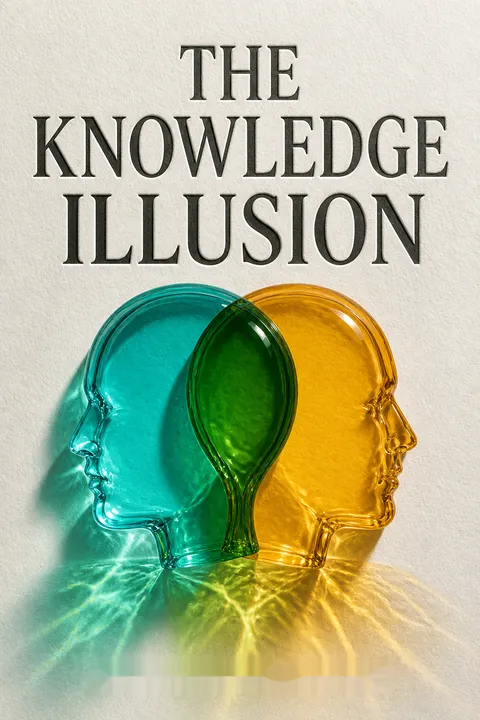


Key Takeaways
Expose your ignorance by explaining how familiar things actually work
Familiarity is not mastery. People often feel they understand everyday objects until asked to explain their mechanisms. In experiments, people rated their knowledge of zippers, toilets, and other familiar devices lower after trying to describe how they work. This gap is the illusion of explanatory depth, the tendency to overestimate how well one understands a system until asked to explain its workings.
Complexity has consequences. Castle Bravo, a 1954 nuclear test, exploded at nearly three times its predicted power. Scientists underestimated how lithium-7 would react, and wind forecasts missed the fallout’s path. Radioactive debris reached inhabited islands and a fishing boat, killing one crew member and sickening many others. The project involved thousands of contributors, yet its specialists did not fully grasp the combined system.
What's striking is that the illusion is not merely a private embarrassment. It can become a safety hazard when confidence substitutes for checking how a system behaves. In engineering, medicine, and aviation, procedures that force people to state assumptions can expose gaps before they become failures. But explanation is not a perfect test of competence: Some people know how to operate a tool reliably without being able to describe its internals. The practical lesson is to distinguish demonstrated performance from claimed understanding, especially when errors carry serious costs.
Remember what helps you act, and let abstraction discard the clutter
Brains prioritize usefulness. The book argues that thought evolved to help organisms choose effective actions, not to build complete records of the world. Memory therefore keeps useful patterns and lets many details go. A person can recognize a melody played on a new instrument because the mind has retained its structure, not a perfect recording of one performance.
Perfect memory can hinder. Borges imagined Funes, a man who remembered every detail but struggled to form general ideas. A rare real-world condition, hyperthymesia, also involves unusually vivid autobiographical memory, which can feel exhausting rather than empowering. The authors cite a rough estimate that an adult’s stored knowledge might amount to about one gigabyte, while emphasizing that the number is not precise. Human competence depends less on storing everything than on extracting patterns that guide action.
This account reframes forgetting as an organizing capacity rather than a defect. The useful contrast is not between a sharp and a weak memory, but between information retained for its own sake and information that supports flexible judgment. Yet abstraction also hides particulars that may matter: a general pattern can mislead when a rare case differs from the usual one. Good thinking therefore needs both compression and a way to retrieve detail when the situation demands it.
Reason through causes, then check whether your mental model fits reality
People think mechanistically. Human reasoning is especially good at linking causes to effects: a doctor traces symptoms to possible causes, while a person deciding whether to carry an umbrella predicts what rain will do. This is more than associating two events. In studies with rats, animals learned that a strange taste could precede illness, but not that a flashing light could cause a stomachache. The associations that made causal sense were easier to learn.
Intuition still misfires. People often expect a rock released from a circular path to keep curving, although it travels in a straight line once the force is removed. They also tend to turn a thermostat higher to heat a room faster, misunderstanding how the system works. Familiar experience supplies quick causal models, but those models can be wrong when hidden mechanisms matter.
Causal reasoning is powerful because it supports prediction and intervention: changing a cause can alter an outcome. It also explains why a plausible story can feel more convincing than a pile of disconnected facts. The danger is that plausibility is not proof. A mistaken mechanism can generate confident predictions, so high-stakes decisions benefit from checking models against measurement, expert knowledge, or outcomes that could prove the explanation wrong.
Treat your body, tools, and surroundings as working parts of your mind
Thinking reaches beyond the skull. The authors describe embodied intelligence as cognition that depends on the brain working with the body and environment. A baseball player catching a fly ball does not need to calculate its full trajectory. By keeping the ball in view and adjusting movement as the gaze rises, the player can arrive where the ball will land. The surroundings provide information that would be difficult to store or calculate internally.
The body contributes too. Seeing a pictured object with its handle on one side can prime the matching hand, speeding a response made with that hand. Writing down arithmetic or using a tool similarly changes how easily a person can think. Calendars, pages, and work surfaces can act as external memory. Cognition is often a coordinated activity involving brain, body, and world.
This view connects naturally to the design of workplaces and learning environments. A well-placed checklist, visible calendar, or clear instrument panel can reduce the burden on memory without making a person smarter in isolation. The qualification is that external supports can fail, disappear, or encourage dependence. Systems work best when they make relevant information visible and when users retain enough skill to notice when the support is misleading.
Build shared goals and complementary expertise, not lone-genius myths
Knowledge is distributed. The division of cognitive labor means that members of a community develop different areas of expertise and rely on one another to accomplish complex tasks. Prehistoric bison hunts illustrate the advantage: specialists guided herds, other hunters waited at traps, and the wider group processed and preserved the meat. No single hunter could perform every role.
Coordination requires common ground. Shared intentionality is the ability to attend to something together, understand that others share the attention, and pursue a joint goal. In studies described by the authors, young children understood an adult pointing toward a hidden object during a shared game, while apes did not show the same understanding. This capacity supports collaboration, teaching, and the accumulation of knowledge across generations.
The account makes cooperation more than a soft social virtue: it is infrastructure for collective capability. A group can solve problems no member could solve alone when its expertise is complementary and its members coordinate their aims. Still, shared purpose does not guarantee sound judgment. A tightly coordinated group can also reinforce error. Effective collaboration needs both mutual understanding and ways for members to challenge assumptions or bring in outside expertise.
Use technology as a tool, while keeping human oversight awake
Access can inflate confidence. Internet searches make information easy to retrieve, but studies in the book found that searching could raise people’s sense of their own knowledge, even on unrelated topics. A quick medical search, for example, is not a substitute for the training needed to diagnose illness.
Automation can dull readiness. The automation paradox describes how reliable systems encourage people to depend on them, leaving operators less prepared when something unusual happens. Air France Flight 447 stalled in 2009, and the crew did not respond correctly. In another case, a cruise ship’s GPS lost reliable positioning data, but the crew continued to trust its display and ran aground. Technology can extend human ability, but it does not necessarily understand the human goal or recognize what its user needs to know.
The central design challenge is not choosing between human skill and automation. It is preserving human capacity while automation handles routine work. In safety-critical settings, operators need meaningful feedback, practice with manual recovery, and independent checks rather than a single authoritative display. The book's account also cautions against treating a search result as personal expertise. Access to information is valuable, but knowing how to judge its source and limits remains a distinct skill.
Teach scientific mechanisms and trust networks, not just isolated facts
Facts alone rarely settle belief. The deficit model assumes that opposition to science mainly reflects missing information, so education should correct the gap. But vaccine information campaigns sometimes failed to increase acceptance and could even strengthen mistaken concerns. Beliefs are tied to identity, cultural values, and trusted communities, not just to a person’s store of facts.
Mechanisms can reveal gaps. Many people hold confident views about technologies while understanding little about how they work. The authors describe research in which a brief explanation of how global warming works improved understanding and acceptance of human-caused climate change. Teaching science should also help people identify credible experts, understand how evidence is checked, and recognize what remains unknown. Scientific knowledge is too extensive for any one person to verify every claim directly.
Science communication is strongest when it addresses both explanation and belonging. A clear account of a mechanism can correct an intuitive misconception, while trusted institutions and communities shape whether that account is heard as credible. This does not mean every disagreement is merely tribal, or that experts are immune to incentives and error. Public trust is better earned through transparent evidence, visible uncertainty, and institutions that correct mistakes than through demands for deference.
Ask people to explain policy consequences before debating their positions
Strong opinions can rest on thin knowledge. In a 2013 poll, more than 40 percent of Americans did not know that the Affordable Care Act was law. Yet people expressed firm views about it, and many could not correctly identify what the Supreme Court had decided. The authors found that asking people to explain how policies would produce consequences lowered their estimates of their own understanding and made their positions less extreme.
Reasons are not explanations. When participants instead listed reasons for their existing views, their confidence and extremity did not decline. Explaining consequences forced them to imagine how a policy would work in a complicated world. This approach has limits: opinions grounded in sacred moral values, such as positions on abortion, did not moderate in the same way. Policy debate should distinguish disagreements about outcomes from disagreements about fundamental values.
A request for causal explanation changes the task from defending identity to examining a proposal's operation. That shift can create space for uncertainty and compromise. It also has a social cost: people may feel exposed or embarrassed and withdraw rather than become curious. A productive discussion therefore treats ignorance as normal, asks everyone to reason through the same mechanics, and avoids using explanation as a trap to humiliate an opponent.
Measure intelligence by what a team accomplishes together
Individual scores tell only part of the story. The conventional measure called general intelligence, or g, captures patterns in how individuals perform across cognitive tests and can help predict some school and job outcomes. But the authors argue that many real tasks depend on teams. In research described in the book, teams that performed well across several group tasks also tended to perform well at a separate task. This collective measure predicted group performance better than the members' individual intelligence scores.
Design learning around contribution. In Ann Brown's jigsaw approach, students first research separate parts of a topic, then join mixed groups where each student teaches an area of expertise. The method improved learning compared with reading the same material alone. It reflects the book's broader claim that knowledge grows through complementary contributions, not simply through exceptional individuals working in isolation.
The team-centered view corrects a familiar mistake: selecting people for individual brilliance and assuming coordination will take care of itself. Listening, turn-taking, and recognizing useful expertise can determine whether a group converts talent into results. Yet group performance is not a complete replacement for individual assessment. Some roles demand personal mastery, and teams can conceal unequal contributions. A sound evaluation asks both what each person can do and how their participation changes the group's work.
Make consequential choices easier instead of expecting everyone to master complexity
Financial numbers bend intuition. People often treat financial growth as linear, underestimating compounding. In one study, participants estimated that saving $400 a month at 10 percent interest for 40 years would yield a median of $223,000; the book calculates the result at nearly $2.5 million. Minimum credit card payments can also prolong debt: a $10,000 balance at 12 percent interest with $110 monthly payments takes just over 20 years to clear.
Design around predictable limits. The authors favor reducing complexity, giving simple decision rules, and offering information just before it is needed. Defaults can help: automatically enrolling workers in retirement plans makes saving easier while allowing them to opt out. Individuals can also pause before major choices, identify what they do not understand, and seek advice from someone without a direct financial stake.
This is a shift from blaming people for imperfect choices to designing decisions that fit human attention and numeracy. Defaults, plain-language documents, and timely guidance can make good options easier to act on. But a helpful nudge can also serve the institution that chose it rather than the chooser. Good decision architecture should make incentives visible, preserve meaningful alternatives, and allow people to understand why an option is being promoted.
Analysis
The book's central move is to replace the image of the mind as a private warehouse with a picture of cognition as a distributed system. Individuals retain a partial model of the world, use perception and bodily action to gather what is missing, and depend on other people and institutions for specialized knowledge. This explains how limited thinkers collectively build technologies, science, and social systems that exceed any one person's grasp. It also explains the knowledge illusion: access to a community's understanding can feel like personal understanding.
That account is most persuasive when it separates two questions often conflated: Can someone act competently, and can that person explain the underlying mechanism? A pilot, mechanic, or consumer may perform well without deep causal knowledge, but the mismatch becomes dangerous when the situation changes or a tool fails. Explanation is therefore not a universal measure of competence; it is a useful stress test for claims of understanding and a way to expose where external support is doing the work.
The social account also cuts both ways. Division of expertise allows cumulative achievement, but shared beliefs can spread error as efficiently as knowledge. More information alone will not repair that problem when identity, incentives, or group loyalty determine which sources count as trustworthy. Better institutions need clear accountability, independent verification, and channels for dissent, not merely access to more facts.
The practical implication is neither that individuals should distrust themselves completely nor that experts should rule without challenge. It is to calibrate confidence to the task, make dependencies visible, and design systems that help people find and evaluate the right knowledge. Humility matters most when paired with structure: the question is not simply whether someone knows enough, but whether the whole human and technological network can detect and correct its own mistakes.
Review Summary
The Knowledge Illusion explores how people overestimate their understanding of complex systems and ideas. The authors argue that human intelligence relies on collective knowledge rather than individual comprehension. Readers found the book insightful, praising its exploration of cognitive biases and social aspects of knowledge. Some critics felt the content was repetitive or lacked originality. However, many appreciated the book's implications for education, politics, and decision-making. Overall, reviewers considered it a valuable read for understanding human cognition and the limits of individual knowledge.
People Also Read








Glossary
Illusion of explanatory depth
Overestimated mechanistic understandingThe tendency to believe one understands how a system works more deeply than one actually does. People often discover the gap when asked to explain the system step by step. In experiments, attempts to explain familiar objects such as zippers led participants to lower their own ratings of how well they understood them.
Community of knowledge
Shared, accessible expertiseThe network of knowledge available through other people, tools, bodies, and the surrounding environment. Individuals rely on this network because no one can master every domain. Personal capability often depends less on storing information internally than on knowing where relevant knowledge can be found and how to access it.
Division of cognitive labor
Specialized thinking across peopleThe distribution of knowledge and mental work among members of a group. Individuals develop different expertise, then coordinate their contributions toward shared tasks. This arrangement allows communities to accomplish work too complex for any one person, from communal hunting to building modern technologies.
Shared intentionality
Joint attention and goalsThe human capacity to attend to something together, understand that others share that attention, and coordinate action toward a common goal. It supports collaboration beyond simply working side by side. The authors connect it to communication, teaching, and the cumulative transmission of knowledge across generations.
Embodied intelligence
Cognition through body and worldAn approach to intelligence in which thinking depends on coordinated activity among the brain, body, and environment. People can use movement, perception, and physical tools to solve problems without constructing a complete internal model. Catching a fly ball by adjusting one's gaze and movement illustrates this kind of cognition.
Automation paradox
Reliability can weaken oversightThe risk that increasingly reliable automation encourages human operators to disengage, leaving them less prepared to respond when the system encounters an unusual situation or fails. The very success of automation can therefore undermine the human skills and attention needed as a backup.
Deficit model
More facts should change attitudesA model of public attitudes toward science that treats opposition primarily as the result of insufficient knowledge. It assumes that supplying accurate information will reduce opposition. The book challenges this view by emphasizing cultural identity, trust, intuitive causal beliefs, and community influence.
Groupthink
Conformity that reinforces shared viewsA group process in which people with similar views can reinforce one another's confidence and move toward more extreme positions. Members may mistake agreement for evidence, creating a sense of collective justification without enough expertise or critical challenge to support the group's conclusions.
Collective intelligence
A group's problem-solving abilityThe capacity of a group to perform effectively across different tasks, arising from the way members work together as well as from their individual abilities. Research discussed in the book identifies a group-level factor that predicts performance on new group tasks better than the members' separate intelligence scores.
Libertarian paternalism
Choice-preserving decision designAn approach to improving decisions by arranging choices so that people are more likely to select options aligned with their own goals, while preserving their freedom to choose otherwise. Examples include automatic enrollment in retirement plans with an option to opt out, and arranging food choices to make a preferred option easier to select.
Cognitive Reflection Test
A test of checking intuitionA short set of problems designed to reveal whether a person accepts an appealing first answer or pauses to evaluate it. Its questions often prompt an intuitive but incorrect response, requiring deliberate checking to solve correctly. In the book, higher performance is associated with less overconfidence about explanatory knowledge.
Just-in-time financial education
Guidance delivered when neededAn approach that provides financial information shortly before a person faces a relevant decision. It contrasts with teaching material long before it is likely to be used, when people may forget it. Guidance at moments such as job loss can help people evaluate retirement-account options while the choice is immediate.
FAQ
What's The Knowledge Illusion about?
- Exploration of Human Ignorance: The book examines how individuals often overestimate their understanding of complex systems, revealing that much of our knowledge is superficial and dependent on communal sources.
- Community of Knowledge: It emphasizes that human thought is deeply rooted in collaboration and shared knowledge, allowing societies to achieve remarkable feats despite individual ignorance.
- Cognitive Science Insights: Integrating findings from cognitive science, psychology, and sociology, the book challenges the notion that intelligence is purely an individual trait.
Why should I read The Knowledge Illusion?
- Understanding Human Limitations: The book provides insights into the limitations of human cognition and encourages humility and recognition of our reliance on others.
- Practical Applications: Concepts discussed can improve decision-making, enhance collaboration, and foster better communication in personal and professional settings.
- Engaging Narrative: Authors Steven Sloman and Philip Fernbach use engaging stories and real-world examples to make complex concepts accessible and relatable.
What are the key takeaways of The Knowledge Illusion?
- Illusion of Understanding: The "illusion of explanatory depth" suggests people often believe they understand complex systems better than they do.
- Cognitive Labor Division: Emphasizes the importance of dividing cognitive labor within communities, enhancing overall intelligence and problem-solving capabilities.
- Role of Technology: Technology serves as an extension of human thought, but reliance on it can lead to a deeper illusion of understanding.
What is the "illusion of explanatory depth" in The Knowledge Illusion?
- Definition of the Concept: It refers to the phenomenon where individuals believe they understand a concept well until asked to explain it in detail, revealing their actual ignorance.
- Research Findings: Studies show participants' confidence drops significantly after attempting to explain everyday objects, illustrating the gap between perceived and actual knowledge.
- Implications for Knowledge: Highlights the importance of recognizing our limitations and the need for collaboration and external resources to fill knowledge gaps.
How does The Knowledge Illusion explain the role of technology in our understanding?
- Technology as an Extension: Technology acts as an extension of our cognitive abilities, allowing access to knowledge stored outside our minds.
- Examples of Technology Use: GPS systems and the Internet help us navigate and find information quickly, but can lead to overconfidence in our knowledge.
- Caution Against Overreliance: While technology aids understanding, it can create a false sense of security regarding our knowledge.
What is the significance of the "community of knowledge" in The Knowledge Illusion?
- Collective Intelligence: Human intelligence is significantly enhanced through collaboration and shared knowledge, allowing societies to achieve complex tasks.
- Historical Context: Communities have historically relied on the division of cognitive labor, leading to greater efficiency and innovation.
- Modern Implications: Understanding the community of knowledge is crucial for effective teamwork and problem-solving today.
How does The Knowledge Illusion address the concept of "thinking with other people"?
- Shared Intentionality: Discusses the importance of aligning goals and actions with others, enhancing problem-solving and decision-making.
- Cognitive Labor in Groups: Highlights how groups can achieve more by dividing cognitive labor, allowing each member to contribute their expertise.
- Examples of Collaboration: Provides historical and modern examples, such as communal hunting strategies and teamwork in professional settings.
What are some examples of the "knowledge illusion" in everyday life?
- Common Misunderstandings: Examples include people's inability to explain how a toilet or zipper works, despite regular use.
- Social and Political Issues: Discusses how the knowledge illusion affects understanding of complex social and political issues, leading to overconfidence in opinions.
- Personal Finance: Highlights misconceptions about financial knowledge, where confidence may not match the depth of understanding required for informed decisions.
How does The Knowledge Illusion relate to decision-making in everyday life?
- Influence of Community: Decisions are often influenced by the knowledge and beliefs of those around us, leading to both positive and negative outcomes.
- Understanding Financial Choices: Misconceptions about financial products can lead to poor decision-making; recognizing limits of understanding can lead to seeking expert advice.
- Political Opinions: The illusion of understanding affects political beliefs, leading to strong views without fully grasping underlying facts.
What methods does The Knowledge Illusion suggest for improving understanding?
- Causal Explanation: Engaging in causal explanations can uncover knowledge gaps and develop a more nuanced view.
- Collaborative Learning: Emphasizes the importance of environments where individuals share expertise and learn from one another.
- Just-in-Time Education: Suggests providing education when needed, ensuring information is fresh and relevant for retention and application.
What are the best quotes from The Knowledge Illusion and what do they mean?
- "We live under the knowledge illusion...": Emphasizes how individuals conflate their knowledge with that of others, leading to overconfidence.
- "Our intelligence resides not in individual brains...": Highlights the importance of collaboration and shared knowledge in achieving complex tasks.
- "Thinking evolved as an extension of the ability to act effectively.": Suggests cognitive abilities are designed to help navigate and manipulate the environment.
What implications does The Knowledge Illusion have for education?
- Focus on Collaboration: Advocates for educational approaches that emphasize collaboration and community learning.
- Teaching About Ignorance: Suggests including discussions about ignorance and limits of understanding to foster curiosity and learning.
- Practical Applications: Argues for hands-on learning experiences that connect classroom knowledge to real-world applications.
Download PDF
Download EPUB
.epub digital book format is ideal for reading ebooks on phones, tablets, and e-readers.








