

Key Takeaways
Measure happiness by what ordinary days make possible, not by emotional highs.
Familiarity can masquerade as happiness. Wiest argues that people may want joy yet keep returning to what they know: cycles of crisis and repair, fixing other people’s problems, or worrying that they still lack enough. When struggle becomes routine, calm can feel strangely unfamiliar rather than rewarding.
Meaning changes the measure. Happiness is not a permanent high but a capacity to create, feel grief and delight, and stay engaged with life. Caring for a home, making something, or showing up for someone can matter more than waiting for a spectacular milestone. Ask what you want daily life to feel like, then notice what worthwhile effort helps create that feeling.
This distinction separates a passing emotion from the quality of a life. It also explains why achieving a desired milestone may not settle someone who has built daily routines around anxiety or external validation. The practical focus on ordinary moments is useful because it makes happiness observable in lived behavior, not just in self-assessment. Still, the language of practice should not turn sadness into a personal failure. Grief, depression, and exhaustion may require support, not simply a new interpretation or a better attitude.
Change your life through small acts that make a new normal familiar.
Begin with one difference. Wiest describes change as a small action that departs from an established pattern. A person who usually withdraws might reach out; someone who keeps pushing might deliberately rest; someone who stays still might take a walk. The action does not have to solve a whole life. It makes another response imaginable.
Repetition builds a new baseline. The book connects what people repeatedly do with what begins to feel normal and, eventually, natural. Large decisions matter, but so do the modest steps that make them real: researching a job, putting a move on the calendar, or correcting one self-defeating thought. A breakthrough is not a substitute for practice. It is often the first moment that practice becomes possible.
The strength of this advice is its low threshold for action. A small, repeatable choice can provide evidence that a person is not completely governed by old habits, which can make a more demanding choice feel less alien. Yet small actions are not magic, and they cannot compensate for every external constraint, such as financial insecurity or illness. Their value is more precise: they create a foothold, clarify what matters, and sometimes expose which larger obstacle needs practical help.
Grieve the relationship, then rebuild the future it used to occupy.
Loss removes a whole forecast. After a breakup, people may mourn not only a partner but also the routines, identity, and imagined future organized around that relationship. Wiest advises allowing the pain to be expressed instead of demanding instant neutrality. When the initial shock eases, a person can also write down what felt wrong or what they feared having to accept indefinitely. That can give quieter doubts room beside the longing.
Make space for a new life. If the empty future remains unfilled, memories of the former partner can dominate it. Reinvesting in one’s own interests, plans, and connections helps restore a sense of direction. The point is not to declare the loss secretly good, but to remember that one ending does not establish personal unworthiness or foreclose every meaningful future.
The focus on the lost future helps explain why heartbreak can feel larger than the absence of one person. Rebuilding plans is not a denial of grief; it gives attention somewhere to go besides repeatedly rehearsing what ended. The caution is important: pain does not prove that a breakup was destined or beneficial, and not every relationship can be neatly reinterpreted as a lesson. People can find meaning in loss without having to justify the loss itself.
Treat fit as something you grow into, not discover once.
A right choice need not be final. Wiest challenges the belief that one partner, home, career, or decision must be perfectly suited for an entire life. A relationship can be right for the people who entered it and still cease to fit as they change. The same can be true of a city or a kind of work. An ending does not automatically mean that the earlier choice was foolish.
Look for mutual growth. A useful question is whether both people can keep developing alongside each other, rather than whether the relationship matches an idealized picture. If their directions become incompatible, letting go may be more loving than insisting the old arrangement must continue. This view makes room for multiple meaningful chapters without pretending every choice will lead to the same outcome.
This is a process-based account of compatibility: a fit is sustained through how people respond to change, not guaranteed by a perfect beginning. It eases the pressure to treat every decision as irreversible and every ending as proof of failure. But growth should not become a reason to tolerate chronic disrespect or harm. Shared development requires safety and reciprocity; persistence alone cannot make an unhealthy arrangement a good fit.
Turn quiet wants into humble experiments with what you already have.
Wanting can be information. Wiest treats desire as a signal about what draws a person toward life, while stressing that recognizing a want does not require acting on it immediately. A wish for success, for example, may conceal a deeper desire to create, to feel secure, or to be recognized. The task is to distinguish the surface goal from the need beneath it.
Practice having, not only wanting. The book uses this phrase for working with resources already available instead of living only in anticipation of a future achievement. Someone drawn to a new field can try a small version of its daily work before attempting a dramatic reinvention. That modest test reveals what the pursuit actually asks of them, and whether the desire survives contact with the process.
This approach makes intuition useful without treating it as a command. Small experiments can test whether an attractive idea still matters once it involves ordinary effort, and they can turn a vague longing into actionable knowledge. The distinction between a goal and its underlying need is especially valuable when status symbols stand in for connection, security, or creative work. Desire is still fallible, though. Reflection, obligations, and likely consequences belong beside inner signals when choices affect other people.
Exit comparison by building a life that satisfies you from within.
Comparison borrows someone else’s ruler. Ranking oneself against others can briefly offer reassurance, but there is always another person who appears further ahead. Wiest suggests that persistent comparison may point less to inferiority than to dissatisfaction with one’s own lived experience. Instead of asking whether a life looks impressive, ask whether it feels connected to what matters.
Choose what receives your attention. The people followed online, the messages revisited, and the objects surrounding a desk all repeatedly shape what seems normal or desirable. They can keep a person focused on performance, or support interests that belong to that person. The aim is not to pretend other people have nothing to teach, but to stop using their lives as a verdict on one’s own and to build something meaningful by personal standards.
The reframing turns comparison into a diagnostic signal: envy can reveal an unmet desire, even when the apparent prize is not the real need. This preserves the possibility of learning from others while challenging the habit of treating life as a single ranking system. Comparison can sometimes provide useful information about skills or opportunities. Its value depends on whether it leads to a concrete choice or merely renews the feeling of being behind.
Keep your kindness, but stop participating in someone else’s wound.
Another person’s hurt is not your identity. Wiest suggests that cruelty often reflects the pain and defensive limits of the person acting cruelly. Recognizing this may explain behavior, but it does not excuse it. The choice is whether to answer in kind, absorb the other person’s worldview, or refuse the conflict while protecting one’s own peace.
Make boundaries behavioral. A boundary can mean deciding what conversations or conduct one will no longer enable, rather than trying to force another person to change. The book also urges discernment about criticism: advice deserves more weight when it comes from someone whose judgment, care, or experience is relevant to the decision. Kindness does not require granting every critic authority or remaining available to mistreatment.
The distinction between understanding and excusing is essential. Seeing the wound behind an insult can reduce the temptation to treat it as a precise measure of personal worth, while a behavioral boundary protects against repeated harm. This view also challenges the assumption that the loudest criticism is the most truthful. Still, discernment should not become an excuse to dismiss uncomfortable feedback. The useful test is whether the criticism is specific, informed, and offered in a way that supports accountability.
Use solitude as a workshop, not proof you have been abandoned.
Private time makes room to change. Wiest describes quiet periods as a chance to feel emotions without immediately distracting from them, and to experiment with a self less shaped by other people’s expectations. A finished performance or piece of art may look sudden in public, but it rests on unseen hours of practice, revision, and reflection.
Guard the in-between hours. Constantly watching other people’s lives, or feeling watched in return, can make it harder to explore a new identity without announcing or defending it. Solitude can offer space to decide what matters and to practice a different way of being. It is not a permanent substitute for connection. It is a condition that can help people hear themselves and prepare for participation on their own terms.
This account gives private effort and unremarkable transition periods their due. It resists the modern pressure to turn every stage of growth into visible evidence for an audience. The image of solitude as a workshop is most helpful when time alone is chosen or can be made supportive. Isolation can also deepen distress, especially when imposed by circumstance. The question is not whether solitude is always good, but whether it creates room for restoration, reflection, or a needed return to connection.
Move while afraid, and let action test the story fear tells.
Fear is not always a stop sign. Wiest argues that people may mistake the presence of fear for proof that they should avoid a meaningful choice. Avoidance can then make the choice seem even less possible. One useful question is what assumption the fear depends on: that failure would be unbearable, for instance, or that uncertainty means danger.
Let movement generate information. The book points to ordinary actions, such as taking a walk or completing a chore, as ways to interrupt the sense of being frozen. It also notes that some anxieties eventually fade from attention, even if people once believed they would never get past them. Action does not guarantee success or erase pain, but it can reveal options that rumination hides.
This advice treats fear as something to examine rather than obey or suppress. Testing a belief through a small, reversible action can distinguish anticipated catastrophe from a manageable risk. That distinction matters because fear also responds to genuine danger, not only imagined limits. The aim should not be fearlessness. It is a better reading of the signal, with safeguards and outside help when the potential harm is real or the decision has serious consequences.
Find purpose in the person you practice becoming each day.
Purpose can arrive as a small request. Wiest pictures everyday opportunities as bells: a person might need care, a place attention, or an idea the patience to become real. Purpose is not only a grand job or a single mission. It can begin with answering a modest call that fits one’s abilities and values.
Start with your own life. The book argues that people often search for a way to change the world while overlooking the internal patterns they can change directly. Learning to respond rather than react, or to stop repeating a destructive habit, can affect how someone treats others and does their work. Purpose is therefore not just an activity to claim. It also appears in the manner of care, courage, and attention brought to ordinary responsibilities.
This view connects purpose to contribution without reducing it to a prestigious occupation. It also links private conduct to public effect: patience or honesty practiced in daily life changes the experience of people nearby. The framing is strongest when self-development remains connected to service, rather than becoming another private optimization project. Individual agency matters, but a person’s impact is also shaped by institutions, resources, and collective action. Personal change is an entry point, not a complete explanation of social change.
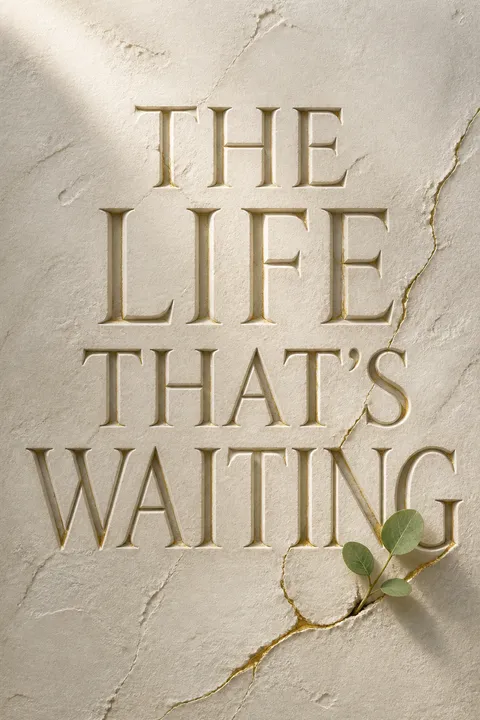
Make room for the life waiting by releasing what no longer fits.
The title names a possibility, not a guaranteed script. Wiest describes a waiting life as what can become visible when someone stops forcing a role, relationship, or plan built for an earlier version of themselves. Change may feel like loss before its direction is clear. The book compares durable growth to adding support beneath a table: greater capacity can make a person steadier, rather than more fragile.
Open your hands and observe. Letting go is presented as a way to see what remains without constantly supplying it with hope or explanation. That does not mean abandoning every difficult commitment or treating every setback as fate. It means noticing when effort is sustaining something that no longer supports a coherent life, then choosing what to build with the space and energy that become available.
The central metaphor is emotionally generous: uncertainty can mark a transition rather than a verdict that life has gone wrong. Read this way, the life waiting is not a supernatural promise but a name for unrealized options that become perceptible through attention and action. That interpretation preserves hope without encouraging passivity. It also guards against a risky conclusion that every loss was secretly necessary. Some changes are imposed or unjust; agency lies in the response, not in pretending every cause was benevolent.
Analysis
The book is best understood as a lyrical field guide for periods of transition. Rather than advancing one technical system, it revisits a compact set of ideas through different emotional situations: happiness, heartbreak, uncertainty, loneliness, purpose, and fear. Its recurring movement is from a familiar inner pattern, through a moment of discomfort or loss, toward a modest act of discernment. That repetition gives the collection coherence, even when individual sections overlap.
Its central claim is that a more meaningful life is built through participation, not discovered as a finished destination. Attention shapes what appears possible; repeated choices make new responses more familiar; and relationships, ambitions, and identities can be meaningful without being permanent. The book’s most practical contribution is its insistence that large change often begins with an unglamorous action in the present. Its most humane contribution is permission to feel before demanding a lesson from pain.
The language also carries a tension. Wiest often describes life as if it were guiding, withholding, or preparing a person for a better outcome. That can comfort readers facing uncertainty, but it is not evidence that every setback has a hidden purpose or that every closed door protects someone from a worse fate. The strongest reading treats this language as metaphor: events do not need to be destined for people to respond to them with imagination and resolve.
The book’s advice is most useful when agency is taken seriously without being confused with total control. A person can choose a response, attention, or next experiment, but cannot choose away grief, structural limits, or another person’s behavior. Read with that distinction, the collection offers not a promise of effortless arrival, but a practical orientation: feel what is happening, notice what no longer fits, and use the next available choice to make life more coherent.
People Also Read







Glossary
practice of having
Using what is already availableWiest’s contrast to living mainly in anticipation of what is missing. The practice of having means using current resources, skills, relationships, and opportunities to begin creating a desired experience now. It does not mean pretending to possess everything one wants. It shifts attention from longing alone toward the daily actions that make a goal more real.
small gesture of differentiation
A departure from an old patternA modest action that differs from a person’s usual response and opens a path toward change. Examples in the book include reaching out instead of withdrawing, resting instead of overworking, or taking a walk instead of remaining still. Repeated gestures can make a different way of living feel increasingly familiar.
quiet hours
Private time for inner workPeriods of reduced activity, visibility, and social input in which a person can process emotions, experiment with identity, and develop skills away from an audience. Wiest treats these hours as part of growth rather than as evidence of failure or exclusion. They can support reflection and preparation, though they are not a replacement for needed connection.
wound perimeter
Limits built around past hurtWiest’s metaphor for the restricted emotional and behavioral world people may construct around pain. Within this perimeter, fear can dictate what feels safe, and a person may try to keep others within the same limits. Recognizing the pattern can help someone avoid adopting another person’s hurtful behavior while setting clearer boundaries.




Download PDF
Download EPUB
.epub digital book format is ideal for reading ebooks on phones, tablets, and e-readers.








