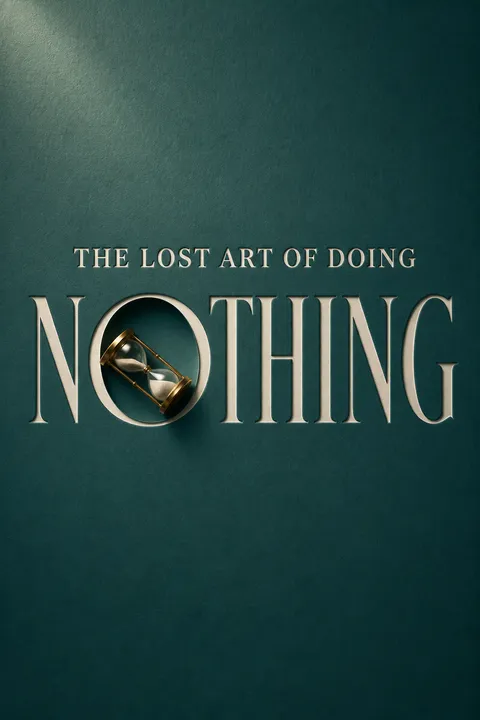


Key Takeaways
Practice niksen: leave an unplanned stretch empty, without turning it into self-improvement.
Nothing is the point. Niksen is the Dutch practice of doing nothing, not an activity disguised as rest. It means having an unoccupied moment and resisting the reflex to fill it with a task, a screen, a book, or a snack. Watching a show may feel relaxing, but it directs attention elsewhere; niksen has no such destination. Its value is not measured by what it produces.
Make room, then release it. The book identifies three helpful conditions: time you do not keep checking, a reasonably calm mind, and a place where others will not shame or interrupt you. The moment may begin when a plan falls through. The challenge is not to schedule a perfect half-hour of idleness, but to let an unexpected pause remain empty.
What's striking is how easily rest becomes another performance category. Once idleness is defended by its benefits, people can feel pressure to relax correctly or produce better ideas from it. Niksen resists that conversion: its value lies partly in refusing measurement. This resembles the distinction between leisure as recovery for work and leisure as an activity valuable in itself. Still, the ideal is easier to reach for people with control over their time and space. A genuine practice must include permission, not just personal technique.
Stop making rest a prize you must earn through productivity.
The earned-rest trap. Many people feel they must finish the list before they can sit down. But perfectionism keeps moving the finish line: the work can always be improved, another chore can be added, and another person might judge the result. The book argues that this learned guilt makes empty time difficult, even when a task could wait. A clean dishwasher is useful, but it need not determine whether anyone deserves a pause.
Cancel without substitution. Look at a commitment and ask whether it truly needs to happen. If it does not, remove it rather than filling the space with a different obligation. The historical backdrop is a culture that has often treated idleness as moral failure, from medieval condemnations of sloth to modern praise of busyness. The book also recalls Dutch writer Eline Capit, who defended letting housework slide so a woman could claim time for herself.
This reframes guilt as social training rather than proof of laziness. Feminist analysis adds an important dimension: leisure is not distributed equally when domestic work remains unevenly assigned, or when someone else quietly absorbs the chores. The point is not simply to lower one person's standards, but to make the labor visible and renegotiate who carries it. At the same time, a deliberate pause can be a modest act of resistance against the belief that every available minute should justify itself.
Build quiet into your day before stress makes stopping impossible.
Stress is not one thing. The book distinguishes a short-lived alert response, such as reacting to danger, from the persistent pressure of feeling inadequate or behind. The latter is difficult to switch off because it can continue without an immediate threat. Stress can sharpen performance for a while, but prolonged strain may leave someone exhausted and unable to settle into doing nothing. The book cites a Dutch workplace report in which reported burnout symptoms rose from 11 to 16 percent over a decade.
Notice the warning signs. Headaches, muscle tension, irritability, and forgetfulness are examples the book gives for recognizing overload. It also describes bore-out, distress associated with too little challenge or meaningful work, as distinct from exhaustion due to excessive demands. Small pauses, adequate sleep, movement, and reduced stimulation may help, but severe or persistent distress deserves more than a lifestyle tip.
The useful insight is that relaxation is not a substitute for diagnosing the source of strain. Occupational health research distinguishes individual coping from job design: unrealistic workloads, low autonomy, and poor support cannot be solved by asking employees to breathe more calmly. The book's attention to both burnout and bore-out also avoids treating all discomfort as overwork. Yet the figures it reports do not, by themselves, establish why symptoms increased. They are a prompt to investigate conditions, not a complete causal explanation.
Let boredom linger long enough for attention to loosen and ideas to connect.
Discomfort can open space. The book separates boredom from niksen: boredom is often an unpleasant mismatch between what someone wants and what their situation offers, while niksen is a chosen or accepted interval without a task. Still, escaping every dull moment with a phone can make ordinary quiet feel intolerable. The psychologist Sandi Mann, as summarized in the book, argues that boredom can prompt daydreaming; the philosopher Awee Prins describes niksen as boredom's more welcoming side.
Give thoughts time to wander. The book links unfocused moments with the brain's default mode network, a set of connected brain regions active during internally directed thought, such as remembering, imagining, or letting the mind drift. J. K. Rowling reportedly developed the idea for Harry Potter while sitting on a train. That does not mean every idle minute yields an idea. It means creativity may need stretches when attention is not tightly commanded.
This is a useful correction to the assumption that every mental blank is wasted capacity. Creative work often alternates focused effort with incubation, when a problem remains in the background rather than under direct scrutiny. But boredom is not automatically fertile: it can also feel painful, especially when someone lacks choice or is isolated. The distinction matters. The aim is not to romanticize tedious conditions, but to notice when a chosen pause gives the mind room to recombine material already encountered.
Protect attention from screens designed to convert every pause into engagement.
A pause can be captured. A phone offers endless ways to avoid stillness: messages, news, games, shopping, and social feeds. These activities may be easy and entertaining, but they keep attention occupied. The book describes an attention economy in which businesses compete to hold people's focus and gather data from their online behavior. It recounts Pokémon GO as an example: players thought they were simply hunting virtual creatures, while businesses could pay to draw those players toward physical locations.
Make the interruption harder. During a genuine attempt at niksen, put the phone away or switch it to airplane mode. Do not mistake reduced effort for recovered time: a shortcut may save minutes, only for a screen to absorb them again. Nor does all screen use have to be condemned. The practical distinction is whether a person deliberately chooses an activity or automatically reaches for stimulation whenever a quiet moment appears.
The attention-economy lens helps explain why self-control alone can feel inadequate. Digital products are built to reduce friction and invite repeated checking, so changing the environment can matter more than issuing oneself another command. This connects to choice architecture: small design features shape behavior before conscious intention enters the picture. Still, screens also sustain friendship, access, and work, so abstinence is not a universal answer. The more useful question is who controls the pause, the person, or the interface competing for it.
Make unstructured time a workplace norm, not a private escape hatch.
Presence is not productivity. The book questions the expectation that employees can work intensely for every hour they are present. Ideas need breathing room, and people have different rhythms; a fixed schedule may reward visibility rather than useful work. It points to the Netherlands' high rate of part-time work and the spread of flexible hours as signs that working arrangements can change.
Ask what the job requires. Anthropologist David Graeber's term bullshit jobs describes roles that workers themselves consider pointless, including tasks that exist to make an organization appear busy or important. The book also discusses proposals for shorter workweeks and universal basic income, while acknowledging that work provides income, structure, and social standing. The broader lesson is not that every job can be abandoned, but that rest should not depend on employees hiding in a restroom or proving their exhaustion first.
The strongest implication is institutional: if recovery is necessary, a workplace should not treat it as misconduct. Flexible schedules and protected breaks can align work with attention and energy, while reducing the stigma attached to stepping away. Yet calls for shorter hours must distinguish office work from jobs requiring continuous care, transport, or public service. The solution is not identical freedom for every role, but fair staffing and real recovery opportunities. Otherwise, one worker's quiet break can become another worker's intensified workload.
Choose trusted company and low-pressure travel over leisure that feels like work.
Rest can be shared. Niksen does not always require solitude. With a close friend, silence, a nap, or simply sitting together may feel safe because neither person must entertain the other. The book connects that ease to dependable relationships, where people can ask for space without fearing rejection. It also recommends JOMO, the joy of missing out: declining an appealing event can be a relief when the calendar is already crowded.
Leave room on vacation. Travel can become another performance, with landmarks to check off and pressure to experience a destination properly. The book suggests treating a place less like a list of required sights and more like somewhere to live for a while. A beach, city, or countryside can be enjoyed without maximizing every day. The goal is not to ban plans, but to avoid turning scarce time away into a second job.
This expands rest beyond individual self-management. Trust makes silence socially possible, while a culture of constant availability can make declining invitations feel like a relationship risk. The same pressure appears in tourism, where experience is often measured by photographs and completed itineraries. A low-pressure approach can deepen attention to place and companionship. The caveat is that cancellation affects others, too. Thoughtful boundaries work best when they are communicated early and when shared expectations leave room for both connection and solitude.
Use meditation as a tool, but keep niksen free of goals.
Different kinds of quiet. Meditation usually involves deliberately directing attention, for instance toward breathing, while niksen asks for no specific mental task or outcome. The book treats meditation as a useful practice, not a synonym for doing nothing. It describes mindfulness training, in which participants practice attention and awareness, and research on meditation, including brain scans of experienced monks. It also notes the limits: findings from expert meditators cannot show exactly what meditation causes in everyone.
Start with a small pause. The book's practical suggestions include lying down briefly, doing one thing at a time, turning off a phone, and noticing bodily tension or an emotion without immediately explaining it away. Such techniques may help someone become calm enough for an unstructured interval. But once the pause becomes a task to complete perfectly, it has changed character. A person can use a relaxation tool without making relaxation another item to optimize.
The distinction protects two valuable practices from being collapsed into one. Meditation can train attention through deliberate repetition; unstructured idleness offers a different experience, one less governed by a method. Their effects may overlap, but neither needs to replace the other. Research on meditation is promising, yet brain changes do not automatically establish broad improvements in everyday life. The book's modest practical advice is therefore apt: experiment with brief, accessible pauses, while avoiding claims that a simple exercise can treat every form of distress.
Alternate stillness with movement instead of confusing rest with inactivity.
Doing nothing is not a fitness plan. The book warns against turning niksen into hours of sitting without movement. It reports that people in the Netherlands sit an average of six and a half hours daily, while averages in the United States and United Kingdom are about seven hours. It also cites an estimate that 31 percent of people worldwide fall short of recommended physical activity. These figures frame a tension: modern life can demand both more rest and more movement.
Let the body change gears. A quiet pause can follow a walk, or a person can break up long periods of sitting with movement. The book recommends nature and physical activity as ways to support the body and mind, while rejecting an all-or-nothing choice between constant exertion and total idleness. Niksen is a pause in a life, not a prescription to stop participating in it.
This qualification keeps a compelling idea from becoming a health hazard. Public-health guidance consistently treats prolonged sitting and insufficient activity as concerns, while rest remains important for recovery. The practical synthesis is rhythmic rather than ideological: alternate effort, movement, and quiet, adapting the balance to individual health and circumstances. The book is right to resist hustle culture, but its defense of idleness should not be mistaken for evidence that inactivity is harmless. Rest and physical activity solve different problems and can support each other.
Analysis
The book's central tension is that it must explain the value of an activity defined by having no purpose. That paradox gives its argument both its charm and its vulnerability. If niksen is promoted because it improves calm, creativity, health, and finances, it risks becoming one more productivity technique. The book recognizes this danger and insists that the pause should not be justified by what it produces. Its most durable contribution is therefore not a new relaxation method, but a challenge to the assumption that every minute must be useful.
The Dutch word gives a memorable handle to a widely shared problem, while the cultural history complicates any claim that busyness is simply a personal flaw. Medieval fantasies of Cockaigne, changing workweeks, feminist arguments for leisure, and modern digital business all show that attitudes toward idleness are shaped by institutions and material conditions. Yet the adaptation should not romanticize a national temperament or assume everyone can freely reclaim time. Care work, insecure employment, disability, and workplace control influence who can pause without consequences.
The book also makes a useful distinction between restorative quiet and passive consumption. A screen can feel restful while still directing attention, but that does not make entertainment inherently empty or harmful. The relevant issue is agency: whether a person chooses an activity or reflexively fills silence. Likewise, boredom may support daydreaming, but it is neither a reliable creativity machine nor a substitute for meaningful work.
The strongest reading treats niksen as a small personal practice and a larger social question. Individuals can protect occasional unstructured intervals, reduce automatic stimulation, and stop treating rest as a reward for flawless performance. Employers and communities, however, determine how much control people actually have over time. A humane culture does not merely teach people to relax after overwork. It makes recovery possible before exhaustion becomes the price of admission.
Review Summary
The Lost Art of Doing Nothing receives mixed reviews, with an average rating of 3.19 out of 5. Readers appreciate the introduction to the Dutch concept of "niksen" and the book's attractive illustrations. However, many find the content repetitive, unfocused, and lacking practical advice. Some praise the book's message about the importance of relaxation, while others criticize its shallow treatment of the subject. Several reviewers note problematic or irrelevant passages. Overall, opinions are divided on whether the book effectively conveys the art of doing nothing.
People Also Read





Glossary
Niksen
Doing nothing without a goalA Dutch term for doing nothing, used in the book for an unoccupied interval that is not filled with a new task or deliberate entertainment. Niksen is not simply watching television, scrolling, or following a relaxation routine. Its defining feature is the absence of a goal, although a calm mind, available time, and a suitable place can make it easier.
Bore-out
Distress from too little challengeA term for distress associated with having too little meaningful or appropriately challenging work. The book contrasts bore-out with burnout: one can arise when someone is underused, underchallenged, or has too little to do, while the other is associated with excessive or prolonged demands. The book notes that bore-out has received less research attention.
Eustress
Helpful, short-term stressA form of stress that helps a person respond to an immediate challenge or danger. The book gives examples such as reacting quickly to a speeding vehicle or protecting food from a bird. This short-lived alert response differs from persistent stress that leaves little opportunity to recover.
Attention economy
Competition for human attentionAn economic environment in which companies compete to capture and retain people's attention, often using digital services that encourage repeated engagement. The book connects this competition to data collection: users generate information through searches and online activity, while platforms can use that attention and data to support business interests.
Default mode network
Network active during inward thoughtA set of connected brain regions associated with internally directed mental activity, including daydreaming, remembering, imagining, and making associations. The book discusses it in connection with unfocused time and creativity. It presents the network as evidence that the brain remains active during apparent idleness, not as proof that every idle moment improves creativity.
JOMO
Joy of missing outAn acronym for the joy of missing out, used for the relief or pleasure of declining an event or opportunity rather than attending out of fear of being excluded. In the book, JOMO helps people make room in crowded social calendars and choose a quiet evening without treating it as a failure to participate.
Cockaigne
Medieval imagined land of plentyA mythical place imagined in medieval Europe as a world without labor, hunger, or scarcity. The book discusses it through a painting by Pieter Bruegel the Elder and a study by historian Herman Pleij. Cockaigne offered an imaginative escape from difficult material conditions and from religious ideas that associated work with punishment.
FAQ
What is "The Lost Art of Doing Nothing" by Maartje Willems about?
- Explores Dutch concept of niksen: The book introduces and explains "niksen," the Dutch art of doing nothing, as a way to counteract the busyness and stress of modern life.
- Challenges productivity culture: It critiques the societal obsession with productivity, self-improvement, and constant activity, advocating for the value of aimless relaxation.
- Blends humor, history, and science: Willems combines personal anecdotes, cultural history, scientific research, and practical tips to make the case for intentional idleness.
- Aims to inspire lifestyle change: The book encourages readers to reclaim unstructured time, find calm, and embrace moments of purposelessness for better well-being.
Why should I read "The Lost Art of Doing Nothing" by Maartje Willems?
- Counteracts burnout and stress: The book offers practical and philosophical tools to help readers manage stress, avoid burnout, and find more balance in their lives.
- Accessible and relatable: Written with humor and honesty, it resonates with anyone feeling overwhelmed by modern expectations and the pressure to always be "on."
- Cultural insight: It provides a unique look at Dutch culture and how their approach to leisure can be applied globally.
- Actionable advice: Readers receive concrete tips for integrating niksen into daily routines, making the concept both inspiring and achievable.
What is "niksen" as defined in "The Lost Art of Doing Nothing"?
- Literal meaning: Niksen is a Dutch word meaning "to do nothing," specifically the absence of any purposeful activity.
- Not the same as laziness: While often misunderstood as idleness or laziness, niksen is about allowing yourself unstructured time without guilt or a specific goal.
- Distinct from other trends: Unlike mindfulness or meditation, niksen doesn’t require focus or intention—it’s about letting your mind and body simply be.
- Requires practice: The book emphasizes that niksen can be difficult at first due to ingrained habits of busyness, but it becomes easier with time and intention.
How does "The Lost Art of Doing Nothing" by Maartje Willems suggest you practice niksen?
- Three key ingredients: The book identifies time, a calm mind, and a non-judgmental environment as essential for successful niksen.
- Let go of the clock: Niksen can’t be scheduled or forced; it happens when you stop watching the clock and allow yourself to drift.
- Recognize and seize moments: Look for unexpected free time—like a canceled appointment—and resist the urge to fill it with tasks.
- Create supportive spaces: Find or create environments where you won’t be interrupted or judged for doing nothing, whether alone or with understanding company.
What are the main benefits of niksen according to "The Lost Art of Doing Nothing"?
- Mental calm and clarity: Niksen helps quiet the mind, reduce anxiety, and provide a break from constant stimulation.
- Physical rest: It offers the body a chance to recover from the demands of a hectic day, supporting overall health.
- Boosts creativity: Unstructured time allows for daydreaming and spontaneous ideas, often leading to creative breakthroughs.
- Free and accessible: Unlike many wellness trends, niksen costs nothing and can be practiced by anyone, anywhere.
How does "The Lost Art of Doing Nothing" address common obstacles to niksen, like guilt or perfectionism?
- Cultural and personal barriers: The book discusses how societal values equate busyness with worth, making it hard to embrace idleness without guilt.
- Perfectionism as an enemy: Perfectionist tendencies and fear of judgment can prevent people from allowing themselves to do nothing.
- Practical reframing: Willems suggests reframing niksen as a necessary and valuable part of life, not something to be earned or justified.
- Tips for overcoming resistance: The book offers advice like writing down to-do lists to clear mental space and canceling non-essential commitments in advance.
What is the relationship between niksen and other concepts like mindfulness, meditation, or boredom in "The Lost Art of Doing Nothing"?
- Niksen vs. mindfulness/meditation: While mindfulness and meditation involve intentional focus, niksen is about the absence of intention or purpose.
- Boredom as a gateway: The book suggests that boredom, often avoided, can be a precursor to creativity and self-discovery if embraced through niksen.
- Not escapism or distraction: Niksen is not the same as zoning out with TV or social media, which are forms of distraction rather than true idleness.
- Complementary practices: While different, niksen can coexist with mindfulness and meditation, offering another tool for relaxation and self-care.
How does "The Lost Art of Doing Nothing" by Maartje Willems connect niksen to work, productivity, and the modern attention economy?
- Critique of work culture: The book examines how modern work environments and the "attention economy" make it difficult to disconnect and do nothing.
- Bullshit jobs and burnout: It references David Graeber’s concept of "bullshit jobs" and discusses how meaningless work contributes to stress and dissatisfaction.
- Niksen at work: Willems offers practical tips for incorporating niksen into the workday, such as taking micro-breaks or finding moments to unfocus.
- Attention as a commodity: The book warns that constant digital stimulation erodes our ability to rest, making niksen a form of resistance against the commodification of our attention.
What practical tips does "The Lost Art of Doing Nothing" offer for integrating niksen into daily life?
- Start small: Begin with brief moments of doing nothing, like staring out the window or pausing between tasks.
- Minimize distractions: Turn off devices, find a quiet spot, and avoid multitasking to create space for niksen.
- Link to routines: Attach moments of niksen to daily activities, such as waiting for the kettle to boil or during a commute.
- Embrace imperfection: Don’t worry if your mind wanders or if you struggle at first—niksen is about letting go, not achieving a perfect state.
How does "The Lost Art of Doing Nothing" explore the cultural and historical context of niksen?
- Dutch cultural roots: The book traces niksen’s origins in Dutch language and culture, noting both its negative and positive connotations.
- Historical attitudes to idleness: It discusses how, historically, idleness was often condemned as sinful or wasteful, but also fantasized about in myths like the Land of Cockaigne.
- Comparison with other cultures: Willems explores similar concepts in other countries, such as Italy’s "dolce far niente" and Japan’s "shinrin-yoku," highlighting both differences and universal needs.
- Modern shifts: The book situates niksen within contemporary trends like slow living, minimalism, and the backlash against overwork.
What are the key takeaways from "The Lost Art of Doing Nothing" by Maartje Willems?
- Niksen is valuable: Doing nothing is not a waste of time but a vital practice for mental, physical, and creative health.
- Let go of guilt: Overcoming internalized guilt and societal pressure is essential to embracing niksen.
- Small changes matter: Integrating moments of niksen into daily life can have significant positive effects, even if only for a few minutes at a time.
- No goal, just being: The beauty of niksen lies in its purposelessness—its value is intrinsic, not instrumental.
What are the best quotes from "The Lost Art of Doing Nothing" and what do they mean?
- "The best thing about niksen is the absence of a goal. It doesn’t serve a purpose, but it’s wonderful."
- This quote encapsulates the core philosophy of niksen: its value lies in simply being, not in achieving or producing.
- "Niksen is simple. The hardest thing is to simply do nothing."
- Attributed to Dutch soccer player Johan Cruyff (about soccer, but applied to niksen), this highlights that while niksen sounds easy, it’s challenging in a culture obsessed with busyness.
- "You don’t want to get tense—you just kind of play with the thought. And then little ideas start popping up."
- Quoted from John Cleese, this illustrates how relaxation and unfocused time can foster creativity.
- "We’re ready to become the people who love doing glorious nothing. It’s time to go from the disapproving 'Stop being a lazy so-and-so' to the encouraging 'Oh nice, you’re doing nothing!'"
- This reflects the book’s call for a cultural shift in how we view idleness and rest.
How can "The Lost Art of Doing Nothing" by Maartje Willems help me change my relationship with time and self-worth?
- Redefines productivity: The book encourages readers to see value in rest and unstructured time, not just in output or achievement.
- Promotes self-compassion: By normalizing niksen, it helps reduce feelings of inadequacy or guilt associated with not being busy.
- Encourages boundary-setting: It offers strategies for saying no, canceling unnecessary commitments, and prioritizing personal well-being.
- Supports sustainable living: Embracing niksen can lead to a more balanced, less stressful, and ultimately more fulfilling life.
Download PDF
Download EPUB
.epub digital book format is ideal for reading ebooks on phones, tablets, and e-readers.








