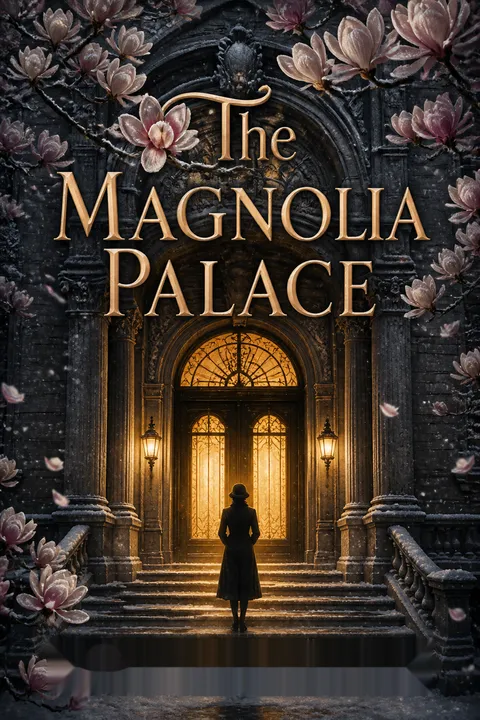


Plot Summary
Blood on the Tenement Stairs
In 1919, Lillian Carter is grieving her mother, Kitty, and struggling to earn rent as the artists’ model Angelica, a celebrated figure whose fame has faded. Her landlord, Walter Watkins, has made an unwanted sexual advance, and Lillian has tried to postpone him with a note.
When police find Watkins’s wife murdered, they discover the note and a photograph of Lillian in Watkins’s desk, turning a tenant’s predicament into a scandalous love triangle. Lillian denies any involvement, but the officers intend to take her in. Afraid the accusation will destroy her chance at a film career, she packs her letters from a Hollywood producer and escapes through her apartment window onto the fire escape.
The Frick House Hires Angelica
After sleeping in Central Park, Lillian finds the Frick mansion’s entrance and is mistaken for a job applicant. Helen Clay Frick, the steel magnate’s forceful, war-haunted daughter, hires her as a private secretary despite her lack of experience.
Lillian hides her modeling identity beneath a plain dress and a tightly pinned hairstyle, hoping the household will shelter her until she can reach California. The work proves harder than expected: she must manage staff, accounts, correspondence, and the family’s scattered homes.
Helen’s father, Henry Clay Frick, soon offers Lillian a thousand-dollar bonus if she can guide Helen into an engagement before Christmas. Lillian accepts, partly to keep her position and partly because the money could finance her escape.
A Match Made by Proxy
As Lillian organizes a Frick dinner party, sculptor and arts patron Gertrude Vanderbilt Whitney recognizes her as Angelica. The encounter threatens the disguise, but the organist, Archer Graham, draws Lillian away before the recognition becomes public.
At dinner, she helps introduce Helen to Richard Danforth, a bereaved, financially strained gentleman whose family business is failing. Helen is anxious in company, so Lillian coaches her through the evening and later writes the letters Helen cannot manage herself.
Danforth confides that he would rather study medicine than inherit his family’s business, while Lillian learns how little his prospects resemble the wealthy match Henry wants. Still, Helen welcomes his attention, and Lillian sees the engagement bonus as a way out of her own danger.
Twenty Clues, One Kiss
When Helen leaves New York with her parents, she sets Richard Danforth a twenty-part scavenger hunt through the mansion’s artworks. Lillian is supposed to leave him to solve it alone, but his confusion draws her in.
The two search the Frick collection together, decoding Helen’s references to enamels, biblical scenes, and paintings. Their growing ease makes the mansion feel less like a workplace and more like a world they share. In the organ chamber, surrounded by thousands of pipes, they kiss.
Helen returns a day early and interrupts them, apparently mistaking their closeness for innocent enthusiasm about the hunt. Lillian realizes that the attraction has put her plan, her employment, and Helen’s hopes at risk, so she resolves to pull away.
Two Futures Refused
Richard presses Lillian to leave with him for Boston, where he hopes to attend medical school, but she reveals that she is the artists’ model Angelica. He recoils from the truth, and she refuses to build a life with someone who loves only the respectable secretary he imagined.
Soon afterward, Lillian meets film producer Alan Broderick, believing their letters have secured her an audition. She discovers that his assistant wrote them, and Broderick wants to turn her public scandal into a lurid screen story rather than let her define herself.
She refuses his terms. With Henry Frick gravely ill, Lillian returns to the mansion and tries to care for Helen, who is terrified of losing her father. Henry dies soon after drinking water Helen fetched for him.
The Secretary Becomes Suspect
Henry’s death unleashes a fight over his will. His son Childs resents Helen’s inheritance and hires a detective after a nurse suspects Henry received a fatal second dose of sleeping medicine. The family also discovers that Martha’s cameo, which Helen placed in her father’s hand, has vanished.
Lillian becomes a convenient suspect in both the death and the theft. Helen’s discovery of Richard’s love letters to Lillian deepens the breach, while the detective learns that Lillian is Angelica and wanted for questioning in the Watkins murder.
Lillian’s friend Bertha admits she once considered poisoning Henry to avenge her family, killed in the Johnstown flood, but says she stopped herself. With the family preparing to hand Lillian over, Archer helps her escape through a window onto the mansion’s roof.
A Blizzard Closes the Frick
In 1966, young British model Veronica Weber arrives at the Frick Collection for a Vogue shoot, determined to earn enough to bring her disabled twin sister, Polly, home from a care residence.
Photographer Barnaby Stone humiliates Veronica and forces the models to pose in freezing snow; when she objects to his treatment of another model, he sends her away. A blizzard traps Veronica inside the mansion, where she meets Joshua Lawrence, a Black art history intern who is also unable to leave.
While exploring the organ chamber, Veronica finds a set of old, numbered clues. She and Joshua share food, stories, and a night beside the fire as the storm shuts down the city. Veronica’s missed shoot now seems less important than the mystery in her hands.
The Cameo’s Hidden Heart
Veronica persuades Joshua to follow the clues, which lead them through the Frick’s paintings and sculptures. Their search turns the museum into a map of Helen’s private memories, and the final clue points to a concealed compartment in the old study. They find a watch fob marked with Richard Danforth’s initials and a cameo of a young girl.
In the basement archives, letters connect the hunt to Helen’s courtship and suggest the cameo mattered deeply to her. When Veronica later opens the cameo, a large pink diamond drops from its hidden interior. It is the long-missing Magnolia diamond. Thinking of Polly’s care and the cost of education she never received, Veronica hides the gem in her pocket instead of telling Joshua.
The Past Opens Its Door
After the storm, the elderly Helen Frick confronts Veronica and Joshua in the mansion, then leads them through a secret passage into the art reference library she founded. Joshua presents the clues, and Helen recognizes her own youthful scavenger hunt.
In the hidden study compartment, they recover the cameo but find its diamond missing. Veronica secretly returns the stone while pretending it has just fallen from the compartment. Helen remembers that her former secretary, Lillian Carter, once sent a letter from a place whose name began with Pine.
Joshua identifies the old organist as Archer Graham, and they trace the couple to Pine Knolls. There, Helen faces Lillian, now an elderly woman, and learns that her former secretary did not steal the cameo or vanish without explanation.
Miss Winnie Breaks Silence
Lillian and Veronica test Helen’s former companion, Miss Winnie, in a nursing-home solarium. Veronica mentions the recovered cameo where Miss Winnie cannot see her lips, and the old woman reacts at once, proving that her supposed deafness was a disguise.
Miss Winnie admits she took the cameo from Henry’s coffin and hid it in the study compartment because she could not bear for him to be buried with Martha’s keepsake. She also reveals that Bertha had almost poisoned Henry, but Miss Winnie finished the act by adding Veronal to his water.
Her self-appointed revenge for Martha’s suffering had left Lillian blamed and Helen tormented by guilt. Helen is furious, yet Lillian urges her to break the family’s chain of cruelty. Helen chooses not to abandon Miss Winnie.
A Name Returns to Marble
Back at Lillian and Archer’s home, Veronica admits to Joshua that she hid the diamond because she feared returning to London with nothing for Polly. She apologizes, and Joshua accepts her remorse after she returns the gem.
Helen decides its sale should support the arts and offers Joshua help with graduate study; she also finds a way for Veronica, her mother, and Polly to build a life in New York. Veronica begins work at the Frick as an assistant archivist, while Joshua receives the first Frick scholarship.
Later, Helen acquires a statue modeled on Lillian and arranges for the museum to identify the woman behind the marble as Lillian Carter Graham. After a life in which her likeness was famous but her name was not, Lillian stands beside the statue with Helen, recognized for her work rather than reduced to her beauty.
Analysis
The novel makes beauty both Lillian’s livelihood and her trap. As Angelica, she is reproduced across New York, yet the public image carries none of her labor, choices, or name. Her attempt to move from modeling into film exposes a new version of the same problem: Broderick wants to market her scandal rather than let her shape her story. The later naming of her statue therefore matters as more than a sentimental tribute. It corrects, however belatedly, the separation between image and person.
The Frick mansion also turns private grief into architecture. Martha’s portraits and keepsakes remain visible throughout the family home, while Helen’s own ambitions struggle to occupy space beside her sister’s memory and her father’s authority. Objects do not simply symbolize the past; they direct action. The cameo is hidden, retrieved, misread, and finally worn, changing from evidence in a criminal mystery into a chosen connection to Martha.
Veronica’s plot tests the ethics of need. She has a credible reason to want the diamond, because Polly’s separation from the family is painful and costly, but desperation does not make the theft harmless. Her decision to return it, and to seek help openly, marks a shift from solitary rescue fantasies toward shared responsibility. Joshua’s skepticism matters because he refuses to treat affection as absolution. Meanwhile, the parallel between Miss Winnie and the Fricks complicates revenge: her grievance is real, but her private judgment repeats the controlling behavior she condemns. The novel’s resolution rests not on declaring every injury equal, but on recognizing how easily caretaking becomes possession, and how truth can interrupt that inheritance.
Review Summary
The Magnolia Palace is a dual-timeline historical fiction novel set in New York City's Frick mansion. Most reviewers enjoyed the rich historical detail and intriguing mystery, praising Davis's storytelling and research. The 1919 storyline following Lillian Carter was generally preferred over the 1966 plot. Some readers found the pacing slow in the middle but appreciated the satisfying conclusion. While opinions varied, many readers considered it one of Davis's best works, highlighting its exploration of art, family dynamics, and New York City history.
People Also Read










Characters
Lillian Carter
Sculptors’ celebrated museA resourceful young New Yorker who models for sculptors under the professional name Angelica. Lillian has spent years learning how posture, silence, and a carefully chosen expression can influence the people around her. Her mother’s guidance taught her to navigate class expectations, but grief and financial danger leave her without the steady partnership she once relied on. She is ambitious and observant, drawn both to artistic recognition and to the practical security that money can buy. Lillian’s challenge is to distinguish the life she genuinely wants from the roles others admire or reward her for playing.
Veronica Weber
Model with an archivist’s eyeAn eighteen-year-old British model whose unusual haircut has helped open doors in an industry that makes young women feel replaceable. Veronica is quick-witted, sharp at noticing details, and fiercely protective of her twin sister Polly. Her father’s death and the family’s financial strain have made her feel responsible for fixing problems that adults cannot solve. She is less confident in elite artistic spaces than in the practical world of work, but curiosity gives her a way into unfamiliar histories. Veronica’s hunger for a better future can make her impulsive, especially when someone she loves seems to depend on her.
Helen Clay Frick
Imperious art patronHenry Clay Frick’s adult daughter, Helen runs her household with forceful opinions and an appetite for projects, particularly her plans for an art reference library. Her sharp manner conceals the strain of returning from Red Cross work during the war and living in the shadow of family expectations. She is devoted to her father, yet wants a purpose that belongs to her rather than simply serving his needs. Art offers her a language for preserving memory and making a mark beyond the family home. Helen’s brusqueness can make intimacy difficult, but her intelligence and persistence keep her from being merely a wealthy heiress.
Joshua Lawrence
Young art history internA Brooklyn College student interning at the Frick, Joshua brings genuine scholarship and personal investment to the museum’s collections. His parents are an artist and a history professor, and he hopes to build a career that makes space for artists and histories neglected by prestigious institutions. As a Black man working in elite art spaces, he is alert to the assumptions that shape who is welcomed, heard, or treated as an authority. Joshua is careful with the objects he studies and skeptical of easy answers, though his curiosity can make him cautious when action is needed.
Miss Winnie
Longtime household companionA longtime member of the Frick household, first serving as a nursemaid and later as Adelaide Frick’s private secretary and companion. Winnie knows the family’s routines and grief at close range, and understands how easily servants become invisible to the people they serve. Her quiet presence allows others to speak freely around her, while her loyalty to the family is complicated by years of witnessing its private tensions. She is shaped by the conviction that she must protect those she considers vulnerable, even when her idea of protection conflicts with their wishes.
Archer Graham
Frick mansion organistThe Fricks’ gifted organist, Archer performs daily within the mansion’s vast instrument and has spent years working beneath the family’s grand rooms. His charm and musical skill sit alongside a practical understanding of his position as an employee. He notices more than he says, and his respect for Lillian is not limited to her public image. Music gives him a private form of expression in a household governed by wealth, duty, and strict routines.
Richard Danforth
Reluctant society suitorA gentleman whose family fortune is fading, Richard is grieving his parents and uncertain about inheriting their business. His wartime experiences have drawn him toward medicine, where he hopes to help rather than stand helplessly by. He is courteous and emotionally open, but his ideas about respectability and marriage remain shaped by his social world. His attraction to Helen and his ease with Lillian expose the difference between a socially convenient match and a connection that feels freely chosen.
Bertha
Helen’s outspoken lady’s maidA lively and candid servant who has worked beside Helen for years. Bertha uses humor and gossip to soften the pressures of the Frick household, and becomes one of the few people Lillian can approach as a friend. Her Pennsylvania roots connect her to the industrial world behind the family’s wealth. She longs for affection and a future beyond service, while carrying anger that has never found an easy place to go.
Kitty Carter
Lillian’s guiding motherLillian’s mother, Kitty, raised her after Lillian’s father abandoned the family. Kitty brought a strict eye for manners and class codes to their precarious life, while also managing the business of Lillian’s modeling career. Protective and forceful, she made sure artists treated her daughter professionally. Her lessons give Lillian tools for navigating the Frick household, but their love was not free of arguments about work, independence, and the life Lillian should pursue.
Henry Clay Frick
Steel magnate and collectorA powerful industrialist whose wealth and intense collecting shape every room of his Fifth Avenue mansion. Henry values order, control, and the preservation of beautiful objects, yet his relationships with his wife and children are marked by old grief and volatile expectations. His daughter Helen seeks both his approval and a life beyond his authority. The mansion’s art collection reflects his cultivated taste, while his business history carries the costs of the fortune behind it.
Adelaide Frick
Withdrawn Frick matriarchHenry’s wife and Helen’s mother, Adelaide rarely leaves her private rooms and often relies on Winnie for companionship. She is reserved and emotionally fragile, particularly around painful family memories. Her withdrawal leaves Helen with much of the household’s social responsibility, even as Adelaide remains a quiet presence in the family’s strained relationships.
Childs Frick
Helen’s estranged brotherHenry and Adelaide’s son, Childs has built a life apart from his father’s art-centered world and shares his interests with his own family. His relationship with Helen is marked by rivalry and old grievances. Their father’s favor and the family’s expectations make ordinary sibling differences feel like contests over identity, inheritance, and whose version of the Frick legacy will endure.
Polly Weber
Veronica’s twin sisterVeronica’s twin, Polly has an intellectual and emotional life that her limited speech makes difficult for strangers to recognize. She communicates through gestures and sounds understood by her family, and shares a close bond with Veronica built on humor and private rituals. Her move to a care residence weighs heavily on Veronica and shapes the risks she is willing to take.
Trish Weber
Veronica’s hardworking motherVeronica and Polly’s mother, Trish works as a secretary after the sudden death of her husband. She makes painful choices under financial pressure and tries to reassure her daughters that the family can endure them. Her practical manner sometimes clashes with Veronica’s urgency, but both are motivated by love for Polly and the need to keep their household afloat.
Alan Broderick
Hollywood film producerA producer who offers Lillian a possible route into silent films. Broderick sees the public fascination with Angelica as material for a screen story, and his commercial instincts do not necessarily align with Lillian’s desire to control her own image.
Barnaby Stone
Vogue shoot photographerA celebrated fashion photographer who expects obedience from the models and treats the shoot as his domain. His authority exposes the precarious position of young women whose careers depend on the approval of powerful men.
Tangerine
Model and kindred spiritA fellow model who helps Veronica recover from a disastrous start on the Vogue shoot. Tangerine understands the industry’s pressures and offers practical kindness, even while carrying the same insecurities about appearance and weight that shape the models’ working lives.
Gertrude Vanderbilt Whitney
Artist and arts patronA prominent patron and practicing artist who recognizes Lillian at the Frick dinner party. Her recognition shows how closely Lillian’s face is linked to the city’s public art, even when the woman behind the statues is trying to disappear.
Sabrina
Veronica’s London agentVeronica’s modeling agent, who secures the American Vogue shoot and urges her to prepare for further opportunities. Sabrina represents the professional promise Veronica hopes will help her family, as well as an industry that can withdraw opportunity as quickly as it offers it.
Plot Devices
The two Frick timelines
Past answers the presentThe narrative alternates between Lillian’s 1919 life inside the Frick mansion and Veronica’s 1966 visit to the museum. Veronica’s discoveries in the archive and among the artworks give fresh meaning to events Lillian experienced without understanding their full cause. The two women’s stories meet through the same rooms, the same family objects, and the long consequences of secrecy. The structure turns the mansion into both a setting and a record of what its occupants could not say openly.
Helen’s scavenger hunt
Artworks become cluesHelen hides a sequence of poetic clues among paintings, sculpture, and furnishings for Richard Danforth to discover. Decades later, Veronica and Joshua use the surviving clues to move through the collection and connect its objects to the Frick family’s private history. Each step rewards observation rather than specialist knowledge alone, allowing the art to function as a map of personal relationships. The hunt also gives the present-day characters a shared task while reviving the unfinished courtship that shaped Lillian’s past.
The Magnolia diamond
A jewel carries family griefThe rare pink diamond belongs to Martha, the Frick child whose early death shaped the family’s grief. Hidden inside a cameo and connected to concealed compartments in Henry’s former study, it becomes both a treasured keepsake and the center of a mystery spanning decades. Veronica’s discovery tests her desperation to help Polly against her respect for Joshua and the people whose history she has uncovered. The diamond’s value is financial, but its meaning is inseparable from the family’s unresolved loss.
Angelica’s public statues
Beauty conceals a working womanLillian’s face and body appear throughout New York as the model for sculptures, while her identity remains unknown to most viewers. This split between public image and private life shapes her struggle to control how others interpret her career. The statues also connect the two timelines: Joshua recognizes the model’s disappearance as a museum mystery, and the later recovery of one sculpture gives Lillian a chance to be recognized by name. Art preserves her likeness even when it erases her authorship and circumstances.
The household archive
Documents expose hidden motivesLetters, menus, and family records preserved in the mansion’s basement give Joshua and Veronica a second route into the past. Unlike the polished portraits on the museum walls, the papers preserve ordinary frustrations, private loyalties, and clues to the Fricks’ relationships. Their discovery allows Veronica to link the scavenger hunt to Richard Danforth and helps the pair trace Lillian and Archer. The archive makes history an active investigation, while raising questions about who controls private records and whose account becomes public memory.
FAQ
Synopsis & Basic Details
What is The Magnolia Palace about?
- Dual timelines intertwine: The story alternates between 1919, where model Lillian Carter navigates a murder scandal and a new job at the Frick mansion, and 1966, where model Veronica Weber gets trapped in the same mansion during a snowstorm and discovers a hidden scavenger hunt.
- Secrets and ambition: Both women are driven by personal ambitions and uncover secrets about the Frick family and their mansion, exploring themes of identity, class, and the pursuit of dreams.
- A historical mystery unfolds: The narrative weaves together elements of historical fiction, mystery, and romance, as the characters grapple with their pasts and the challenges of their present circumstances.
Why should I read The Magnolia Palace?
- Intriguing dual narratives: The parallel stories of Lillian and Veronica, set decades apart, create a compelling narrative that keeps readers engaged and eager to uncover the connections between the two timelines.
- Rich historical detail: The novel offers a fascinating glimpse into the Gilded Age and the 1960s, with vivid descriptions of New York City, the art world, and the social dynamics of each era.
- Complex characters and relationships: The characters are well-developed, with their own unique motivations and flaws, and the relationships between them are nuanced and emotionally resonant.
What is the background of The Magnolia Palace?
- Gilded Age New York: The 1919 storyline is set against the backdrop of the Gilded Age, a time of great wealth and social change in New York City, with a focus on the art world and the lives of the elite.
- 1960s cultural shifts: The 1966 storyline takes place during a period of cultural change, with references to fashion, music, and the social dynamics of the era, contrasting with the opulence of the Frick mansion.
- The Frick Collection: The novel is inspired by the real-life Frick Collection, a museum housed in the former mansion of industrialist Henry Clay Frick, and explores the history of the family and their art collection.
What are the most memorable quotes in The Magnolia Palace?
- "I do this not for me. It's for humanity.": This quote from Mr. Konti, Lillian's first employer, highlights the artistic ambition and the desire to create beauty for the world, a theme that resonates throughout the novel.
- "You're too pretty. I don't want you running off with the footman after two weeks.": Miss Helen's blunt assessment of Lillian reveals her insecurities and her pragmatic approach to managing her household, showcasing her complex personality.
- "We only have a limited shelf life as models, so we might as well make the best of it.": Tangerine's cynical yet practical view of the modeling industry reflects the harsh realities faced by women in that profession, adding a layer of social commentary.
What writing style, narrative choices, and literary techniques does Fiona Davis use?
- Alternating perspectives: Davis employs a dual narrative structure, alternating between Lillian's and Veronica's perspectives, creating a sense of mystery and suspense as the two timelines gradually converge.
- Vivid descriptions and sensory details: The author uses rich language and sensory details to bring the settings to life, from the opulent interiors of the Frick mansion to the bustling streets of New York City.
- Foreshadowing and symbolism: Davis uses subtle foreshadowing and recurring symbols, such as the magnolia flower, to hint at future events and deepen the thematic resonance of the story.
Hidden Details & Subtle Connections
What are some minor details that add significant meaning?
- The recurring magnolia motif: The magnolia flower, present in the mansion's decor and the missing diamond, symbolizes both beauty and transience, reflecting the fleeting nature of fame and fortune.
- The use of mirrors: Mirrors appear throughout the novel, reflecting the characters' inner selves and their struggles with identity, as well as foreshadowing the dual nature of the story.
- The mention of specific artworks: The detailed descriptions of the paintings and sculptures in the Frick Collection not only add to the historical setting but also serve as symbolic representations of the characters' emotional states and the themes of the novel.
What are some subtle foreshadowing and callbacks?
- The mention of the Titanic memorial: Lillian's posing for the Titanic memorial foreshadows her own experience with loss and the fleeting nature of life, as well as her connection to the Frick family through art.
- The description of the organ pipes: The organ pipes, described as a "gilded jail," foreshadow Lillian's entrapment in the Frick mansion and her struggle to escape her past.
- The recurring image of a hand: The image of Mrs. Watkins's hand, "gently, almost daintily, curled in," foreshadows the themes of death and the fragility of life, and is later echoed in Mr. Frick's hand holding Martha's cameo.
What are some unexpected character connections?
- Lillian and Helen's shared vulnerability: Despite their different backgrounds, Lillian and Helen share a vulnerability stemming from their relationships with their fathers, creating an unexpected bond between them.
- Veronica and Joshua's shared passion for art: Veronica and Joshua's shared passion for art and history, despite their different backgrounds, creates a connection that transcends their initial differences.
- The connection between the past and present: The scavenger hunt, created by Helen in the past, is discovered by Veronica in the present, highlighting the enduring impact of the past on the present.
Who are the most significant supporting characters?
- Miss Winnie: As Mrs. Frick's private secretary, Miss Winnie serves as a confidante and observer, providing insights into the Frick family's dynamics and the secrets they keep.
- Mr. Graham: The organist, Mr. Graham, is a mysterious figure who connects Lillian to the world of music and art, and his presence adds a layer of intrigue to the story.
- Bertha: As Helen's lady's maid, Bertha provides a glimpse into the lives of the servants in the Frick household, and her friendship with Lillian offers a sense of camaraderie and support.
Psychological, Emotional, & Relational Analysis
What are some unspoken motivations of the characters?
- Lillian's desire for independence: Lillian's unspoken motivation is to escape her past and create a new life for herself, free from the constraints of her former identity and the scandal that surrounds her.
- Helen's need for validation: Helen's unspoken motivation is to gain her father's approval and recognition, which drives her actions and her desire to create a lasting legacy through her library.
- Joshua's desire for recognition: Joshua's unspoken motivation is to be recognized for his knowledge and passion for art, and to challenge the traditional narratives of the art world.
What psychological complexities do the characters exhibit?
- Lillian's internal conflict: Lillian struggles with her desire for fame and fortune and her need for safety and security, torn between her ambition and her fear of exposure.
- Helen's emotional fragility: Helen's emotional fragility is masked by her imperious demeanor, revealing a deep-seated insecurity and a need for control.
- Joshua's struggle with identity: Joshua grapples with his identity as a Black man in a predominantly white art world, and his desire to challenge the status quo while also seeking acceptance.
What are the major emotional turning points?
- Lillian's decision to leave Mr. Danforth: Lillian's decision to reject Mr. Danforth's proposal marks a turning point in her character arc, as she chooses her own path over a secure future.
- Veronica's decision to return the diamond: Veronica's decision to return the Magnolia diamond marks a turning point in her character arc, as she chooses integrity over personal gain.
- Helen's confrontation with her past: Helen's confrontation with her past, including the truth about her father's death and the missing cameo, forces her to reevaluate her relationships and her own identity.
How do relationship dynamics evolve?
- Lillian and Helen's complex bond: Lillian and Helen's relationship evolves from one of employer and employee to a complex bond of shared experiences and mutual understanding, as they navigate their personal struggles and the challenges of their respective worlds.
- Veronica and Joshua's growing connection: Veronica and Joshua's relationship evolves from a shared adventure to a deeper connection based on mutual respect and understanding, as they navigate the mysteries of the Frick mansion together.
- The Frick family's strained relationships: The Frick family's strained relationships are highlighted by their inability to communicate openly and honestly, and their reliance on secrets and manipulation to maintain control.
Interpretation & Debate
Which parts of the story remain ambiguous or open-ended?
- The true nature of Mr. Frick's death: The novel leaves the true nature of Mr. Frick's death ambiguous, with multiple characters having motives and opportunities, leaving the reader to question who was truly responsible.
- The future of Lillian and Archer: The novel leaves the future of Lillian and Archer open-ended, with the reader left to imagine what their life together will be like after their escape from the Frick mansion.
- The long-term impact of the Frick family's secrets: The novel leaves the long-term impact of the Frick family's secrets on their legacy and the future of the Frick Collection open-ended, inviting readers to consider the enduring power of the past.
What are some debatable, controversial scenes or moments in The Magnolia Palace?
- Lillian's relationship with Mr. Danforth: Lillian's relationship with Mr. Danforth is a controversial element, as it raises questions about her motivations and her willingness to prioritize her own desires over her responsibilities to Miss Helen.
- Miss Winnie's actions: Miss Winnie's actions, including her role in Mr. Frick's death and the theft of the cameo, raise questions about the nature of justice and the lengths people will go to for revenge.
- The portrayal of the Frick family: The portrayal of the Frick family as both wealthy and flawed raises questions about the nature of privilege and the impact of wealth on personal relationships.
The Magnolia Palace Ending Explained: How It Ends & What It Means
- Lillian's escape and new life: Lillian escapes the Frick mansion and starts a new life with Archer, leaving behind her past as Angelica and embracing a future where she is valued for who she is, not what she represents.
- Veronica's choice of integrity: Veronica chooses to return the Magnolia diamond, prioritizing her values over personal gain, and embarks on a new path as an archivist, combining her love for history with her desire to help others.
- Miss Helen's acceptance of her past: Miss Helen comes to terms with her family's history and her own identity, choosing to honor her father's legacy while also forging her own path, and ultimately offering Veronica a job, showing a change in her character.
About the Author
Other books by Fiona Davis


Download PDF
Download EPUB
.epub digital book format is ideal for reading ebooks on phones, tablets, and e-readers.








