

Plot Summary
A Collar Returns
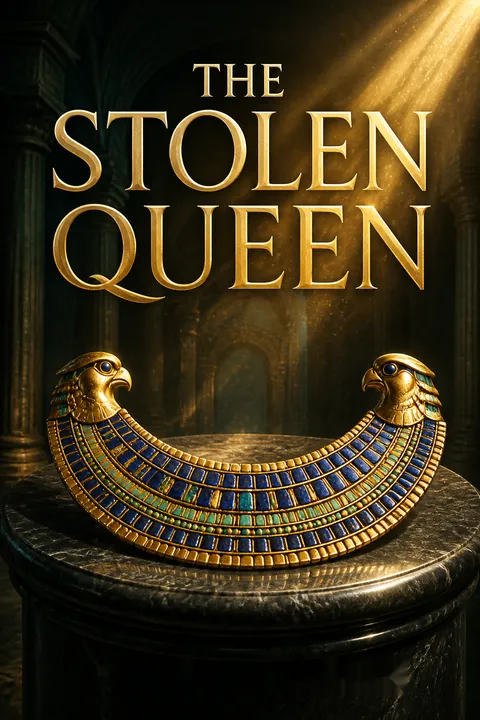
In 1978, associate curator Charlotte Cross is preparing the Metropolitan Museum for the King Tut exhibition while quietly building a case that the ancient pharaoh Hathorkare was a capable ruler, not the villain later historians made of her. Then a gold collar arrives on loan.
Charlotte recognizes its missing amulet and Hathorkare's name on the clasp: she saw it excavated in Egypt in 1936, and believed it had vanished in the Nile. Her panic unsettles the staff, but she cannot explain why the object matters so personally. The Met's leadership treats the loan as a welcome addition. Charlotte sees a question that could reopen the most painful chapter of her life, and a clue to why the collar resurfaced.
The necklace turns museum work into personal exposure. Charlotte has spent years protecting herself by making the past an intellectual subject, but the collar refuses that separation: it is not simply evidence of an ancient queen or an interesting acquisition. It links her current ambition to a history she has never been able to narrate. The Met's polished procedures also contrast with the uncertain provenance behind the object. In this opening, stewardship means more than keeping an artifact intact. Charlotte must decide whether protecting the institution's reputation is worth ignoring what she knows.
A Student Finds Her Place
At eighteen, Charlotte arrives in Egypt as the lone undergraduate on a Met excavation, expecting to observe rather than lead. When a Bedouin man arrives suffering from a cobra bite, she uses the medical kit to treat him while the senior archaeologists are away. Her composure earns her a chance to dig, and she grows close to Henry Smith, a kind, sharp British archaeologist who respects Egyptian workers and shares her curiosity.
After Charlotte discovers a buried stairway near the Valley of the Kings, her team opens a forgotten tomb. Inside are a sarcophagus, two mummies, and signs of a burial tied to Hathorkare. Charlotte's first consequential discovery gives her a place in the field, though others are already competing to claim it.
Charlotte's initiation into archaeology is practical rather than ceremonial. She earns trust by attending to a living person before she earns recognition for uncovering the dead. That contrast anticipates the novel's recurring moral question: who counts as worthy of care, and who is treated as a means to someone else's ambition? Henry's respectfulness offers Charlotte a model of partnership, while the dispute over credit shows how easily a young woman's expertise can be appropriated. The discovery matters to her not only as a career breakthrough, but as proof that her judgment belongs in a world that has not yet made room for it.
The Collar Leaves Egypt
While examining the tomb, Charlotte finds a hidden niche containing an exquisite gold broad collar inscribed with Hathorkare's name. The team leader credits Leon Pitcairn, a status-conscious English archaeologist, with helping retrieve it, although Charlotte found both the tomb and the concealed opening.
The Egyptian authorities claim the collar for their museum, and the team leaves the mummies behind. Charlotte and Henry fall in love, and she becomes pregnant.
When their American expedition withdraws, Henry turns down a chance to stay in Egypt, but Charlotte persuades him to join a Polish team instead. They marry and remain in the country. The collar's fate seems settled, yet its removal from the tomb will soon entangle their family in a dangerous secret.
The broad collar is introduced as both an artwork and a contested possession. Charlotte's discovery is diminished by the team's hierarchy, while the artifact itself is treated as a prize whose destination can be decided by institutions. Her insistence that the mummies are people rather than discarded remains sets her ethical instincts against the casual extraction around her. Meanwhile, choosing Egypt with Henry gives Charlotte a rare sense of agency, but it also places love, work, and risk in the same landscape. The collar's eventual theft will expose how those private hopes can be damaged by the unequal power structures surrounding antiquities.
Annie Finds an Opening
In 1978, nineteen-year-old Annie Jenkins divides her days between diner shifts, cleaning her landlady's townhouse, and managing her mother's moods and money. Joyce's modeling work has dried up, but she clings to the hope that a new boyfriend will rescue them both. Mrs. Hollingsworth sends Annie to the Met with a feather boa for fashion editor Diana Vreeland, who rejects it as useless for her Costume Institute exhibition.
Annie returns the next day with a better idea: a gold Egyptian broad collar she has seen in the galleries would transform the costume. Vreeland recognizes Annie's eye and hires her as an assistant. For the first time, Annie's love of clothes and her knack for practical problem-solving offer a route beyond caretaking.
Annie's talent has developed in the shadow of service. She knows how to mend a dress, anticipate a crisis, and read what another person needs because her family has made those skills necessary. Vreeland's attention briefly converts that invisible labor into professional value. Yet the opportunity is precarious: Annie's confidence depends on approval from a powerful older woman, much as her home life depends on Joyce's emotional stability. Her instinct for fashion is not mere decoration. It is a way of imagining that a person can shape how the world sees her, rather than simply endure the role others assign.
Charlotte's Past Breaks Cover
Charlotte presents her Hathorkare research to Frederick, her dismissive department head. She argues that the later pharaoh erased Hathorkare's masculine images to secure his son's succession, not to avenge a personal feud.
Frederick admires the theory but refuses to support publication without proof from Egypt, the place Charlotte has avoided since a disaster in 1937. Meanwhile, the Met director will not reveal the collar's anonymous lender, and Charlotte hires art-recovery investigator Tenny Woods to trace its ownership.
At home, Mark Schrader's planned proposal unsettles her, especially as his daughter Lori has moved in and strained their household. Charlotte hides her Egypt history even from Mark, choosing distance when closeness asks her to risk telling the truth.
Charlotte's professional dispute mirrors her intimate life. She is asking colleagues to revise a story built on assumptions about a powerful woman, while keeping her own history sealed because she fears what disclosure might cost. Frederick's demand for proof is intellectually sound but personally impossible, which makes the research a test of whether she can reclaim authority without revisiting trauma. Mark's proposal exposes the same conflict in a quieter form: commitment feels less like safety than a threat to the independence Charlotte has built around grief. Her evasiveness protects her in the moment, but it also keeps others from understanding her.
The Nile Takes a Family
In Egypt, Charlotte gives birth to Layla and tries to balance motherhood with her stalled archaeological ambitions. As political danger grows in Europe, Henry abruptly takes Charlotte and the baby onto a steamer bound for Cairo, carrying a suitcase he says belongs to Leon.
During a storm, the ship collides with another vessel and begins to sink. The case spills open, revealing stolen antiquities, including the broad collar. Charlotte is trapped under deck furniture and urges Henry to take Layla toward the upper deck; then the flood separates them.
Charlotte survives with help from a passing boat, but Henry and Layla are presumed dead. Back in New York, grief and shock leave Charlotte hospitalized, while her parents suppress the truth of her marriage and the life she lost.
The shipwreck makes private trust inseparable from public wrongdoing. Charlotte has chosen Egypt for love and work, but Henry's concealed smuggling has put their infant in danger without her knowledge. Her final act as a mother is to send Layla away from immediate peril, even as separation becomes permanent in her understanding. The collar's appearance in the suitcase transforms it from a scholarly object into evidence of betrayal. Charlotte's later silence is not simple avoidance; it is a survival strategy reinforced by parents who believe erasure will protect her. Their secrecy preserves appearances while denying her the chance to grieve openly.
Moths and a Missing Queen
As Annie prepares the Met Gala, she takes Vreeland literally and brings live insects for the VIP tour. Someone has secretly exchanged butterflies for fabric-eating moths, which swarm the Costume Institute and draw guards into the basement.
In the confusion, a thief steals the Cerulean Queen, the small jasper fragment beloved by Charlotte and Annie. Charlotte pursues the man and is attacked in an underground storage passage; Annie frightens him off with a dagger.
At the same time, Charlotte discovers that her Hathorkare research file has vanished and a warning has been left in its place. The moths, theft, and threat appear connected. Annie is blamed for the chaos, while Charlotte realizes someone may be targeting her questions about the collar.
The gala's spectacle becomes a mechanism for concealment. Vreeland's theatrical ambition and Annie's eagerness to please provide an opening for someone who understands the museum's routines better than its staff do. The stolen statue and missing research file turn Charlotte's private investigation into an active danger, while Annie's mistake makes her an easy scapegoat. The Cerulean Queen's absence is especially potent because the fragment has served as a quiet emblem of survival for both women. Its removal makes the museum's vulnerability visible and forces Charlotte to act before institutional caution buries the evidence.
Two Women Cross the Sea
Charlotte learns that Leon survived the shipwreck, served prison time for smuggling, and now works as a guide in Luxor. Investigator Tenny also connects his name to Ma'at, a secret group that steals Egyptian antiquities from foreign museums. When the Met's board delays action, Charlotte decides to return to Egypt and confront Leon.
Annie, barred from the museum and facing further questioning, is also pushed out of her home when Joyce accepts a proposal from Brad and expects Annie to leave. Mrs. Hollingsworth gives Annie shelter and her saved wages. Annie buys a ticket on Charlotte's flight without permission, believing she can help identify the thief and clear her name. Charlotte objects, but allows her to stay for now.
Both women leave New York because the roles that once contained them have become intolerable. Charlotte risks her career to confront a past she has been forbidden to discuss; Annie loses a job and home just as she begins to imagine a life beyond managing Joyce. Their decision to travel together is not yet a stable alliance. Annie's determination partly reflects her old habit of making herself indispensable, while Charlotte resists becoming responsible for another person. The journey begins with unequal expectations, but shared vulnerability creates the possibility of a relationship neither woman knows how to ask for directly.
A Queen's Hidden Box
In Luxor, Charlotte and Annie meet Mehedi, the Bedouin man Charlotte once saved from a cobra bite. His grandson Jabari helps them enter the tomb Charlotte discovered decades earlier, where Charlotte photographs faded images of Hathorkare and studies the mummies.
When a loose wall stone reveals a concealed niche, a wooden canopic box bearing Hathorkare's name appears inside. The tomb begins to crumble before officials can secure it. Annie runs back into the danger and pulls the box free, saving it from falling masonry.
The discovery prompts the Egyptian Museum to invite Charlotte to help transfer the box and mummies to Cairo. Annie's impulsive act earns Charlotte's gratitude and begins to change their relationship from reluctant escort and burdened guide into partners.
The tomb encounter reverses the usual hierarchy between expert and novice. Charlotte brings historical knowledge, but Annie's instinctive courage saves the object that makes further investigation possible. The scene also unsettles the romance of discovery: the tomb is fragile, the dead are vulnerable, and curiosity can cause harm if it ignores material limits. Annie's intervention is not the product of expertise; it comes from noticing Charlotte's attachment and choosing to act. Their partnership grows through a concrete consequence, not a declaration. Charlotte can no longer treat Annie solely as an inconvenience, and Annie experiences competence outside the caretaking role she knows.
Leon Leaves a Trail
Charlotte confronts Leon in Luxor. He admits that he and Henry stole antiquities, but claims not to know what became of Henry after the ship sank. His wording suggests otherwise. A landlady remembers an Englishman with Henry's distinctive ears visiting Leon years later and warning him to stay away from his daughter.
Annie secretly searches Leon's outgoing mail and finds a note about an antiquity awaiting transfer to a place described as unique. In Cairo, Charlotte verifies that the broad collar is listed in the Egyptian Museum's records despite never having arrived there.
The director arranges CT scans of the mummies and canopic box. Charlotte now has reason to believe Henry survived, while Annie's clue points toward the Farid Gallery and the stolen Cerulean Queen.
Leon provides information by refusing to provide it. Charlotte reads the gap between his claims and his tense, while the landlady's memory establishes that Henry returned to Egypt and was looking for someone. Annie contributes through improvised investigation, though her break-in to Leon's mail repeats the boundary-crossing behavior that got her into trouble at the Met. The two clues converge on a deeper pattern: ownership records and family histories can both be manipulated, but traces remain in the margins. The chapter shifts the search from a single stolen object toward the possibility that Charlotte's family was not lost in the way she believed.
The Mummy's Tooth
At a Cairo hospital, specialists scan the canopic box without opening it. Annie recognizes a shape in the image as a tooth, and experts compare it with the jaws of the mummies. A molar in the box matches a missing tooth in the mummy with the crossed arm, identifying her as Hathorkare.
During the examination, Charlotte alone sees a regal female figure appear above the scanner before vanishing; the vision leaves her feeling unexpectedly released from the curse she has feared.
Outside, Annie connects Leon's note about a unique destination with the name of the Farid Gallery, whose name carries that meaning. The scan gives Charlotte an archaeological breakthrough, while Annie's linguistic deduction redirects them toward the shop that may be hiding the stolen statue.
Scientific procedure and personal belief coexist without the novel forcing one to cancel the other. The CT scan establishes Hathorkare's identity through measurable evidence, while Charlotte's vision gives emotional form to a release that no instrument can register. Annie's contribution is equally important but different: she notices a word across contexts and turns it into a practical lead. The chapter refuses to rank intelligence by institutional credential. Charlotte has the historical framework, specialists provide the technology, and Annie makes the connection that moves the investigation forward. Their cooperation produces knowledge no one could have reached alone.
The Queen Inside Tut
Charlotte and Annie return to Cairo's Farid Gallery and notice that its owner, Heba, seems to recognize the wedding photograph of Henry. Charlotte distracts her by smashing a perfume bottle while Annie keeps Heba occupied.
In the back room, Charlotte finds a King Tut plaster statue packed for customs and discovers blue stone beneath its surface. Before they can alert the museum director, the attacker from the Met ambushes them in an alley. Charlotte fights to shield Annie until Jabari intervenes.
Police and Omar arrive; a conservator removes the plaster and confirms that the Cerulean Queen is inside. While the officers search the shop, Annie notices a photograph of Heba with a woman who resembles one of the Met's docents. That image gives them a lead back to New York.
The recovery depends on reading ordinary objects against their expected weight and use. A mass-produced tourist statue becomes a concealment device, and the gallery's polished surface hides a network of illicit movement. Charlotte and Annie's tactics reflect their different strengths: Charlotte tests the physical evidence, while Annie watches people and notices what does not fit. Yet their success is not clean triumph. The attack shows that cultural restitution has been made dangerous by the methods used to pursue it, and Heba's confusion complicates any easy picture of a unified criminal conspiracy. The photograph points toward a person inside the Met, tightening the story's two settings together.
Mona's Double Life
Back at the Met, Charlotte and Annie summon Mona, the docent trainee seen in the photograph. Mona admits that she joined Ma'at to return Egyptian art, arranged the moth switch as cover for the theft, and used the broad collar loan to gain access to the museum. She also stole Charlotte's research file after learning Charlotte was investigating the collar.
Mona says her father is English, and Charlotte recognizes the possibility that he is Henry, but Mona denies being Charlotte's daughter. Police arrest her; her mother and other Ma'at members are also taken into custody, and Charlotte's file is later recovered from Mona's apartment. Before she is led away, Mona claims she knows where Charlotte's lost daughter is, then refuses to explain.
Mona's political conviction is sincere, but sincerity does not excuse the coercion and deception through which she pursues it. Her plan depends on exploiting the museum's trust in volunteers, its appetite for prestige, and the blind spots of its security staff. Her personal history also echoes Charlotte's search for recognition, though Mona has turned grievance into a rigid doctrine that leaves little space for other people's claims. Her arrest resolves the immediate theft while deepening the emotional mystery. The recovered research file restores Charlotte's work, but Mona's tantalizing claim transfers the central question from the stolen artifact to the missing child.
Henry Comes Back
Henry appears at the Met after learning Mona has been arrested, and Charlotte takes him to the rooftop to hear his account. He confirms that he survived the sinking and searched hospitals, but left Egypt under forged documents after being told Charlotte and Layla were dead.
He admits Leon persuaded him to smuggle antiquities, partly because he feared he could not provide for his family. Henry wrote Charlotte's parents, but her father replied that they were mourning and barred further contact.
The parents never told Charlotte that Henry had tried to reach her. Henry explains that another woman, Heba, later became his partner and that Mona is their daughter, not Charlotte's. Charlotte ends her relationship with Mark and prepares to pursue the truth about Layla.
The reunion does not erase harm; it gives Charlotte a more accurate account of it. Henry's motives include fear and shame, but his choices still placed his family at risk. The parents' intervention reveals a second betrayal, one committed under the language of protection. By withholding Henry's letter, they made Charlotte's grief appear final and denied her the possibility of choosing what to do with the truth. Charlotte's separation from Mark is similarly an act of agency rather than punishment. She recognizes that affection cannot substitute for a life she has never fully claimed as her own.
The Clue in the Cold
On the Met rooftop, Henry confirms that Layla was swept from his arms when the steamer sank; no body was found. Mona had told Charlotte that Layla was nearby and that she would reveal her location only on an impossibly cold day. Annie recognizes the phrasing as a clue to the Winter Palace Hotel, where Charlotte and Annie had stayed in Luxor.
Meanwhile, Charlotte's colleague Helen reconstructs faded tomb images from Annie's slides, and Charlotte locates an ancient contract in the Met's storeroom. It records an order to erase only Hathorkare's male-coded images so the next king's claim would be secure. Charlotte now has proof for her theory, and Annie's deduction gives them a reason to return to Egypt.
This turn braids the novel's two central forms of recovery. Charlotte's historical argument becomes demonstrable through an overlooked document, while Annie interprets Mona's cruelty as a coded map rather than accepting it as mere malice. The archive does not speak by itself; it requires patient reconstruction, comparison, and a willingness to revisit material dismissed as insignificant. Likewise, the family clue emerges through attentive listening across earlier conversations. Charlotte's professional vindication and personal search are both advanced by work that institutions and individuals had failed to complete. Annie is no longer merely trying to be useful. She has become an interpreter of the story.
Layla at the Winter Palace
In Luxor, Charlotte and Henry meet Fatima, the Winter Palace clerk Annie identified as Layla. A fisherman rescued the baby from the Nile and raised her with his wife, who had recently lost an infant. Fatima discovered the truth as a teenager but stayed silent to spare her adoptive parents; later, she recognized Henry and Charlotte when they came to the hotel, but feared another rejection.
Charlotte and Henry embrace their daughter, and Annie offers them jasmine. Back in New York, Charlotte's Hathorkare research is restored, her article moves forward, and she leaves the Met to work in Egypt. Annie returns to Vreeland's employ and reconnects with Billy. The family cannot reclaim its lost years, but it can begin again with the truth in view.
The final reunion is deliberately restrained: Fatima has a life, loyalties, and grief of her own, so recognition does not make her childhood losses disappear. Charlotte's embrace matters because it is offered without claiming that biology cancels the family that raised her. Annie's role is equally integral. Her attentive reading of Mona's words makes the meeting possible, and her gesture of jasmine marks her place in this newly formed circle. Charlotte's return to Egypt also resolves the opening tension between scholarship and avoidance. She can now pursue Hathorkare's history and her own without pretending either belongs only to the past.
Analysis
The Stolen Queen makes recovery its central action, but it refuses to treat recovery as a simple return to an undamaged past. Charlotte wants to recover her daughter, the stolen collar, her research, and Hathorkare's reputation. Each search exposes a different kind of loss: a family divided by a shipwreck and deliberate silence, an artifact stripped of a reliable history, and a female ruler reduced by later interpreters to a cautionary figure. The novel's parallel investigations suggest that evidence is never neutral. It must be located, interpreted, and made public, and those tasks are shaped by power.
The museum setting sharpens the ethical problem of cultural ownership. The Met can conserve objects and make them accessible, yet those virtues do not erase the colonial histories or questionable transfers behind some collections. Ma'at identifies a real injustice but answers it through theft, deception, and danger. The novel therefore resists the comforting claim that good intentions settle questions of custody. Charlotte's changing perspective is significant because she learns to question not only other people's assumptions about Egypt, but also her own institutional sense of possession.
The two protagonists develop through reciprocal recognition. Annie begins by managing Joyce and seeking approval from Vreeland; Charlotte begins by managing the museum and withholding her past. Annie's observation and nerve repeatedly move the investigation forward, while Charlotte's expertise gives Annie's discoveries historical context. Their partnership does not make them interchangeable. It lets each act beyond the role she has been assigned. The recovered contract and the reunion with Layla offer different forms of closure: one restores a suppressed historical argument, the other begins a relationship that cannot recover its lost decades. The novel's final hope comes not from undoing damage, but from telling the truth and choosing what to do next.
Review Summary
The Stolen Queen receives mixed reviews averaging 3.91 stars. Readers praise the dual timeline between 1936 Egypt and 1978 New York, strong female characters Charlotte and Annie, and atmospheric settings from archaeological sites to the Met Gala. Many appreciate the Egyptian history and museum culture elements. However, criticisms include predictable plotting, superficial treatment of themes, excessive reliance on coincidences, slow pacing due to timeline switches, historical inaccuracies, and overly neat resolutions. Some found the mystery anticlimactic with villain reveals feeling like "Scooby-Doo" moments. Despite flaws, historical fiction fans generally enjoyed the found-family dynamics and intergenerational friendship.
People Also Read








Characters
Charlotte Cross
The relentless EgyptologistCharlotte is an associate curator at the Met, a meticulous scholar whose practical intelligence has long been more valuable to her department than its hierarchy admits. She is drawn to overlooked histories, especially those of women whose achievements have been reduced to ambition or deceit. Her confidence in research contrasts with her guardedness in personal life: she keeps grief private, avoids asking others to share its weight, and treats emotional distance as a form of control. Her work on Hathorkare gives her a way to challenge the museum's inherited assumptions, while her relationships with colleagues and family test whether she can be known beyond her expertise. Charlotte's central tension is between self-protection and the risk of returning to what she has buried.
Annie Jenkins
The resourceful newcomerAnnie is a nineteen-year-old New Yorker who has spent years supporting her mother through money troubles and emotional crises. She is strong from physical work, observant about clothes, and quick to improvise, but she has little confidence in her own judgment because she is often treated as a burden or an afterthought. Fashion gives her a language for self-expression, while her love of the Met offers steadiness in a life shaped by uncertainty. Annie initially seeks approval by making herself useful, then gradually discovers that usefulness can coexist with independent thought and desire. Her capacity to notice people, patterns, and practical details makes her an unexpected partner to Charlotte, even when her impulsiveness creates complications.
Henry Smith
The gifted field archaeologistHenry is a British archaeologist with deep knowledge of ancient Egypt and an unusually easy rapport with the people who work alongside him. He is warm, humorous, and adaptable, able to move between social worlds without losing his curiosity. His childhood as the maintenance man's son at an elite boarding school leaves him sensitive to class and status, even as professional insecurity shapes his choices. With Charlotte, he shares intellectual excitement and a sense of possibility; as their circumstances change, he struggles to reconcile love with his fear of financial inadequacy. Henry's charm can make him seem more settled than he is, and his private decisions carry consequences beyond his intentions.
Layla Smith
Charlotte's infant daughterLayla is the daughter Charlotte and Henry welcome while living in Egypt. As an infant, she becomes the center of Charlotte's attention and a measure of how radically motherhood changes the life Charlotte had imagined for herself. Her small gestures and needs remain vivid in Charlotte's memory, even when the family is separated from her. Layla's place in the story is both intimate and historical: she connects the excavation years to Charlotte's later search for the truth, while reminding the adults that their decisions affect someone unable to choose for herself.
Mona
The polished docent traineeMona is a wealthy, socially composed woman who enters the Met's docent program and moves comfortably among its donors and volunteers. Her attachment to Egyptian heritage is intense, and she sees cultural repatriation as a moral obligation rather than a matter of museum policy. Beneath her polished manner is a person shaped by questions of belonging, family, and cultural identity. Mona's certainty gives her purpose but can also make compromise seem like complicity. She is capable of charm and strategic patience, especially when pursuing access to people or institutions. Her presence unsettles Charlotte because Mona embodies a different answer to the same question: who has the right to decide where history belongs?
Leon Pitcairn
The resentful archaeologistLeon is a British archaeology candidate whose aristocratic background has not protected him from family decline or professional disappointment. He often responds to frustration with complaint, mockery, or competition, especially when a colleague's success exposes his own lack of recognition. His relationship with Henry is shaped by old friendship and unequal temperament: Henry tends to draw people together, while Leon watches for advantage. Leon's interest in antiquities is mixed with a hunger for status and reward, making him difficult to trust even when he is being candid.
Diana Vreeland
The extravagant fashion editorDiana Vreeland is the Met's forceful Costume Institute consultant, famous for turning historical clothing into theatrical encounters. She thinks in images, moods, and surprising juxtapositions, and expects her staff to translate her leaps of imagination into workable plans. Her demands can be bewildering and her judgments severe, but she recognizes originality in people whom conventional beauty standards overlook. For Annie, Diana is both a formidable employer and a model of how style can become a deliberate way of seeing the world.
Joyce Jenkins
Annie's fragile motherJoyce is a former fashion model whose fading career has left her struggling to accept age, financial limits, and the loss of attention. She is beautiful and charming, but her moods and romantic hopes make her dependent on Annie, often reversing the expected roles between parent and child. Joyce's vulnerability is real, yet she sometimes uses it to keep Annie close and avoid responsibility. Her longing for a new partner reflects a wish to recover the life she once imagined, even when that wish blinds her to the costs Annie has carried.
Mark Schrader
Charlotte's theater partnerMark is a playwright and Columbia theater professor who offers Charlotte humor, companionship, and a home in an apartment inherited from his family. He is affectionate and thoughtful, but his bond with his daughter Lori shapes the household in ways Charlotte struggles to navigate. Mark wants emotional openness and a shared future; Charlotte's silences leave him unsure where he stands. His patience is genuine, though it cannot resolve the mismatch between the life he hopes to build and the independence Charlotte is trying to reclaim.
Frederick
The self-protective curatorFrederick leads the Met's Egyptian Art department and is more comfortable with broad concepts and donor relations than the detailed work of managing a department. Charlotte quietly handles much of that work, though he retains authority and public credit. He is not without scholarly judgment; he recognizes that her argument needs stronger evidence. But he is also invested in his own reputation and in preserving the museum's established account of Hathorkare. Their professional relationship exposes how expertise and institutional power can be distributed unevenly.
Mrs. Hollingsworth
Annie's practical landladyMrs. Hollingsworth is an elderly, financially strained woman from a once-wealthy New York family. She employs Annie to clean her townhouse, notices the imbalance between Annie and Joyce, and quietly sets aside money for the young woman. Her directness can sound brusque, but it is grounded in attention rather than judgment. She recognizes that Annie needs more than sympathy: she needs room, a little financial security, and permission to imagine a life beyond managing other people.
Helen
Charlotte's conservator friendHelen is a skilled Met conservator and Charlotte's closest friend at the museum. Her work restoring paintings requires patience, scientific knowledge, and an eye for details others might dismiss. She is frank with Charlotte, willing to challenge her self-blame, and offers a rare friendship in which Charlotte can speak more honestly. Helen's ability to reconstruct damaged images also makes her a fitting ally to Charlotte's effort to recover both historical evidence and personal truth.
Tenny Woods
The art-recovery investigatorTenny Woods is an independent investigator who specializes in stolen art and the trails objects leave behind. His office is cluttered, his manner unsentimental, and his expertise practical rather than institutional. He asks Charlotte to distinguish what she knows from what she suspects, but he takes the collar's provenance seriously and gives her leads she cannot obtain through the Met. Tenny also understands that recovery work can be dangerous, not merely procedural.
Omar Abdullah
The Egyptian Museum directorOmar directs the Egyptian Museum in Cairo and works within an institution with far fewer resources than the Met. He is hospitable, knowledgeable, and eager to protect Egypt's collections, while wary of Ma'at's illegal methods. His collaboration with Charlotte on the mummies and canopic box shows his willingness to value outside expertise without surrendering Egyptian authority over Egyptian history.
Jabari
The Valley's watchful guideJabari is Mehedi's grandson and a member of the council overseeing the Valley of the Kings. He knows the site, its risks, and its local relationships, and he helps Charlotte and Annie gain access to the old tomb. His practical judgment becomes especially important when the tomb begins to collapse. Jabari embodies a living community's connection to the archaeological landscape, not simply its role as a destination for foreign researchers.
Mehedi
Charlotte's old patientMehedi is the Bedouin man Charlotte treated for a cobra bite during her first excavation season. Years later, he remembers her and offers help in the Valley of the Kings. His gratitude establishes a bond that crosses decades and gives Charlotte a reminder that her earliest act in Egypt mattered to someone beyond the archaeological team.
Billy
The hopeful Met guardBilly is a young security guard from Brooklyn who hopes to study at university and eventually work as a museum technician. He is talkative, curious about the art around him, and quick to help Annie when she needs it. His warmth contrasts with the suspicion that falls on them after the gala theft. Billy treats Annie as someone worth listening to before she has learned to trust her own abilities.
Heba Farid
The Cairo gallery ownerHeba owns the Farid Gallery in Cairo and moves through the antiquities trade with the confidence of an experienced dealer. She is alert to customers, protective of her business, and connected to a family history that spans Egypt and Europe. Her shop's polished displays conceal a complicated relationship with the movement of ancient objects, while her personal loyalty to her daughter shapes what she is willing to see or admit.
Mr. Lavigne
The Met's measured directorMr. Lavigne directs the Metropolitan Museum and is known for fairness and a discreet, efficient manner. He follows institutional rules around anonymous donors and provenance, even when Charlotte presses him for information. His authority reflects the museum's competing obligations to protect its reputation, respect confidentiality, and respond to questions about objects in its care.
Plot Devices
The Hathorkare Broad Collar
A trail of contested ownershipThe gold collar, inscribed with Hathorkare's name and missing one amulet, links Charlotte's 1936 excavation to the 1978 Met loan. Its illicit movement makes it evidence of a crime, a source of professional danger, and a clue to the fate of Charlotte's family. The collar also forces the novel's institutions to confront the difference between a documented loan and legitimate ownership. Its movement from tomb to ship, private collection, museum, and concealment demonstrates how an artifact can survive physically while its history is repeatedly obscured.
The Cerulean Queen
A fragment worth pursuingThe five-inch fragment of a queen's face is Charlotte's favorite Met artifact and one of Annie's childhood links to her father. Its disappearance during the gala pulls the two women into an investigation that joins museum security to the collar's uncertain provenance. Hidden inside a mass-produced King Tut plaster statue, it becomes proof that Ma'at's operation reaches across continents. The fragment's damaged beauty also echoes the people seeking it: incomplete histories can be preserved, misread, or recovered, but their survival does not erase the harm done to them.
Hathorkare's Tomb Evidence
History made testableCharlotte's theory begins with the timing and selectivity of the erasures made to Hathorkare's images. Photographs from the tomb, a canopic box bearing the queen's name, a matching molar identified through CT scans, and an ancient contract in the Met's collection provide distinct forms of evidence. Together they identify the mummy and show that the erasures served a succession plan rather than a personal revenge. The device makes historical revision a process of careful comparison: a faded image, overlooked text, or tooth can change the story a museum has told for generations.
Ma'at's Repatriation Network
A cause turned criminalMa'at is an underground organization that seeks to return Egyptian antiquities taken abroad, including objects removed under the approval of earlier governments. Its operatives use diversions, forged documentation, insider access, and false packaging to move artifacts. The organization gives the thefts a political rationale, but its methods put people at risk and make the stolen objects harder to study or display. Through Mona, the novel shows how a sincere cause can become coercive when moral certainty treats every individual and institution as an obstacle rather than a participant in an unresolved debate.
About the Author
Other books by Fiona Davis

Download PDF
Download EPUB
.epub digital book format is ideal for reading ebooks on phones, tablets, and e-readers.








