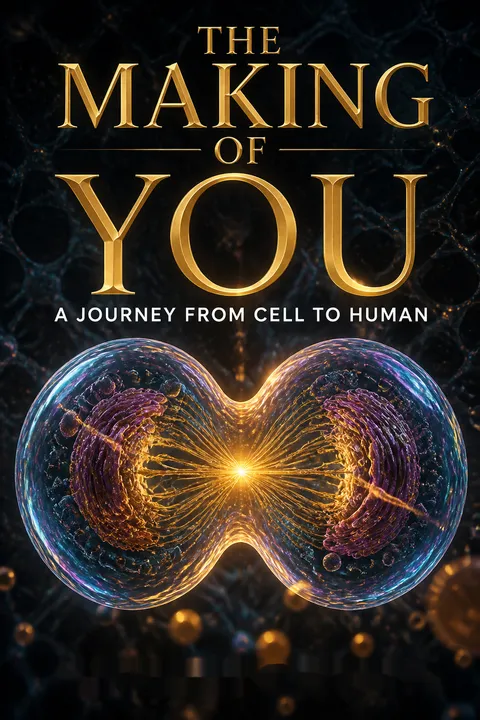


Key Takeaways
Your existence depended on one sperm among hundreds of millions
A narrow biological chance. Hundreds of millions of sperm begin the journey to an egg, but only one usually enters. The egg itself is the result of a long process: its chromosomes have been shuffled and divided, just as the sperm’s were. Each carries a different combination of inherited genes. Had another sperm reached the egg, a different person would have begun developing. Even before the first cell divided, chance had shaped the genetic starting point.
A beginning, not a blueprint. The egg and sperm unite to form one cell with 46 chromosomes. That cell starts a process in which the inherited instructions are copied, interpreted, and used to build a body. The story is both ordinary, because reproduction follows biological mechanisms, and astonishingly particular, because the combination is unique.
What's striking is how this account makes individuality contingent without making it mysterious. Biology supplies a concrete chain of events, yet the outcome cannot be predicted from the parents' identities alone. That is a useful distinction between explanation and inevitability. The same idea appears in probability theory: a process can obey rules while remaining sensitive to tiny differences in starting conditions. Still, genetic chance is only the opening condition, not a complete account of a person. Development, environment, and experience shape what the inherited material becomes, so uniqueness is not reducible to a winning sperm.
DNA is a shared alphabet, not a finished human blueprint
A molecular recipe. In 1869, Friedrich Miescher studied white blood cells in pus and isolated a substance from their nuclei. Later identified as DNA, it carries hereditary information in sequences built from four chemical bases: A, T, C, and G. Matching pairs let cells copy DNA, passing the same sequence from one cell generation to the next. A single cell contains 46 chromosomes, together holding more than two metres of tightly packed DNA.
Small gene count, vast complexity. Humans have about 20,500 genes, and genes make up less than two per cent of DNA. Genes are recipes for proteins, not miniature body plans. Cells use different subsets of those recipes, and can process a gene's message in more than one way. The order and control of gene activity help explain how the same basic code can support very different forms of life.
The recipe metaphor is powerful because it separates inherited information from the machinery that uses it. In computer science, a program's output depends not only on stored code but also on the system executing it and the conditions under which it runs. Development works similarly: DNA matters enormously, but the sequence is not a self-reading instruction manual. This framing also resists genetic determinism. The caution is that metaphors can imply a tidier plan than biology possesses. Genes, proteins, and cellular conditions interact in networks, and those interactions can make outcomes difficult to forecast.
Cells build a body by reading local chemical instructions
The same cells diverge. In the third week, the embryo forms three layers of cells. The outer layer contributes to skin, nerves, and brain; the middle layer to muscles, bones, and blood vessels; the inner layer to structures such as the intestines, liver, and lungs. These cells carry the same DNA, but make different proteins because they activate different genes. Their identities emerge through signals from nearby cells and the surrounding environment.
No master builder. Cells send and receive molecular messages through receptors on their surfaces. A message can trigger a chain of reactions inside a cell, changing which genes it uses. The developing heart, for example, begins as two tubes that move together and merge. Signals also help establish left and right: tiny rotating cilia create a fluid current that directs messages toward one side.
This is a vivid example of self-organization: large-scale structure emerging from many local interactions rather than a central controller. Similar principles appear in ant colonies and traffic flow, where simple rules can produce patterns no individual agent designed. The analogy helps explain how an embryo can become complex without cells needing a picture of the finished body. It also has limits. Cells are not independent agents making choices; their responses depend on tightly regulated chemistry, and small errors can have serious consequences. Emergence does not mean randomness or effortless coordination.
The placenta begins as an invasion, then becomes a life-support interface
An aggressive beginning. About a week after conception, the developing cell cluster reaches the uterus and burrows into its lining. Cells break down tissue, attach to maternal blood vessels, and begin forming the placenta. The placenta helps move oxygen and nutrients to the embryo and carry waste back to the mother's circulation. Their blood does not normally mix directly, but substances can cross the thin barrier between them. Placental hormones also alter the mother's body to support pregnancy.
An imperfect checkpoint. The uterus appears to accept only some developing embryos. The book estimates that perhaps a third, or fewer, pass the early implantation stage; many losses occur before pregnancy is recognized. The relationship is not one-way, either. Experiments in mice found fetal cells reaching a mother's damaged heart, and cells from a pregnancy can remain in a mother's body for decades.
The placenta shows that biological boundaries are often interfaces, not walls. It separates maternal and fetal blood while enabling extensive exchange, a design problem familiar in engineering: keep systems distinct, but permit carefully controlled flows. The image of invasion captures the physical intensity of implantation, while the later exchange complicates any simple story of conflict. The evidence for fetal cells supporting maternal repair is intriguing, but it should not be read as proof that pregnancy reliably heals a mother's organs. The central insight is reciprocal dependence, not a guaranteed medical benefit.
Evolution reuses ancient body-building genes across flies, fish, and humans
A shared patterning toolkit. Fruit flies, humans, and many other animals use Hox genes to assign identities to body segments. In flies, mutations can put legs where antennae belong or alter the number of wings. In humans, related genes help organize structures along the spine, from ribs to pelvis. The arrangement of these genes along DNA corresponds broadly to the body regions they help pattern.
Old tools, new uses. Researchers found related Hox genes across worms, fish, frogs, mice, and humans. Humans have four sets, while fruit flies have one, but the basic principle is conserved. The book uses this evidence to show that evolution often modifies inherited developmental tools rather than inventing an entirely new system. Similar genes can help build very different organisms when used in different combinations and contexts.
This is the central insight of evolutionary developmental biology: major differences in form can arise through changes in when, where, and how shared genes are deployed. It helps explain why a fruit fly can illuminate human development despite obvious differences in body plan. The same logic makes evolution less like a designer starting with a blank page and more like an improvisor working with inherited materials. Conservation is not evidence that species are interchangeable, however. Shared genes can have different targets and effects within different regulatory systems.
A hand emerges through chemical gradients and deliberate cell death
Signals assign positions. As an early limb grows into a paddle, cells receive different amounts of a protein called Sonic Hedgehog. In the book's example, cells closest to its source develop as the little finger, while cells farther away take on other finger identities. Position and signal strength help guide development; the protein's message is interpreted in context, not as a simple one-to-one command.
Sculpting by subtraction. Early fingers are joined by webbing. During week eight, cells in the tissue between them receive signals to die. Their contents are broken down and cleared away, leaving separate fingers. This programmed cell death also appears elsewhere in development, including the removal of nerve cells that fail to make useful connections. Building a body therefore involves both making new structures and removing cells that no longer belong.
The hand is a compact lesson in how biological form can emerge through both graded instruction and selective removal. People often imagine development as construction, with cells adding material until a finished structure appears. Here, subtraction is equally important: the shape depends on which cells are eliminated and when. That logic resonates with sculpting, software pruning, and neural learning, though those are analogies rather than identical processes. A useful nuance is that a molecular gradient does not act alone; cells interpret it through their history and other signals.
Sex develops through signals, not chromosomes alone
A cascade, not a switch. Early embryos share basic reproductive structures. In embryos with a Y chromosome, the SRY gene helps start a chain of activity that leads to testicle development. The testicles then release hormones, including testosterone, which influence the development of other reproductive features. Cells must also have working receptors to receive those messages. If a receptor cannot respond, the body's development may not follow the pattern that the hormone signal would usually produce.
Different species, different cues. The book describes alligators, whose sex development is influenced by egg temperature, and a sea worm whose sex depends on where its larva settles. Some fish can change sex in response to social conditions. These examples show that sex development is biologically varied. In humans, chromosomes, genes, hormones, and cellular responses all contribute, so a chromosome label alone does not describe the entire developmental process.
The account usefully replaces a single-cause explanation with a pathway: genes influence organs, organs produce hormones, and target cells must receive those signals. That systems view is valuable wherever biological traits emerge through multiple linked steps. Comparisons across species also reveal that sex determination is not governed by one universal mechanism. The examples should not be stretched into claims about human gender or social identity, which the developmental biology discussed here does not address. Nor do they make human pathways arbitrary; they show that development depends on interacting biological conditions.
Your brain and senses are assembled through activity, not just inheritance
A brain built in motion. During the fourth month, the developing brain produces about 200,000 nerve cells each minute. Many travel from their birthplace toward a final location, guided by glial cells, which also support and maintain the nervous system. Nerve cells extend axons toward targets; those that fail to connect successfully may die. Glial cells later insulate axons with myelin, a process that continues into a person's late twenties.
Experience starts early. Taste and smell develop before birth, and flavours from a mother's diet can reach the fluid surrounding the fetus. Studies described in the book found that newborns showed preferences for flavours their mothers had consumed during pregnancy. Foetuses also respond to sound, and newborns can prefer their mother's voice or familiar speech patterns. These findings show early learning, though a response to sound does not by itself prove conscious experience.
The brain's development illustrates a broader principle of plasticity: activity helps shape the networks that later support perception and action. In this account, inherited structure creates possibilities, while connections and sensory exposure refine them. That avoids the false choice between nature and nurture. It also demands care in interpretation. A newborn's preference for a familiar sound is evidence of recognition or learning, not direct access to what fetal experience feels like. The book's distinction between measurable response and consciousness is especially important in a field where observable behavior can invite confident but premature conclusions.
Your organs rehearse for air, food, and fluid balance before birth
Practice inside the womb. The kidneys develop through several temporary versions before reaching their final form. By week nine they produce urine, which enters the surrounding fluid; the fetus later swallows that fluid and passes it again. The placenta filters waste into the mother's blood, while the kidneys begin preparing to regulate water, salt, and waste after birth.
A different oxygen supply. Before birth, oxygen comes through the placenta rather than the lungs. The lungs branch into airways and develop alveoli, the tiny sacs where oxygen and carbon dioxide will be exchanged. They also produce surfactant, which helps keep the air sacs from sticking together. At the first breath, blood flow shifts toward the lungs. Premature babies may struggle because their lungs, including their surfactant production, are not yet ready.
This is a striking account of preparation without premature independence. The fetus practices swallowing and urination, while the placenta performs much of the exchange and filtering that the newborn's organs must soon manage. Development is not simply a miniature version of adult life; it is a temporary arrangement designed around the womb. The transition also shows how medical technology can support a system that is not ready, as artificial surfactant can help premature infants. Such support has limits, since a device cannot recreate the full biological environment of pregnancy.
Human birth trades a narrow pelvis for a highly unfinished brain
An evolutionary compromise. Walking upright reshaped the human pelvis, while large brains increased the size of babies' heads. Birth must negotiate both constraints: the baby moves through a limited opening and rotates as it passes. Human babies are unusually helpless compared with many animals, partly because the brain is only about a third of its eventual size at birth. That immaturity leaves room for extensive learning and adaptation after birth.
A coordinated departure. The exact trigger for labor is not fully understood. The book describes evidence that signals from the fetus, placenta, and mother's body interact. Hormonal changes help prepare the lungs and other tissues, while stronger contractions move the baby through the birth canal. A surge of stress hormones helps the newborn cope with the transition, including the shift from placental oxygen to breathing air.
Birth makes visible a recurring feature of evolution: adaptations solve problems while creating new constraints. Upright walking and a large brain are valuable traits, yet their combination makes delivery difficult and leaves infants dependent. Human helplessness is therefore not simply a defect; it also reflects a prolonged period in which experience can shape development. Still, evolutionary explanations are reconstructions, not recordings of the past. The account presents a plausible trade-off, but the precise origins of human birth's difficulties involve multiple pressures and should not be reduced to one neat story.
Analysis
The book's organizing achievement is to make embryology feel like a continuous narrative without pretending that development follows a single master plan. Its chronology begins with fertilization and proceeds toward birth, but its real subject is coordination: cells copy DNA, specialize, signal, migrate, divide, and sometimes die. Each stage transforms earlier material rather than replacing it. The reader sees that a mature body is less like a factory product assembled from a blueprint than a living system built through local interactions, inherited constraints, and timed changes.
The book's strongest storytelling device is scale. It moves from an almost invisible cell to organs, then to evolutionary history and the newborn body. Historical episodes, such as Leeuwenhoek's search for miniature life inside sperm, show how scientific explanations change when new instruments and evidence become available. The animal comparisons serve a similar purpose: fruit flies clarify shared genetic mechanisms, while fish, worms, and mammals reveal that evolution repurposes old structures. These stories make abstract mechanisms memorable without requiring a technical background.
The narrative also complicates familiar ideas of individuality. A person begins with a unique genetic combination, but the body is shaped by regulatory signals, maternal exchange, and conditions encountered during development. Even the placenta, often treated as a passive conduit, appears as an active interface. The result is a view of the self as biologically distinct yet relationally formed.
A few metaphors require caution. The language of sperm racing, cells communicating, or the embryo invading can make blind biochemical processes sound intentional or adversarial. These images are useful as introductions, but they are not literal explanations. Likewise, claims about fetal learning or birth's evolutionary trade-offs deserve careful boundaries: measurable responses do not settle questions of conscious experience, and plausible evolutionary accounts rarely identify a single cause. The book is most persuasive when it pairs vivid imagery with those limits. Its lasting lesson is that a human body is neither a finished design nor a random accident, but an evolving system assembled through many contingent, highly coordinated processes.
Review Summary
The Making of You receives overwhelmingly positive reviews, with readers praising its accessible writing style, fascinating content, and ability to explain complex embryology in an engaging manner. Many appreciate the book's humor, clear explanations, and interesting facts about human development. Readers find it informative for both expecting parents and those simply curious about biology. The book's short length and beautiful illustrations are also noted positively. Some reviewers mention learning new information and being captivated by the author's storytelling approach to science.
People Also Read

Glossary
DNA
hereditary molecular codeDeoxyribonucleic acid is the molecule that stores hereditary information. It consists of two linked strands built from four bases, abbreviated A, T, C, and G. Cells can copy DNA and use portions of it as recipes for making proteins. DNA is not itself a complete body plan: different cells use different genes, and the regulation of those genes helps produce different cell types.
Hox genes
body-segment identity genesHox genes help tell developing cells which body region they occupy and what structures belong there. In fruit flies, mutations can cause body parts to appear in the wrong locations. Related Hox genes occur in many animals, including humans, where combinations of their activity help organize structures along the spine. The genes are conserved across species, though their number and use differ.
homeobox
shared gene-control sequenceThe homeobox is a short DNA sequence found in certain genes involved in development. It encodes part of a protein that can bind to DNA and help regulate other genes. Researchers identified it in fruit-fly body-patterning genes, then found related sequences in other animals. Its conservation helped reveal that different species use related genetic tools to organize their bodies.
Sonic Hedgehog
developmental signaling proteinSonic Hedgehog is a signaling protein used in several parts of the developing body, including the brain, lungs, intestines, and limbs. Cells can respond differently depending on the amount of the protein they receive, when they receive it, and what signals they encountered before. In early limb development, differences in its concentration help specify the identities of cells that form fingers.
chimera
body with two DNA lineagesA chimera is an individual whose cells contain genetic material from two distinct cell lineages. The book describes one possible origin: two embryos, often conceived as twins, merge before developing into separate bodies. Different tissues can then carry different DNA profiles. This can complicate genetic testing, because a sample from blood or skin may not match a sample from reproductive tissue.
notochord
early body-patterning supportThe notochord is a temporary, rod-like structure formed in the embryo. It provides important developmental signals, including signals that help organize the nervous system and the body's central axis. In humans, most of it is replaced as the spine develops. A small remnant contributes to the cushioning material between vertebrae.
SRY
testicle-development initiating geneSRY is a gene on the Y chromosome that helps initiate testicle development in typical human development. Its protein activates other genes involved in forming the testes. The testes then produce hormones that influence further development. The pathway depends on more than SRY alone: hormone production and the ability of cells to receive hormone signals also matter.
surfactant
lung-sac anti-collapse substanceSurfactant is a substance produced in the developing lungs that helps prevent the tiny air sacs from sticking together when a person exhales. Adequate surfactant is important for breathing after birth. Premature infants may not yet produce enough, which can make breathing difficult. The book describes how artificial surfactant can be given to help support their lungs.
Download PDF
Download EPUB
.epub digital book format is ideal for reading ebooks on phones, tablets, and e-readers.








