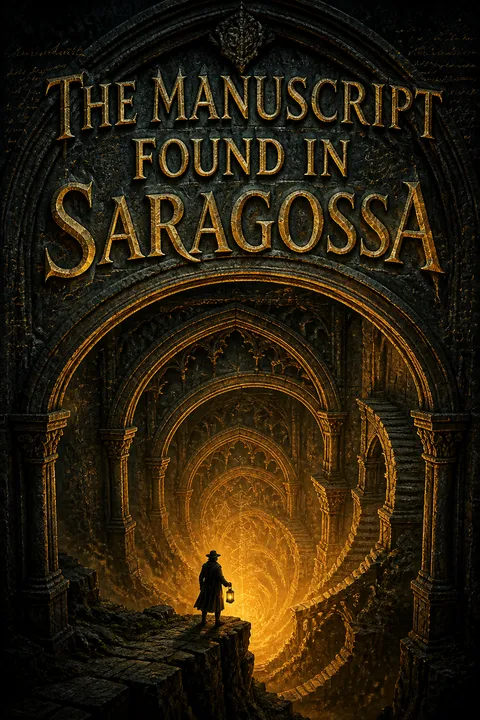


Plot Summary
Prologue
After French troops take Saragossa, an officer discovers a Spanish manuscript in an abandoned house. He keeps it through capture, and his Spanish captor recognizes the diary as the story of his ancestors.
The officer asks him to translate it. The account that follows belongs to Alphonse van Worden, a young Walloon captain whose journey through the Sierra Morena becomes a chain of adventures and stories nested inside one another.
The frame makes reading itself part of the adventure: a manuscript survives war, changes hands, and becomes a meeting place between enemies. Its Spanish captor is not merely a translator but a descendant of the people Alphonse encounters, so the reader enters the book already caught between testimony and inheritance. That arrangement also prepares us for uncertainty. The diary promises a record of events, yet its pages contain ghosts, disguises, invented identities, and stories passed from speaker to speaker. The question is not simply whether Alphonse can trust what he sees, but how any listener can distinguish experience from the story that gives it meaning.
The Road Into the Sierra
In 1739, Alphonse van Worden, a young Walloon captain bound for Madrid, rejects warnings about the Sierra Morena because his father has taught him that an officer must not retreat from danger. Near Los Alcornoques, his muleteer Mosquito disappears with the provisions; soon his valet Lopez vanishes too.
Alphonse rides on alone, reaches the abandoned Venta Quemada, and finds a warning that its former innkeeper died there. He searches its Moorish rooms for food, then settles in for the night hungry and determined not to turn back. His choice begins as a demonstration of courage, but the empty inn makes him dependent on whatever strangers, stories, or terrors the road brings next.
Alphonse enters the story with a moral vocabulary inherited rather than examined. His father’s code equates honour with visible fearlessness, so caution feels less like prudence than disgrace. The vanished servants immediately test that code: he is not merely choosing a dangerous route but losing the ordinary protections that make choice manageable. The Venta Quemada sharpens the conflict between a stated warning and an aristocratic self-image. Alphonse treats danger as an audience before whom he must perform. That habit will make him brave in moments of real threat, but it will also leave him vulnerable to people who know how to stage a test for his pride.
The Gallows Bed
At midnight, a black servant leads Alphonse to a banquet hosted by Emina and Zubeida, two beautiful women from Tunis who claim kinship through his mother’s Gomelez ancestry. They tell him their family’s history and invite him to abandon Christianity for wealth and marriage. After he drinks from their ceremonial cup, desire and confusion overtake him.
He wakes beneath the gallows at Los Hermanos, beside two rotting corpses, with vultures tearing at the dead. His horse has been groomed and returned to the inn, but the room where he met the sisters has vanished. Alphonse remembers promising secrecy and chooses to honor it, even though he cannot explain whether the night was enchantment, deception, or both.
The sisters offer Alphonse a double temptation: erotic intimacy and a place in a powerful ancestry. His refusal to trade faith for either prize looks principled, yet his promise of secrecy binds him before he understands the bargain. The abrupt change from sumptuous hospitality to carrion is not only Gothic shock. It turns the body into unreliable evidence: he remembers pleasure, sees death, and cannot reconcile them. His decision to keep the oath reveals that honour can protect others, but also that a rule adopted in the dark may narrow judgment in daylight. The book begins asking whether fidelity is a virtue when the person demanding it controls the circumstances.
A Son Raised for Duels
At a hermitage, Alphonse hears Pacheco describe a night of illicit passion followed by an apparent attack from the hanged men. The tale echoes Alphonse’s own strange awakening, but he refuses the hermit’s demand to confess. Asked to explain himself, he recounts how his father, Juan van Worden, made duelling and punctilious honour the center of family life.
Alphonse was trained for combat, taught to suppress fear, and sent to Spain with a captain’s commission. After he leaves the hermitage, armed men arrest him for the Inquisition and accuse him of protecting the Tunisian women. He stays silent under threatened torture. Zoto and his band storm the prison, free Alphonse and the sisters, and carry them into the mountains.
Pacheco’s story works as a distorted rehearsal of Alphonse’s own experience: it gives him a possible explanation but no reliable proof. His autobiography clarifies why he responds to uncertainty with silence. His father’s elaborate duel tribunal trained him to treat honour as an external law, one that can be measured by conduct rather than motive. That training sustains Alphonse under torture, yet his refusal to speak also shows how easily loyalty can become rigidity. Zoto’s rescue breaks the institutional test by force, but it does not settle what Alphonse should believe. Instead, the rescue transfers him into another system of authority, the Gomelez network, whose tests will resemble the Inquisition’s in their secrecy and coercion.
Zoto's Underground Kingdom
Zoto takes Alphonse, Emina, and Zubeida to a hidden palace reached through a well, where his supposedly hanged brothers are alive and armed. He explains that the Gomelez pay his band to guard the Sierra and its secret mines. His own history offers a rougher lesson in honour: his father became a bandit to satisfy his wife’s appetite for status, then killed two patrons after promising each he would kill the other.
Zoto’s childhood brings him into conflict with a prince, and jealousy later drives him to kill Sylvia and Antonino before discovering a rival’s deception. He now serves the Gomelez, while Alphonse’s growing intimacy with the sisters makes him part of their hidden family drama.
Zoto’s story attacks the moral certainty Alphonse brought from home. The elder Zoto keeps promises even when they require murder, while the young Zoto mistakes jealousy for justice and discovers treachery only after killing the people he loves. Their conduct exposes honour as a language that can dignify incompatible acts. The cave, meanwhile, gives political power a physical address: hidden wealth supports a criminal band, a persecuted lineage, and a covert religious project at once. Alphonse’s closeness to the sisters draws him into this structure before he understands it. The scene’s abundance is therefore double-edged. The underground palace promises refuge and inheritance, but it also makes hospitality another instrument of recruitment.
Rebecca and the Mirror
After a night with Emina and Zubeida, Alphonse wakes again beneath the gallows beside Rabbi Zadok ben Mamoun, a Jewish cabbalist known in Spain as Don Pedro de Uzeda. Ben Mamoun describes a vision of the sisters as immortal brides and asks Alphonse to explain what happened at the inn. Alphonse refuses, bound by his promise.
At Uzeda’s castle, Rebecca, the cabbalist’s learned sister, tries to question him and confesses that she wants an ordinary husband rather than the supernatural spouses her father planned for her. Her mirror visions and the sisters’ changing appearances keep Alphonse unsure of what is real. When Rebecca urges him to investigate the gypsies, he leaves the castle and joins their camp.
Rebecca offers a counterpoint to the sisters’ invitation and her brother’s occult ambition. She has knowledge, yet what she wants is not mastery over spirits but a finite, embodied life. Alphonse’s oath prevents her from acquiring information, making his honour appear both admirable and costly. Mirrors intensify the problem: they show figures that are absent from the room, while the room itself may be a stage for deception. The cabbalist’s elaborate system does not secure truth; it multiplies interpretations. Alphonse therefore moves from the closed castle to the gypsy camp, another social world with its own rules. His search for certainty keeps putting him among people who specialize in making appearances persuasive.
Pandesowna's Wandering Company
The gypsy chief introduces himself as Juan Avadoro, called Pandesowna by his adopted people. He recalls growing up with an orderly, nearly silent father, then becoming a restless boy whose aunt indulged his appetite for travel and mischief.
His account folds other lives inside his own. Alphonse hears of Giulio Romati, whose scientific journey leads him into a haunted palace, and of a girl raised in isolation who mistakes sexual encounters for innocent play.
The camp meanwhile moves contraband through mountain passes, hiding bales in rock hollows and letting customs officers seize designated goods to preserve the illusion of enforcement. Avadoro’s stories and the smugglers’ trade share a method: they make audiences participants in a carefully managed performance.
Avadoro’s authority comes from movement rather than rank. He was not born a gypsy, and his adopted identity suits a temperament that cannot remain content in one settled role. His father’s rigid routine becomes the foil for his own changing loyalties, while the nested stories extend that instability into form: each teller becomes a listener within someone else’s account. The smuggling operation literalizes the same logic. Officials participate in a public fiction of law enforcement while contraband passes beneath their notice. Alphonse is entertained, but he is also being trained to accept that a coherent surface can conceal several competing arrangements underneath it. The camp turns storytelling into both communal pleasure and a lesson in suspicion.
Ahasuerus Keeps Walking
Ben Mamoun summons Ahasuerus, the Wandering Jew, who cannot remain still and reluctantly tells fragments of his long life as he walks beside Alphonse and Velásquez.
His memories begin with his family at Cleopatra’s court, where his grandfather Hiskias serves the queen, then move through Roman power struggles, the rise of Herod, and the injustices that drive his family from wealth into poverty. Ahasuerus also recounts learning Egyptian theology from the priest Chaeremon, whose teachings blur the boundaries among Jewish, Egyptian, and Greek religious thought.
He repeatedly leaves before reaching the events that made him a wanderer. His interrupted testimony becomes another mystery: centuries of experience have made him knowledgeable, but not able to finish the story that defines him.
Ahasuerus turns historical memory into a burden that cannot be put down. He has witnessed empires, religious change, and private betrayals, yet his endless movement prevents experience from becoming settled wisdom. His account also challenges the idea that religions emerge in isolation: Egyptian prayers, Jewish scripture, and Greek philosophy appear in conversation long before Alphonse can make sense of them. But the Wandering Jew never provides a stable synthesis. His story breaks off at the threshold of its defining event, leaving listeners with knowledge that is vivid but incomplete. That incompletion mirrors Alphonse’s own predicament. He can collect testimony, but no witness, however ancient, can tell him exactly what his night at the Venta Quemada means.
The Viceroy's Borrowed Bride
Avadoro tells how Maria de Torres, a widowed mother, discovers that her son Lonzeto and her niece Elvira have secretly married, despite being cousins. When the Viceroy of Mexico arrives to claim Elvira, the young pair flee, leaving Maria trapped between her niece’s promised inheritance and the viceroy’s power.
Avadoro, then a boy travelling with his aunt, exchanges clothes with Elvira and takes her place in the procession. He accepts the viceroy’s gifts, then pleads for convent life at the wedding ceremony.
The viceroy relinquishes the marriage, secures Elvira’s fortune, and leaves the lovers free to reunite. Avadoro’s disguise saves them, but the story also reveals how easily wealth, rank, and gender can turn a person into a role others expect him to perform.
The episode makes theatricality a means of survival rather than mere amusement. Avadoro’s cross-dressing is a child’s improvised solution to a power imbalance: the viceroy can command a marriage, while Maria’s family has little leverage except performance. The deception works because public identity is read from clothes, ceremony, and title before anyone asks what the person beneath them wants. Yet the escape does not simply defeat authority. The viceroy chooses to preserve Elvira’s property and withdraw, making mercy as consequential as disguise. Avadoro’s story also complicates his later role as a confident narrator. He learned early that changing the visible self can protect another person, but every successful disguise leaves a debt to be explained.
Velásquez's Human Equation
Don Pedro de Velásquez recounts how his father, Enrique, lost Blanca de Velásquez when a letter requesting her marriage was accidentally signed with his brother Carlos’s name. Carlos married Blanca and inherited the title, while Enrique’s grief drove him into a monastery and later to a modest command in Ceuta.
The father tried to raise his son away from mathematics, but locking young Pedro in a room only led him to discover numerical patterns in the windowpanes. Pedro’s absent-minded calculations eventually reveal him as an exceptional mathematician.
After Blanca restores the family property, he is summoned to inherit the duchy. In the mountains he explains human feeling through geometry, while Rebecca, weary of occult study, grows interested in the man rather than the system.
The Velásquez family story makes a tiny clerical error redirect an entire life. Enrique’s signature mistake is not a failure of intelligence but a collision between attention and emotion: the arrival of his brother overwhelms the task before him. Pedro inherits both the consequences and the contradiction. His father fears that mathematics will bring sorrow, yet mathematical curiosity is precisely what gives Pedro a vocation and eventually a title. His attempt to quantify feelings is intellectually serious but also a defense against their unpredictability. Rebecca’s attraction to him suggests a movement from abstract power toward human attachment, though she remains drawn to the mind that explains the world. Their conversations ask whether analysis can illuminate emotion without reducing a person to a formula.
Inés, Lope, and Busqueros
Avadoro next recounts the young merchant Lope Soarez’s arrival in Madrid, where his father has forbidden him to associate with the Moro banking family. Lope falls in love with Inés Moro, unaware at first that she belongs to the house his father despises.
Don Roque Busqueros reads Lope’s private letter, meddles in their meetings, and eventually sends him climbing to the wrong window. Lope falls, breaking several bones. The Knight of Toledo nurses him and helps bring Inés and Lope back together, even facing the Duke of Santa Maura, who also claims her hand.
Busqueros later attaches himself to Toledo and begins plotting around Avadoro’s father. His talent for interference makes personal life feel like a public stage with an unreliable director.
Lope’s romance is squeezed between inherited commercial grudges and the social machinery of surveillance. His father’s prohibition makes Inés desirable partly because loving her means disobeying a family rule, while Busqueros turns private feeling into public evidence. The letter and the mistaken window show how easily a relationship can be redirected by a third party who controls access and information. Toledo’s intervention offers a contrasting form of influence: he uses rank and courage to protect the lovers rather than to manage them. Busqueros is not simply a comic nuisance; his opportunism exposes the vulnerability of anyone whose desires depend on intermediaries. In Avadoro’s world, intimacy is repeatedly endangered by those who claim to assist it.
The Duchess's Hidden Vault
As a boy, Avadoro is imprisoned beneath the house of the Duchess of Medina Sidonia after he hides from a religious tribunal. There he hears her story: she grew up with Hermosito, the son of her nurse, and later recognizes him when he returns as a young man. Her husband, the Duke of Sidonia, suspects them of adultery and secretly has Hermosito shot inside a vault.
The nurse, Girona, poisons the duke in revenge, while the Duchess hides the death and keeps the body from discovery. Avadoro escapes through a concealed passage and reaches Madrid disguised as a beggar. The Duchess’s account turns a family’s refined surface into a chamber of coercion, where jealousy, class difference, and maternal grief produce irreversible violence.
This story connects the novel’s fascination with masquerade to the violence that can hide beneath social respectability. Hermosito and the Duchess share childhood intimacy, but rank makes their bond politically dangerous before either can name its terms. The Duke’s secret prison converts marital suspicion into absolute control: he does not seek truth so much as impose a verdict. Girona’s revenge answers one private crime with another, showing how maternal love can become a justification for violence without making the violence innocent. Avadoro’s escape through the hidden passage places the listener inside the architecture of secrecy. The vault is not only a plot device; it is the material form of a household where those with power decide who may be seen.
Tlascala's Ancestral Curse
The Marqués de Torres Rovellas tells of marrying Elvira after years of childhood courtship, then encountering Tlascala, a descendant of Montezuma, in Mexico. Her dignity and concern for Indigenous people change the direction of his life.
When she reads an ancestral inscription cursing any woman of her line who loves a Spaniard, fear overwhelms her. Rovellas later protects two Mexican leaders from execution and is imprisoned for opposing the viceroy. Tlascala visits him, confesses her love, and then grows gravely ill after the government’s death sentence for rebels reaches them.
She dies, leaving him with grief that neither public esteem nor his marriage can undo. Velásquez listens to the story as though it were a curve, while Rovellas remembers it as a wound that never closes.
Rovellas’s account is shaped by two competing inheritances: his marriage to Elvira, formed by childhood fantasy, and his love for Tlascala, awakened by her ethical seriousness. The inscription turns colonial history into an intimate threat. Tlascala is asked to experience Spanish affection through the accumulated violence of conquest, while Rovellas must decide whether loyalty to office will outweigh justice for the people under his authority. His intervention earns political danger rather than easy redemption. Velásquez’s later mathematical reading of the marqués’s life is not false, but it cannot contain the moral specificity of Tlascala’s fate. The contrast exposes a limit of abstraction: a curve may describe changing intensity, but not what a particular loss means to the person who survives it.
The Gold Under Cassar
At last Alphonse descends into the hidden Gomelez domain, swears secrecy, and is shown the family’s gold seam. The Great Sheikh offers him wealth and a place in the Muslim branch, but explains that the family’s fortune has been guarded through generations of concealed identities, alliances, and ordeals.
He recounts his own life, from a youth raised underground to travels across the Muslim world, and reveals that Alphonse’s encounters were arranged to test his courage, loyalty, and susceptibility to temptation.
The missing servants, staged arrest, apparent demoniac, and bewildering appearances belong to a deliberate Gomelez design. Alphonse has already pledged himself to secrecy and refuses to exchange faith for power. He leaves the depths with his inheritance promised, but without surrendering his judgment to the family’s ambitions.
The revelation does not simply replace supernatural explanation with rational explanation. It shows how power can manufacture the very evidence that seems to justify belief in it. The Gomelez arrange disappearances, accusations, and apparitions, then assess Alphonse by how he responds to crises they themselves create. His courage is real, but the test is compromised because its makers control the conditions. The gold seam makes this manipulation materially consequential: the family can offer wealth in exchange for religious allegiance and political obedience. Alphonse’s refusal preserves a boundary between kinship and conscience. Yet his oath remains binding, so his independence is partial. The novel leaves him neither fully liberated from the Gomelez nor absorbed by them, but more alert to the difference between loyalty and submission.
Epilogue
In the years after the diary’s sixty-six days, Alphonse returns to military service and later becomes governor of Saragossa. He keeps the Gomelez secret and, in 1760, encounters Emina and Zubeida again in Tunis, where one has become the mother of the bey.
He recognizes his daughter, Fatima, and arranges for her to live as a Christian in Spain. The family’s hidden gold is distributed before the underground domain is destroyed. Alphonse later copies his diary and seals it in an iron chest, where a French officer will find it after the fall of Saragossa.
The epilogue gives the sprawling narrative a practical afterlife. Alphonse’s return to military duty suggests that experience has not detached him from public obligations, while his later reunion with the sisters and daughter gives private affection a place outside the caves’ secrecy. Fatima’s Christian upbringing preserves a distinction Alphonse has defended throughout the story, even as he remains tied to the Gomelez by family and memory. The collapse of the hidden domain ends the material system that sustained its intrigues, but not the stories it generated. By sealing his diary, Alphonse turns a lived adventure into a portable mystery, ready to be inherited by a stranger.
Analysis
The novel treats identity as something performed under pressure. Alphonse arrives with a fixed self-image, the honourable officer, but the people he meets keep placing him in roles he did not choose: alleged heretic, Gomelez heir, lover, captive, initiate. Some roles are imposed through force; others tempt him with affection, wealth, or recognition. His central task is therefore not simply to discover whether the supernatural exists, but to decide what obligations remain valid when the circumstances producing them may be staged.
The nested tales extend this problem beyond Alphonse. Zoto calls murder honour, Maria de Torres bends gender and ceremony to protect the young, and the Duke of Sidonia turns suspicion into lethal authority. Velásquez tries to systematize emotion, while Rovellas discovers that political ideals and personal desire can pull in different directions. Their stories refuse a single moral formula. Honour can steady a person, as it does Alphonse under torture, or excuse violence, as it does Zoto’s father. Faith can provide ethical shelter, yet religious institutions also become instruments of interrogation and social control.
The book’s storytelling structure is itself an argument about knowledge. A tale is never simply delivered; it is interrupted, disputed, reframed, and carried onward by someone with an interest in how it will be received. The audience’s uncertainty is not a puzzle that the Sheikh entirely dissolves. His explanation clarifies the Gomelez tests, but it cannot erase the emotional reality of what Alphonse experienced or settle every supernatural claim. The result is a narrative in which interpretation becomes a form of participation. Readers, like Alphonse, must distinguish between evidence and authority, while accepting that human motives are rarely as orderly as the stories used to explain them.
Review Summary
Readers widely praise The Manuscript Found in Saragossa as a labyrinthine masterpiece of nested stories within stories, drawing comparisons to The Arabian Nights and The Decameron. Most admire its extraordinary blend of Gothic horror, picaresque adventure, philosophy, eroticism, and humor, set against 18th-century Spain. The intricate structure — tales embedded within tales — challenges but rewards attentive readers. A minority found the complexity exhausting and the characters difficult to connect with. Overall, it is celebrated as a uniquely imaginative, timeless work of remarkable originality.
People Also Read

Characters
Alphonse van Worden
The honour-bound captainAlphonse is a young Walloon officer travelling to join the Spanish army, raised by a father who made honour a strict, visible discipline. He is courageous, loyal to his word, and inclined to treat inherited rules as if they were self-evident truths. That makes him resistant to coercion, but also slow to distinguish a genuine moral obligation from a trap designed around his sense of duty. He listens closely to the people he meets and records their stories, even when he cannot decide what to believe. His presence links the novel’s many tales, while his changing responses to danger, desire, faith, and authority give the frame its emotional continuity.
Juan Avadoro
The gypsy storytellerKnown among the gypsies as Pandesowna, Avadoro is a Spaniard by birth who adopts the life of a wandering chief. His restless temperament grows out of a childhood split between his father’s rigid routine and his aunt’s indulgence. He enjoys both telling stories and carrying other people’s stories onward, often nesting one account inside another. His fluency makes him the social center of the camp, but his narratives also reveal his limits: he can describe courage, violence, and love with vivid ease without always resolving their moral contradictions. Avadoro values freedom of movement and conversation, and his camp offers Alphonse a temporary alternative to the closed institutions of court, church, and family.
Emina
The elder Gomelez cousinEmina is a Muslim woman from Tunis and, through Alphonse’s maternal ancestry, his cousin. She is confident, articulate, and accustomed to acting on the orders of her powerful family. Alongside her sister Zubeida, she welcomes Alphonse at the Venta Quemada and presents him with an enticing picture of the Gomelez inheritance. Her warmth is genuine in manner, but it is inseparable from political purpose: she wants Alphonse to understand his place in a family whose plans precede his arrival. Emina’s combination of tenderness and strategic judgment makes her difficult for him to read. She treats intimacy as both a personal bond and a means of drawing him into a larger design.
Zubeida
The younger Gomelez cousinZubeida is Emina’s younger sister, raised alongside her within the protected world of a Tunisian harem. Their intense closeness shapes how they imagine love and marriage before either has encountered men beyond family stories. Zubeida is more impulsive and openly affectionate than Emina, and she expresses the Gomelez wish to draw Alphonse toward their faith with less reserve. Her playfulness can soften the threatening atmosphere around the sisters, but it also makes the stakes of their invitation harder to dismiss. She shares Emina’s family loyalty while bringing a more spontaneous emotional energy to their encounters with Alphonse.
Rebecca de Uzeda
The questioning cabbalistRebecca is the learned sister of Don Pedro de Uzeda, raised in the study of the cabbala and expected to pursue a supernatural destiny. Her education gives her formidable intellectual range, but it also leaves her questioning whether abstract knowledge can satisfy ordinary human needs. She seeks information from Alphonse because his encounters may clarify mysteries that her brother cannot solve. At the same time, she longs for a life shaped by affection rather than inherited occult obligations. Her conversations with Alphonse and Velásquez place desire, religious identity, and reason in direct contact. Rebecca is neither a simple skeptic nor a spellbound scholar; she is testing which kind of knowledge might make a life feel truly her own.
Pedro de Velásquez
The mathematical dukeVelásquez is a Spanish nobleman and gifted geometer whose attention is often absorbed by calculations. His father’s broken engagement and long grief shape the education he tries to give his son, though Pedro’s talent develops despite those intentions. He applies mathematical language to emotion, religion, and human intelligence, treating systems as a route toward clarity. His reasoning can be illuminating, but his absent-mindedness reminds those around him that formal understanding does not guarantee practical awareness. Velásquez’s conversations with Rebecca give intellectual inquiry a social and emotional dimension. He is drawn toward connection even as he instinctively translates experience into patterns, measurements, and proofs.
Ahasuerus
The restless witnessAhasuerus, called the Wandering Jew, is an ancient traveller summoned by cabbalists and compelled to keep moving. His long memory encompasses dynasties, religious communities, and personal losses across many centuries. He is knowledgeable but not serene; his testimony can be bitter, and he sometimes refuses to finish a story when it approaches painful events. His encounters with Alphonse and Velásquez bring the novel’s religious debates into historical perspective, showing traditions in contact and conflict. Ahasuerus’s inability to settle gives his knowledge an unsettling quality: he can carry the past forward, but cannot step outside the punishment and resentment that shape his existence.
Zoto
The Gomelez banditZoto is a feared bandit operating in the Sierra Morena, but his service to the Gomelez places him within a wider political network. His story traces a childhood shaped by poverty, public humiliation, and a consuming desire for revenge. He becomes an effective leader and protector, yet his own actions expose the danger of treating loyalty or honour as permission for violence. Zoto’s underground refuge gives Alphonse shelter after the Inquisition arrests him, while his history challenges the young captain’s inherited moral code.
Maria de Torres
The protective auntMaria de Torres is a widowed mother whose life is shaped by financial vulnerability and loyalty to her niece Elvira. She tries to protect Elvira from an advantageous but unwanted marriage while managing the consequences of the girl’s secret attachment to Lonzeto. Maria is practical, affectionate, and often overwhelmed by decisions made by wealthier men. Her account of the viceroy’s pursuit reveals how women with limited formal power use family devotion, caution, and improvisation to protect one another.
Lope Soarez
The romantic merchantLope is the son of a wealthy Cadiz merchant, raised under strict instructions to avoid aristocrats and the Moro banking family. His love for Inés places him between personal feeling and a feud inherited from his father. He is imaginative and sincere, with a tendency to interpret life through the romances he reads. That idealism makes him generous in love but also vulnerable to Busqueros’s interference and his own inexperience. Lope’s story tests whether affection can outlast the grudges and social strategies surrounding it.
Don Roque Busqueros
The relentless meddlerBusqueros is a social climber whose appetite for other people’s affairs is both comic and dangerous. He treats access to private information as a source of power, inserting himself into courtship, family business, and political intrigue. His elaborate assistance often creates the crisis he then claims to solve. Busqueros’s persistence exposes the instability of privacy in the novel’s world: letters are read, rooms are watched, and reputations are managed by opportunists. His self-importance rarely stops him from being useful to more powerful patrons.
The Duchess of Medina Sidonia
The secluded aristocratLeonor, Duchess of Medina Sidonia, is a high-born woman whose marriage and household are governed by rank, reputation, and rigid expectations. Her youth links her to Hermosito, the son of her nurse, and their bond exposes how class distinctions shape intimacy. She is intelligent and capable of affection, but the social world around her offers few safe ways to act on her own wishes. Her private story contrasts the ceremonial dignity of noble life with the emotional costs concealed behind it.
The Marqués de Torres Rovellas
The divided Spanish nobleThe marqués is a Spanish aristocrat whose life joins a childhood marriage, public service, and an intense attachment to Tlascala in Mexico. He is capable of acting against his own political interests when he believes Indigenous leaders have been treated unjustly. His account is shaped by hindsight: he can trace how ambition, vanity, grief, and love altered his choices, yet he cannot turn those memories into a clean moral lesson. His role brings the novel’s private romantic stories into contact with colonial power.
The Great Sheikh of the Gomelez
Guardian of the hidden lineageThe Great Sheikh governs the secretive Gomelez family network, whose members preserve a hidden lineage, wealth, and political ambition in the Sierra Morena. He treats Alphonse’s arrival as an event that must be tested rather than simply welcomed. His authority rests on inherited rules, carefully guarded information, and the ability to enlist outsiders in the family’s plans. The sheikh is also a storyteller, using his own history to explain the customs and aims of the group. He embodies the novel’s question of whether a powerful tradition can claim a person’s loyalty before that person understands its purpose.
Don Pedro de Uzeda
The occult scholarDon Pedro de Uzeda, whose Jewish name is Rabbi Zadok ben Mamoun, is a wealthy cabbalist with a deep command of languages, astronomy, and occult learning. He studies the supernatural not as a passing curiosity but as a route to extraordinary power and immortality. His confidence in his methods is repeatedly unsettled by experiences he cannot explain. As Rebecca’s brother, he connects private family desires to the larger mysteries surrounding Alphonse, while his scholarship offers a learned counterpoint to the hermit’s religious certainty.
Hermosito
The devoted childhood companionHermosito is the son of the Duchess of Medina Sidonia’s nurse and grows up beside her in Asturias. His loyalty begins in childhood and remains central to how he understands his place in the world. When he is separated from the young duchess, he struggles to build an identity beyond serving her. His story exposes the emotional pressure created when affection crosses a rigid class boundary.
The Commander of Toralva
The penitent knightThe Commander of Toralva is a Spanish Knight of Malta who becomes haunted after killing another commander in a duel on Good Friday. He is not presented as a simple villain: his act arises from anger and honour, then becomes a source of religious terror. His journey to shrines and sacred places reflects the novel’s recurring interest in repentance, ritual, and the uneasy boundary between guilt and supernatural punishment.
Plot Devices
The Found Manuscript
A tale passed between enemiesThe novel begins with a French officer finding Alphonse’s Spanish diary after the fall of Saragossa. Captured by the Spanish, he persuades his captor to translate it, and the diary becomes the narrative container for the events in the Sierra Morena. This frame makes the reader a secondhand listener rather than an invisible witness. It also links military conflict to inheritance: the captor knows the manuscript because it concerns his ancestors. The device permits the book to present stories within stories without pretending that every event has a single, neutral narrator. Each account is shaped by who tells it, who hears it, and what the speaker chooses to withhold.
The Recurrent Gallows
A threshold between fear and explanationThe gallows at Los Hermanos repeatedly marks the boundary between Alphonse’s ordinary journey and the strange episodes that follow. He wakes beneath it beside corpses, and other travellers appear there after nights they cannot fully explain. Stories of vampires and wandering spirits gather around the site, making it a shared landmark for characters who otherwise have little in common. The gallows also carries political memory: two men were executed under the names of Zoto’s brothers, while their bodies become props in later encounters. Its repetition encourages the reader to seek a pattern, but the stories attached to it disagree about what the pattern means.
Nested Storytelling
One life opens anotherCharacters repeatedly narrate their own lives, then recount the stories of people they met, creating layers that can extend several tellers deep. Avadoro, the gypsy chief, becomes the most elaborate example: his adventures include Maria de Torres’s account, the viceroy’s history, and the episodes of Lope Soarez, Busqueros, and others. The structure turns listening into an action. Alphonse’s companions interrupt, question, and interpret stories, sometimes revealing their own motives as they do so. It also makes chronology less secure, since a person may appear first as a teller and later inside another character’s past. The reader must track not only what happened but whose version is being heard.
Gomelez Initiation
A family tests the outsiderThe Gomelez use secrecy, staged danger, wealth, and religious pressure to test people they may want to bring into their lineage. Alphonse encounters missing servants, an arrest, a rescue, apparent hauntings, and invitations that mix erotic desire with political promises. The tests are connected to a family that guards a hidden gold seam and hopes to restore its influence. Their function is not merely to conceal a treasure but to measure whether a candidate can be brave, loyal, discreet, and susceptible to temptation. The device makes the reader experience the same uncertainty as Alphonse before the Sheikh explains the family’s methods.
Mirrors and Disguises
Appearances withhold identityMirrors show figures that are absent from the room, while costumes allow characters to cross social boundaries or conceal who they are. Rebecca sees supernatural spouses in reflections; Alphonse repeatedly mistakes gypsy girls for Emina and Zubeida; Avadoro dresses as Elvira to deceive the viceroy. These episodes make appearance an active force in the plot, not decoration. A reflection may expose a desire the character has not admitted, while a disguise may protect someone from an authority that would otherwise control them. The device also keeps perception uncertain: characters can be deceived by what they see, but a false appearance may still reveal a real fear or longing.
Download PDF
Download EPUB
.epub digital book format is ideal for reading ebooks on phones, tablets, and e-readers.








