

Key Takeaways
Treat the first answer as a testable hypothesis, not a verdict
Start with a provisional answer. A hypothesis is an early, evidence-informed guess about what may solve a problem. It gives research a direction instead of inviting a team to collect facts without knowing what they need. The Quick and Dirty Test, or QDT, asks what must be true for the guess to work. If a key assumption fails, discard or revise it before investing heavily in analysis.
Question the diagnosis. A client once blamed a struggling finance chief. Investigation instead found that the chief executive's shifting plans and poor communication were central causes, although the finance chief also had weaknesses. A quick search for the underlying problem can prevent an organization from solving the wrong one, even when its first explanation comes from a senior leader.
A provisional answer makes inquiry purposeful, much like a scientific model that generates predictions rather than merely describing observations. The discipline is valuable because managers rarely have unlimited time or complete information. But a hypothesis can also become an anchor: people may notice confirming evidence and discount inconvenient facts. The safeguard is to state assumptions explicitly, include evidence that could disprove the idea, and treat revision as progress rather than failure. A strong hypothesis narrows the search without closing the mind.
Map the problem broadly, then investigate only branches that matter
Separate the moving parts. MECE means mutually exclusive and collectively exhaustive: categories should not overlap, and together they should cover the relevant territory. A logic tree organizes a problem into component parts. An issue tree turns those parts into questions that can test a hypothesis. For a company seeking higher profits, a tree might split profit by business unit, then by revenue and costs, and finally into more specific drivers.
Choose the map deliberately. The same business can be divided by product line or by functions such as sales and production, and each view may reveal different questions. A bank executive used a structured tree to test whether his business could meet a demanding growth target. The framework helped expose what needed scrutiny, but it did not supply the answer or excuse attention to the organization's particular circumstances.
Trees externalize reasoning. Once assumptions and branches are visible, teams can find gaps, assign questions, and challenge each other's logic more easily than they can in an unstructured discussion. This resembles systems engineering, where a complex design is decomposed into components before testing. Yet exhaustive-looking maps can create false confidence: a neat set of categories is not proof that every important cause has been captured. The map should be treated as a working model, open to revision when evidence or frontline knowledge reveals a missing branch.
Spend analysis on decisions, not on perfect-looking numbers
Plan backward from the decision. A useful work plan connects each question to a hypothesis, the analysis and data needed, a source, an owner, a deadline, and a clear output. This prevents interesting but irrelevant analysis from consuming scarce time. It also helps teams tackle the questions that could eliminate entire branches of work before polishing minor details.
Aim for decision-grade evidence. The book recommends estimates that are directionally sound when precision would cost too much or depend on unknowable futures. When direct evidence is scarce, triangulation means using several indirect clues or analogies to bound a likely answer. One pharmaceutical team assessed a possible market for a condition rarely diagnosed by comparing it with other disorders and treatments. Such comparisons can guide a decision, but they cannot turn uncertainty into certainty.
This is a practical version of bounded rationality: decision makers operate with limited attention, time, and information, so the sensible target is often adequate evidence rather than perfect knowledge. Scenario ranges and analogies make assumptions inspectable, which is better than burying uncertainty beneath decimal points. Still, an estimate that is merely plausible can be dangerously persuasive when leaders mistake it for measurement. Good analysis distinguishes observed facts from assumptions, shows which assumptions drive the result, and asks whether a different plausible estimate would change the decision.
Ask people well, and build a culture that shares knowledge quickly
Prepare, then listen. An interview guide is a short written set of priority questions that helps an interviewer use limited time well. The book advises focusing on a few central questions, listening without leading, and treating the interviewee with care. Sharing questions in advance can help people prepare; recording and checking the findings afterward can catch misunderstandings. Interviews also reveal where useful documents or other experts may be found.
Make knowledge findable and current. Knowledge management, or KM, is the organizational effort to create value from information combined with experience and context. The book distinguishes this living expertise from facts alone. Databases help, but they cannot capture everything people know. Sharing also depends on a culture that responds to requests, dedicated support such as information specialists, and useful external sources. Stale or poorly indexed material can make a knowledge system worse than useless.
Interviews are not simply extraction tools. They are social encounters in which trust, status, and perceived risk affect what people disclose. Advance questions and follow-up checks improve accuracy, while respectful listening can surface tacit knowledge that formal records miss. The same principle appears in organizational learning research: knowledge travels through relationships as well as repositories. However, a fast-response norm can become a demand for constant availability. A durable knowledge culture needs clear priorities and protected time, not just pressure to answer every request immediately.
Let evidence overturn your favorite explanation, then ask what changes
Test the result, not just the spreadsheet. The 80/20 rule is a heuristic: a relatively small share of inputs often accounts for a large share of outcomes. It can reveal where to investigate, such as a small group of products driving most profits, but the ratio is not a law. Every analysis should also pass the so what test: what does the finding imply for a decision or action?
Check plausibility and revise. A manager used a simple calculation to find that one proposed inventory change would produce only a small fraction of its projected savings. That sanity check prevented a costly procedure change. If results contradict the original hypothesis, the answer is to reconsider the hypothesis, not force the facts to comply. Data inform decisions, but judgment is still needed to interpret them.
The value of the 80/20 idea is less its precise ratio than its invitation to search for concentration and leverage. It can help teams find high-impact opportunities in overwhelming data. The same compression can hide important exceptions, including small customers or risks with outsized consequences. Sanity checks are powerful because they test whether a result is plausible before it becomes institutional fact. The strongest practice combines that quick check with a deeper question: which assumptions, measurement choices, or incentives might have produced this result?
Lead with the recommendation, then show evidence in client-sized portions
Make the point easy to follow. The book recommends opening with the conclusion and then organizing supporting reasons in a clear sequence. The elevator test asks whether the central recommendation can be explained briefly and plainly. If it cannot, the presenter may not yet understand the argument, or the argument may be too tangled.
Keep each visual focused. A chart should make one point quickly, not display every fact the analyst collected. A simple visual, with its source identified, often communicates more than a crowded slide. Recommendations also need to fit the audience's capabilities. A sound proposal considers the client's skills, systems, staff, and resources, then expresses the evidence in language that decision makers can use. The objective is a usable decision, not admiration for analytical complexity.
Putting the conclusion first reduces the audience's cognitive burden: people can interpret evidence against a known question instead of guessing where a long presentation is headed. This also makes disagreement more productive because listeners can identify the claim they are evaluating. Yet clarity is not neutral. A tidy story can conceal uncertainty or make one option seem inevitable. A credible presentation should keep the argument simple while making material limitations visible, and it should distinguish evidence for a recommendation from the practical conditions required to carry it out.
Prewire decisions so key stakeholders are never ambushed by your findings
Surface concerns early. Prewiring means privately discussing a recommendation with important decision makers before presenting it to a larger group. These conversations can uncover objections, missing information, and political constraints while there is still time to respond. They also reduce the odds that a formal meeting becomes the first time influential people encounter the proposal.
Adapt without changing the logic. A business unit leader seeking substantial funding first spoke with leaders across the organization to learn what they expected and to gather reactions to the planned case. The final presentation was better informed and had stronger support. Tailoring means adjusting the detail, examples, and language to an audience's needs, not distorting the evidence to please it. A board, an operating team, and a customer may need different explanations of the same recommendation.
Prewiring recognizes that decisions are made through relationships and institutions, not through evidence alone. Private discussion gives stakeholders room to raise concerns without performing for a room, and it can expose blind spots before they harden into a public dispute. That is a form of procedural fairness as well as persuasion. The risk is that early alignment becomes quiet exclusion, or that a presenter avoids dissent to preserve consensus. Useful prewiring invites challenge and improves the decision, rather than merely arranging approval in advance.
Make clients co-authors of change, not spectators to your analysis
Create demand through usefulness. The book's model of selling relies less on forceful pitching than on demonstrating expertise against problems people already care about. That starts with identifying who the client really is, since a role may serve several people with competing needs. Reliable, relevant help makes colleagues more likely to seek out the person offering it.
Share ownership of the work. Involving clients in analysis and interpretation helps them understand the reasoning and become advocates for action. Responsibility can then shift toward the people who must carry out the change. A client's ability should not be underestimated, but involvement needs a clear scope, purpose, and timeline. The goal is not to hand over every task or flatter a sponsor. It is to build the understanding and commitment required for a recommendation to survive contact with daily work.
Participation can improve both the quality and legitimacy of a decision. People close to operations often know constraints that a central team cannot see, and involvement gives them a stake in the result. This is consistent with participatory design, where intended users help shape a system rather than merely receive it. But participation is not automatically empowering: poorly scoped involvement can burden clients with extra work or make them accountable without authority. Co-creation works best when roles are explicit and the people affected can genuinely influence the solution.
Hire for potential, then make communication and development part of the work
Build a capable mix. Team selection should match the problem, not simply reproduce familiar résumés. The book favors assessing analytical ability and learning potential alongside experience, and it values varied professional backgrounds because they can challenge shared assumptions. Consistent recruiting methods help make those judgments less dependent on intuition alone.
Manage the work and the people. Teams need regular information, active listening, and attention to morale. Modest shared activities can help people know one another, but excessive bonding demands can become another burden. Development requires clear expectations, recurring feedback, and both recognition of strengths and specific guidance on improvement. A team leader's role is not only to deliver the analysis. It includes creating conditions in which people can coordinate, learn, and raise problems before those problems damage the work.
A team benefits from cognitive variety when members can combine different kinds of expertise without turning difference into status competition. Structured hiring and explicit expectations can reduce the tendency to select people who resemble the decision maker. Psychological safety, the shared belief that questions and mistakes can be voiced without humiliation, also supports learning and early error detection. The book's preference for frequent communication is sensible, but volume is not the same as clarity. Teams need concise updates, clear decision rights, and feedback delivered in ways that preserve candor.
Set limits on work before work expands to occupy everything
Choose what deserves your effort. The book advises professionals to rely on mentors and networks, delegate around their limitations, and deliver consistently instead of setting unsustainable expectations through heroic overwork. Keeping a manager informed can build trust, while assistants and colleagues can take responsibility for work that does not require one's unique judgment.
Make personal commitments concrete. Work tends to fill whatever hours are available, so a boundary needs to be planned and defended. One senior executive described sharing household responsibilities with his spouse, protecting family time, and treating family needs as real rather than as leftover time. The broader advice is to check whether the rewards of a demanding role justify its costs, communicate expectations to people close to you, and change course when the balance no longer works.
Time boundaries are a form of resource allocation, not a failure of ambition. Without them, urgent requests can displace relationships and recovery because their costs arrive gradually and privately. The executive's experience also shows that balance is often negotiated across a household, rather than achieved through individual scheduling tricks. No single weekly limit fits every career or family, and some roles offer little control over hours. Still, periodically asking what the workload is buying, and who is absorbing its costs, makes that tradeoff harder to ignore.
Analysis
The book's central contribution is not a collection of consulting tricks but a way to make reasoning visible. A vague business concern becomes a structured set of questions; those questions guide a targeted search for evidence; evidence is interpreted into a recommendation; and the recommendation is shaped for the people who must act on it. The method treats analysis, communication, and management as connected parts of one decision process, rather than separate specialties.
Its most useful tension is between disciplined structure and incomplete knowledge. A hypothesis prevents aimless research, while the demand to test and revise it counters premature certainty. MECE categories and trees make a problem discussable, but real organizations rarely fit perfect boxes. Their most consequential causes may be political, cultural, or hard to measure. The tools work best as scaffolding that can be altered, not as a claim that every situation has a clean answer.
The emphasis on client involvement also corrects a common flaw in expert work: a technically persuasive solution can fail because those expected to implement it were treated as an audience rather than as sources of knowledge. Prewiring and shared analysis can improve both the recommendation and its legitimacy. Still, consensus is not the same as truth. Leaders should preserve room for dissent and distinguish legitimate adaptation from tailoring a story to secure approval.
Finally, the book connects organizational effectiveness to individual limits. Focused analysis, selective communication, delegation, and protected personal commitments all acknowledge that attention and energy are finite. That premise is more than a lifestyle footnote. It explains why the process prizes prioritization over exhaustive work. Its enduring lesson is to seek enough structure to act, enough evidence to challenge intuition, and enough humility to change direction when reality disagrees.
Review Summary
The McKinsey Mind receives mixed reviews, with an average rating of 3.66 out of 5. Some readers find it insightful and practical, praising its structured approach to problem-solving and decision-making. Others criticize it as overly promotional of McKinsey, lacking depth, and outdated. The book's strengths include its introduction to frameworks like MECE and issue trees, while weaknesses include its vague explanations and self-aggrandizing tone. Many readers appreciate the glimpse into McKinsey's methods but question their universal applicability.
People Also Read







Glossary
MECE
Nonoverlapping, complete categoriesMECE stands for mutually exclusive, collectively exhaustive. It is a test for organizing a problem into categories that do not overlap and, together, cover the relevant issues. The method helps teams spot omissions and avoid counting the same factor twice, but the categories still need to reflect the specific problem.
Logic tree
A map of problem componentsA logic tree breaks a broad problem into a hierarchy of component parts, moving from the central question toward more specific elements. For example, a profit problem might be divided into business units, then into revenue and costs. Different ways of drawing the tree can reveal different aspects of the same situation.
Issue tree
Questions that test a hypothesisAn issue tree organizes the questions that must be answered to evaluate a proposed explanation or solution. Its branches break major questions into smaller ones, helping a team identify needed analyses and research. Unlike a logic tree, which groups components, an issue tree is explicitly designed to test a hypothesis.
Quick and Dirty Test (QDT)
A rapid assumption checkThe QDT is an early screen for a proposed hypothesis. The team asks what assumptions must hold for the idea to be true, then checks whether any can be quickly rejected with available knowledge. It can eliminate weak options before extensive analysis, but it does not replace more complete testing.
Triangulation
Estimating through indirect evidenceTriangulation uses several indirect sources, comparisons, or analogies to estimate an answer when direct evidence is scarce. The sources help define a plausible range or order of magnitude, rather than guaranteeing precision. It can support decisions in unfamiliar markets or other uncertain settings, provided its assumptions remain visible.
80/20
A search for concentrated effectsThe 80/20 rule is a business heuristic suggesting that a minority of inputs often accounts for a majority of an outcome. It prompts teams to look for concentration, such as a small share of products producing much of a firm's profit. The ratio varies and should guide questions, not be treated as a universal law.
Prewiring
Discussing findings before presentationPrewiring is the practice of taking a recommendation or emerging conclusion to key stakeholders privately before a formal presentation. These conversations can uncover objections, missing information, and practical constraints. They also reduce the chance of surprise in a group meeting and give the team time to improve its case.
Knowledge management (KM)
Making organizational knowledge usefulKnowledge management is the systematic effort to make an organization's knowledge available and valuable. In the book's usage, knowledge combines information with experience and context. KM can include documents and databases, but it also depends on people sharing expertise, useful organizational infrastructure, current information, and incentives that support exchange.
Elevator test
A brief explanation checkThe elevator test asks whether a person can explain a recommendation, product, or business idea clearly in a very short encounter. Difficulty doing so may signal an unclear argument or insufficient command of the subject. It is a test of concise understanding, not a demand to reduce every complex issue to a slogan.
FAQ
What's "The McKinsey Mind" about?
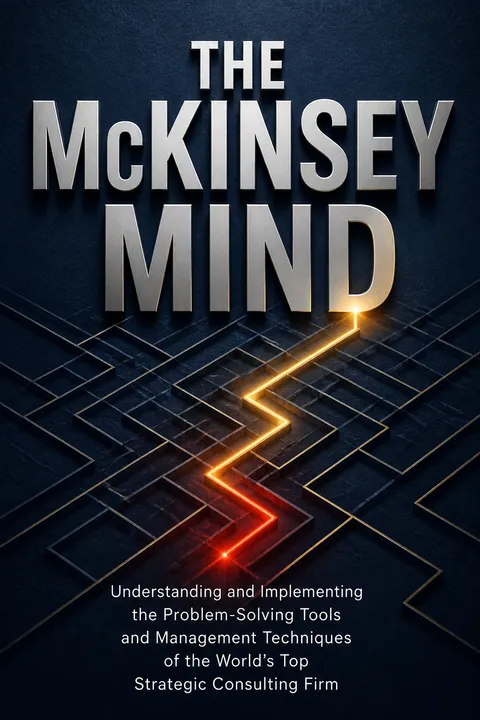
- Overview: "The McKinsey Mind" by Ethan M. Rasiel is a guide to understanding and implementing the problem-solving tools and management techniques used by McKinsey & Company, a leading strategic consulting firm.
- Focus: The book emphasizes practical application of McKinsey's methods in various organizational settings, aiming to improve decision-making and management practices.
- Structure: It covers a range of topics from framing problems, designing analyses, gathering data, interpreting results, to presenting ideas and managing teams.
- Audience: It is intended for business professionals, managers, and anyone interested in enhancing their strategic thinking and problem-solving skills.
Why should I read "The McKinsey Mind"?
- Practical Insights: The book provides actionable insights into McKinsey's problem-solving and management techniques, which can be applied in various business contexts.
- Proven Methods: It offers a glimpse into the methodologies of one of the world's most prestigious consulting firms, known for its rigorous analytical approach.
- Skill Development: Readers can develop skills in structured thinking, data analysis, and effective communication, which are crucial for business success.
- Real-World Applications: The book includes examples and lessons from McKinsey alumni, demonstrating how these techniques have been successfully implemented in different organizations.
What are the key takeaways of "The McKinsey Mind"?
- Structured Problem Solving: Emphasizes the importance of breaking down problems into manageable components using frameworks like MECE (Mutually Exclusive, Collectively Exhaustive).
- Hypothesis-Driven Approach: Advocates for forming initial hypotheses to guide research and analysis, making decision-making more efficient and effective.
- Data and Intuition Balance: Stresses the need to balance fact-based analysis with intuition to make sound business decisions.
- Effective Communication: Highlights the significance of clear, structured presentations to convey ideas and gain buy-in from stakeholders.
How does "The McKinsey Mind" suggest framing a problem?
- Use of Structure: Begin with a structured approach, defining the boundaries of the problem and breaking it down into its component elements.
- MECE Principle: Apply the MECE framework to ensure that all aspects of the problem are covered without overlap.
- Initial Hypothesis: Formulate an initial hypothesis to provide a roadmap for research and analysis.
- Iterative Process: Be prepared to revisit and refine the hypothesis as new data and insights emerge.
What is the hypothesis-driven approach in "The McKinsey Mind"?
- Initial Hypothesis: Start with a hypothesis based on limited information to guide the research and analysis process.
- Efficiency: This approach saves time by focusing on proving or disproving the hypothesis rather than exploring all possibilities.
- Iterative Testing: Use issue trees to break down the hypothesis into sub-issues and test them systematically.
- Flexibility: Be ready to adjust the hypothesis as new data and insights are gathered.
How does "The McKinsey Mind" recommend gathering data?
- Strategic Focus: Emphasize gathering the most important information quickly rather than collecting as much data as possible.
- Interviews: Conduct structured interviews with key stakeholders to gather primary data and insights.
- Research Tools: Utilize a variety of research tools and resources, including industry reports and databases, to gather relevant data.
- Knowledge Management: Implement effective knowledge management practices to leverage existing information and expertise within the organization.
What are the best practices for presenting ideas according to "The McKinsey Mind"?
- Structured Presentation: Organize presentations with a clear, logical structure that guides the audience through the argument.
- Inductive Reasoning: Start with conclusions and then present supporting evidence, making it easier for the audience to follow.
- Simplicity: Use simple, focused charts and visuals to convey one message per chart, avoiding unnecessary complexity.
- Prewiring: Engage key stakeholders before the presentation to address concerns and build consensus.
How does "The McKinsey Mind" suggest managing a team?
- Team Selection: Choose team members based on a mix of skills, experience, and potential, ensuring diversity of thought and background.
- Communication: Maintain open and frequent communication within the team to keep everyone informed and aligned.
- Bonding Activities: Foster team bonding through strategic activities that enhance morale and collaboration.
- Development: Set high expectations and provide regular feedback to support individual and team development.
What does "The McKinsey Mind" say about managing clients?
- Client Engagement: Actively involve clients in the problem-solving process to ensure their needs and perspectives are addressed.
- Building Relationships: Focus on creating long-term relationships by consistently delivering value and exceeding expectations.
- Implementation Focus: Ensure that solutions are actionable and that clients have the capability to implement them effectively.
- Client as Partner: Treat clients as partners in the process, sharing responsibility and credit for successes.
How can "The McKinsey Mind" help with self-management?
- Time Management: Respect your time by setting boundaries and prioritizing tasks to maintain a work-life balance.
- Networking: Leverage your professional network for support, advice, and opportunities, while also being willing to help others.
- Delegation: Recognize your limitations and delegate tasks to capable team members to maximize efficiency.
- Sanity Checks: Regularly assess your career and personal life to ensure alignment with your goals and values.
What are some notable quotes from "The McKinsey Mind" and their meanings?
- "Facts are friendly." This emphasizes the importance of relying on data and evidence to make informed decisions, rather than avoiding uncomfortable truths.
- "Solve the problem at the first meeting." Encourages forming an initial hypothesis early in the process to guide research and analysis efficiently.
- "If you want a life, lay down some rules." Highlights the need to set personal boundaries to achieve a healthy work-life balance.
- "Make the client a hero." Suggests focusing on empowering clients and ensuring their success, which in turn strengthens the relationship.
How does "The McKinsey Mind" balance data and intuition in decision-making?
- Complementary Roles: Recognizes that both data and intuition play crucial roles in decision-making, with data providing evidence and intuition offering insights.
- Fact-Based Analysis: Advocates for rigorous analysis to support decisions, ensuring they are grounded in reality.
- Intuitive Insights: Encourages using intuition to fill gaps where data may be incomplete or unavailable, especially in novel situations.
- Iterative Process: Suggests an iterative approach where data and intuition inform each other, leading to more robust decisions.

Download PDF
Download EPUB
.epub digital book format is ideal for reading ebooks on phones, tablets, and e-readers.








