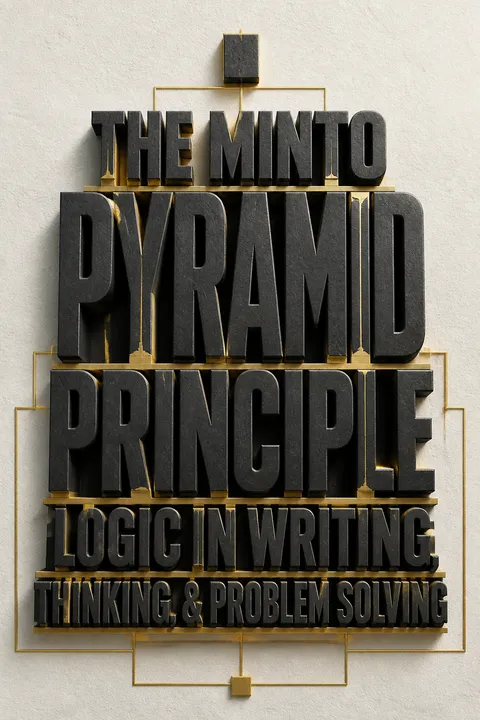


Key Takeaways
Put the conclusion first, then make every supporting point earn its place
Lead with the answer. The central method is to arrange ideas as a pyramid: one main claim at the top, supported by groups of related points, each in turn supported by detail. Readers receive the main idea before the evidence, rather than having to assemble a conclusion from scattered information. The same structure can clarify the writer's own thinking before drafting begins.
A meeting example. Instead of listing why several people cannot attend at the scheduled time, first ask whether Thursday at 11 would work. Then explain that it accommodates the attendees and is the available room booking. The recommendation is immediately visible, and the reasons have a clear job: support it.
The approach treats the reader's attention as a limited resource and spends it on the decision before the supporting material. That is especially useful in workplaces where people scan messages between competing demands. Yet a conclusion-first format can also make a tentative judgment sound settled. Its strength depends on making the basis for the recommendation visible, not merely placing a confident sentence at the top. A clear structure should expose the reasoning to inspection, including uncertainty, rather than disguise a weak inference with polished presentation.
Build each paragraph as an answer to the question above it
Create a question path. A claim naturally prompts a reader to ask why it is true, how it works, or what supports it. The points beneath that claim should answer the question it raises. Their support can then raise a narrower question, answered by the next level of detail. This vertical relationship keeps the reader oriented and gives each fact a reason to be present.
Keep the dialogue in order. If a report announces its assumptions before stating the conclusion those assumptions support, the reader has not yet had reason to ask about them. Likewise, unrelated details placed together force the reader to invent a connection. The pyramid is useful as a test: for each supporting group, ask what question the point above creates, and whether the group answers it directly.
This is a practical method for checking relevance, not just a layout trick. Each supporting detail must have a clear relationship to a claim, which makes digressions easier to spot. The question path also helps writers predict what a skeptical reader needs to know. However, readers do not all ask identical questions. A document for executives, specialists, and affected employees may need different support, even when the main conclusion is unchanged. The framework works best when the intended reader is defined rather than treated as an abstract, universal audience.
Group like ideas, then order them by time, structure, or importance
Name the relationship. Points in a group should belong to the same logical category and appear in an order the reader can understand. For inductive reasoning, several related observations support a broader inference. For deductive reasoning, connected premises lead to a consequence. These are different forms of argument, so mixing them in one group obscures how the conclusion follows.
Use the source of the order. Actions or events usually follow time order. Parts of an organization or process follow the structure being described. A group of comparable problems or reasons can be ordered by degree of importance. If none of these orders fits, the points may not belong together, or the analysis may be incomplete. For a headline-level set of points, the book generally favors an inductive grouping because it gets the reader to the answer faster.
The ordering rule makes an outline diagnostically useful: disorder can signal a thinking problem, not merely an editing problem. It also distinguishes a list from an argument. Still, a category is not automatically meaningful just because its items share a label. A writer must explain why these observations matter together and why their sequence is justified. The structure should reveal the reasoning, while leaving room for a reader to question whether the categories or ranking criteria are appropriate.
Replace empty lists with the insight their evidence actually supports
Do not stop at the label. Statements such as “the company has three problems” announce a category, but tell the reader nothing about what connects the problems or why they matter. Minto calls these intellectually blank assertions. A useful summary states the inference supported by the grouped evidence, or the result produced by a set of actions.
Find what the points share. Consider complaints about a monthly sales and inventory report: its data arrive late, contain errors, and appear in an awkward format. Simply calling these “three issues” leaves the reader to make sense of them. Grouping them as failures of timing, reliability, and usability clarifies why the report is unhelpful and points toward what must be repaired. If the evidence does not support a precise shared claim, the summary should not pretend that it does.
A strong summary is a compression of reasoning, not a decorative heading. It helps readers remember a pattern rather than a pile of examples, and it can reveal missing evidence to the writer. The discipline also guards against vague labels that sound analytical but conceal unfinished thought. There is a limit, though: not every collection of facts supports a single elegant inference. Where evidence is mixed, a careful account of competing explanations is more honest than forcing a neat summary.
Define the problem as the gap between today and the result wanted
Make the gap explicit. The book's problem-definition method identifies the current situation, the event or realization that disturbed it, the undesired result, and the desired result. It calls these outcomes R1 and R2. Defining both sides turns a vague concern into a question that analysis can address. A desired result should be specific enough to recognize when it has been achieved.
The warehouse example. A distributor's facilities were theoretically designed to serve 490 stores, yet the existing network struggled with 438. With growth of 4 to 5 percent and 198 new stores planned, the company expected to run out of capacity within two years. The issue was not merely “warehouses.” It was how to provide enough capacity at acceptable cost and service levels. The question changes if a solution has already been proposed or tried.
This framing stops a team from confusing symptoms, causes, and goals. It also clarifies what counts as success, a prerequisite for choosing among possible actions. But the desired result is not always obvious: different stakeholders may disagree about whether cost, speed, service, or risk matters most. A well-defined gap therefore needs both a measurable target where possible and explicit acknowledgment of whose priorities shape that target.
Map the system before collecting facts, or drown in irrelevant data
Start with a model. A diagnostic framework is a structured picture of the process, physical system, or financial relationships where a problem occurs. It helps identify possible causes and formulate questions that can be answered with evidence. The problem-solving cycle, which Minto calls Sequential Analysis, moves from asking whether a problem exists and where it lies to explaining why it exists, then identifying and choosing remedies.
Test, do not just gather. The book reports that one consulting firm estimated 60 percent of its fact-finding and analysis effort was wasted. A better approach is to form plausible hypotheses from the system's structure, then collect the information that could confirm or disprove them. This hypothesis-first reasoning is a form of Abduction. For instance, a manufacturing shortfall might be investigated through lead times, material availability, capacity, and reporting controls.
A model makes research purposeful: every data request should help distinguish among explanations or guide a decision. That is more efficient than treating information volume as a proxy for understanding. But a framework also channels attention. If its categories omit a cause, focused data gathering may confidently miss it. Analysts should therefore treat the initial map as a revisable hypothesis, actively seek disconfirming evidence, and update the framework when observations do not fit.
Write actions as observable outcomes, not foggy management verbs
Make the end visible. Phrases such as “improve reporting” or “strengthen regional effectiveness” do not say what anyone must do or how completion will be judged. Rewrite an action so it names a result that can be observed, such as establishing a process for following up overdue accounts. Then ask whether the listed steps actually produce that result.
Separate levels of work. In a process, some actions are immediate steps, while others are smaller tasks carried out to complete those steps. A collection system, for example, might sort accounts by age and amount, assign responsibility according to seriousness, and establish follow-up. Grouping actions by the result they jointly achieve makes omissions and overlaps easier to detect. A list of activities becomes useful only when its intended effect is clear.
Concrete outcomes improve both communication and accountability: people can tell what must be delivered, rather than interpreting a broad aspiration differently. They also reveal whether a process is complete. The caution is that observability should not reduce every worthwhile aim to a simplistic metric. Some outcomes, especially changes in judgment or cooperation, resist neat measurement. In those cases, writers can still describe evidence of progress while acknowledging that the indicator is an imperfect proxy.
Open with what readers know, then reveal what changed
Give the question a history. The Situation-Complication-Question pattern is an introductory structure: establish familiar context, explain what changed or went wrong, and make clear what question the document answers. The answer is the pyramid's main point. The opening should orient and remind the reader, not unload facts that belong in the argument.
Match the reader's position. A familiar business process may have become inadequate; a proposed fix may need evaluation; or an accepted solution may still need implementation. Each starting point creates a different question. A short introduction can be enough for a colleague who already knows the issue, while a broader audience may need more context. The introduction earns attention by connecting the recommendation to a situation the reader recognizes.
The narrative opening gives an argument a point of departure. It reduces the sense that a recommendation has appeared from nowhere and helps readers understand why the issue matters now. Yet narrative is not neutral: selecting a particular event as the complication can steer interpretation before the evidence arrives. The most credible introduction distinguishes established facts from the writer's framing, so that orientation does not become a subtle substitute for proof.
Make the page reveal the logic before the reader deciphers prose
Show levels clearly. Headings, indentation, numbering, and underlining can make the hierarchy visible on a page. In a presentation, text slides should carry only the central points, while charts and diagrams show relationships that words alone make cumbersome. The book suggests keeping text slides short, around six lines or 30 words, and favors exhibits over text-heavy recitations.
Write from an image. Before drafting a difficult sentence, picture the relationship it is meant to convey. The image might be a sequence, a hierarchy, or a comparison. Then choose words that let the reader reconstruct that relationship. A chart should likewise state its message in its title, rather than merely name its topic. Visual clarity does not replace sound logic; it helps expose whether the logic is there.
Visual hierarchy reduces the effort required to distinguish a main claim from its evidence, and a sentence built around a clear relationship is easier to follow than one crowded with abstractions. The medium still matters. A live presentation has a speaker who can explain a slide, while a standalone document must carry more context on the page. The book's slide proportions are useful guidance, not a universal rule; accessibility, audience, and purpose should shape the final design.
Analysis
The book's most important shift is from treating writing as sentence-making to treating it as the public form of reasoning. Its pyramid is not simply an outline. It is a test of whether a claim has support, whether the support belongs together, and whether the sequence lets a reader see the inference without rebuilding it. The writer gains a second benefit: a broken hierarchy can expose a broken analysis before prose makes it harder to revise.
The system is strongest in decision-oriented communication, especially reports that must turn a complex analysis into a recommendation. The problem-definition method also gives analysts a disciplined boundary: specify the undesirable result, name the result sought, and investigate the system connecting them. This reduces aimless research. Its emphasis on end products makes plans easier to evaluate than lists of aspirations.
The approach is less complete as a theory of all communication. Some writing explores a question rather than answers one, and some readers need evidence before they can accept the headline. A pyramid can also make a disputed interpretation appear settled simply by giving it a prominent top position. The remedy is not to abandon structure, but to make assumptions, uncertainty, and alternative explanations visible within it. A clear argument is not necessarily a correct one.
The book's advice about audience framing deserves particular care. An introduction selects what counts as the relevant situation and which event matters. That selection can illuminate a problem, but it can also constrain what the reader considers. Writers should therefore treat the opening as a transparent map of the case, not as a device for making the conclusion feel inevitable.
Read this way, the Pyramid Principle offers a rigorous craft discipline: reason before drafting, make relationships explicit, and design the presentation to expose rather than conceal the argument. Its standard is not brevity for its own sake. It is lower effort for the reader without loss of intellectual accountability.
Review Summary
The Minto Pyramid Principle receives mixed reviews, with ratings ranging from 2 to 5 stars. Many praise its logical approach to structuring business writing and problem-solving, considering it invaluable for consultants and analysts. Critics find it outdated, dense, and difficult to follow. Readers appreciate the book's emphasis on clear communication and top-down thinking but note its dated examples and writing style. Some suggest the content could be condensed or modernized. Despite its flaws, many still consider it a classic text on effective business communication.
People Also Read







Glossary
Minto Pyramid Principle
Hierarchical organization of ideasA method for organizing thinking and communication around one central point, supported by groups of logically related ideas. Each point summarizes the material below it, and each group answers a question raised by the point above. Writers can build the structure from an initial conclusion downward or sort evidence upward into a defensible conclusion.
Situation-Complication-Question
Narrative introduction structureAn introductory pattern that establishes a situation familiar to the reader, identifies a change or difficulty that disrupts it, and clarifies the question the document will answer. The answer becomes the main point of the argument. The structure is intended to orient the reader with relevant context, rather than use the introduction to present evidence that belongs in the body.
Key Line
Main supporting pointsThe group of principal points directly beneath the central claim in a Minto pyramid. Together, these points explain or defend the main claim and set out the document's basic plan. Each Key Line point should be an idea, not merely a topic label, and its supporting material should answer the question it raises.
MECE
Non-overlapping, complete groupingAn abbreviation for mutually exclusive and collectively exhaustive. A MECE division separates categories so that they do not overlap, while covering the full relevant whole. The principle helps analysts test whether a framework has duplicated items or omitted important ones. In practice, completeness depends on how the whole and the purpose of the analysis are defined.
Sequential Analysis
Ordered problem-solving processA problem-solving method that proceeds through linked questions: whether a problem or opportunity exists, where it lies, why it exists, what could be done, and what should be done. The early questions define the problem; the middle questions structure diagnosis; the final questions develop and select a solution. Its sequence is meant to focus analysis before recommendations are made.
Diagnostic frameworks
Maps of possible causesStructured representations of the system or process in which a problem occurs. They can show physical components, trace cause and effect, or classify possible causes. Analysts use the framework to identify what information is needed and to create questions that distinguish among explanations, rather than collect every available fact without a clear purpose.
Abduction
Reasoning from a puzzling resultA form of reasoning used to propose a possible explanation for an observed result. The analyst notices an outcome, considers a rule or structure that could explain it, and investigates whether the relevant conditions are present. In problem analysis, plausible causes guide data collection. In scientific inquiry, a proposed structure can lead to experiments designed to test it.
Issue Analysis
Analysis of decision choicesA decision-analysis approach originally developed for complex choices involving multiple alternatives, objectives, variables, and consequences. In its specific historical use, it mapped decision areas and important variables, then assessed alternatives against objectives and criteria. The book distinguishes this demanding technique from diagnostic frameworks and from logic trees used to generate possible actions.
Magical Number Seven
Limit on items held in mindThe name associated in the book with George A. Miller's discussion of short-term memory capacity, described as roughly seven items, plus or minus two. Minto uses the idea to argue for grouping information into meaningful categories, allowing readers to work with fewer higher-level chunks. The number is presented as a practical rationale for organizing information, not as a strict limit for every person or task.
FAQ
What's The Minto Pyramid Principle about?
- Clear Communication Focus: The book emphasizes the importance of clear communication in writing, thinking, and problem-solving, introducing a structured approach to organizing thoughts and ideas.
- Pyramid Structure: It advocates for organizing ideas in a pyramid format, where the main point is at the top, followed by supporting arguments and details.
- Application in Business: Originally developed for consulting reports, the principles can be applied to various types of documents, making it a valuable resource for professionals across industries.
Why should I read The Minto Pyramid Principle?
- Improve Writing Skills: The book provides practical techniques to enhance writing clarity and effectiveness, which is crucial for career advancement.
- Structured Thinking: It teaches readers how to organize their thoughts systematically, leading to better problem-solving and decision-making.
- Widely Recognized Method: The Minto Pyramid Principle is a standard in consulting and business communication, making it a respected resource for professionals.
What are the key takeaways of The Minto Pyramid Principle?
- Pyramid Structure: Organize ideas in a pyramid format, starting with the main point and supporting it with logical arguments.
- Question/Answer Technique: Use a question/answer approach to clarify thinking and ensure that all points are relevant to the main argument.
- Logical Order: Ensure that ideas are presented in a logical order, whether through time, structure, or degree, to enhance understanding.
What is the Minto Pyramid Principle?
- Definition: The Minto Pyramid Principle is a method for structuring communication to enhance clarity and effectiveness, organizing ideas hierarchically.
- Purpose: It aims to help writers present their thoughts logically, making it easier for readers to follow and understand complex information.
- Application: It can be applied to various forms of writing, including reports, presentations, and proposals, making it versatile for business communication.
How do I build a pyramid structure according to The Minto Pyramid Principle?
- Top-Down Approach: Start with the main idea at the top of the pyramid, followed by supporting points that provide evidence or reasoning.
- Bottom-Up Approach: Alternatively, gather detailed points first and then summarize them into a main idea, ensuring that all points are logically connected.
- Check for Clarity: Ensure that each level of the pyramid summarizes the ideas below it, maintaining a clear and logical flow throughout the document.
What is the importance of logical order in writing according to The Minto Pyramid Principle?
- Enhances Understanding: Presenting ideas in a logical order helps readers process information more easily, reducing confusion and improving comprehension.
- Types of Logical Order: The book identifies three main types of logical order: time order, structural order, and degree order, each serving different purposes in organizing ideas.
- Facilitates Effective Communication: A well-structured document allows the writer to convey their message more effectively, ensuring that the reader grasps the intended meaning without unnecessary effort.
What are the common pitfalls in writing that The Minto Pyramid Principle addresses?
- Intellectually Blank Assertions: The book warns against vague statements that do not convey meaningful insights, urging writers to provide clear, actionable points.
- Loose Groupings of Ideas: It emphasizes the need for ideas to be logically connected and relevant to the main argument, avoiding disjointed lists that lack coherence.
- Failure to Summarize Effectively: Writers often neglect to summarize their points clearly, which can lead to misunderstandings and a lack of engagement from the reader.
How does the Minto Pyramid Principle apply to problem-solving?
- Defining Problems: The principle encourages a structured approach to defining problems, identifying the gap between current and desired results.
- Sequential Analysis: It promotes a sequential analysis method to explore the causes of problems and develop actionable solutions.
- Clear Communication of Solutions: By organizing solutions in a pyramid structure, the principle ensures that recommendations are presented clearly and persuasively.
What is the Problem Definition Framework in The Minto Pyramid Principle?
- Components of the Framework: It consists of four elements: Starting Point/Opening Scene, Disturbing Event, R1 (Undesired Result), and R2 (Desired Result).
- Identifying Gaps: This framework helps identify the gap between the current situation and the desired outcome, facilitating targeted problem-solving.
- Three Key Questions: To define a problem, one must answer: "What's going on?", "What don't we like about it?", and "What do we want instead?"
How does the pyramid structure improve writing and presentations according to The Minto Pyramid Principle?
- Logical Flow: The pyramid structure ensures that ideas are presented in a logical order, making it easier for the audience to follow.
- Focus on Key Points: It helps writers focus on the main message and supporting arguments, avoiding unnecessary details that can confuse the reader.
- Visual Clarity: By organizing information visually, it enhances comprehension and retention for the audience.
What is the significance of the Situation-Complication-Question (SCQ) format in The Minto Pyramid Principle?
- Engaging Introductions: The SCQ format helps create engaging introductions that capture the reader's attention by presenting a relatable situation followed by a complication.
- Clear Problem Definition: It sets the stage for the main question that the document will address, guiding the reader's expectations.
- Logical Progression: This format ensures a logical progression from the context to the problem, making it easier for the audience to understand the relevance of the content.
What are the best quotes from The Minto Pyramid Principle and what do they mean?
- "The key to clear writing is to structure your thinking into a pyramid.": This emphasizes the foundational concept of the book, highlighting that clarity in writing stems from organized thought.
- "There is nothing so useful as a good theory.": This quote underscores the importance of having a solid theoretical framework, like the Minto Pyramid Principle, to guide effective communication.
- "Applying the Minto Pyramid Principle still requires considerable discipline.": This serves as a reminder that while the principles are powerful, they require practice and commitment to implement effectively.
About the Author
Other books by Barbara Minto

Download PDF
Download EPUB
.epub digital book format is ideal for reading ebooks on phones, tablets, and e-readers.








