

Key Takeaways
Answer the reader's live question before offering your analysis.
Start where the reader stands. A document earns attention by answering a question the reader already has, or can see becoming relevant. Minto recommends opening with the familiar situation, describing what changed or went wrong, and making the resulting question clear before giving the answer. That narrative path gives the recommendation a reason to exist, rather than dropping it onto the page without context.
A scheduling note illustrates the difference. A list of colleagues' conflicts makes the reader reconstruct the issue. A clear request to move the meeting to a specific time, followed by the reason, answers the practical question immediately. The opening need not be long. It needs only enough shared context to show why the reader should care.
The opening is not merely a courtesy. It is a relevance filter: readers can judge whether the issue belongs to them before investing effort in the reasoning. This resembles good journalism, which establishes what changed and why it matters before unpacking causes. There is also a persuasive risk. Selecting the situation and complication can make one interpretation feel inevitable, even when other accounts are possible. The method is strongest when the opening states common ground honestly and distinguishes established facts from the writer's framing.
Lead with the conclusion, then make its supporting logic visible.
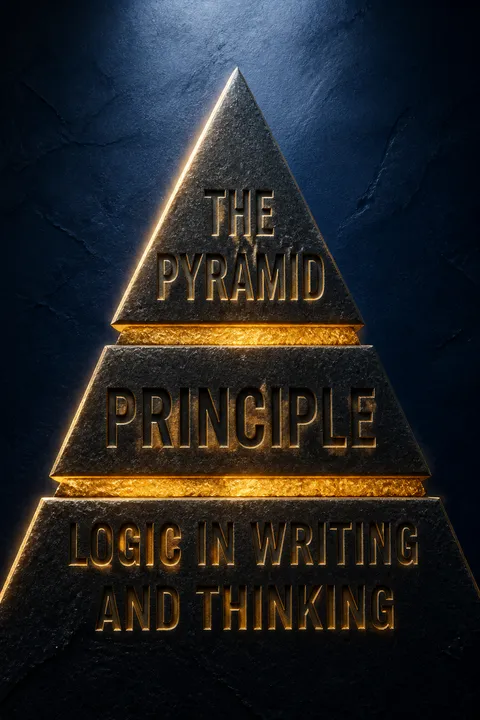
Give the headline first. The Pyramid Principle organizes a document around one central conclusion, supported by progressively more specific ideas. Readers encounter the main point first, then the reasons or evidence beneath it. This is the reverse of drafting by discovery, where a writer records details and hopes the reader will infer the conclusion.
Minto cites George Miller's estimate that short-term memory holds roughly seven items, with individual variation. The practical point is not a rigid limit: when a list grows unwieldy, people group related items into fewer categories. A shopping list becomes easier to retain when grouped by store section. A business report works similarly. A clear summary at the top helps readers store the supporting points as organized groups instead of an unconnected stream.
This structure reduces the reader's burden of assembling a thesis from scattered evidence. It also makes disagreement more productive: readers can challenge the conclusion or inspect the supporting chain, rather than guess what the writer is building toward. Miller's number is best treated as a memorable guide, not a universal capacity limit. People differ, and familiarity can make complex material easier to group. The durable lesson is to avoid making readers perform organizational work that the writer can do in advance.
Make each higher-level point a genuine summary of its support.
Test every grouping. A sound pyramid has three requirements: the upper point summarizes the ideas below, the points grouped together belong to the same logical kind, and their sequence has a defensible order. A label such as “three problems” is not a summary. It tells readers what sort of material follows, but not what those problems reveal.
For example, a list of low productivity, excessive overtime, and uncompetitive prices needs a specific relationship. If the figures show that weak productivity drives overtime and pricing problems, state that causal claim and support it. If the points do not fit a shared explanation, the grouping needs more analysis. When the conclusion is unclear, Minto also offers a bottom-up route: list the ideas, sort their relationships, and infer the point they collectively support.
A useful summary compresses information without erasing its structure. That makes it a form of reasoning, not a decorative heading. The same discipline matters in data analysis: a chart title should describe the pattern shown, not merely announce that a chart exists. Yet summaries can overreach. A concise claim may sound more certain than its underlying evidence warrants. Writers should make the relationship explicit while preserving appropriate limits, especially when a group contains exceptions or incomplete information.
Make each claim raise a question its next layer actually answers.
Build a visible dialogue. Every new claim gives the reader a reason to ask something: Why is this true? How would it work? What follows from it? In a well-structured document, the next layer answers that question. The supporting points then generate smaller questions, which receive their own answers until the reasoning is complete.
Suppose a report recommends buying a business. The reader will ask why. The next section might explain that the business can grow faster than its market, improve the buyer's finances, and fit smoothly into its operations. Each reason needs support of its own. This arrangement lets readers follow the argument without searching across pages for connections. It also helps writers notice missing support: if a claim raises a reasonable question that the document never answers, the structure is unfinished.
This question-and-answer test gives revision a practical diagnostic: read each claim, pause, and name the question it creates. The approach echoes the way a good teacher scaffolds an explanation, adding one answer at a time. It does not guarantee that the answer is convincing, only that the reader can see what it is responding to. That distinction matters. Clear reasoning can still rest on weak evidence, but hidden reasoning cannot be evaluated at all.
Keep deduction and induction separate so readers can follow the argument.
Choose the logic deliberately. Deduction moves through connected steps toward a conclusion: one statement sets up the next, and the final point follows from them. Induction gathers separate but related observations, names what they have in common, and draws an inference. Three armies moving troops toward the same border, for instance, may be grouped as signs of mounting military danger. That inference is only as strong as the observations and their interpretation.
The forms should not be mixed carelessly. If points are reasons, problems, or examples of one kind, give the reader a clear summary of their shared meaning. If each point depends on the preceding point, preserve that chain. Minto especially favors a direct recommendation followed by grouped reasons in business documents, rather than making readers wade through the full investigation before learning what action is proposed.
The distinction helps separate two questions that are often blurred: how claims relate to one another, and whether they are true. A deductive chain can be valid while starting from a false premise. An inductive pattern can be well organized while relying on too few or unrepresentative examples. Putting the main conclusion first improves access, but it should not bury uncertainty. Strong business communication makes both the reasoning pattern and the quality of evidence inspectable.
Order lists by the analysis that produced them, not by convenience.
Find the source of the sequence. Minto identifies three common origins for a group of points. If the points are steps in a process, put them in the order they happen. If they describe parts of a structure, follow the structure. If they are members of a class, rank them by the relevant measure, often from most important to least.
A related test is MECE: the categories should not overlap, and together they should cover the defined subject. An organization chart, for example, should assign each activity to a clear place while accounting for the whole organization. These checks expose incomplete lists and double-counting. They also force a writer to say what principle created the categories. “Three priorities” is not enough; readers need to understand why these priorities belong together and why they appear in this order.
Ordering reveals the analysis beneath the prose. It is especially valuable in procedures, where a misplaced step can make instructions unusable, and in classification, where overlap can distort totals or priorities. MECE is a useful audit, not proof that a framework is correct. Categories can be exhaustive only relative to a chosen boundary, and different boundaries can produce different but reasonable divisions. A writer should state the scope clearly, then check the divisions against it.
Define the problem as a measurable gap before hunting for causes.
Make the problem concrete. The problem-solving sequence asks five questions: What is wrong? Where does it occur? Why does it happen? What could change it? What should be done? Begin by defining the gap between the result now and the result wanted. In Minto's example, one department's machines produce fewer cigarettes than comparable machines. Measuring productive hours makes the shortfall visible and focuses the search for causes.
A logic tree then lays out possible explanations, such as missing materials, equipment trouble, staffing, or supervision. Each possibility can be examined instead of treating the problem as a vague complaint. When the underlying structure is unknown, Minto calls the reasoning abduction: propose a possible explanation, then design a test that could support or reject it. The aim is to turn a murky situation into questions that analysis can answer.
A measurable gap disciplines attention. Without it, teams can confuse symptoms, causes, and preferred solutions, then collect data that never resolves the central issue. The logic-tree approach also makes assumptions visible: a branch is a hypothesis about what could produce the outcome, not a fact. That distinction is crucial in organizational settings, where people may defend their own department's explanation. A good analysis makes alternatives explicit and identifies what evidence would distinguish them.
Write recommendations as observable end products, not managerial fog.
Say what completion looks like. Vague verbs such as improve, strengthen, or review do not tell a reader what to do or how to know the task is finished. Replace them with actions that produce something observable. Instead of calling for stronger regional performance, specify where responsibility for planning should sit. Instead of asking for better financial reporting, describe a system that gives managers earlier notice of changes.
This precision makes the causal structure testable. Each action should contribute to an identifiable result, and the actions grouped together should produce the effect stated above them. Minto advises visualizing a person carrying out each step and asking what would be in that person's hands at the end. If no one can tell when the action is complete, the wording probably conceals unfinished thinking.
Observable outputs improve coordination because different people can agree on whether a task is done. They also make recommendations easier to assign and evaluate. But measurement can create its own distortion: a team may deliver the specified report or system without improving the underlying outcome. End products therefore work best when linked to the purpose they serve. The writer should clarify both the deliverable and the change it is meant to enable.
Draw the system before recommending how to repair it.
Compare the current and desired states. A diagram can expose what prose hides: who passes information to whom, where work is repeated, and which step creates delay or error. In Minto's document-delivery example, readers request a paper article through a service that copies and mails it, a process taking several days. The proposed digital system would transmit stored documents electronically and aim for overnight delivery.
The analysis does not stop at whether the technology can work. Minto reports that digital delivery appeared technically possible, but low unit costs required large volumes and expensive equipment. A Europe-wide operation, a demonstration project, shared standards, and solutions to legal and organizational issues all mattered. Drawing both processes makes the recommendation concrete and reveals constraints that a simple claim of technical feasibility would miss.
Before-and-after models are powerful because they turn abstract proposals into systems with actors, handoffs, and bottlenecks. This is the same advantage found in process mapping: a delay often belongs not to one person but to the connections between tasks. Diagrams can also mislead by making uncertain assumptions look settled. A model should distinguish what is observed from what is proposed, and should include costs, incentives, and institutional barriers as well as technical components.
Turn clear mental pictures into prose readers can reconstruct.
Write for comprehension, not ceremony. Minto argues that writers often understand an idea as a mental picture or a simple map of relationships, then obscure it with abstract nouns and jargon. Her remedy is to identify the concrete elements and how they relate, then express that arrangement in direct sentences. A scene of someone working among pines beside a pond is easier to remember than a dense paragraph of disconnected facts because the reader can build a mental representation as the words arrive.
Page design should reinforce the same logic. Headings should state ideas, related headings should use parallel grammatical forms, and indentation should show levels of support. A reader should be able to scan the structure without relying on headings to supply meaning that the paragraphs never explain.
The image-making idea connects writing to visual explanation: a reader can retain a relationship more easily when language gives it a coherent shape. Headings and parallel phrasing further reduce the effort required to compare points. Still, not every subject has a useful picture. Abstract arguments may need definitions, examples, or explicit logical steps rather than a metaphor. The test is not whether prose feels vivid, but whether readers can accurately restate the relationships it describes.
Analysis
Minto's central contribution is to treat clear writing as the visible result of disciplined analysis. The writer is not simply polishing sentences. The writer is deciding what question matters, identifying the answer, grouping the support, and choosing an order that lets another mind follow the reasoning. That shift explains why her method applies to reports, presentations, proposals, and problem solving, not just prose style.
The book's strongest practical insight is its insistence that structure can be inspected. A claim should have support that answers the question it raises. Groups should have a meaningful summary, consistent membership, and a reason for their order. Recommendations should point to observable actions. These tests turn vague advice to “be clearer” into revision procedures. The examples of messy business memoranda are especially effective because they show how an apparently grammatical document can still leave its central message buried.
The framework also has limits. A neat hierarchy can imply that a problem has one decisive answer when evidence is incomplete, stakeholders disagree, or outcomes depend on feedback. Categories that appear exhaustive may only reflect the writer's chosen boundary. Leading with a conclusion can help time-pressed readers, but it can also lend an unearned authority to a contested claim. The method therefore needs an ethical companion: disclose uncertainty, test competing explanations, and distinguish evidence from inference.
Taken together, the book offers a powerful bridge between thinking and communication. Its deeper promise is not that every issue fits a tidy pyramid, but that writers should discover the relationships they intend readers to see before asking readers to find them. When reality is complicated, the structure should make that complexity legible, not pretend it has disappeared.
Review Summary
The Pyramid Principle receives praise for its structured approach to communicating complex ideas, with readers particularly valuing the first half's clear concepts and frameworks like MECE and SCQA. Many find it essential for business writing, consulting, and problem-solving, noting its immediate practical application. Common criticisms include dense second-half content, outdated examples, dry textbook-like prose, and occasional formatting issues. Despite mixed views on readability, most reviewers recommend it as foundational reading for professionals seeking clearer, more logical communication skills.
People Also Read




Glossary
Pyramid Principle
Hierarchical idea structureA method for organizing a document around one main point, supported by grouped ideas that explain or defend it. The reader meets the main conclusion first, then follows the supporting structure downward. Each group should have a clear relationship and order, so the document reflects the logic of the writer's thinking.
Key Line
Main supporting pointsThe set of principal points directly supporting the central conclusion. These points answer the next question raised by that conclusion, such as why it is true or how to act on it. In a longer document, stating the Key Line near the beginning lets readers see the argument's main branches before reading their detailed support.
Situation, Complication, Question, Answer
Context-to-conclusion sequenceA structure for an introduction. It begins with a situation the reader knows, identifies a change or difficulty, makes clear the question this raises, and gives the document's answer. The sequence establishes relevance before presenting analysis. The elements can be arranged in different orders for tone, but the writer should know how they connect.
MECE
Nonoverlapping, complete categoriesAn abbreviation for mutually exclusive and collectively exhaustive. Applied to a set of categories, it means that their contents do not overlap and that, taken together, they cover the defined subject. The test helps expose duplication and omissions, but only within the boundaries chosen for the analysis.
Logic tree
Map of possible causesA branching diagram that begins with a result or problem and divides it into possible causes or contributing activities. Each branch can be examined and divided further, helping analysts identify where evidence is needed. A useful tree aims to cover the relevant possibilities without overlap and can guide both analysis and recommendations.
Abduction
Hypothesis-driven problem solvingA form of reasoning used when an observed result needs explanation. The problem solver proposes a possible structure or cause that could produce the result, then looks for a test that could support or reject that explanation. In scientific inquiry, this can require inventing a new hypothesis when the existing model does not account for what is observed.
The Magical Number Seven, Plus or Minus Two
Short-term memory estimateGeorge A. Miller's named estimate, cited by Minto, that people can hold roughly five to nine separate items in short-term memory at once. Minto uses the idea to explain why readers benefit from grouping many details into a smaller number of meaningful categories. The number is an approximate guide, not a fixed capacity for every person or task.
Memory image
Mental scene of informationA mental representation a reader builds while taking in a passage. It is not necessarily a literal picture; it can be a simple arrangement of people, objects, or relationships that captures the passage's meaning. Minto argues that concrete, well-ordered language helps readers form and remember such representations.
About the Author
Other books by Barbara Minto
Download PDF
Download EPUB
.epub digital book format is ideal for reading ebooks on phones, tablets, and e-readers.








