

Key Takeaways
Build at the intersection, where distant fields multiply possible ideas.
Distant fields combine. Johansson calls the potential for breakthroughs at the meeting point of separate disciplines the Medici Effect. The name refers to Renaissance Florence, where people from different fields and cultures gathered and exchanged ideas. The book's examples range from spider genes introduced into goats to produce silk-like material, to computer animation reshaping storytelling, to a card game that fused games with collectibles.
Combinations multiply quickly. In one illustration, rock and classical music each offer roughly 2,400 combinations of instruments, structures, and vocals. Combining the categories creates a theoretical 5.76 million pairings. This is a thought experiment, not a prediction that every pairing is useful. The book argues that migration, scientific convergence, and computing make encounters between fields more frequent and easier to explore.
What's striking is that innovation here is treated as a search problem: distant knowledge expands the menu of possibilities before anyone knows which possibility will matter. That connects to recombination in evolution, where existing elements are rearranged rather than created from nothing. The arithmetic illustrates abundance, not value. Most combinations will be trivial, impractical, or already known. A productive intersection therefore needs both wide search and disciplined selection, including people who can translate an unfamiliar idea into something others can test.
Notice the mental labels that make familiar answers feel inevitable.
Associations narrow attention. Associative barriers are the habitual links between ideas that keep thinking inside familiar categories. A chef seeing a fish may immediately imagine a recipe, while a fishing writer may think of tackle. These mental shortcuts are efficient, but they can make other possibilities hard to see.
Expertise can conceal patterns. Darwin sent his Galapagos bird collection to zoologist John Gould, who identified distinct finch species. Gould classified the birds, but Darwin connected their differences to isolation and proposed that species change over time. A separate example in the book asks whether an outspoken environmentalist named Susan is more likely to be an office manager, or an office manager active in environmental causes. People often choose the vivid combined description, although the simpler category is statistically more likely.
This is a useful distinction between seeing more and knowing more. Expertise supplies rich patterns, yet it can also make one interpretation feel exhaustive. Cognitive psychology describes this as the availability of familiar associations: the mind retrieves what is practiced, not necessarily what is most probable or insightful. Still, specialists are not merely obstacles. Their knowledge can detect meaningful anomalies that novices miss. The strongest arrangement is often a boundary-crossing team where deep expertise meets someone willing to ask why the accepted categories are arranged that way.
Practice crossing cultures, reversing assumptions, and changing your point of view.
Different lenses loosen habits. Marcus Samuelsson grew up in Sweden after being adopted from Ethiopia, traveled widely, and trained in several European kitchens. Those experiences helped him combine Swedish ingredients and techniques with flavors from other cuisines. At New York's Aquavit, dishes such as smoked salmon with tandoori seasoning challenged expectations and earned the restaurant a rare three-star review.
Use deliberate perspective shifts. Johansson describes assumption reversal as listing what people take for granted, turning those assumptions around, and asking whether the opposite could work. A restaurant might remove its menu, for example, and let the chef build meals from the day's ingredients. Another tactic is to view a problem from several roles or impose a constraint, such as imagining service without speech. The aim is to unsettle automatic answers, not to accept every reversal.
Cross-cultural experience can widen the set of comparisons available to a person, while assumption reversal turns that broad exposure into a practical method. This resembles design research, where reframing a user's problem often reveals options hidden by the original brief. Exposure alone is not enough: people can live among difference without questioning their assumptions, and cultural borrowing can become superficial when context is ignored. The book's strongest advice is therefore active curiosity, treating unfamiliar practices as evidence of alternative solutions rather than as novelty for its own sake.
Manufacture useful collisions through diverse work, people, and encounters.
Create chances for collision. Occupation diversification means moving among projects or fields so that methods from one area can illuminate another. Astronomer Luis Alvarez, for instance, applied ideas about asteroid impacts to the puzzle of dinosaur extinction. At the Santa Fe Institute, researchers from biology, economics, physics, and other fields collaborate on questions such as how markets behave.
Make encounters intentional. The Bletchley Park codebreaking team combined cryptologists with mathematicians, classicists, chess players, and crossword enthusiasts to attack Germany's Enigma code. Johansson also calls deliberate searches for unlikely connections intersection hunting. One exercise is to collect unrelated objects or words, list their properties, and see whether any property suggests a new approach to a current problem. Diverse teams help only when members can exchange ideas and disagree productively.
The examples show that diversity matters through what it lets people do, not simply through who is present. Different backgrounds can supply varied analogies and methods, but social friction, status differences, and poor communication can prevent those resources from combining. Research on team performance likewise distinguishes diversity of information from the conditions needed to use it. A practical implication is to design mixed teams around a shared question, give participants a common vocabulary, and make disagreement about ideas safe without pretending that every perspective carries equal expertise on every issue.
Generate a large pool before deciding which ideas deserve effort.
Volume improves the odds. The psychologist Dean Simonton found that creative achievement tends to rise with the amount of work produced. Many celebrated creators made large bodies of work, including failed or forgotten pieces. The point is not that every idea is good, but that producing more gives chance more opportunities to deliver an exceptional one. The book cites Thomas Edison's thousands of experiments and Mike Oldfield's extensive recording work on the album Tubular Bells.
Separate making from judging. When people list uses for a brick, the first suggestions are predictable, such as building a wall. A target of thirty ideas can force more unusual possibilities to surface. Group brainstorming can suppress output because people wait for their turn to speak. Johansson recommends individual idea generation before group discussion, or brainwriting, in which participants write ideas and build on one another's notes.
This argument treats creative work as sampling a broad possibility space. More attempts raise the probability of finding a strong result, much as repeated experiments improve a search, but only if the attempts are meaningfully varied. Repeating the same weak premise at scale produces waste, not discovery. The separation between generation and evaluation is especially valuable because early judgment favors familiar solutions. Yet selection still matters: teams need criteria for usefulness, feasibility, and ethical impact so that abundance becomes learning rather than an ever-growing pile of untested notions.
Let promising ideas incubate before deadlines and quick judgments flatten them.
Insight needs room. Johansson distinguishes flash-in-the-sky serendipity, where a long period of focused effort is followed by an unexpected connection, from prepared-mind discoveries, where prior knowledge helps someone recognize the importance of an accidental finding. Richard Garfield had worked on game ideas for years before realizing that players could bring different private collections of cards into Magic: The Gathering.
Protect the pause. In a study described by the book, researchers tracked 177 employees on 22 project teams across seven companies. High time pressure was generally associated with weaker creativity, and the effects could linger beyond the pressured day. A useful rhythm is to work deeply, step away, and return with fresh attention. Recording ideas as they appear matters too, since a promising thought can disappear before it is fully understood.
Incubation gives associative thinking time to operate beyond deliberate, step-by-step reasoning. It is not a mystical substitute for expertise: the most useful surprise usually connects with material that has already been learned and worked over. Nor does every break produce insight. The practical value lies in alternating concentration with recovery, and in keeping a record that lets a half-formed idea survive until it can be examined. The account also challenges the workplace assumption that visible urgency equals creative productivity, while leaving room for focused deadlines on tasks with clear answers.
Budget for failed attempts, then adapt instead of defending the first plan.
Treat failure as information. Deborah Prothrow-Stith saw a connection between violence prevention and public health after treating a young man injured in a fight. Her first assumption, that hospitals could readily draw young people into preventive services, proved wrong. She shifted toward teaching violence prevention in schools, where students practiced less dangerous responses to conflict. The work helped establish violence prevention as a public health concern.
Keep room to revise. The Palm Pilot followed the failure of the Zoomer, a handheld device burdened with too many computer-like functions. Its creators learned that users wanted a small, simple organizer. Johansson argues for reserving time, money, and credibility for more than one attempt. He also notes that creativity relies heavily on intrinsic motivation: rewards framed as payment for creative work can reduce engagement, while fair recognition of contribution remains important.
The cases illustrate experimental learning: a failed attempt is valuable when it reveals which assumption was wrong and changes the next test. This is closely related to iterative product development, where small trials can expose mistaken beliefs before they become expensive commitments. Failure is not automatically productive, however. Repeated mistakes without analysis, or failures imposed on people with little power to recover, are not healthy experimentation. Leaders need to protect learning, limit avoidable harm, and reward honest reporting rather than only polished success stories.
Leave networks that reward yesterday's logic, without burning every bridge.
Success creates a structure. A value network is the set of customers, partners, processes, and expectations that helps a person or company succeed in a particular market. Those relationships also reinforce what the group considers valuable. Disney's experience with traditional animation illustrates the tension: its expertise and organization were built around hand-drawn features, while Pixar explored computer animation through smaller projects before moving into feature films.
Change dependence, not history. Telecom engineer Eric Bonabeau saw that ant foraging patterns might help solve network-routing problems. France Telecom was not ready to pursue the idea, so he moved to the Santa Fe Institute, where he could develop new collaborations and build a field around swarm intelligence. Leaving a network does not require rejecting everyone in it. Former colleagues, institutions, and customers may become valuable allies once the new idea has evidence behind it.
Networks are not merely social circles; they allocate attention, resources, legitimacy, and career rewards. That makes them powerful engines of incremental progress and poor judges of ideas that challenge their own assumptions. The book's advice to reduce dependence is compelling, but a clean break is not always possible or wise. A bridge strategy can preserve trust while creating protected space for exploration, such as a separate team, pilot, or partnership. The central question is whether existing relationships can support a genuine test, rather than only translate the new idea back into old priorities.
Name the risk, then choose a frame that makes exploration rational.
Fear changes the math. People often avoid a possible loss more strongly than they pursue an equal-sized gain. They may also keep investing in a failing path because of time or money already spent. Johansson urges innovators to acknowledge what could be lost, and to decide whether they can recover if the attempt fails. Richard Branson launched Virgin Atlantic after limited initial research, but arranged to lease an aircraft with a return option, keeping the experiment bounded.
Do not confuse safety with control. Risk homeostasis is the idea that people may compensate for added safety by behaving more boldly. The book uses this concept to argue that extra resources do not automatically reduce failure risk, because people often expand their ambitions to match what they have. The practical target is enough time and funding for several trials, not endless preparation before beginning.
Risk perception is shaped by framing, loss aversion, and the scale of the downside, so naming a risk can make a vague dread more manageable. The book's argument is strongest when it distinguishes recoverable experiments from bets that threaten basic security. Risk homeostasis can be a useful warning, but it should not be treated as a universal law: added safeguards sometimes do reduce harm, and the response depends on incentives and context. Courage is not indiscriminate exposure. It is selecting a bounded experiment whose possible learning justifies its cost.
Analysis
The book's central contribution is a practical model of innovation as recombination under uncertainty. Its memorable claim is that distant fields enlarge the supply of possible ideas. Its more demanding claim is that people must change how they work to benefit from that supply: loosen familiar categories, seek heterogeneous collaborators, generate options, protect incubation, and preserve resources for revision. These stages form a coherent account of discovery and execution rather than a simple celebration of creativity.
The strongest cases are not merely stories of unusual ideas. They show translation in action. Samuelsson made unfamiliar combinations legible on a restaurant menu. Prothrow-Stith converted a clinical encounter into a school-based intervention. Bonabeau carried an insect behavior model into telecommunications and logistics. Each needed a bridge between insight and a community capable of testing or adopting it. That suggests a missing emphasis in any purely combinatorial account: innovation depends not only on producing combinations, but on building institutions, language, and trust that let others evaluate them.
The book's numerical illustrations make the case vivid, but they are better understood as metaphors for possibility than as measured forecasts. A huge number of combinations does not guarantee originality, usefulness, or social benefit. Expertise, selection, and implementation remain essential. Similarly, diverse teams can generate richer perspectives, but diversity without shared goals and fair participation can produce conflict rather than synthesis.
The enduring lesson is therefore not to chase novelty for its own sake. It is to create deliberate contact between bodies of knowledge that usually remain separate, while designing a process that can reject weak combinations without punishing exploration. The intersection is valuable because it increases both opportunity and uncertainty. Its promise is realized by people who can search broadly, learn quickly, and convert a surprising connection into something others can use.
Review Summary
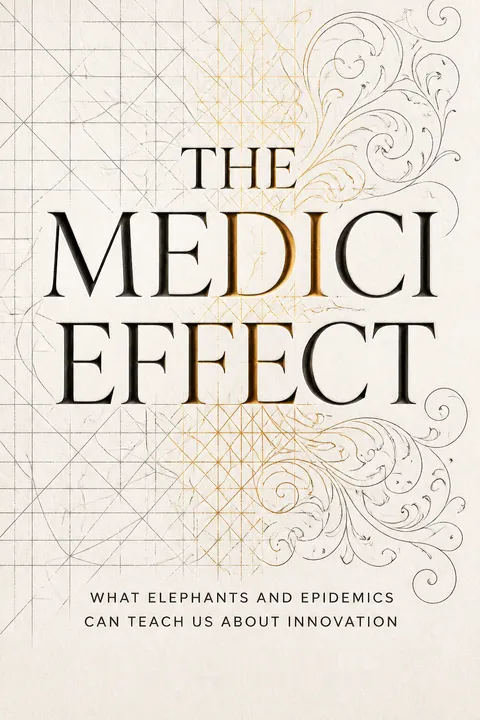
The Medici Effect explores how innovation arises at the intersection of diverse fields and cultures. Readers praise its insights on creativity, though some find it repetitive. The book argues for breaking down barriers between disciplines, generating many ideas, and embracing risk to foster innovation. It offers practical strategies for thinking differently and combining concepts in novel ways. While some reviewers found the concepts familiar, many appreciated the engaging anecdotes and inspirational tone, considering it a valuable read for those seeking to innovate.
People Also Read








Glossary
The Medici Effect
Breakthroughs from intersectionsJohansson's name for the creative potential generated when ideas, skills, or perspectives from separate fields meet. The effect is not that every cross-field combination succeeds. Rather, the meeting expands the range of combinations available, increasing the chance of producing a novel idea that can be developed into an innovation.
Intersection
Meeting point of fieldsJohansson's metaphor for the space where distinct disciplines, cultures, or areas of knowledge overlap. At an Intersection, people can combine concepts that are usually kept separate. Reaching it requires openness to unfamiliar connections, while making something useful there requires the knowledge and effort to develop and test those connections.
Associative barriers
Habitual limits on associationThe familiar mental links that guide people toward conventional interpretations and keep ideas within established categories. They make thought efficient, but can restrict attention to a field's standard answers. Lowering these barriers makes unusual connections easier to notice, though it does not ensure that every connection is relevant or workable.
Directional innovation
Progress within a fieldInnovation that improves or extends an established product, method, or field along a relatively familiar path. Because the relevant customers, standards, and technologies are better understood, plans can often rely on past experience. Johansson contrasts this with intersectional innovation, which combines ideas across fields and involves greater uncertainty.
Occupation diversification
Experience across different fieldsThe practice of moving among different jobs, projects, or areas of work to encounter methods and concepts beyond one's main specialty. These experiences can create unexpected analogies and help transfer an approach from one domain into another. The strategy is most useful when the person can connect the new experience to a real problem.
Intersection hunting
Seeking unlikely connectionsA deliberate search for links between a problem and ideas or objects that appear unrelated to it. Johansson describes exercises such as choosing random words or items, listing their characteristics, and testing whether any characteristic suggests a fresh approach. The purpose is to disrupt predictable associations and generate options, not to force a predetermined answer.
Value networks
Systems that reinforce prioritiesThe customers, partners, suppliers, organizational routines, and expectations within which a firm or person operates. A value network helps its members meet established needs and succeed in a market. It can also make unfamiliar ideas difficult to pursue because resources and approval tend to flow toward what the network already values.
Risk homeostasis
Adjusting behavior to riskThe theory that people may alter their behavior in response to changes in perceived safety, sometimes taking greater risks when safeguards increase. Johansson uses the idea to caution that more resources do not necessarily make an innovative project safer, since ambitions may expand along with those resources. It is a theory of behavior, not a guarantee that all safety measures are neutralized.
Flash-in-the-sky serendipity
Unexpected insight after effortJohansson's term for a sudden connection that arises after sustained attention to a problem, sometimes during a period when the person is no longer consciously working on it. The idea appears unexpected, but it draws on earlier effort and accumulated knowledge. A pause can create room for new associations, though insight cannot be scheduled reliably.
Prepared-mind discoveries
Recognizing accidental significanceDiscoveries that occur when an unexpected event reveals something important to someone equipped to understand it. The observer may not have been seeking that particular result, but prior knowledge makes its meaning visible. Pasteur's observation that previously exposed chickens resisted a later infection is an example used in the book.
Brainwriting
Written collaborative idea generationA group ideation technique in which participants write ideas and pass them around so others can read and build on them. Because everyone can contribute at once, it reduces the waiting and interruption that can limit spoken brainstorming. The method can help teams produce and combine more ideas without requiring each person to compete for speaking time.
FAQ
What's "The Medici Effect" about?
- Intersection of Ideas: "The Medici Effect" by Frans Johansson explores how breakthrough ideas often occur at the intersection of different fields, cultures, and disciplines.
- Historical Reference: The book is named after the Medici family of Renaissance Florence, who fostered a creative environment that led to a burst of innovation by bringing together artists, scientists, and thinkers.
- Innovation Principles: Johansson argues that by combining diverse concepts, individuals and organizations can generate groundbreaking innovations.
- Practical Examples: The book provides numerous examples from various industries and disciplines to illustrate how intersectional thinking leads to creative breakthroughs.
Why should I read "The Medici Effect"?
- Unlock Creativity: The book offers insights into how you can unlock your creative potential by exploring intersections between different fields.
- Practical Advice: It provides practical strategies for fostering innovation in personal and professional settings.
- Diverse Perspectives: By reading it, you gain an understanding of how diverse perspectives can lead to unique solutions and ideas.
- Inspiration for Innovators: It's particularly useful for entrepreneurs, leaders, and anyone interested in driving change and innovation.
What are the key takeaways of "The Medici Effect"?
- Diversity Drives Innovation: Embracing diverse perspectives and experiences can lead to more creative and innovative solutions.
- Intersectional Thinking: Breakthrough ideas often come from combining concepts from unrelated fields.
- Embrace Failure: The book emphasizes the importance of trying many ideas and learning from failures to achieve success.
- Challenge Assumptions: Reversing assumptions and viewing problems from different angles can lead to unexpected insights.
How does Frans Johansson define "The Medici Effect"?
- Concept of Intersection: The Medici Effect refers to the phenomenon where innovation happens at the intersection of different fields, cultures, and disciplines.
- Historical Inspiration: It draws inspiration from the Medici family, who created an environment that allowed for the cross-pollination of ideas during the Renaissance.
- Exponential Idea Generation: At these intersections, the number of potential idea combinations increases exponentially, leading to more opportunities for innovation.
- Breaking Down Barriers: The effect is achieved by breaking down associative barriers and encouraging diverse thinking.
What are some practical strategies from "The Medici Effect" for fostering innovation?
- Diversify Occupations: Engage in different projects and fields to gain varied experiences and insights.
- Interact with Diverse Groups: Work with people from different backgrounds to enhance creativity and idea generation.
- Go Intersection Hunting: Actively seek out connections between unrelated concepts to spark new ideas.
- Embrace Randomness: Introduce randomness into your thinking patterns to discover unexpected intersections.
What role does failure play in "The Medici Effect"?
- Inevitable Part of Innovation: Failure is seen as an inevitable part of the innovation process, especially at the Intersection.
- Learning Opportunity: Each failure provides valuable lessons that can lead to future success.
- Encourages Experimentation: By accepting failure, individuals and organizations are more likely to experiment and take risks.
- Quantity Leads to Quality: The book suggests that producing a large number of ideas, even if many fail, increases the chances of finding a successful one.
How does "The Medici Effect" suggest overcoming fear of failure?
- Acknowledge Fear: Recognize and accept the fear of failure as a natural part of the creative process.
- Balanced Risk View: Adopt a balanced view of risk by understanding that the Intersection offers a low-risk opportunity for innovation.
- Focus on Learning: Emphasize learning and growth over immediate success to reduce the fear of taking risks.
- Intrinsic Motivation: Maintain intrinsic motivation by focusing on passion and interest rather than external rewards.
What are some examples of intersectional innovation from "The Medici Effect"?
- Magic: The Gathering: Richard Garfield combined the concepts of card games and collectibles to create a new genre of games.
- Swarm Intelligence: Eric Bonabeau applied the behavior of social insects to solve complex problems in telecommunications and logistics.
- Violence Prevention and Health Care: Deborah Prothrow-Stith connected violence prevention strategies with health care to address youth violence.
- Optical Fibers: Corning Inc. innovated in telecommunications by exploring intersections between glass technology and physics.
How does "The Medici Effect" address the role of diversity in innovation?
- Cultural Exposure: Exposure to different cultures helps break down associative barriers and fosters creative thinking.
- Diverse Teams: Working with diverse teams leads to a greater variety of ideas and perspectives, enhancing innovation.
- Interdisciplinary Collaboration: Collaboration across disciplines encourages the combination of different concepts, leading to unique solutions.
- Globalization Impact: The movement of people and ideas across borders increases opportunities for intersectional innovation.
What are the best quotes from "The Medici Effect" and what do they mean?
- "The best way to get a good idea is to have a lot of ideas." This quote emphasizes the importance of generating numerous ideas to increase the likelihood of finding a successful one.
- "Creativity comes from passion." It highlights the role of intrinsic motivation and passion in driving creative efforts and innovation.
- "Expect the unexpected." This encourages openness to new experiences and perspectives, which can lead to unexpected insights and breakthroughs.
- "The future lies at the Intersection." It suggests that the most innovative solutions will come from combining diverse fields and disciplines.
How does "The Medici Effect" suggest balancing depth and breadth of knowledge?
- Core Competence: Develop a core competence in one area before exploring other fields to ensure a solid foundation of knowledge.
- Team Collaboration: Collaborate with others who have different expertise to leverage both depth and breadth of knowledge.
- Continuous Learning: Engage in lifelong learning to expand your knowledge base and increase your ability to connect diverse concepts.
- Flexible Thinking: Maintain flexibility in thinking to adapt and apply knowledge from one field to another.
How can "The Medici Effect" be applied in a business context?
- Encourage Diversity: Foster a diverse workplace to enhance creativity and innovation through varied perspectives.
- Promote Cross-Disciplinary Projects: Encourage employees to work on projects that combine different fields and expertise.
- Support Experimentation: Create an environment where experimentation and risk-taking are encouraged and supported.
- Leverage Globalization: Take advantage of global networks and cultural exchanges to find new opportunities for innovation.
Download PDF
Download EPUB
.epub digital book format is ideal for reading ebooks on phones, tablets, and e-readers.








