Key Takeaways
1. Your Mind's Core: Thoughts, Emotions, and Behaviors Drive Trading
Your entire mental life (the biosystem known as the human mind) is defined by and can be broken down into a combination of three basic elements: 1. Thoughts 2. Emotions 3. Behaviors
Interconnected mental life. The human mind operates as an inextricable system of thoughts, emotions, and behaviors, each influencing the others in a continuous feedback loop. A negative thought, for instance, can trigger negative feelings, which in turn can lead to detrimental actions, and vice-versa. Understanding this dynamic is the first step to gaining control over your mental state in trading.
Brain's dual pathways. The brain functions with two main parts: the superficial cortex (shell) for complex thought and decision-making, and the deep subcortex (core) for primitive emotions and survival instincts. Emotional stimuli can either take a slow, precise indirect pathway through the cortex for logical analysis, or a fast, crude direct pathway that bypasses the cortex, leading to rapid, emotion-driven reactions. Successful trading requires a balance, preventing emotions from short-circuiting logical reasoning.
The reward center's influence. Deep within the brain's core lies the nucleus accumbens, the seat of reward, pleasure, and addictive behaviors. This system, designed for species survival, gets highly activated by the anticipation of rewards, including money. For traders, this means the thrill of anticipating profits can be more stimulating than the profits themselves, potentially leading to excessive risk-taking and a vicious cycle of seeking "rushes" rather than rational gains.
2. Personality is Dimensional: Understand Your Unique Spectrum, Not Just Categories
It’s not whether you have it or not, but how much of it you have in comparison to everyone else.
Spectrum of traits. Unlike diseases that you either have or don't, personality traits exist on a quantitative spectrum, or dimension, where everyone falls somewhere along a bell-shaped curve. This means it's not about being "good" or "bad" in a trait, but rather how much of it you possess compared to the average person.
Extremes reveal insights. The most telling aspects of your personality are found at the "very high" or "very low" ends of these dimensional scales. Just as an extremely tall basketball player leverages his height for success but must adapt to challenges like low doorways, extreme personality traits offer unique advantages and vulnerabilities that require conscious adaptation.
Adaptation is key. Understanding your position on these dimensional scales is crucial for self-awareness. Since personality is largely stable after early adulthood, the goal isn't to change who you are, but to identify your unique blend of traits, acknowledge their implications, and learn to adapt your behaviors and strategies to maximize strengths and mitigate weaknesses.
3. The NEO-AC: Your Gold Standard for Unlocking Trading Personality
The Revised NEO Personality Inventory, NEO PI-R, is the gold standard of personality testing.
The Five-Factor Model. The NEO-AC (Neuroticism, Extraversion, Openness, Agreeableness, Conscientiousness) is the most researched and validated personality inventory, assessing five major domains and 30 specific facets. It provides a comprehensive, detailed, and scientifically robust assessment of normal adult personality, applicable across cultures and ages.
Hierarchical assessment. Interpreting NEO-AC results involves a top-down approach: first, examine the five broad domains for pervasive trends and significant deviations from the mean. Second, analyze the six facets within each domain to understand which specific traits contribute most to the overall score. This detailed breakdown offers profound insights into a person's temperament.
Beyond simple quizzes. Unlike brief, vague online quizzes, the NEO-AC offers quantitative assessments, plotting scores on a "Norms Profile Sheet" to show how an individual compares to the general population. This allows for precise identification of outlier traits that are most impactful, whether problematic or advantageous, in various life contexts, including trading.
4. Low Anxiety and Vulnerability Are Hallmarks of Top Traders
That is, these successful traders, compared to the average people walking around on the street, experience far less anxiety and feel far less vulnerable to failure and defeat when they are placed under stress.
Emotional stability under pressure. Research consistently shows that successful traders exhibit low scores in Neuroticism facets N1 (anxiety) and N6 (vulnerability). This means they remain calm, collected, and less prone to worry or feelings of helplessness when facing market volatility or stressful trading situations. Their emotional stability prevents negative feelings from derailing their cognitive functions.
Cognitive clarity. Traders with low anxiety and vulnerability are better equipped to make logically sound decisions, unclouded by the emotional rollercoaster of wins or losses. They don't let the excitement of a winning trade lead to overconfidence, nor the fear of a losing trade trigger panic. This allows them to maintain focus on market analysis, pattern recognition, and strategic planning.
Habituation and titration. For traders with higher anxiety, the solution lies in habituation and titration. Gradually exposing oneself to increasing levels of trading stress, starting with small positions and less volatile markets, helps the brain adapt and reduce anxiety's impact. Avoiding premature exits from winning trades due to fear, and instead sticking to a plan, is crucial for building emotional endurance.
5. Master Impulsivity and Overconfidence with Deliberate Strategies
Overconfidence tends to lead traders to underestimate the risks involved with trading, and that is what sets them up for failure.
Impulsivity's pitfalls. High impulsivity (N5) can lead to "trigger-happy" trading, entering or exiting positions without full evaluation, often resulting in overtrading. This trait, especially when combined with low vulnerability, can cause traders to plunge recklessly into trades, neglecting due diligence and increasing exposure to risk.
Overconfidence's dangers. While a degree of confidence (C1) is beneficial, excessive overconfidence can be disastrous. It leads traders to believe they are immune to mistakes, underestimate risks, and ignore warning signs. "Beginner's luck" often fosters this, causing new traders to take on larger positions prematurely and ultimately face significant losses.
Strategic countermeasures. To combat impulsivity and overconfidence, implement structured strategies:
- Checklists: Create and rigorously follow a pre-trade checklist to ensure all variables are considered before acting.
- Cool-off periods: Introduce brief pauses before and after trades to gain perspective and prevent emotion-driven decisions.
- Pro/Con lists: Tangibly write down logical and emotional pros and cons for each trade to force a balanced analysis.
- Humility: Cultivate respect for the markets, acknowledging their unpredictability and your own limitations, especially after winning streaks.
6. Align Your Trading Style with Your Conscientiousness for Optimal Results
Both discretionary trading and mechanical or system trading have the potential to be equally profitable.
Conscientiousness and trading styles. Your level of conscientiousness (C), particularly the C2 (order) facet, strongly correlates with your optimal trading style. High C individuals, who are orderly and disciplined, thrive with mechanical systems that rely on strict rules and automated execution. Conversely, those low in C2 find rule-based systems confining and are better suited for discretionary trading.
Systems trading advantages. For high-C traders, mechanical systems offer a structured approach, removing emotional interference by dictating trades based on predefined criteria. This allows for consistent execution and can even be delegated or automated, as exemplified by KD Angle's long-term success with systematic programs.
Discretionary trading strengths. Low-C traders, like Linda Raschke and Scott Ramsey, excel in discretionary trading, where they make decisions based on their judgment, interpretation of market patterns, and intuition. This style demands adaptability, creativity, and the ability to synthesize diverse information, often appealing to those with high openness and artistic inclinations.
7. Beware of Excitement-Seeking and Unchecked Greed in the Markets
For many—especially those high in E5—the markets all too easily become a source of “expensive thrills.”
Excitement-seeking as a trap. High excitement-seeking (E5) can lead traders to place trades not for logical market reasons, but to fulfill an emotional need for stimulation, potentially compensating for a lack of excitement elsewhere in life. This turns trading into a "drug," leading to impulsive, ill-advised trades and "expensive thrills" that prioritize the rush over rational profit.
Greed's deceptive pull. The desire for monetary gain (often linked to high O4, actions) is a natural human drive, but excessive greed can be detrimental. It pushes traders to take undue risks, hold positions longer than prudent, or enter trades at market peaks, hoping to "squeeze a few more points." This emotional pull can override logical analysis, leading to significant losses.
Mitigating the risks. To counter excitement-seeking and greed:
- Diversify excitement: Seek thrills in other, safer areas of life to prevent using markets as a substitute.
- Focus on process, not just profit: Emphasize the challenge and mastery of trading rather than solely the monetary outcome.
- Define criteria: Clearly articulate your trading goals and adhere to them, preventing emotional urges from dictating actions.
- Self-awareness: Continuously monitor your motives and emotional state to ensure decisions are rational, not driven by a need for a "high" or an insatiable desire for "just a little bit more."
8. Cultivate Autonomy, Mastery, and Relatedness for Lasting Trader Happiness
The three key components to long-term happiness (SLS) in life include: 1. The ability to pursue autonomous goals 2. A sense of mastery or skill in something that is meaningful 3. The experience of feelings of relatedness with other people
Beyond monetary gains. Long-term happiness, or subjective life satisfaction (SLS), is not solely about making money. For traders, true fulfillment comes from a blend of autonomy, mastery, and relatedness, which trading can uniquely offer. If trading consistently brings negative emotions, regardless of profit, it may be detracting from overall well-being.
Autonomy and mastery in trading. Trading provides unparalleled autonomy, allowing individuals to be their own boss, set their hours, and make all critical decisions. It also offers a profound path to mastery, as the markets present an endless intellectual and psychological challenge. The satisfaction derived from understanding and skillfully navigating these complexities can be immensely rewarding.
The challenge of relatedness. While trading excels in autonomy and mastery, personal traders often struggle with relatedness due to the solitary nature of the profession. To achieve balanced happiness, it's crucial to actively seek social interaction, whether through trading groups, mentorship, or community involvement, ensuring that the pursuit of market success doesn't lead to isolation.
9. Adapt Your Innate Personality; Don't Try to Fundamentally Change It
You cannot lower your innate propensity very much, but you can lower your emotional reactivity using various methods.
Personality is stable. As an adult, your core personality traits are largely stable and difficult to fundamentally alter. The goal is not to become a "perfect trader" with an idealized personality, but to deeply understand your unique blend of traits, including strengths and weaknesses, and then learn to adapt your trading strategies and behaviors accordingly.
Leveraging strengths, mitigating weaknesses. Successful traders, even those with seemingly "disadvantageous" traits like high anxiety (Dan Zanger) or impulsivity (Larry Williams), learn to thrive by recognizing their predispositions. They develop compensatory mechanisms, such as strict money management, disciplined routines, or specific market approaches that align with their temperament.
Continuous adaptation. The market is dynamic, and so must be your approach. Even the most conscientious traders, like C.M., can become too rigid and slow to adapt to changing market conditions, leading to losses. Continuous self-assessment and a willingness to adjust strategies based on both market shifts and personal emotional responses are vital for sustained success.
10. Recognize and Avoid the Traps of Over-Dependency and Trading Addiction
An addiction occurs when a given behavior (food, sex, money, drugs, or what have you) provides an intense stimulation that fuels the brain’s reward system.
The dependent trader. Overly dependent traders seek constant reassurance, follow "hot tips," and rely on others' advice rather than developing their own understanding and strategies. This behavior, often linked to high anxiety (N1), warmth (E1), low assertiveness (E3), and high trust (A1), prevents them from cultivating their unique trading style and can lead to significant losses.
Healthy mentorship vs. reliance. While mentorship can be valuable, it should foster independence, not perpetual reliance. A good mentor teaches self-mentorship, guiding students to develop their own skills and judgment. Once confident, traders should "cut ties" to avoid becoming overly reliant, which can lead to confusion and a loss of personal trading identity.
Identifying trading addiction. Trading can become an addiction when it primarily fuels the brain's reward system, leading to compulsive behavior despite negative consequences. Key signs include:
- Inability to cut back or stop trading.
- Trading for excitement or to alleviate boredom.
- Increasing trade frequency or size for the same "high."
- Trading losses causing relationship or financial problems.
- Preoccupation with trading outside market hours.
If three or more of these signs are present, professional help is crucial, and a permanent cessation of trading may be necessary.
Last updated:
Review Summary
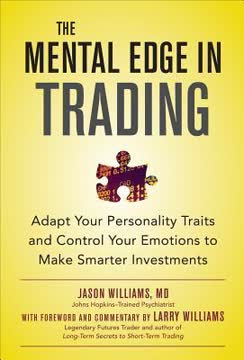
The Mental Edge in Trading receives high praise from readers, with an average rating of 3.81 out of 5. Reviewers emphasize its importance for traders and investors, highlighting the focus on the mental aspects of trading. The book's insights on embracing anxiety, shifting focus from profits to process goals, and understanding individual trading personalities are particularly valued. Readers describe it as eye-opening, a game-changer, and essential reading for those in the trading field. Some note that it helped them realize not everyone is suited for trading.
Similar Books