Key Takeaways
1. Myth Organizes Emotions into Social Reality
Myth does not arise solely from intellectual processes; it sprouts forth from deep human emotions.
Myth's fundamental nature. Myth is not merely a product of "primeval stupidity" or simple imagination, as some early anthropologists suggested. Instead, it is a profound expression of deep human emotions, transforming vague feelings into concrete images and narratives. This process of objectification allows man to confront and organize his most deeply rooted instincts, hopes, and fears, especially in the face of overwhelming challenges like death.
Beyond intellectualism. Early theories, like those of Tylor and Frazer, intellectualized myth, seeing it as primitive philosophy or science, while Max Müller viewed it as a "disease of language." Cassirer argues these approaches miss the crucial emotional core. Levy-Bruhl's "prelogical" mind, though emphasizing difference, also failed to explain how myth could be understood if entirely alien to rational thought.
Expression and function. Cassirer synthesizes these views, asserting that myth is emotion "turned into an image," a symbolic expression that condenses and intensifies feelings rather than merely discharging them. This transformation from passive state to active process allows myth to serve a vital function in social life, fostering collective identity and providing understandable interpretations of nature and human existence, particularly through ritual.
2. Greek Logos Challenged Myth with Rational Ethics
To overcome the power of myth we must find and develop the new positive power of "self-knowledge."
Early rational inquiry. Greek philosophy initiated a profound shift from mythical to rational thought, beginning with the Milesian school's inquiry into the physis (nature) of things, seeking substantial causes rather than capricious supernatural agents. Thinkers like Heraclitus and Xenophanes further challenged anthropomorphic deities, insisting on a unified, ethical divine nature, thereby laying the groundwork for a more reasoned understanding of the cosmos.
Socrates' ethical turn. The Sophists attempted to rationalize myth through allegorical interpretation, but Socrates rejected this as a mere "subterfuge." He redirected philosophical inquiry from cosmic speculation to human self-knowledge, arguing that true understanding and ethical conduct could only be achieved through rational self-examination, not through the arbitrary reinterpretation of ancient legends.
Good and evil. For Socrates, the essential question was not about the deeds of gods or heroes, but about good and evil in human life. The Socratic "Logos" offered a method of dialectical inquiry to discern moral truth, contrasting sharply with myth's inability to provide answers to this fundamental ethical problem, thus marking a decisive step in liberating human thought from mythical dominance.
3. Plato's Ideal State Demanded Rational Justice, Not Myth
If we tolerate myth in our political systems, he declared, all our hopes for a reconstruction and reformation of our political and social life are lost.
Politics as psychology's key. Plato, a devoted disciple of Socrates, expanded the quest for self-knowledge to the realm of the state, asserting that individual human nature could only be fully understood by examining it in the larger context of political and social life. His Republic thus became a foundational text for a rational theory of the state, aiming to establish justice as its supreme principle.
Justice as universal order. Plato defined justice not as a specific virtue, but as a universal principle of order, regularity, and lawfulness, akin to "geometrical equality." This principle applied to both the individual soul (harmony of its parts) and the state (right proportion among social classes), making the political cosmos a symbol of the universal cosmos. This vision laid the groundwork for the "Legal State," governed by immutable rational principles.
Expelling myth for order. Despite being a great myth-maker himself, Plato vehemently argued for the expulsion of poets and traditional myths from his ideal state. He recognized that mythical narratives, with their portrayals of warring and deceitful gods, fostered disorder and prevented the establishment of a truly rational and ethical commonwealth. For Plato, genuine political reform required replacing mythical authority with the guiding light of the "Idea of the Good."
4. Medieval Thought Grounded Law in Divine Will and Natural Equality
God and the soul, that is what I desire to know. Nothing else? Absolutely nothing.
Christian transformation of Plato. Medieval political theory, deeply rooted in Christian revelation, adopted Plato's ideal of justice as the state's primary task but fundamentally reinterpreted its source. Platonic ideas, including the Idea of the Good, were transformed into the thoughts of God, making justice an expression of a personal, divine will rather than an impersonal, eternal geometric principle.
Voluntarism and revelation. Influenced by Jewish monotheism, medieval thinkers emphasized God as the supreme lawgiver, whose will, not human reason, defined good and evil. Augustine, for instance, rejected the "longer way" of Greek philosophy, asserting that true wisdom and knowledge of God came through divine revelation and faith, with human reason serving as an illuminated instrument.
Stoic equality and limited power. Despite the emphasis on divine authority, medieval philosophy also integrated the Stoic concept of the fundamental equality of all men, often justified by the idea that human reason is the "image of God." This led to the crucial principle that no political power could be absolute; it was always bound by divine and natural law, allowing for the legitimacy of resistance against unjust rulers, as articulated by Thomas Aquinas.
5. Machiavelli Forged a Secular Science of Power and Statecraft
However, since I write only for the instruction of such, as I would have thoroughly acquainted with the nature of things, I thought it better to represent them as they really are in fact, than to amuse the imagination with visionary models or Republics and Principalities (as several have done) which never did nor can exist.
Break from tradition. Machiavelli's The Prince marked a radical departure from previous political philosophy, discarding the medieval emphasis on divine right and moral ideals. He ignored theocratic principles, focusing instead on the empirical realities of power acquisition and maintenance, thereby founding a new, secular science of politics based on observation rather than abstract ideals.
Amoral pragmatism. Machiavelli approached political actions with the detached coolness of a scientist, analyzing them as "imperatives of skill" rather than moral judgments. He recommended deception, cruelty, and perfidy not as inherently good, but as necessary tools for a ruler, particularly in "new principalities," to secure and maintain power, viewing politics as a game where the winning move is the only concern.
Religion as a tool. For Machiavelli, religion was not a transcendent truth but a pragmatic instrument for statecraft. He admired how the Romans used religion to foster civic order and military success, contrasting it with Christianity's perceived weakening effect on men. This instrumental view completed the secularization of the state, legitimizing its existence and actions independently of spiritual values.
6. Machiavelli's Fortune: The Unpredictable Force in Politics
It is better to be bold than bashful: for Fortune is like a woman who must be teased and treated in a Cavalier manner by those that expect to prevail over her.
The unpredictable element. Despite his scientific approach to politics, Machiavelli acknowledged the powerful, often whimsical, role of "Fortune" in human affairs, which seemed to defy all rational calculation and prediction. This presented a paradox to his otherwise deterministic view of history, where human passions and events were thought to repeat themselves.
Virtù against Fortune. Machiavelli secularized the medieval concept of Fortune, stripping it of divine providence. He argued that while Fortune might control half of human actions, the other half remained within man's grasp through virtù—a combination of strength, skill, and resolute will. This required a leader to be adaptable, combining timidity with courage, and knowing when to act impetuously.
Action over passivity. Machiavelli's emphasis on virtù was a call to action against fatalism. He likened Fortune to a raging river that, while powerful, could be mitigated by foresight and preparation. A prince must not only understand the "art of war" but also possess a mental strategy, a boldness to seize opportunities and confront challenges head-on, rather than passively submitting to fate.
7. Enlightenment Reasserted Natural Rights and Rational Autonomy
The object of the Declaration of Independence... was not to find out new principles, or new arguments, never before thought of, not merely to say things which had never been said before; but to place before mankind the common sense of the subject, in terms so plain and firm as to command their assent.
Revival of Stoic ideals. The 17th and 18th centuries witnessed a powerful resurgence of Stoic-inspired natural rights theories, which became the bedrock of Enlightenment political philosophy. Thinkers like Grotius, Locke, and Rousseau, and later figures like Jefferson and Kant, championed the inherent equality and unalienable rights of man, viewing these as self-evident truths accessible through reason.
Reason's autonomy. This era, characterized by Cartesian rationalism, asserted the autonomy of human reason, liberating it from theological guardianship. Political theories, like those of Hobbes and Grotius, sought to derive principles from the "nature of man" and the state through deductive, almost mathematical, methods, aiming for clarity and certainty in social organization.
Practical application. The Enlightenment philosophers were not content with abstract speculation; they sought to translate these rational principles into practical political action. The American and French Declarations of Rights embodied this spirit, transforming philosophical ideals into foundational documents for new political orders, driven by a belief in the "primacy of practical reason" and the possibility of a better future.
8. Carlyle's Hero Worship: The Moral Force of Great Individuals
Hero Worship, heartfelt prostrate admiration, submission, burning, boundless, for a noblest godlike form of man—is not that the germ of Christianity itself?
Hero as secularized saint. Thomas Carlyle, in his On Heroes, Hero Worship and the Heroic in History, posited hero worship as an "everlasting hope" for governing the world, a fundamental human instinct. He saw the hero as a secularized saint, an incarnation of a "Divine Idea," whose word and actions were indispensable for progress and salvation from anarchy, reflecting a transformed Calvinistic ethos.
Insight and sincerity. Carlyle's hero is defined by "insight" and "sincerity," despising lies and deception. He is a profound thinker, a "spiritual hero" whose intellectual depth fuels his imagination and action. This emphasis on moral force and genuine conviction distinguishes Carlyle's heroes from mere power-seekers, making them figures of integrity and truth.
Action and duty. Influenced by Goethe and Fichte, Carlyle championed a "Life-Philosophy" where doubt is overcome by action, and self-knowledge is found in "what thou canst work at." His categorical imperative, "Produce, Produce!", underscored a dynamic, ethical view of reality, where man's worth is determined by his active engagement with duty, rather than passive contemplation or abstract speculation.
9. Gobineau's Race Worship: The Totalitarian Principle of Blood
History springs only from contact of the white races.
Race as sole historical determinant. Gobineau's Essai sur l'inégalité des races humaines presented a fatalistic, pseudo-scientific theory asserting race as the exclusive and omnipotent force driving human history. He claimed to elevate history to a natural science, arguing that all civilization originated solely from the "white races," with other races being inert masses incapable of self-governance or cultural creation.
Destruction of universal values. Gobineau's theory systematically dismantled all universal values—religious, moral, and political—that might challenge the supremacy of race. He dismissed Christianity's practical influence, condemned Buddhism as a "moral perversity," and branded patriotism as a "Canaan monstrosity," arguing that virtue and dignity were inherited through blood, not acquired through action or universal principles.
Pessimistic outcome. Despite his initial exaltation of the Aryan race, Gobineau's theory culminated in profound pessimism. He posited that the higher races, through inevitable blood mixture with inferior stocks, would ultimately degenerate and self-destruct. This process, leading to a future of contented somnolence and eventual lethargy, sealed the fate of human civilization in a "twilight of the gods," entangled in its own ruin.
10. Hegel's State: The Divine Idea Manifested in History
The State... is the Divine Idea as it exists on earth.
State as supreme reality. Hegel's metaphysics profoundly influenced political thought by elevating the state to the highest reality, the "Divine Idea as it exists on earth." He viewed the state not merely as a part of history, but as its very essence and prerequisite, arguing that historical life and the actualization of reason only truly begin within the framework of the state.
Dialectic of history. Hegel's philosophy of history served as a "Theodicaea," justifying the existence of evil and suffering as necessary components of the Spirit's self-realization. He rejected abstract moralism (like Kant's "law of the heart" leading to the Reign of Terror), asserting that true ethical substance is found in the concrete, often harsh, reality of the state, where the "cunning of reason" uses individual passions to achieve universal ends.
Imperialistic nationalism. Hegel's doctrine posited that the "world-spirit" manifests through one dominant nation in each historical epoch, granting that nation "absolute right" over others. While he distinguished between "reality" and "idle existence" and valued cultural goods like art and philosophy above the state's direct control, this concept laid a theoretical groundwork for ruthless imperialistic nationalism, where power and historical destiny became intertwined.
11. Modern Political Myths: Manufactured Reality and Social Control
Henceforth myths can be manufactured in the same sense and according to the same methods as any other modern weapon—as machine guns or airplanes.
Crisis and irrationality. The period after World War I, marked by profound social and economic crises, created fertile ground for the resurgence of political myths. In desperate times, when rational solutions failed, collective desires became personified in leaders, leading to a reliance on "social magic" and the belief that a single "right man" could resolve all problems, much like the sorcerer in primitive societies.
Technique of myth-making. Unlike ancient myths, modern political myths are not spontaneous but are deliberately fabricated using sophisticated techniques. This involves a transformation of language, where words are stripped of their semantic meaning and charged with violent emotions to produce specific political effects, alongside the introduction of pervasive rituals that demand uniform behavior and suppress individual judgment.
Erosion of freedom and responsibility. The systematic imposition of these manufactured myths and rituals aims to paralyze critical thought and dissolve individual responsibility, replacing it with collective acquiescence. By destroying the sense of ethical freedom—the autonomy of the moral subject—modern political myths effectively subdue populations, turning citizens into passive agents controlled by political leaders, akin to Odysseus's companions transformed by Circe.
Last updated:
Review Summary
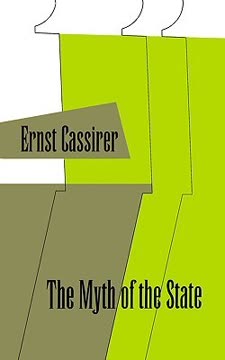
The Myth of the State receives mixed reviews (3.91/5). Readers praise Cassirer's analysis of how mythical thinking influences politics from ancient Greece through modern totalitarianism, particularly his examinations of Plato, Machiavelli, and Hegel. Many appreciate his exploration of how rational societies revert to myth during crises, enabling fascism's rise. Some find the dense philosophical discussions challenging, especially early chapters on myth theory. Critics note the work feels unfinished and question Cassirer's defense of certain philosophers like Hegel. Most recommend it for understanding totalitarianism's philosophical roots, though opinions vary on its coherence and accessibility.