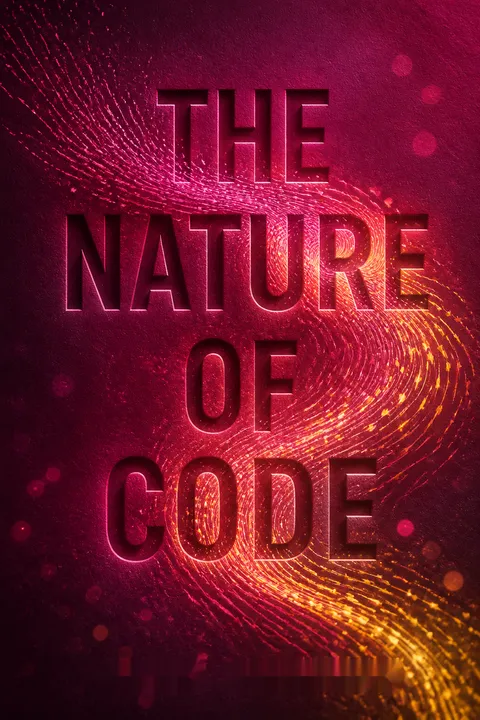


Key Takeaways
Model nature as code: specify rules, then watch behavior emerge.
A book about making. Daniel Shiffman’s guide uses Processing to turn observations of the physical and biological world into working simulations. It is not a rigorous physics text or a design manual. Its central question is practical: what rules could produce this behavior, and how can those rules be programmed? The book assumes readers already know programming basics, especially object-oriented programming, and builds from there.
A widening world. The journey starts with simple motion, then adds forces, groups, autonomous behavior, and systems that learn or evolve. A random walker introduces the core habit of thinking in rules. An ongoing digital ecosystem project shows how separate techniques can become parts of one larger simulation. The aim is not to copy nature perfectly, but to expand the programmer’s toolbox for creating convincing, controllable behavior.
What’s striking is the book’s shift from drawing an image of nature to specifying a process that could generate it. That distinction matters in animation, design, and scientific visualization: a convincing result can come from a useful model even when the model is not a complete account of reality. The tradeoff is worth keeping visible. A simulation can look natural while encoding arbitrary assumptions, so its rules should be treated as design decisions, not as proof of how nature works.
Choose randomness deliberately, from weighted chances to smooth Perlin noise.
Not all chance is equal. A uniform random number generator gives each outcome the same probability. That works for a basic random walk, but often makes a system look mechanical or scattershot. A weighted distribution can favor some outcomes: a walker, for instance, can have a greater chance of stepping right than left. A Gaussian distribution instead clusters values around an average, useful for examples such as generating mostly average-sized creatures with occasional extremes.
Add continuity or rare jumps. Perlin noise produces smoothly changing pseudo-random values, useful for wandering motion, cloud-like patterns, or a changing wind force. A Lévy flight approximates foraging by mixing many small steps with rare, much larger ones. Each method creates a different character of variation. The programmer chooses the rules rather than treating randomness as a universal answer.
Randomness is a design material, not a synonym for naturalness. Weighted chance expresses preference, Gaussian variation expresses clustering around a typical value, and Perlin noise expresses continuity. Those distinctions help make a simulation legible because the source of variation matches the behavior being represented. Smoothness can also mislead: real events may be abrupt, and Perlin noise can become a new default crutch. The useful question is not which method looks organic, but what kind of variation the system needs.
Track motion with vectors, and let accumulated forces drive acceleration.
Bundle motion data. A vector stores magnitude and direction, making it a compact way to represent location, velocity, or acceleration. In Processing, a PVector replaces separate horizontal and vertical variables and provides operations such as addition, subtraction, scaling, and normalization. The basic motion loop is simple: acceleration changes velocity, then velocity changes location. This gives an object a history instead of teleporting it to each new position.
Let forces add up. Newton’s second law relates force, mass, and acceleration. A mover can collect several forces, such as wind and gravity, divide their sum by mass, and update its acceleration. The acceleration must be cleared after each update so forces apply only when present. Friction and drag can slow motion, while gravitational attraction can pull objects together. These are models whose strengths can be tuned for the intended effect.
Vectors are valuable not only because they reduce repetitive coordinates, but because they make relationships explicit. A force points somewhere and has a strength, so different causes can be combined with the same operation. This is also the foundation of feedback control: acceleration adjusts velocity, and velocity adjusts position. The simple Euler update is easy to understand, but it advances motion in discrete frames and can be inaccurate or unstable in some situations. Clarity and fidelity are separate goals.
Use angles and sine waves to give motion rhythm and elasticity.
Rotation follows the same logic. An object’s angle can change through angular velocity, which can itself change through angular acceleration. Trigonometry converts between an angle and Cartesian coordinates, allowing a point to trace a circular path or a shape to face the direction it is moving. Sine and cosine provide smooth oscillation, described by amplitude, the distance from the center, and period, the time required for a full cycle.
Model the connection. A pendulum can be animated by calculating angular acceleration from gravity and the sine of its angle, then damping its motion so it gradually slows. A spring can be modeled with Hooke’s law: its force grows with the difference between its current length and its resting length, and points toward equilibrium. Sine waves are quick visual shortcuts; force-based springs are more useful when the object must respond to other forces.
Periodic motion gives animation a useful vocabulary: amplitude controls how far something moves, while period controls how quickly it repeats. The distinction between a sine-wave shortcut and a force-based model is especially practical. One gives direct artistic control; the other lets motion respond to changing conditions. This is a general modeling choice: prescribe the output when appearance is the priority, or represent the mechanism when interaction is the priority. Neither is automatically more truthful or more useful.
Build particle systems for scale, then choose physics engines by task.
Manage many small bodies. In a particle system, an emitter creates individual particles that move, change, and eventually disappear. William Reeves developed the technique for the Genesis effect in Star Trek II: The Wrath of Khan. A particle can have a lifespan, fading as it dies; an ArrayList lets the system add and remove particles as needed. Inheritance and polymorphism allow one system to contain different particle types without duplicating all its management code.
Borrow machinery when needed. Box2D is suited to realistic collisions, joints, and motors, but requires translating between its world units and Processing pixels. toxiclibs’ Verlet physics is simpler for connected particles and springy forms, supports 3D, and does not handle collision geometry. The choice depends on the project. A simple falling circle needs no engine; interacting polygons may justify Box2D, while a soft, connected structure points toward Verlet physics.
The particle system is both a visual effect and a reusable way to manage collections whose size changes over time. Its architecture separates the behavior of one element from the rules governing the group, a pattern useful well beyond graphics. Physics engines make a similar separation between a programmer’s goal and the calculations required to achieve it. Their convenience has a cost: units, APIs, and rendering must agree. A library removes certain work, not the need to understand the model.
Let local steering rules organize a flock without a leader.
Give agents limited awareness. An autonomous agent perceives part of its environment, chooses an action, and moves without a central controller. Craig Reynolds’s steering method calculates a desired velocity, compares it with the agent’s current velocity, and turns the difference into a steering force. Seeking points toward a target; arriving reduces speed as the agent approaches. A flow field gives agents a local direction to follow, while path following steers them back toward a route.
Combine rules for groups. Reynolds’s flocking model combines separation, which avoids crowding; alignment, which matches nearby headings; and cohesion, which moves toward nearby group members. The group’s organized motion comes from local interactions, not a flock leader. A straightforward implementation checks every agent against every other agent, requiring roughly N-squared comparisons. Dividing space into grid cells can reduce unnecessary neighbor checks.
The key modeling decision is what an agent can perceive. A limited neighborhood makes local interaction part of the system’s design, rather than granting every creature perfect knowledge. The three flocking rules also show how cooperation and competition can coexist: alignment and cohesion hold a group together, while separation preserves space. These ingredients do not guarantee a compelling result. Neighbor distance and force weights matter, and small parameter changes can produce very different group behavior.
A cell’s next state depends on neighbors, not overwritten history.
Define a local update. A cellular automaton is a grid of cells whose states change according to rules applied to their neighborhoods. In a one-dimensional elementary automaton, each cell has a binary state and a neighborhood of three cells. There are eight possible neighborhood patterns, so a rule can be represented by eight bits. Rule 90, for example, produces a Sierpiński triangle pattern from a single active starting cell.
Preserve the generation. To calculate a new generation correctly, read every cell from the old grid and write results into a separate new grid. Only after all updates are complete should the new grid replace the old one. Conway’s two-dimensional Game of Life uses rules based on the number of living neighbors: an isolated cell dies, an overcrowded one dies, and a dead cell with exactly three living neighbors is born. Simple rules can yield stable, oscillating, or moving patterns.
Separate old and new states are not merely a coding convenience. They preserve the model’s assumption that every cell responds to the same previous moment, rather than to a mixture of old and already-updated neighbors. That makes update order meaningful and reproducible. Cellular automata also make emergence visible: patterns arise from repeated local rules without being drawn cell by cell. Still, complexity of appearance should not be confused with intelligence or biological realism.
Grow fractal forms recursively, and stop before recursion eats the machine.
Repeat a smaller rule. A fractal is a finely structured shape that often resembles itself at different scales. Recursion, a function calling itself on a smaller version of its problem, provides a direct way to generate such forms. The Cantor set repeatedly removes the middle third of a line. The Koch curve replaces each segment with four smaller segments. A recursive tree branches into new branches, and adding variation to branch lengths or angles can make the result less rigid.
Set a clear limit. Every recursive process needs an exit condition, such as stopping when a line becomes smaller than a pixel or when a chosen number of generations has been reached. L-systems provide another approach: a starting string and replacement rules produce instructions for drawing, such as moving forward, turning, or saving a position. Recursion and L-systems can generate plant-like structures, but visual style remains a choice.
Recursion is powerful because a short rule can describe a large structure, much like a compact grammar can generate a long sentence. It also exposes a practical tension: the mathematical idea may continue indefinitely, while a computer has finite time, memory, and screen resolution. The stopping condition is therefore part of the model, not a mere technical patch. Natural forms also vary, so exact self-similarity is often a useful starting point rather than a complete description.
Make evolution computational: encode traits, score fitness, and preserve variation.
Turn traits into data. A genetic algorithm searches for solutions by maintaining a population of candidates. Each candidate has encoded traits, or genes. A fitness function scores how well it meets a goal; selection makes higher-scoring candidates more likely to reproduce. Crossover combines traits from two parents, and mutation introduces new variation. In the book’s typing example, random character strings evolve toward a known phrase, a demonstration of the process rather than a practical writing method.
Choose the score carefully. Smart Rockets use sequences of forces as their genetic material and are rewarded for reaching a target while avoiding obstacles. In an ecosystem, creatures that find food may live longer and reproduce, so survival shapes the population without a central evaluator. A poor fitness function can reward the wrong behavior. Population size, mutation rate, and the balance between selection and variation all influence whether the search improves, stalls, or becomes random.
The hardest part of an evolutionary simulation is often not mutation or crossover, but deciding what success means. A numerical proxy makes selection computable, yet it can favor a shortcut that satisfies the score while missing the designer’s real aim. This resembles a broader problem in optimization: the measurable target is not always the meaningful one. Variation matters for another reason: a population that converges too quickly may discard useful traits before they can be combined.
Use perceptrons as simple learners, not as replicas of human thought.
A neuron in miniature. A perceptron receives numerical inputs, multiplies each by a weight, sums the results, and applies an activation rule. The book’s simplest rule outputs positive one or negative one depending on the sum’s sign. A bias input helps shift the decision boundary. With labeled examples, the perceptron compares its guess with the known answer and adjusts its weights according to the error and a learning rate.
Know the limits. This model can learn to classify points on either side of a line, but a single perceptron cannot solve every pattern. The book uses XOR, a problem that cannot be separated by one straight line, to motivate networks with hidden layers and backpropagation. A creative steering example lets a perceptron weight forces, but this is an intentionally simplified inspiration from brain function, not a realistic model of a biological brain.
The perceptron is valuable because its learning process can be inspected: inputs, weights, output, error, and adjustment are all visible. That makes it a strong teaching model for adaptive systems. Its simplicity also draws a boundary around what it can do. A single linear decision rule cannot represent every classification, and adding layers creates new training challenges. The book’s distinction between inspiration and scientific imitation is essential here: a brain-like metaphor is not evidence of brain-like cognition.
Analysis
The book’s organizing achievement is a ladder of models. It begins with an object pushed by external forces, gives that object a limited capacity to steer, then moves from individuals to populations and from fixed rules to systems that adapt. Vectors, particle systems, cellular automata, genetic algorithms, and neural networks are not presented as unrelated topics. Each adds a new kind of relationship: between motion variables, between bodies and environments, between neighbors, or between outcomes and future behavior. That progression gives the reader a reusable way to ask what a simulation needs to represent.
Its strongest pedagogical choice is to favor working approximations over exhaustive derivations. The reader can build a pendulum, flock, or evolving rocket without mastering all of physics or artificial intelligence. The book repeatedly makes assumptions adjustable, which treats programming as a form of model design. Its central caution follows from that strength: an animation can feel natural without being scientifically accurate. The equations, forces, and learning rules are tools for producing behavior, and their usefulness depends on the purpose of the project.
The framework also clarifies where complexity comes from. A flock does not need a leader if each agent follows local rules. A cellular automaton can create intricate patterns from a small neighborhood and a compact rule. An evolutionary search can find solutions without a programmer specifying every intermediate step. Yet complexity is not a guarantee of intelligence, and adaptation is only as meaningful as the fitness measure or feedback signal guiding it. The book gives readers the mechanisms, while leaving the interpretation and quality of the model in their hands.
The result is best read as a programming education in computational thinking, not as a catalog of ready-made effects. Its enduring lesson is to move from appearance to mechanism: identify the state, define the interaction, choose the update rule, and observe what follows. That method can support artistic invention, useful simulation, or simply a better understanding of how simple rules produce surprisingly rich behavior.
Review Summary
The Nature of Code is highly praised for its accessible explanations of complex topics like physics simulations, artificial intelligence, and natural systems using Processing. Readers appreciate its clear writing, practical examples, and visual approach to teaching programming concepts. Many found it useful for learning both coding and natural science principles. The book is recommended for beginners and experienced programmers alike, with particular praise for its coverage of particle systems, genetic algorithms, and neural networks. Some readers noted it could have more depth in certain areas.
People Also Read






Glossary
Perlin noise
Smooth pseudo-random valuesA deterministic noise function that produces smoothly changing pseudo-random values. Unlike independent random samples, nearby inputs tend to produce similar outputs. In Processing, noise() returns values between 0 and 1, which can be mapped to positions, forces, colors, or other variables. The book uses it for organic-looking motion and textures, while warning that it should not become an automatic substitute for designing rules.
Force accumulation
Summing forces per updateA motion technique in which every force acting on an object during a time step is added to its acceleration. The object then updates velocity and location, and its acceleration is cleared before the next step. Clearing prevents forces from lingering unintentionally. This allows wind, gravity, friction, and other influences to act together rather than overwriting one another.
Particle system
A managed particle collectionA collection of small, independent objects that are created, move, change, and are eventually removed. A system commonly includes an emitter that establishes where new particles begin. Individual particles can have their own motion and lifespan, while a particle-system object manages the list as a whole. The technique can represent effects such as smoke, fire, bubbles, and other fuzzy or irregular forms.
Steering force
Correction toward desired motionA force used by an autonomous agent to change its current movement toward a desired velocity. The book calculates it by subtracting the current velocity from the desired velocity, then limits its strength to control turning ability. Seeking, arriving, and flocking behaviors can all be expressed through this calculation by defining different desired velocities.
Cellular automaton
A grid of rule-driven statesA computational system made of cells arranged on a grid. Each cell has a state, such as alive or dead, and a neighborhood of nearby cells. At each generation, rules use the previous states of that neighborhood to determine the cell’s next state. Cellular automata can produce stable, repeating, moving, or complex patterns from simple local rules.
Fractal
A finely structured shapeA rough or fragmented geometric form whose parts can resemble the whole at smaller scales. Fractals have fine structure across scales and are commonly generated through repeated rules or recursion. Perfect self-similarity is not required. In the book, recursive lines, branching trees, and L-systems provide practical methods for generating fractal-like patterns within finite computational limits.
L-systems
Grammar rules for growthA formal system for generating strings through repeated replacement rules, developed by botanist Aristid Lindenmayer to model plant growth. An L-system specifies an alphabet, an initial string called an axiom, and rules that replace symbols. A drawing procedure interprets the resulting string as instructions, such as moving, turning, drawing, or restoring a previous position.
Genetic algorithm
Search through evolving candidatesA search method inspired by natural selection. It creates a population of candidates, scores them with a fitness function, and makes fitter candidates more likely to contribute to a new generation. Crossover combines parental traits, while mutation introduces variation. Its effectiveness depends on how candidates are encoded and whether the fitness function rewards the intended outcome.
Genotype and phenotype
Encoded traits and expressionThe genotype is the data encoding an entity’s traits, such as numbers, characters, or vectors. The phenotype is the visible or behavioral expression of that data. In a simulation, genes might store a creature’s speed or steering weights, while the creature’s movement displays those values. Separating the two makes it possible to change the encoding without rewriting the entire entity.
Perceptron
A weighted-input classifierA simple computational model of a neuron. It multiplies each input by a corresponding weight, sums the results, and passes the sum through an activation function to produce an output. A perceptron can adjust its weights from labeled examples by using the difference between its guess and the known answer. A single perceptron is limited to linearly separable problems.
Verlet integration
Motion from successive positionsAn integration method that updates motion by using an object’s current and previous positions rather than maintaining velocity as a separate variable. The method is useful for particle systems and spring-connected structures. In the book’s comparison, toxiclibs provides a Verlet-based physics system suited to connected particles and soft forms, but it does not provide collision geometry.
FAQ
What's The Nature of Code about?
- Focus on Simulation: The Nature of Code by Daniel Shiffman explores simulating natural systems using code, particularly through physics and algorithms.
- Programming with Processing: It uses the Processing programming language, making it accessible for artists and designers interested in learning coding.
- Concepts Covered: Topics include vectors, forces, oscillation, particle systems, autonomous agents, genetic algorithms, cellular automata, and fractals.
Why should I read The Nature of Code?
- Learn Through Examples: The book is filled with practical examples and exercises that help readers understand complex concepts through hands-on coding.
- Accessible to Beginners: Designed for those with little to no programming experience, it's a great starting point for anyone interested in creative coding.
- Inspiration for Artists: Shiffman emphasizes the intersection of art and technology, encouraging visually engaging projects using programming.
What are the key takeaways of The Nature of Code?
- Understanding Motion: Readers learn to simulate motion in a digital environment, understanding the principles of physics that govern movement.
- Object-Oriented Programming: The book teaches essential object-oriented programming concepts for structuring code effectively in Processing.
- Creative Applications: It encourages applying coding skills in creative projects, blending art and technology seamlessly.
What are the best quotes from The Nature of Code and what do they mean?
- “The world around us moves in complicated and wonderful ways.”: Highlights the complexity of natural systems and sets the stage for simulating these behaviors in code.
- “Emergence is the result of simple rules leading to complex behaviors.”: Reflects the core theme where simple algorithms create intricate systems, like flocking behavior in birds.
- “Creativity is the key to understanding and applying these concepts.”: Emphasizes that creativity is essential in coding, encouraging experimentation and innovation.
How does The Nature of Code approach teaching programming?
- Step-by-Step Tutorials: Each chapter builds on the previous one, gradually introducing more complex concepts while reinforcing foundational knowledge.
- Visual Examples: Visual examples and animations clarify abstract concepts, making them more tangible for readers.
- Exercises and Projects: Includes exercises at the end of each chapter, encouraging readers to apply what they’ve learned in practical projects.
What programming concepts are covered in The Nature of Code?
- Vectors and Forces: Introduces vectors as fundamental building blocks for simulating motion and forces, modeling real-world behaviors.
- Particle Systems: Covers creating and managing particle systems, simulating phenomena like smoke, fire, and explosions.
- Object-Oriented Programming: Teaches structuring code using classes and objects, crucial for managing complex simulations effectively.
What are autonomous agents in The Nature of Code?
- Definition of Autonomous Agents: Entities that perceive their environment and make decisions based on that perception without external control.
- Key Components: Limited perception, processing information to calculate actions, and operating without a leader.
- Applications in Code: Provides examples of implementing autonomous agents in Processing, creating interactive simulations.
How does The Nature of Code explain genetic algorithms?
- Definition and Purpose: Computational methods inspired by natural selection, used to solve optimization problems.
- Core Principles: Heredity, variation, and selection guide the algorithm's process.
- Implementation in Code: Walks through creating a genetic algorithm in Processing, including initializing a population and reproducing new generations.
What are cellular automata and how are they used in The Nature of Code?
- Definition of Cellular Automata: Discrete models with a grid of cells, each evolving over time based on a set of rules.
- Types of Cellular Automata: Discusses one-dimensional and two-dimensional cellular automata, illustrating intricate patterns.
- Practical Applications: Provides coding examples for creating cellular automata simulations, modeling natural processes.
How does The Nature of Code approach fractals?
- Definition of Fractals: Complex geometric shapes exhibiting self-similarity at different scales, generated using recursive algorithms.
- Key Examples: Covers fractal patterns like the Cantor set, Koch curve, and Sierpiński triangle.
- Applications in Art and Science: Emphasizes the beauty of fractals in artistic and scientific contexts, encouraging creative exploration.
What is the significance of recursion in The Nature of Code?
- Definition of Recursion: A programming technique where a function calls itself to solve a problem, essential for generating fractals.
- Examples in the Book: Provides examples of recursive functions, such as drawing trees and fractals.
- Understanding Complex Patterns: Recursion helps understand how simple rules lead to complex patterns, a key theme throughout the book.
How can I apply the concepts from The Nature of Code to my own projects?
- Experimentation and Creativity: Encourages experimenting with concepts, applying them to creative projects.
- Building Simulations: Use principles of autonomous agents, genetic algorithms, and cellular automata to create simulations.
- Combining Techniques: Highlights potential for combining techniques, allowing for a wide range of creative possibilities.
Download PDF
Download EPUB
.epub digital book format is ideal for reading ebooks on phones, tablets, and e-readers.








