Key Takeaways
1. Liberal Zionism Faces an Irreconcilable Crisis
Given what has transpired, how does a professed liberal support a state that is openly illiberal and whose liberal elements have almost collapsed?
A fundamental disconnect. Liberal Zionism, once a dominant framework for American Jewish engagement with Israel, is in profound crisis. Its core tenets, such as the two-state solution and the vision of Israel as a liberal democracy, are increasingly at odds with the political realities on the ground. The rise of an openly illiberal, ethnonationalist government in Israel, coupled with the entrenchment of the occupation, has rendered the liberal Zionist narrative conceptually incoherent.
Outdated paradigms. Many liberal Zionist arguments remain stuck in an earlier era, failing to acknowledge the extent to which Israel's political landscape has shifted. The persistent defense of a "Jewish and democratic" state, despite the 2018 Nation-State Law codifying Jewish supremacy and the ongoing military occupation, appears divorced from reality. This forces liberal Zionists into a defensive posture, struggling to reconcile their values with a state that no longer reflects them.
Erosion of the middle ground. The crisis is exacerbated by the shrinking viability of the two-state solution, which was the bedrock of liberal Zionist hope. As this possibility fades, liberal Zionists are left with few realistic alternatives, often resorting to euphemisms like "shrinking the occupation" rather than confronting its permanence. This intellectual impasse alienates many progressive Jews who prioritize liberal values over an increasingly illiberal state.
2. Zionism as an Ideology Has Exhausted Its Purpose
I am suggesting that this is the very crux of the current ideological crisis. Perhaps one way out of this crisis is to untether oneself from a liberal Zionism that today is no longer viable, and begin to think anew.
A chauvinistic core. Zionism, as an ideology, is fundamentally chauvinistic, rooted in a "proprietary" claim to the land that inherently excludes others. While it served as a necessary response to European antisemitism and the desperate need for a Jewish homeland, its ethnocentric nature now hinders the possibility of an equitable and just society. The initial miscalculation that Palestinians would emigrate or integrate without challenging Jewish majoritarianism proved false.
Beyond its historical context. While Zionism was a powerful engine for state-building in the 20th century, its continued application in the 21st century is problematic. Like other historical ideologies such as Manifest Destiny, it has outlived its constructive purpose and now perpetuates systemic discrimination and domination. The author argues that Zionism, in its current forms, cannot ensure equal rights for both Jews and Palestinians.
Impediment to a new vision. The unwavering attachment to Zionism prevents the emergence of new collective ideologies for Jewish self-determination. To move forward, Israel needs to shed its founding ideology and cultivate a new framework that prioritizes shared sovereignty and dual autonomy. This would allow for a more liberal and democratic future, free from the hierarchical assumptions of Zionism.
3. "Negation of Exile" Undermines Jewish Identity and Ethics
I argue that much is lost when we abandon the idea of exile, and that, at least to some degree, the attempt to erase exile may still be contributing to the significant problems of the Jewish national project as it exists today, both in the diaspora and in Israel.
A foundational Zionist tenet. The "negation of exile" (shlilat ha-golah/galut) is a core principle of Zionism, asserting that Jewish life in the diaspora is inherently degraded, dangerous, or spiritually inferior to life in the land of Israel. This idea shaped Zionist-Israeli culture, creating an archetype of the "New Jew" in stark opposition to the "Old Jew" of exile, often mirroring antisemitic tropes of the time.
Loss of productive tension. Abandoning the concept of exile leads to a significant loss for Jewish identity and ethics. Historically, exile fostered:
- A deep sense of empathy and ethical posture towards the world.
- A unique spiritual development, unburdened by worldly power.
- A humility that recognized the "not-yet" of redemption.
- A focus on Torah and mitzvot distinct from political power.
Contributing to illiberalism. The attempt to erase exile contributes to the problems of the Jewish national project by fostering an ethnocentric state that struggles to integrate "the stranger in its midst." By equating sovereignty with the end of exile, Zionism risks becoming a state of "violence and power," lacking the humility and compassion that an exilic ethos could provide.
4. Counter-Zionism Offers a Path Beyond Ethnonationalism
I believe the term “counter-Zionism” better represents my views about Israel today. I suggest we need another ideology—not a “post” but a “counter” to better equip Israel to face the next century.
Severing ideology from state. Counter-Zionism proposes a radical recalibration: separating Zionism as an ideology from Israel as a nation-state. This allows for continued support of Israel as a country, but rejects its functioning as an exclusively "Jewish" state based on proprietary claims. The goal is to foster a liberal democracy that equally represents all its citizens, Jewish and Palestinian.
Rejecting ethnocentrism. At its heart, counter-Zionism resists the ethnocentrism embedded in Zionism, which is based on claims of ownership and privilege. It advocates for a state of shared sovereignty and dual autonomy, where neither party claims exclusive ownership of the land. This vision acknowledges the equal rights of Palestinian self-determination alongside Jewish self-determination.
A new collective ideology. Counter-Zionism aims to move beyond Zionism as an "important relic of the past" to cultivate a new collective ideology. This ideology would reappropriate exile as a productive motif for a humble, non-proprietary Jewish relationship to the land, fostering a more equitable and democratic future for Israel/Palestine.
5. The Holy Land is for Stewardship, Not Exclusive Ownership
The Torah tells us that it is only God who owns land, “for all the land is Mine.”
Divine ownership, human stewardship. The biblical narrative explicitly states that God, not any human people, owns the land. The land of Israel is bequeathed to the Jews as an inheritance, conditional on their fidelity to the covenant, implying stewardship rather than absolute ownership. This theological premise challenges "proprietary Zionism," which asserts exclusive Jewish rights to the territory.
Challenging modern claims. Modern claims of exclusive Jewish ownership, often rooted in biblical references, ignore the conditional nature of the biblical promise and the historical reality of other peoples dwelling in the land. The argument for Jewish "indigeneity" is also critiqued as a rhetorical tool to displace Palestinian claims, despite the biblical narrative portraying Israelites as conquerors, not indigenous.
Buber's vision of shared dwelling. Martin Buber, a Zionist, argued that Zionism should be based on the idea of dwelling in a land that belongs to no one people because it belongs to God. He saw the presence of Palestinians not as an obstacle, but as an opportunity for Jews to embody their divine mission as caretakers, fostering a place that reflects God's beneficence through shared space and justice.
6. Antisemitism Needs Re-evaluation Beyond Oppression
What does antisemitism mean if it does not refer to Jews in a context of oppression?
The shifting landscape of antisemitism. Historically, antisemitism has been inextricably linked to Jewish oppression, as seen in the Nuremberg Laws or centuries of European persecution. However, in contemporary contexts like America, Jews are not systematically oppressed, yet antisemitic acts persist. This raises the question of how to understand antisemitism when it is severed from oppression.
Antisemitism in power dynamics. The most complex case is in Israel, where Jews are sovereign and, in the context of the occupation, act as oppressors. The author questions whether acts of violence by oppressed Palestinians against Israeli Jews, even if violent or terroristic, should be automatically labeled "antisemitic." To do so risks:
- Decontextualizing the violence.
- Invalidating legitimate resistance to oppression.
- Implying Jewish exceptionalism where Jewish suffering is always paramount.
Weaponizing the term. Recklessly expanding the definition of "antisemitism" to include any criticism of Israel or any act against Jews, regardless of context, risks weaponizing the term. This can delegitimize valid critiques of Israeli policies and undermine the Palestinian struggle for self-determination, portraying Jews always as victims even when they hold power.
7. BDS and Settler Movements Unwittingly Collude to Erase the Occupation
Although the Boycott, Divestment, and Sanctions movement (BDS) and the settler movement are ostensibly at loggerheads, in reality, they are working in tandem.
Erosion of the Green Line. Both the BDS movement and the Israeli settler movement, despite their opposing goals, contribute to the erasure of the "occupation" as a distinct political reality. This undermines the liberal Zionist narrative, which relies on distinguishing between a legitimate Israeli state and an illegitimate occupation.
Parallel logics of erasure:
- BDS: Advocates for anti-normalization, arguing that Israel proper is indistinguishable from the occupation. For BDS, Tel Aviv is functionally the same as a West Bank settlement, as both facilitate the occupation.
- Settler Movement: Engages in rhetorical and practical normalization, claiming settlements are part of Israel proper and rejecting the term "occupation." For settlers, a West Bank settlement is like Tel Aviv.
Undermining liberal Zionism. This convergence creates a conundrum for liberal Zionists who oppose BDS but also reject the normalization of settlements. When products from settlements are labeled "Made in Israel," it forces a choice: either accept the normalization of the occupation or boycott all Israeli products, inadvertently affirming BDS's logic. This dynamic leaves liberal Zionism without a coherent response.
8. Religious Post-Zionism Embraces Exile and Mystical Indeterminacy
For him, the purpose of Zionism was to create a state in the land of Israel, and now that this state exists, the goal must be peaceful coexistence with its neighbors and those who live under its aegis. But, according to Shagar, Zionism is structurally unable to achieve this goal, in part because its ethnocentric state-building was not sufficiently flexible to easily absorb the stranger in its midst.
Critique of modern Zionism. Rav Shagar, a religious post-Zionist thinker, argues that Zionism, particularly religious Zionism, is a product of modernity's "grand narrative" of unification and certainty. This modernist framework, exemplified by Maimonides's naturalistic messianism and Rav Kook's romantic cosmic unity, is now obsolete and incapable of fostering true coexistence in a postmodern, multicultural reality.
Postmodernism as a spiritual opening. Shagar reinterprets postmodernism not as radical relativism, but as a deconstruction of certainty that opens the door to a neo-mystical vision. This vision, influenced by Rebbe Nahman of Bratslav, embraces brokenness, indeterminacy, and the "empty space" where God is not, allowing for multiple, equally legitimate narratives to coexist without one subsuming the others.
Exile in the land. Central to Shagar's vision is the integration of exile into the existential posture of the Israeli nation-state. He rejects the "negation of exile," arguing that exile is a necessary, humbling force that fosters empathy and an ethical stance towards the "other." A state without this exilic ethos, he warns, becomes one of "violence and power," unable to achieve true justice and compassion.
9. Hasidic Thought Affirms the Necessity of Exile for Redemption
For Teitelbaum, establishing a secular state in the land of Israel is one thing; attempting to nullify, delegitimize, and reverse the Jewish diaspora is another. While the former may be prohibitive on halachic grounds, the latter is prohibitive on theological grounds.
Exile as a redemptive stage. Both Rabbi Yoel Teitelbaum of Satmar and Rabbi Menachem Mendel Schneerson of Chabad-Lubavitch, despite their differences, shared a vision of America as a crucial, perhaps final, exilic station before the messianic era. They believed that Jews still lived under a "decree of exile" and that the "negation of the diaspora" by Zionism was anti-messianic, undermining the necessary work of purification and spark-gathering in the world.
America's unique role. For Schneerson, America offered "incomparable ascent" and "fertile resources" for a global Jewish renaissance, a place where the "tikkun" (spiritual rectification) could be completed. Teitelbaum, similarly, saw America as enabling the creation of insular enclaves like Kiryas Joel, designed to preserve piety and spread Torah wisdom, fulfilling a necessary exilic mission.
Beyond state sanctity. Neither Hasidic leader ascribed sanctity to the Israeli state in the way religious Zionists did. While acknowledging the spiritual significance of living in Israel, they prioritized the ongoing work of exile. For them, the Messiah could not arrive until the diaspora's mission was complete, making exile a necessary and productive aspect of Jewish destiny, not a deficient state to be overcome.
10. Yiddish Embodies the Productive Spirit of Jewish Exile
Yiddish was the language of the Ashkenazic Jewish exile. It was remarkably appropriate not only to my experience but also to my spirit.
Exile as spiritual growth. Isaac Bashevis Singer, the Nobel Prize-winning Yiddish writer, argued that exile was not merely a punishment but a "link in religious evolution" that enabled Jews to achieve spiritual heights. He speculated that without exile, Jews might have become just another "Arab tribe," losing their unique piety and intellectual productivity.
Yiddish as the language of Jewishness. For Singer, Yiddish was the quintessential language of exile, embodying the "Jewishness" (Yiddishkeit), religious longing, and soul of the Ashkenazic experience. He believed that while Modern Hebrew aimed to transcend exile, Yiddish preserved the "otherworldliness" and spiritual depth that the new Hebraists sought to erase.
Preserving the exilic mentality. Singer, though considering himself a Zionist, rejected the idea that Zionism should replace exile. He saw the value in Yiddish precisely because it expressed the longing, hopes, and dreams of a people in exile, a mentality he believed was crucial for Jewish genius and identity. His perspective highlights the cultural richness that can emerge from an exilic condition.
11. Pacifism and Ethics Flourish in the Exilic Jewish Condition
The foundation of Judaism is the proper admixture of ethics and religion, and the religious sensibility found a good ground (karka tov) in exile (galut) where it could develop in ways that it could not if Jews were the owner of a grand structure (ba’al ahuza) [i.e., if Jews had political power].
Exile as an ethical imperative. Rabbi Aaron Samuel Tamares, a Lithuanian rabbinic leader and pacifist, argued that exile was the optimal condition for Jews to maintain humility and the delicate balance between spirituality and ethics. He believed that Jewish statist nationalism, by normalizing Jews as "a nation among nations," would inevitably lead to violence and undermine Judaism's unique contribution to world peace.
Critique of nationalism and unbalanced religion. Tamares opposed Zionism not just for its secularity or premature messianism, but because it made violence inevitable, mirroring the destructive nationalism he witnessed in pre-World War I Europe. He also critiqued Reform Judaism for collapsing religion into mere ethics, arguing that true Judaism requires a distinct yet intertwined religious and ethical sensibility.
Judaism's unique contribution. For Tamares, the "exilic Jew," living outside the realm of political power, was the exemplar of covenantal fidelity. This positionality, combined with Judaism's innate ability to meld religion and ethics, constituted its unique contribution to humanity. He believed that abandoning exile would cause Jews to lose their purpose and destiny, becoming violent like other nations.
Last updated:
Review Summary
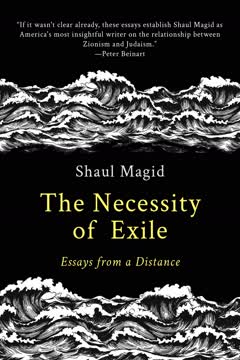
The Necessity of Exile by Shaul Magid presents a "counter-Zionist" argument that challenges American Jewish identity's reliance on Zionism. Reviewers appreciate Magid's scholarly yet accessible approach, examining how Zionism has shifted rightward and proposing exile as central to Jewish flourishing. Many praise his critique of liberal Zionism's incompatibility with ethical Judaism and his exploration of diaspora identity. Some find the religious/academic chapters dense or "inside baseball," while others value his generous engagement with diverse thinkers. Readers describe the work as essential, thought-provoking, and timely, though opinions vary on accessibility and political premises.