

Key Takeaways
Turn real frustrations into comedy instead of borrowing someone else's voice.
Your life is the source. Carter argues that the book cannot make someone funny from scratch, but it can help a naturally funny person shape material and perform it. The strongest topics are often ordinary or painful: a job, a breakup, a family complication, or an illness. Jim Gaffigan built material around his wife's brain tumor, while Hannah Gadsby found comedy in her knowledge of art history. Neither subject arrives funny on its own. The comic's perspective makes it distinctive.
Truth beats imitation. Audiences connect when a performer has a real point of view, not when they recycle familiar jokes or imitate a successful comic's style. The aim is not confession for its own sake. It is to discover which parts of lived experience can be shaped into a surprising, shared laugh.
What's valuable here is the distinction between material and talent. The book does not promise that exercises manufacture a comic sensibility; it treats craft as a way to make an existing sensibility legible. That resembles good memoir writing, where private experience becomes meaningful through selection and form. There is also an important boundary: authenticity need not mean exposing every wound. A comic can be honest about a subject while choosing what stays private. The useful test is whether the material expresses a genuine perspective, not whether it reveals the most intimate detail.
Write briefly every day, and capture ideas before memory edits them.
Consistency lowers the stakes. Carter adapts Jerry Seinfeld's calendar-chain method: mark each day spent writing, and focus on keeping the practice alive rather than producing brilliant work on demand. Her exercises call for at least ten minutes of morning writing. Seinfeld's approach, as described in the book, uses a timed daily session and a visible calendar to make the habit concrete.
Collect raw material everywhere. Record observations, overheard phrases, irritations, and half-formed thoughts as they happen. Then revisit them, transcribe or organize them, and develop promising ideas. Carter describes Joan Rivers sorting a huge store of jokes by subject, a reminder that good material is hard to use if it cannot be found. A dedicated notebook or digital folder turns scraps into a working archive.
A daily quota solves a specific creative problem: judgment often arrives before ideas do. By separating the act of producing from the later act of selecting, the routine protects rough material from premature criticism. The calendar also makes effort visible, which can matter when progress is otherwise difficult to measure. Still, a streak is a tool, not a verdict on commitment. A missed day should prompt a return to the work, not a spiral of self-reproach. The durable habit is capturing and revisiting ideas, not worshipping an unbroken chain.
Schedule a stage date before fear invents another reason to wait.
A deadline creates motion. Carter urges beginners to book a short open mic before they feel ready. The looming performance gives writing a purpose and turns vague ambition into a date on the calendar. Her own first stand-up set came when an airline lost her magician's equipment before a performance at the Playboy Club. With no tricks available, she described the predicament honestly and built a comic set from it. The unexpected constraint became an opening because she went onstage rather than retreating.
Do not work alone. A Comedy Buddy is a trusted collaborator who listens, takes notes, helps revise material, and keeps both people accountable. Regular meetings make comedy less like a private test of talent and more like shared practice. The buddy should respect the work, show up reliably, and offer candid feedback without taking over the comic's voice.
This is a useful application of exposure: fear becomes manageable through repeated contact with the situation, not through waiting for confidence to appear. The lost-equipment story also shows how constraints can generate a comic premise, though crisis is not a dependable creative strategy. A scheduled first performance offers a smaller, safer version of that pressure. Collaboration adds another advantage: speaking material aloud reveals timing and energy that silent drafting cannot. The risk is choosing a partner who only praises or rewrites. Good support makes the comic more themselves, not more like the collaborator.
Pick topics that provoke you, then investigate their smallest details.
Start with emotional charge. Carter recommends searching everyday life for subjects that feel hard, weird, scary, or stupid. These four attitude words, abbreviated in the book as HWSS, are prompts for finding a strong reaction rather than trying to invent a clever joke immediately. A topic such as waiting tables can lead to complaints about customers, tipping, or quitting. The initial rant is raw material, not the finished bit.
Keep digging. Narrow a long list of personal subjects to a few that sustain genuine interest. Then mind-map each one: branch from a main topic to related subjects, and from those to specific details. A topic about hospitals might expand into food, lighting, admissions, or the difficulty of sleeping. Specifics give a comic more routes to a fresh observation than a broad subject alone.
The method resembles exploratory research: begin with a question that matters, gather particulars, and delay the final conclusion. That is a stronger starting point than demanding a punchline from a blank page. The attitude prompts also help performers move from neutral description into a clear emotional stance. However, anger is not the only productive emotion, and not every painful topic needs to become public material. Curiosity, affection, embarrassment, or delight can also supply energy. The deeper principle is to choose subjects that keep generating meaningful details.
Build each joke around a clear opinion, then surprise without losing logic.
Give the audience a point of view. A premise is the comic's specific opinion or insight about a subject. A joke needs more than a story about what happened; it needs a reason the situation feels absurd, frustrating, or revealing. The setup gives the audience enough context to follow that opinion, then the payoff changes the direction. An act-out is a short performed scene in which the comic embodies a person or thing. A turn is a linked reversal of expectation. A mix compares seemingly unrelated subjects to reveal a connection.
Make the surprise coherent. Carter teaches several ways to find payoffs, including a list whose third item breaks the pattern created by the first two. The mismatch should be unexpected but still understandable. If the audience has to solve the logic of the joke, attention shifts from laughter to confusion.
The emphasis on a clear premise treats comedy as an argument compressed into a performance. The audience follows a line of reasoning, then enjoys the moment that reasoning takes an unforeseen but recognizable path. This is close to how analogy works in explanation: two domains are linked, and the link makes a hidden feature visible. The warning against incoherence is especially practical, since surprise alone is not enough. Yet no single architecture fits every comic voice. A structure is best used as a diagnostic aid, not as a rule that flattens deliberate absurdity or long-form storytelling.
Make the setup concise, understandable, and fair to its target.
Earn the audience's attention. A setup should establish one subject, a clear attitude, and the opinion that gives the joke direction. Carter advises cutting unnecessary background, favoring present-tense delivery once context is established, and avoiding long story openings that postpone the comic point. If the audience cannot follow the premise, it cannot appreciate the payoff.
Choose the target deliberately. The book warns against using people with less social power as easy targets, and recommends directing criticism toward the powerful or examining one's own flaws. It also advises comics to consider clean material, because explicit jokes can close off corporate and other paid opportunities. The point is not to remove all risk or edge. It is to make the joke's perspective intentional and to understand which audiences and venues the material suits.
Clarity and fairness are connected: a well-framed joke makes visible both what is being criticized and why. Punching up can expose hypocrisy or power, while self-mockery lets a performer share the joke's cost. Neither guarantees success, and social status alone cannot decide whether a joke is humane or insightful. The sharper question is whether the material reveals something or merely repeats a stereotype. Clean material is similarly a strategic choice rather than a moral ranking of comedy styles. A comic benefits from knowing what a joke may make possible, and what it may rule out.
Rehearse the mechanics until your personality can take the stage.
Prepare without sounding recited. Carter recommends organizing a set with short cue words rather than reading a script. Memorize the first line of each section and the final joke, then practice the rest until it feels available rather than locked. Walking while speaking material aloud can help connect language to movement and expose lines that are hard to remember. A set list is a brief sequence of cues that helps a performer recall the order of jokes.
Perform the scene, not just the sentence. Act-outs can gain force through space work, the controlled mime of objects and movements that are not physically present. Practice where an object sits and how a character moves so the scene stays clear. Hold for the audience's laughter after a payoff, use a short tag if useful, and respect the allotted time.
Rehearsal is not the enemy of spontaneity. In music, sports, and theater, practiced fundamentals free attention for live adjustment; the same logic applies here. Once transitions and key lines are secure, a comic can look at the audience instead of searching for the next sentence. Physical detail also gives an imagined scene a shared shape, making a voice or movement easier to read. The caution is that precision can become rigidity. Rehearsal should create room to listen and adapt, not force every audience into the same response.
Treat the room as a partner, not a passive audience.
Open by connecting. A strong opening quickly signals that the performer is in command, likeable, and attuned to the room. Carter suggests noticing something everyone can see, acknowledging the previous performer without insulting them, or adapting a prepared opening to the audience. Later, a callback can bring back an earlier word, image, or idea in a new context, making the ending feel connected to the whole set.
Listen before improvising. Crowd work means interacting with audience members during the performance. Carter recommends starting with the whole room, then engaging a responsive group or individual. Ask open-ended questions, build on answers instead of arguing, and keep the performer as a safe target. If a heckler is disruptive, the comic can ignore them, respond proportionately, or ask staff to intervene.
The book's strongest performance insight is relational: comedy is not merely a delivery of text but an exchange whose timing depends on the room. A callback rewards audience memory, while a well-chosen question makes participation feel invited rather than coerced. This also explains why kindness can be strategically powerful. When people feel safe, they are more willing to respond, and the comic has more information to work with. The limitation is that not every crowd wants interaction. Reading reluctance as meaningful feedback is part of responsiveness, not a failure of nerve.
Expand a promising bit through comparisons, dialogue, observation, and live riffing.
Use several routes to new material. Carter offers exercises for self-mocking, combining two parts of one's background, comparing groups or eras, and reenacting conversations with a sharper response than the one available in real life. Political jokes can turn a news item into a comparison or imagined scene, but they age quickly and may not suit corporate audiences. Observational comedy starts with small, familiar details and asks what makes them strange.
Let the room contribute. Riffing means improvising beyond a prepared joke when the audience responds. A passing comment or an audience answer may reveal a new angle. Record the set, listen back, and preserve the improvised lines that work. These methods help generate a larger body of material without stretching one premise until it runs dry.
The variety matters because writers get stuck when they mistake one successful technique for the whole craft. Comparison, dialogue, and observation are different cognitive routes: one links domains, one dramatizes conflict, and one makes unnoticed details salient. Live riffing adds social information that solitary drafting cannot provide. But spontaneity is not automatically originality. A topical joke can be stale by the next news cycle, while a spontaneous line may only work in that room. Recording and testing across settings help distinguish a repeatable insight from a lucky moment.
Use laugh scores to revise the joke, not to grade your worth.
Review the evidence. Carter proposes rating each joke from zero for silence to five for laughter and applause, then averaging the points by minutes onstage. She calls this LPM, or laughs per minute. The number is a rough way to compare sections and identify material that may need work, not a universal measure of comic quality.
Diagnose before deleting. Listen to a recording and ask whether the setup was unclear, too long, emotionally flat, unfair, or missing a payoff. Check whether the audience could hear, whether laughter was cut off, and whether the material fit the room. A joke that fails once may need a rewrite or a different audience. Bombing is part of testing new material, but repeating the same failed version without learning from it is not useful risk.
The score is most useful as instrumentation, not judgment. It turns a vague feeling of failure into specific questions about timing, wording, and audience fit. That resembles iterative design: observe a response, change one element, and test again. Yet laughter is noisy data. Room layout, fatigue, cultural references, and lineup order all affect results, and a meaningful joke may earn less immediate response than a simple crowd-pleaser. The book's diagnostic questions wisely widen the frame beyond punchline quality. A comic should treat the audience's response as information, not a verdict on identity.
Count the people your comedy reaches, not only the booking you want.
Success can be present-tense. Carter recalls a career with tours, television appearances, and other markers of achievement, yet says she remained focused on what she had not received. A student living with cancer changed her perspective by insisting that illness would not take away her humor. The class developed material about the experience, and the student performed it successfully. For Carter, that moment made the impact of comedy feel more substantial than celebrity or status.
Notice small evidence of progress. Completing an exercise, finding a usable turn, or getting one genuine laugh can count as a win. The book ends by urging performers to keep writing and taking risks while recognizing what their work already does for others. A future career may be a useful aim, but it should not erase the value of today's work.
This ending reframes success from a distant credential into an observable relationship: someone feels recognized, relieved, or less alone because a performer gave shape to an experience. That is a more durable measure than fame, which depends on institutions and chance beyond the comic's control. It also avoids pretending that ambition is foolish; bookings and income matter in a professional career. The useful distinction is between pursuing external rewards and making them the only evidence that the work matters. Small impact is not a consolation prize when it is the very purpose of the performance.
Analysis
The book is a practical workshop disguised as a guide to comedy. Its underlying claim is that comic instinct becomes dependable when the writer builds a repeatable process: gather lived material, find an emotionally charged angle, shape it into a clear opinion, test possible payoffs, rehearse delivery, and revise in response to an audience. The stories make that process memorable, especially Carter's first set after her performance equipment went missing and the student who made illness part of her material. Both show how a difficult circumstance can become a comic perspective, not because suffering is inherently funny, but because a performer can choose a revealing frame.
The method is especially tuned to short club sets, where quick comprehension and frequent laughter matter. Its insistence on concise setups, clear premises, and measurable audience response is useful for beginners who tend to over-explain or treat personal storytelling as sufficient. At the same time, the book acknowledges that longer narrative comedy and unconventional forms exist. That tension matters: its structural advice is a strong training scaffold, but not a complete theory of comedy. Experimental, absurdist, or slow-building work may intentionally resist the rapid setup-payoff rhythm.
The book's strongest contribution may be its integration of writing and performing. Jokes are not treated as finished products on the page. Physicality, audience attention, room conditions, ethical targeting, and timing are part of the writing itself. Its LPM score offers a practical feedback device, though laughter cannot fully measure originality, resonance, or long-term value. The broader lesson is to use form and feedback without confusing either with artistic worth. The comic's task is both technical and interpersonal: make the idea clear, make the moment live, and remain responsive to the people hearing it.
Review Summary
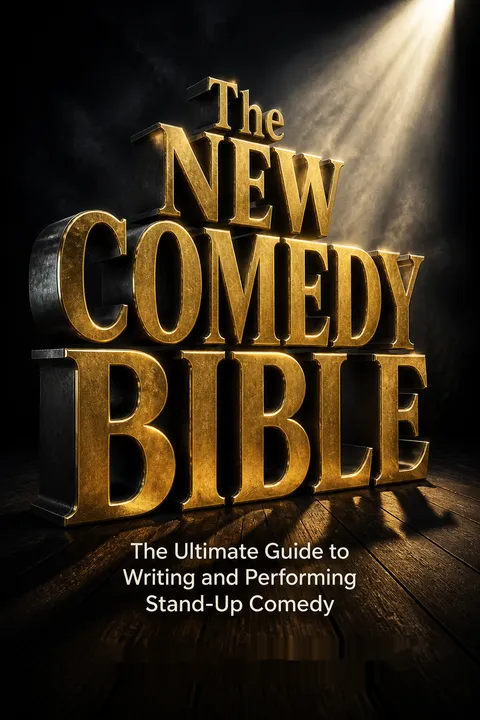
The NEW Comedy Bible receives positive reviews for its comprehensive guide to stand-up comedy. Readers appreciate its step-by-step approach, useful exercises, and insights into joke writing and delivery. Many find it helpful for beginners and as a reference for experienced comedians. The book's structured format and examples from successful comics are praised. Some reviewers note its focus on a methodical approach may not suit all comedic styles. Overall, it's highly recommended for those looking to develop their comedy skills and understand the craft better.
People Also Read



Glossary
Comedy Buddy
Comedy writing partnerA trusted collaborator who listens to new material, takes notes, helps generate and revise ideas, and supports consistent practice. Carter recommends regular meetings with each person taking a turn performing material while the other listens. The partner should be reliable and honest, while respecting that each comic must develop an individual voice.
HWSS
Four ranting promptsAn abbreviation for hard, weird, scary, and stupid, the four attitude words Carter uses to help writers investigate a topic. The comic begins by explaining why a subject fits one of these reactions, then follows the emotion into specific observations. The words are prompts for discovery, not a requirement that finished material use them.
Premise
A comic's central opinionThe premise is the comic's distinct opinion, insight, or interpretation of a topic. It explains why the subject feels absurd, difficult, frightening, or otherwise worth discussing. In Carter's method, a premise gives a joke direction and separates a comic bit from a sequence of events that is merely being retold.
Act-Out
Performed imagined sceneAn act-out is a brief shift from addressing the audience to embodying a character or entering an imagined scene. The performer uses voice, posture, movement, and dialogue to portray a person, animal, or even an object. The scene should clarify and heighten the joke rather than expand into an extended dramatic performance.
Turn
Linked expectation reversalA turn redirects a joke from its apparent direction to a surprising but logically connected outcome. One common form establishes a pattern with two examples, then breaks that pattern with a third. The audience should be surprised by the destination while still understanding how the setup leads there.
Mix
Unexpected comparisonA mix connects two seemingly unrelated subjects through an analogy or imagined scenario. It often begins with a comparison prompt and may develop into an act-out. The link must make sense to the audience; the humor comes from the fresh perspective created by placing the subjects together, not from an arbitrary pairing.
Space Work
Precise mime of objectsSpace work is the physical portrayal of objects, locations, or actions that are not actually present. A comic might mime handling a cup or opening a refrigerator, keeping the imagined object's position and movement consistent. Clear, specific physical details help the audience follow an act-out and make the imagined scene feel tangible.
Set List
Cues for joke orderA set list is a brief sequence of words or phrases that reminds a performer which section of material comes next. It is a memory aid rather than a script. Carter advises arranging material for the venue and set length, knowing the closing bit, and practicing transitions so a performer can stay present with the audience.
Callback
Earlier joke, new contextA callback reuses a word, image, phrase, or subject from earlier in the set, but places it in a new context. It rewards the audience for remembering what came before and can create a satisfying ending. Carter also describes callbacks as a way to recover a connection after a joke does not land.
LPM
Laughs per minuteLPM is Carter's shorthand for a rough performance score calculated by rating each joke's audience response, adding those ratings, and dividing by the minutes onstage. It helps a comic compare sections and identify material to review. It is a practical diagnostic, not a definitive measure of a joke's artistic or personal value.
Comedy Persona
Authentic stage characterA comedy persona is the recognizable combination of a performer's subjects, point of view, voice, and mannerisms onstage. Carter advises allowing it to develop through writing and performance rather than copying another comic or inventing a character before the material exists. The persona can change as the performer and their life change.
FAQ
What's "The NEW Comedy Bible" by Judy Carter about?
- Comprehensive Guide: "The NEW Comedy Bible" is a comprehensive guide to writing and performing stand-up comedy, offering insights into the evolving world of comedy since the original "Comedy Bible" was published in 2001.
- Practical Exercises: The book includes numerous exercises designed to help aspiring comedians develop their material, find their authentic voice, and overcome creative anxiety.
- Industry Insights: Judy Carter shares her extensive experience in the comedy industry, providing tips on everything from joke writing to performing on stage and dealing with hecklers.
- Career Development: It also explores various career opportunities for funny people, emphasizing the importance of networking and building a social media presence.
Why should I read "The NEW Comedy Bible"?
- Skill Development: If you're interested in stand-up comedy, this book offers practical tools and exercises to develop your comedic skills.
- Overcoming Fear: It provides strategies to overcome stage fright and procrastination, which are common barriers for new comedians.
- Industry Knowledge: Judy Carter shares insider knowledge about the comedy industry, helping readers understand how to navigate their careers.
- Inspiration and Motivation: The book is filled with motivational advice and success stories from comedians who have followed Carter's guidance.
What are the key takeaways of "The NEW Comedy Bible"?
- Authenticity is Key: Finding your authentic comedic voice is crucial for success in stand-up comedy.
- Practice and Persistence: Writing every day and performing regularly are essential practices for honing your craft.
- Networking Matters: Building relationships within the comedy community and maintaining a strong social media presence can open doors to various opportunities.
- Adaptability: Comedy is about breaking rules, but it's important to learn them first before you can effectively break them.
How does Judy Carter suggest overcoming creative anxiety in "The NEW Comedy Bible"?
- Seinfeld Strategy: Carter recommends the Seinfeld Strategy, which involves writing every day without the pressure of being brilliant, to build a habit and overcome procrastination.
- Morning Writings: She suggests starting each day with morning writings to clear the mind and spark creativity.
- Comedy Buddy: Finding a Comedy Buddy to collaborate with can help alleviate anxiety and provide constructive feedback.
- Commit to a Gig: Booking a performance, even before feeling ready, can serve as motivation to overcome fear and procrastination.
What is the "List of Three" method in "The NEW Comedy Bible"?
- Pattern Creation: The "List of Three" method involves creating a pattern with two similar items followed by a third, unexpected item to create a comedic turn.
- Big-Big-Small: This technique can be used by listing two big, serious items followed by a small, trivial one for comedic effect.
- Small-Small-Big: Alternatively, start with two small items and end with a big, over-the-top one to surprise the audience.
- Logical Connection: The key to this method is ensuring the third item logically connects to the first two, maintaining the joke's coherence.
How does Judy Carter define a "comedy persona" in "The NEW Comedy Bible"?
- Authentic Self: A comedy persona is your most authentic self onstage, reflecting your unique voice, mannerisms, and point of view.
- Organic Development: Carter advises letting your persona develop organically through the topics you choose and how you deliver them.
- Avoiding Characters: She cautions against adopting a character as a facade, emphasizing the importance of authenticity and relatability.
- Audience Perception: Often, a comedian's persona is shaped by how the audience perceives and connects with their material.
What are some of the best quotes from "The NEW Comedy Bible" and what do they mean?
- "Follow your passion, stay true to yourself, never follow someone else’s path." This quote emphasizes the importance of authenticity and individuality in comedy.
- "Comedy is a tool of togetherness." It highlights the role of comedy in bringing people together through shared laughter and experiences.
- "The hardest thing to do is to be true to yourself, especially when everybody is watching." This quote, attributed to Dave Chappelle, underscores the challenge of maintaining authenticity under public scrutiny.
- "You’re never too young, or too old, to be funny." It encourages aspiring comedians of all ages to pursue their passion for comedy.
How does "The NEW Comedy Bible" address the issue of stage fright?
- Fear as Motivation: Carter suggests using the fear of public humiliation as motivation to prepare thoroughly and perform.
- Adrenaline Rush: She encourages reframing fear as excitement, likening it to the thrill of a roller-coaster ride.
- Authenticity in Fear: Embracing and incorporating fear into your act can create a relatable connection with the audience.
- Savers: The book advises preparing "savers," or recovery lines, to use if you forget your material onstage.
What is the role of a "Comedy Buddy" according to "The NEW Comedy Bible"?
- Collaborative Support: A Comedy Buddy provides support, feedback, and accountability, helping you stay committed to your comedy goals.
- Idea Generation: Working with a buddy can spark new ideas and lead to more organic, conversational material.
- Regular Meetings: Carter emphasizes the importance of regular meetings to maintain continuity and progress in your comedy journey.
- Mutual Respect: It's crucial to choose a buddy who respects your material and shares a similar commitment to comedy.
How does "The NEW Comedy Bible" suggest using social media for comedy?
- Build a Presence: Carter advises building a strong presence on social media platforms to connect with followers and showcase your material.
- Daily Engagement: Regularly post videos and observations to keep your audience engaged and grow your fan base.
- Authentic Content: Share content that reflects your authentic comedic voice and resonates with your audience.
- Networking Tool: Use social media as a networking tool to connect with other comedians and industry professionals.
What are some exercises from "The NEW Comedy Bible" to develop comedy material?
- Morning Writings: Start each day with free writing to clear your mind and generate ideas.
- Ranting and Raving: Use attitude words like hard, weird, scary, or stupid to rant about your topics and find the funny.
- Mind-Mapping: Expand your topics into subtopics and microtopics to explore different angles and details.
- Act-Outs and Turns: Practice adding act-outs and turns to your jokes to enhance their comedic impact.
How does "The NEW Comedy Bible" address the issue of sexism in comedy?
- Historical Context: Carter acknowledges the historical challenges female comedians have faced in a male-dominated industry.
- Alpha Job: She describes stand-up comedy as an alpha job, emphasizing the need for women to assert their power and be taken seriously for their ideas.
- Freedom in Comedy: Women comics are encouraged to take risks, have strong opinions, and be appreciated for their intellect rather than their appearance.
- Future Focus: Carter is writing a book on how female comedians can market themselves and achieve financial success in comedy.
About the Author

Download PDF
Download EPUB
.epub digital book format is ideal for reading ebooks on phones, tablets, and e-readers.








