

Key Takeaways
Creativity is a practice you can reclaim, not a title you must earn
Start with making. Krysa opens with a familiar contradiction: children create freely, while adults hesitate to call themselves artists. Even accomplished artists she interviewed described uncertainty about claiming that identity. Her own father treated a childhood drawing as worth framing, giving her a lasting sense that her making mattered. Encouragement can strengthen creative confidence, while a careless dismissal can weaken it, but neither response settles what a person is capable of creating.
Broaden the definition. Creativity is not limited to gallery art or bestselling books. It can appear in cooking, gardening, music, photography, or any effort to make something with imagination. The practical invitation is to recover the pleasure of creating before judging whether the result is impressive. A playful, low-stakes project can be a real beginning, even if it never becomes a profession.
What's useful here is the separation of creative action from public recognition. A person can make things before feeling entitled to an artistic identity, and practicing that identity can make it feel less alien. This resembles self-efficacy: confidence often grows through attempts that provide evidence of capability, not through waiting for certainty. Still, encouragement is not distributed evenly, and reclaiming confidence cannot erase material barriers or past harm. The claim that everyone is creative is most compelling when it expands the range of meaningful making, rather than implying that everyone must pursue art in the same way.
Put creative time on the calendar before life fills every open space
Make time visible. Krysa describes feeling overwhelmed by writing a book while juggling design work, family, and household tasks. She reserved Thursdays for writing and arranged takeout so the day could stay focused. A friend protected early mornings for art. The point is not that everyone needs a full day or a 5 a.m. alarm. It is that waiting for a perfect, empty stretch of time makes creative work vulnerable to every competing demand.
Build a workable routine. Set a deadline, reserve a regular session, and make essential supplies easy to reach. A small corner can serve as a studio; a recurring daily assignment can train attention and make noticing the world part of the practice. On low-energy days, creative preparation, such as sorting materials or collecting ideas, can help maintain contact with the work.
Scheduling is a form of precommitment: the decision is made before fatigue, distraction, and competing obligations arrive. That makes the practice less dependent on inspiration, which is notoriously difficult to summon on command. The book's examples also show that creative routines can be designed around different chronotypes and responsibilities, rather than copying a single ideal schedule. A useful limit is worth naming: calendar discipline cannot manufacture free time for someone carrying an impossible workload. In those cases, the task is not self-blame, but finding the smallest sustainable opening and negotiating for support where possible.
Treat labels, credentials, and age as context, not permission slips
A label is partial. Parent, office worker, rural resident, self-taught beginner, and art-school graduate describe parts of a person, not the full range of what they can make. Krysa argues that formal education can offer time, peers, and mentors, but it is not the only route to skill. Self-directed learners can seek classes, online instruction, and mentors without apologizing for their path.
Starting late still counts. Artist Lisa Congdon began making art in her early thirties, first as a hobby, and built a career gradually. Minnie Pwerle began painting at eighty. Krysa also points to Julia Child, who took up cooking in her late thirties and published her first cookbook at fifty. These stories challenge the belief that a creative life must begin young. They demonstrate possibility, not a guarantee of income or recognition.
This section treats identity as editable rather than fixed, a useful corrective to the way credentials and job titles can become boundaries. It also resists a narrow model of expertise in which only institutional training counts. The counterweight is important: stories of late success can inspire, but exceptional careers do not make financial or caregiving constraints disappear. Congdon's advice about getting finances in order before leaving employment makes the strongest version of the argument practical: pursue a new path without pretending that passion cancels risk.
Make the first attempt cheap, constrained, and deliberately imperfect
Lower the stakes. Krysa once left an expensive sketchbook unused because its blank pages felt too precious. She found more freedom painting on pages from a secondhand cookbook: the existing text and pictures gave her a starting point, and a spoiled page no longer felt tragic. Artist Kim Werker offers another route: make something intentionally ugly first. That deliberately bad attempt drains some of the pressure from the next one.
Give possibility a boundary. When an empty page offers too many choices, impose a rule. Use one color, begin with a sentence found elsewhere, work on an unconventional surface, or let someone else make the first mark. These constraints are not limitations on imagination; they provide a first move. A group can make the exercise social through an evening devoted to playful, intentionally unsuccessful work.
Constraints can reduce decision overload by shrinking the field of possible actions. The same principle appears in design briefs and improvisation: a boundary gives experimentation something to push against. Intentionally bad work is especially effective because it changes the question from “Can this be good?” to “What happens if this is allowed to be bad?” It is not a universal remedy, however. Some people need quiet or skill-building more than comic release. The broader lesson is to change the conditions of starting, rather than treating hesitation as a character flaw.
Use jealousy to identify what you want, then turn admiration into a plan
Translate the feeling. Krysa's jealousy of other artists once left her discouraged and unwilling to make work. She began writing publicly about artists whose work she admired, which helped turn envy into attention and appreciation. In one conversation, she told a coworker she was jealous of her, only to discover that the coworker felt similarly about Krysa. Naming the feeling made room for a more honest relationship.
Find the useful information. Ask what specifically provokes the envy: a daily practice, a body of work, a public opportunity, or a sense of balance. Write down one action that fits your own life. Look behind visible success for the effort and choices involved. Inspiration can become imitation if the first admired idea is copied; the challenge is to transform the influence until it speaks in a personal voice.
Jealousy can function as a rough signal of desire. Its emotional sting may point toward a neglected ambition, while the admired person offers a concrete object of comparison. Turning that feeling into an action list is a form of cognitive reappraisal: the emotion is not denied, but its meaning is changed. The caution is that envy can also reflect status competition or a distorted view of someone else's life. Admiration is most useful when it reveals a value to pursue, not a person to duplicate or a scoreboard on which to rank oneself.
Question the inner critic's message before accepting its verdict
Investigate the voice. Krysa uses “inner critic” for the harsh internal commentary that discourages creative work. She recommends noticing whose language it resembles, what kind of activity triggers it, and whether guilt about family, work, or time is disguising the same fear. A familiar attack is not automatically a reliable judgment. Writing it down and reading it aloud can make its cruelty easier to recognize.
Translate, then choose. Sometimes a harsh remark contains a useful observation buried under an insulting delivery. “This is hopeless” might conceal a specific concern that a piece feels crowded or that a format is not working. Reword the concern as a practical possibility, then decide whether to act on it. Krysa also suggests gathering evidence against sweeping claims: if the voice says a person cannot paint, make a few small paintings and see what actually happens.
The exercise creates distance between a thought and a fact. In cognitive behavioral approaches, identifying and testing an automatic thought can loosen its authority; here, the same move is made accessible through writing and translation. A further nuance is that the inner voice may not come only from other people. It can also reflect real standards, uncertainty, or a need for practice. The key distinction is between actionable information and global condemnation. A useful critic identifies a choice to examine; a bully declares the creator unworthy.
Separate criticism of a piece from judgment of the person who made it
The wound can linger. Near graduation, Krysa's professor praised a series, then led a later critique that ended with a blunt instruction to stop painting. She graduated but lost confidence and avoided making art for years. Other artists in the book describe similarly painful remarks from teachers and directors. These stories show how easily feedback can become fused with identity, especially when it comes from someone with authority.
Choose what to keep. Criticism can be useful when it identifies a specific problem and comes from a source worth trusting. Listen for that information without treating a judgment about one work as a verdict on the maker. Share painful experiences with supportive people, delete abusive online comments, and avoid preemptively listing every flaw when presenting a piece. Defending the work does not require claiming that it is perfect.
The distinction between person and product is psychologically important because creative work often feels intimate: the maker's choices and sensibilities are visibly present. Yet feedback quality depends on more than kindness. Specificity, relevance, and the recipient's goals matter too. A supportive critic can still be wrong, while a painful comment may contain a useful observation. Krysa's account also shows that the power relationship matters: authority can make careless words unusually durable. Good critique should increase the creator's ability to choose, not replace it.
Treat imperfect results as evidence, not proof that you should quit
Redefine the miss. A result that falls short of the plan can show what to change, what to practice, or what not to pursue. Krysa's own attempt to force herself back into painting clarified that she wanted to make collages instead. Painting felt like a struggle; cutting and combining found images brought back the pleasure of making. In this case, persistence did not mean staying with the same medium at any cost.
Keep experimenting. The book points to the Impressionist painters, whose work was rejected by the Paris Salon in 1863. Rather than abandoning their approach, they organized an exhibition of rejected works. It also emphasizes the value of imperfect marks and unfinished attempts as starting material. The practical test is whether a setback suggests another experiment, a skill to develop, or a different path worth exploring.
Failure becomes useful only when it produces information that can guide another decision. An unsuccessful attempt may reveal a technical gap, a flawed strategy, or a mismatch between the activity and the person's interests. Those possibilities call for different responses, so “keep going” should not mean repeating the same action indefinitely. Krysa's shift from painting to collage illustrates a form of adaptive persistence: the aim is sustained creative engagement, not loyalty to a particular medium. That distinction makes resilience more intelligent than sheer endurance.
Build a trusted audience before exposing unfinished work to everyone
Leave the vacuum carefully. Krysa describes a creative block relieved by asking local artists Jessica Bell and Sarah Gee Miller for help. They listened, shared experience, and helped her see a way forward. The episode changed her view of working alone: solitude can support concentration, but total isolation removes encouragement and useful perspective.
Make a small circle. Invite a few people whose judgment and care you respect to discuss work in progress. A regular group can create deadlines, provide feedback, and make creative practice less lonely. Krysa describes artists meeting monthly to share work and encourage one another to stretch. Sharing does not mean posting every draft online or inviting feedback from people who routinely dismiss the work. Choose the audience, the stage of the work, and the kind of response being requested.
A trusted creative group supplies both emotional safety and accountability. That combination matters: reassurance alone can feel pleasant but leave the work unchanged, while critique without safety can trigger withdrawal. A strong group makes room for disagreement while preserving the maker's agency. The book's boundary around who gets access is as important as its call to share. Public visibility is not the same as useful feedback, and social platforms often mix audiences with incompatible expectations. Smaller, intentional circles can make creative risk more manageable.
Expect creative blocks, then change your conditions instead of attacking yourself
A block is part of practice. Krysa argues that creative stalls happen even to experienced artists and need not be treated as evidence of lost talent. Possible sources include self-doubt, harsh feedback, deadlines, commissions, and ordinary life pressures. Naming the source can suggest a response: seek trusted feedback, allow more time, or protect a small period for making during a difficult stretch.
Move to restart. The book returns to three useful approaches: accept imperfection, get outdoors, and set a rule for the next attempt. Other options include doing a mundane task, keeping notes beside the bed, or taking a randomly chosen trip and exploring the destination. The aim is not to force constant inspiration. It is to create movement and attention, so an idea has more chances to emerge.
This is a humane account of creative work because it treats interruption as normal rather than as personal failure. It also distinguishes feeling blocked from being incapable: changing context can loosen a familiar loop and bring new material into view. Still, not every block yields to a walk or a prompt. Exhaustion, grief, and heavy responsibilities may call for rest or support, not another productivity tactic. The strongest practical use of the advice is diagnostic: notice what is obstructing the work, then select a proportionate response rather than applying the same cure to every stall.
Analysis
The book's most persuasive argument is not simply that everyone is creative. It is that creative identity is maintained through repeated acts of permission: permission to begin without credentials, to make poor work, to accept help, and to change direction. Krysa makes this argument through a braid of personal experience and other artists' testimony. Her painful art-school critique gives the advice stakes, while the range of interviewees prevents her own recovery story from becoming a universal formula.
The chapters also connect individual psychology to practical conditions. The inner critic may sound like a private voice, but it is shaped by teachers, family, public feedback, and social ideas about who gets to count as an artist. A calendar, a cheap surface, or a trusted peer group is therefore more than a productivity trick. Each changes the environment in which self-doubt operates. This is a grounded form of agency: people cannot control every judgment they receive, but they can shape how often they practice, whom they consult, and how much authority they grant a hostile comment.
A productive tension runs through the advice. Readers are urged to persist, but also to notice when another medium or path brings more joy. The distinction is between quitting because fear has taken over and redirecting because experience has revealed a better fit. That is a more nuanced account of resilience than endless perseverance.
The book's exuberant promise that creativity is available to everyone can understate unequal access to time, space, money, and encouragement. Yet its concrete suggestions, from brief daily projects to shared studios and supportive groups, partly answer that limitation by refusing to equate creative life with a full-time career. Its lasting value lies in making creativity ordinary enough to practice and social enough to sustain.
Review Summary
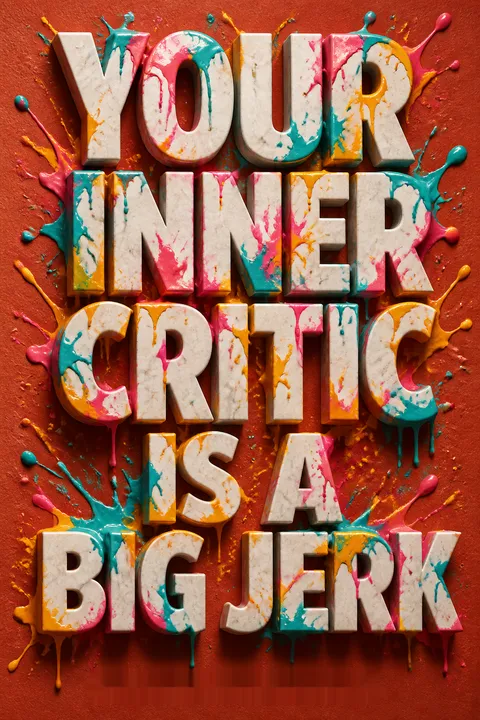
Your Inner Critic Is a Big Jerk offers encouragement and practical advice for creatives struggling with self-doubt. Readers appreciate Krysa's relatable tone and personal anecdotes. The book provides tips on overcoming creative blocks, embracing failure, and silencing one's inner critic. While some found the content familiar, many felt inspired to create after reading. The colorful illustrations and quick-read format were well-received. Critics noted repetition and editing issues, but overall, the book is recommended for artists seeking motivation and reassurance.
People Also Read


Glossary
Inner critic
Discouraging internal commentaryThe inner critic is the harsh voice that predicts failure, attacks a creator's ability, or urges them to stop. Krysa encourages readers to identify when and where it appears, distinguish useful observations from insults, and answer its claims with specific actions. The term does not mean that every doubt is false; it names a pattern of discouraging self-talk that can be examined.
Creative block
A stall in makingA creative block is a period when ideas, motivation, or progress feel stalled. Krysa treats blocks as a common part of creative practice rather than proof that someone lacks talent. They can arise from self-doubt, criticism, deadlines, commissions, or life pressures. Responses include changing the setting, accepting imperfection, adding constraints, and seeking constructive support.
Creative tribe
Trusted creative peersA creative tribe is a small network of people who can offer encouragement, thoughtful feedback, companionship, and accountability. It may be a regular in-person group, a pair of collaborators, or an online community. The emphasis is not on sharing with everyone, but on finding people whose judgment is trusted and whose responses help the work develop.
Bad Art Night
A playful group-making exerciseBad Art Night is a social activity in which participants deliberately try to make something awkward, ugly, or unsuccessful. By removing the expectation of producing a polished result, the exercise makes experimentation less threatening and can help participants laugh, loosen up, and begin again. It also creates a low-pressure setting for becoming more comfortable showing work to others.
Procrastinate with Purpose
Useful creative preparationProcrastinate with Purpose means using a day when direct creative work feels difficult to do a related, low-pressure task instead. Examples include sorting materials, collecting images, doodling, or preparing supplies. The activity can preserve contact with the project and may prompt ideas, while avoiding the all-or-nothing choice between producing a finished piece and abandoning the work entirely.
Green-Light Assignment
Turn envy into actionThe Green-Light Assignment is Krysa's exercise for converting jealousy into a practical guide. Identify whom or what you envy, specify the particular quality that triggers the feeling, and write an action that expresses that desire in your own circumstances. The purpose is to replace passive comparison with admiration, inquiry, and a next step that fits the person's own creative life.
FAQ
What's "Your Inner Critic Is a Big Jerk" about?
- Creative encouragement: The book by Danielle Krysa is a guide to overcoming self-doubt and embracing creativity. It addresses the negative voice inside that often hinders creative expression.
- Practical advice: It offers practical strategies and exercises to help readers silence their inner critic and pursue their creative passions without fear.
- Personal stories: Krysa shares personal anecdotes and stories from other creatives to illustrate common struggles and how to overcome them.
- Community and support: The book emphasizes the importance of finding a supportive creative community to share work and receive constructive feedback.
Why should I read "Your Inner Critic Is a Big Jerk"?
- Overcome self-doubt: If you struggle with self-doubt or fear of failure in your creative endeavors, this book provides tools to overcome these barriers.
- Inspiration and motivation: It offers inspiration and motivation through relatable stories and practical exercises that encourage creative exploration.
- Practical exercises: The book includes exercises designed to help you break through creative blocks and develop a consistent creative practice.
- Community building: It highlights the importance of building a creative community for support and feedback, which can be crucial for personal growth.
What are the key takeaways of "Your Inner Critic Is a Big Jerk"?
- Everyone is creative: Krysa emphasizes that creativity is inherent in everyone and can be nurtured at any stage of life.
- Silence the inner critic: The book provides strategies to identify and quiet the negative voice that often stops creative expression.
- Embrace imperfection: It encourages embracing imperfection as a natural part of the creative process, rather than a barrier.
- Find your tribe: Building a supportive community is crucial for sharing work, receiving feedback, and staying motivated.
How does Danielle Krysa suggest dealing with the inner critic?
- Identify the voice: Krysa advises identifying the source of the inner critic's voice, whether it's from past experiences or external influences.
- Translate negativity: Learn to translate the critic's negative comments into constructive feedback that can help improve your work.
- Reframe the narrative: Change the inner critic's narrative by focusing on positive affirmations and celebrating small successes.
- Turn critic into ally: Work on transforming the inner critic into a supportive voice that encourages rather than hinders creativity.
What are some practical exercises from "Your Inner Critic Is a Big Jerk"?
- Bad Art Night: Organize a night with friends to create intentionally bad art, which helps release the pressure of perfection.
- Daily creative habits: Establish small, daily creative habits to keep the creative juices flowing and reduce the power of procrastination.
- Procrastinate with purpose: Use procrastination time to do creative housekeeping tasks that can spark new ideas.
- 30-day challenge: Engage in a 30-day creative challenge to develop consistency and explore new creative avenues.
What does Danielle Krysa say about failure in creativity?
- Redefine failure: Krysa suggests redefining failure as a learning opportunity rather than a setback, emphasizing that mistakes are part of the creative process.
- Feedback, not failure: View negative feedback as a chance to improve and refine your work, rather than a personal failure.
- Embrace imperfection: Accept that imperfection is inherent in creativity and can lead to unexpected and beautiful results.
- Keep creating: The only true failure is quitting; continue creating and experimenting to find your unique voice.
How does "Your Inner Critic Is a Big Jerk" address creative blocks?
- Accept blocks: Krysa acknowledges that creative blocks are a natural part of the creative process and should not be feared.
- Break the block: Use strategies like setting constraints, changing environments, and embracing imperfection to break through blocks.
- Stay present: Focus on the present moment and the act of creating, rather than worrying about the outcome or future blocks.
- Community support: Lean on your creative community for support and feedback to help navigate through blocks.
What role does community play in "Your Inner Critic Is a Big Jerk"?
- Find your tribe: Krysa emphasizes the importance of finding a supportive community to share work and receive constructive feedback.
- Creative collaboration: Engaging with others can lead to new ideas, inspiration, and motivation to continue creating.
- Safe space: A trusted community provides a safe space to experiment and grow without fear of harsh criticism.
- Accountability: Being part of a community can help maintain accountability and consistency in your creative practice.
What are the best quotes from "Your Inner Critic Is a Big Jerk" and what do they mean?
- "An artist cannot fail; it is a success to be one." This quote highlights that simply engaging in creative work is a success, regardless of the outcome.
- "Failure is a bruise, not a tattoo." It suggests that failure is temporary and not a permanent mark on your creative journey.
- "No one can wrestle the pencil out of your hand." This emphasizes personal agency and the power to continue creating despite criticism.
- "When we stop fearing failure, we start being artists." It encourages embracing the creative process without fear of making mistakes.
How does "Your Inner Critic Is a Big Jerk" suggest building creative confidence?
- Own your creativity: Krysa encourages readers to confidently claim their creative identity, regardless of external validation.
- Celebrate small wins: Focus on small successes and progress rather than waiting for major achievements to build confidence.
- Positive affirmations: Use positive affirmations to counteract negative self-talk and reinforce creative confidence.
- Continuous practice: Regular creative practice helps build confidence over time by developing skills and reducing fear of failure.
What does Danielle Krysa say about labels in creativity?
- Labels are limiting: Krysa argues that labels like "imposter" or "just a mom" can limit creative potential and should be discarded.
- Embrace multiple identities: You can be more than one thing at a time, such as a parent and an artist, without conflict.
- Self-taught vs. formally trained: Both paths have value, and neither should limit your creative expression or confidence.
- Create your own label: Define your creative identity based on your unique experiences and passions, rather than societal labels.
How does "Your Inner Critic Is a Big Jerk" encourage readers to find inspiration?
- Look behind the curtain: Understand the hard work behind others' success to find inspiration rather than jealousy.
- Avoid imitation: Use others' work as inspiration but challenge yourself to create something unique and personal.
- Explore new environments: Change your surroundings to spark new ideas and perspectives.
- Embrace creative accidents: Allow unexpected outcomes to guide your creative process and lead to new discoveries.
Download PDF
Download EPUB
.epub digital book format is ideal for reading ebooks on phones, tablets, and e-readers.








