

Key Takeaways
Stop treating clock time as the only time that counts
A clock is a tool, not reality. The book begins with moss growing unnoticed in a planter. It changes with moisture, survives dormancy, and records conditions around it, while refusing to fit neatly into human definitions of when life starts or stops. Its rhythms make time feel less like an empty substance and more like change unfolding in particular places and relationships.
Odell contrasts chronos, measured, sequential time, with kairos, a moment whose quality makes action possible. The first can make the future seem predetermined; the second leaves room for surprise and choice. Her aim is not to abolish clocks, but to recover the other temporal experiences that clocks cannot measure.
The moss is a useful opening because it makes an abstract argument sensory: duration is visible in growth, dormancy, and response. This resembles a basic insight from ecology, where organisms are understood through their relations to surroundings rather than as isolated units. A clock remains indispensable for coordination, but it is a poor judge of whether a life is meaningful or a moment ripe for action. The practical test is not whether clock time is false, but whether its convenience has become a monopoly on what counts as real.
Ask who controls the clock before blaming yourself for running late
Timekeeping has a history. Equal, countable hours became powerful as churches, businesses, railways, and colonial administrations needed coordinated schedules. The book traces this standardization from monastic bells to railway time zones and factory clocks. It also shows how plantation owners measured enslaved people’s labor in days and output, turning human lives into quantities to optimize.
The same logic appears in modern tracking systems. An Amazon warehouse worker describes a scanner that sets a seconds-long deadline for each task; remote employees may be monitored through keystrokes, screenshots, and activity reports. The key question is not simply how much time passes, but who gets to measure, direct, and profit from it.
This history helps explain why workplace metrics can feel neutral while distributing power unevenly. Measurement makes activity legible, and legibility can enable coordination, but it can also make surveillance and punishment easier. The distinction matters: a schedule agreed upon by a team is not equivalent to a timer imposed by someone who captures the gains. The book’s account is strongest when it connects everyday devices to those institutional choices. It is less a case against measurement than a demand to examine who sets the measure and who can contest it.
Treat time scarcity as a power problem, not a personal flaw
Twenty-four hours are not equally usable. Care work, insecure jobs, long commutes, disability, and unpredictable schedules shape how much control people have over their days. A working mother may spend paid and unpaid hours meeting others’ needs, while a time-management guide counts those duties as if they were optional. Gender and race also affect who is expected to help, and who pays a penalty for refusing.
A zeitgeber is a person, system, or recurring condition that sets someone else’s rhythms. Children’s needs, a manager’s timetable, an app, or a cycle of illness can all act as one. Better personal organization may help, but it cannot by itself fix unstable scheduling, low wages, or the lack of childcare and leave.
This framing corrects a common category error: treating a constraint imposed by institutions as a failure of individual discipline. It also suggests a useful diagnostic. Before optimizing a calendar, identify which demands are chosen, which are imposed, and which are essential to survival. Yet personal techniques are not worthless simply because they are insufficient. A person can gain relief from planning while also recognizing that lasting autonomy depends on policy, workplace rules, and shared care. The strongest response works at both scales rather than asking either one to do everything.
Protect leisure from becoming another product or productivity tool
Rest can be sold back to workers. Travel posts offer curated images of slowness, while resorts package mindfulness and wellness as services to consume. Odell calls the broader commercial model the experience economy: businesses sell memorable, staged experiences, often turning places, workers, and nature into scenery. Even leisure can become a performance of self-improvement, with goals, metrics, and posts documenting how well someone relaxed.
The book contrasts this with leisure as an open state of attention, not simply recovery for more work. It may arise in an ordinary walk, a quiet moment in a park, or shared rest. Access matters, though: public spaces have often excluded people by race, disability, and class, so leisure cannot be treated as equally available or politically neutral.
The distinction between rest as a commodity and leisure as an unplanned encounter is especially relevant in a culture where even hobbies can acquire dashboards and audiences. A useful question is whether an activity expands attention or merely produces a better-performing self. Still, paid retreats and commercial entertainment can provide genuine pleasure, and not every consumer experience is hollow. The deeper criticism concerns a system that makes recovery purchasable while leaving the causes of exhaustion untouched, and that presents exclusive access as a private lifestyle choice.
Learn a place's rhythms to feel time as change, not inventory
Attention reveals time already happening. At a beach, pebbles carry the history of ancient seafloors and are still becoming sand. A buckeye branch changes through buds, flowers, fruit, and bare winter wood. Odell calls the practice of following one such process “unfreezing” it: seeing an apparent object as a changing history rather than a fixed thing in a timeline.
She also draws on timefulness, an awareness that the past remains materially present. A tree, rock, tide, or migrating bird is not merely a symbol of time. Each is shaped by overlapping processes, some unfolding by the minute and others across geological ages. Following a small local patch can make those otherwise abstract scales perceptible.
This approach resembles field observation: repeated attention improves perception, and better perception changes the observer’s sense of what is important. A familiar tree can become a record of weather, season, insects, and human history. The method is accessible because it requires no special equipment, only return visits and patience. Its limitation is also clear: noticing ecological change cannot substitute for addressing the policies and industries that drive damage. Attention can sharpen responsibility, but it is not itself a climate intervention.
Challenge climate fatalism by recovering the choices history erased
The present is not inevitable. Odell links climate dread to a linear story in which disaster simply advances, leaving people helpless. But landscapes have histories shaped by decisions. In California, Indigenous communities used regular, careful burns to support prairies, food, and wildlife. Colonial authorities and later forestry agencies suppressed those practices, helping create forests more vulnerable to severe fires.
The same pattern appears in corporate climate messaging. Fossil fuel companies have portrayed rising energy demand as unavoidable and emphasized individual carbon footprints, while continuing to expand extraction. Recovering the actors and policies behind present conditions does not erase losses or guarantee success. It does, however, show that the crisis is political and historical, not a natural fate without alternatives.
Historical context can counter despair without requiring optimism. It distinguishes what is already locked in from what remains subject to choices, a distinction essential for effective action. The fire example also complicates a simple nature-versus-human story: people can damage ecosystems, but human stewardship can be part of ecological processes. Care is needed not to romanticize Indigenous practices or imply that one management method fits every landscape. The broader lesson is to ask whose knowledge was excluded, whose interests shaped policy, and which options that history made difficult to imagine.
Create shared rhythms that let people give time without losing it
Time can be a commons. A temporal commons is a shared practice that organizes time for a group, such as a recurring rest period or an agreed quiet hour. These arrangements need protection: engineers in one company valued a daily quiet period, but it faded when the experiment ended because the organization’s incentives still rewarded constant interruption.
Odell also points to smaller forms of shared time, from household agreements to invented family expressions. Her friend’s beans offer the most vivid image: seeds passed between people multiply rather than diminish. Mutual aid, worker organizing, and informal support can similarly create capacities that no one person could produce alone. Collective time requires both relationships and structures that keep those relationships possible.
The commons metaphor shifts the problem from private efficiency to collective design. It highlights a familiar institutional truth: a good practice rarely survives when its surrounding incentives punish it. Shared rhythms need more than goodwill; they may require staffing, predictable schedules, and enforceable boundaries. The metaphor of time as seeds also challenges zero-sum assumptions, though time is not literally limitless. Care work still takes effort, and generous arrangements can become unequal if the same people always provide it. Reciprocity and fair distribution are essential to making shared time durable.
Extend life through regard, not just by adding years
Aliveness is relational. The book questions wellness culture’s promise that discipline can steadily increase lifespan, especially when health also depends on wealth, support, and access. It offers another meaning of life extension: becoming more fully alive through reciprocal attention to other people and the nonhuman world.
This matters in the account of social death, a condition in which people are treated as if they lack a meaningful future or inner life. Incarceration can impose that status through long sentences, denied education, and restrictions that continue after release. Yet incarcerated people still make plans, draw, study, and care for vulnerable animals and plants. Recognizing their agency is not sentimental inclusion; it challenges the structures that mark some lives as disposable.
The shift from lifespan to aliveness is powerful because it refuses to reduce health to a private optimization project. It also connects everyday recognition to institutional conditions: regard cannot replace education, freedom, or material support, but those policies often reflect whose future is considered worth investing in. There is a productive tension here. Relational meaning can enrich a life without guaranteeing longevity, and longer life can matter deeply to people facing illness. The two measures should not be collapsed. The argument instead asks that years and human worth be separated.
Use doubt to keep the future open for action
The meantime is not empty. A king-tide photograph can make future flooding visible in the present, but treating the outcome as settled risks turning dread into paralysis. Odell argues that uncertainty can be a space for agency. She connects this to kairos, the timely opening in which a particular action becomes possible, and to the gap between past and future where new choices can emerge.
On Maury Island, watching a tide reverse through a narrow channel and seeing a living sea star made change feel concrete rather than abstract. The sea star faced real threats, but its presence made a future with sea stars imaginable. The point is not to deny loss. It is to resist assuming that the losses still preventable have already happened.
This is a disciplined alternative to both denial and fatalism. Uncertainty is not evidence that everything will turn out well; it is evidence that outcomes remain responsive to action. That distinction helps keep hope from becoming a prediction. The book’s emphasis on timely openings also suggests that action depends on noticing conditions, not only following a plan. Still, individual acts cannot match the scale of corporate and political power on their own. Hope becomes credible when attention to possibility is joined to collective action.
Analysis
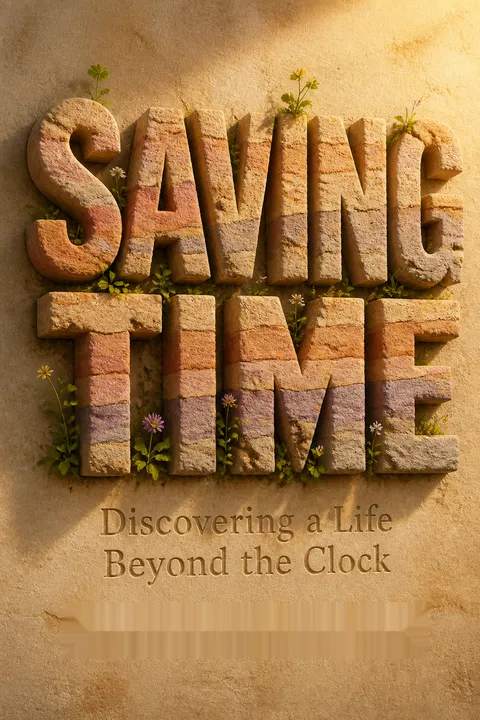
Saving Time is a philosophical argument delivered through scenes rather than a conventional productivity system. The moss in a planter, a freight port, an influencer’s volcano video, a beach of ancient stones, a wildfire landscape, a library, and a cemetery each become laboratories for asking what time is and who gets to define it. This braided structure is demanding: the book moves among labor history, ecology, race, disability, leisure, and mortality. Its coherence comes from one repeated question: are people and places treated as living participants in time, or as resources measured for someone else’s use?
The argument is strongest when it connects intimate experience to infrastructure. A worker’s sense of having too little time is not simply a feeling to be managed; it can reflect surveillance, unpaid care, insecure work, or a schedule controlled by someone else. Likewise, climate fatalism becomes less convincing when fire suppression, extraction, and corporate messaging are restored to their histories. The book’s attention to Indigenous knowledge also unsettles the assumption that clock-based, abstract time is the universal standard rather than one culturally specific system.
There is a useful tension between critique and practice. Observing a branch or tide does not create policy change, and a meaningful moment of leisure does not dissolve economic constraints. Odell recognizes this by arguing for both individual shifts in perception and structural change. The practical contribution is therefore not a set of scheduling hacks, but a richer diagnostic: who sets the rhythm, whose labor disappears from the account, and what living processes does the clock leave out?
Some claims require care. Respecting nonhuman agency need not mean attributing human-like intention to every organism or geological process. Nor should alternate time systems be romanticized as automatically just. The book is most persuasive when these ideas widen attention and responsibility, not when they appear to settle scientific or political questions. Its lasting invitation is to hold measurement alongside lived duration, and to treat the future as a field of contested possibilities rather than a completed schedule.
Review Summary
Saving Time receives mixed reviews. Many praise Odell's thought-provoking exploration of time, capitalism, and our relationship with nature. Readers appreciate her research and unique perspective. However, some find the book unfocused, meandering, and difficult to follow. Critics argue it lacks practical solutions and may alienate working-class readers. Fans of Odell's previous work tend to enjoy this book more. Overall, reviewers agree it offers interesting ideas but can be challenging to digest. The book's unconventional structure and dense writing style divide opinion.
People Also Read









Glossary
chronos
measured sequential timeA Greek term for time understood as linear, measurable succession: one moment following another on a clock or calendar. In the book, chronos is useful for coordination but can make time seem uniform and the future predetermined, obscuring the distinct qualities of particular moments.
kairos
a timely openingA Greek term for qualitative or opportune time, when circumstances make a particular action possible or necessary. Unlike chronos, which counts elapsed units, kairos emphasizes that moments differ in their conditions and potential. The concept helps describe agency and possibility during periods of crisis or change.
fungible time
interchangeable time unitsTime treated as uniform, divisible, and exchangeable, much like currency. Under this view, one hour can be swapped for another and filled with labor or sold for wages. The book traces how this abstraction supports productivity measurement while concealing differences in bodies, working conditions, and control.
zeitgeber
a rhythm-setting influenceA German term meaning “time giver,” used for a person, system, or recurring condition that organizes someone’s experience of time. A manager’s schedule, a child’s needs, an app, or a cycle of illness can act as a zeitgeber. Different zeitgebers can conflict, and social power affects whose rhythm others must follow.
temporal commons
shared rhythms of timeA collectively maintained way of organizing time, such as a shared rest period, work rhythm, or recurring social practice. Because such arrangements depend on group participation and wider institutional conditions, they can disappear when surrounding incentives undermine them. The concept shifts attention from private time management toward shared agreements and their protection.
timefulness
time present in thingsAn acute awareness that the past remains materially present in the world and that things are made through time. A rock, tree, or landscape is not merely evidence of elapsed years; it embodies ongoing and past processes. The term is associated in the book with geologist Marcia Bjornerud.
crip time
time shaped by disabilityA disability studies concept describing the mismatch between disabled people’s varied rhythms and standard schedules built around able-bodied speed and productivity. It can involve needing more time for everyday tasks, unpredictable changes in capacity, or life courses that do not follow conventional timelines. It also invites a broader reconsideration of whose timing institutions accommodate.
social death
denial of full personhoodA condition in which individuals or groups are treated as outside full social recognition, with their inner lives, agency, or future disregarded. The book applies the concept to histories of enslavement and to incarceration, where policies can mark people as permanently dangerous or disposable despite their continuing hopes, relationships, and capacity to change.
chronodiversity
variety in temporal rhythmsThe coexistence of different rhythms and timescales in human and nonhuman life. Seasonal cycles, daily routines, caregiving, geological change, and shared cultural practices all unfold differently. The term counters the assumption that one standardized clock should define every activity, and suggests that diverse rhythms can be recognized and cultivated.
Download PDF
Download EPUB
.epub digital book format is ideal for reading ebooks on phones, tablets, and e-readers.








