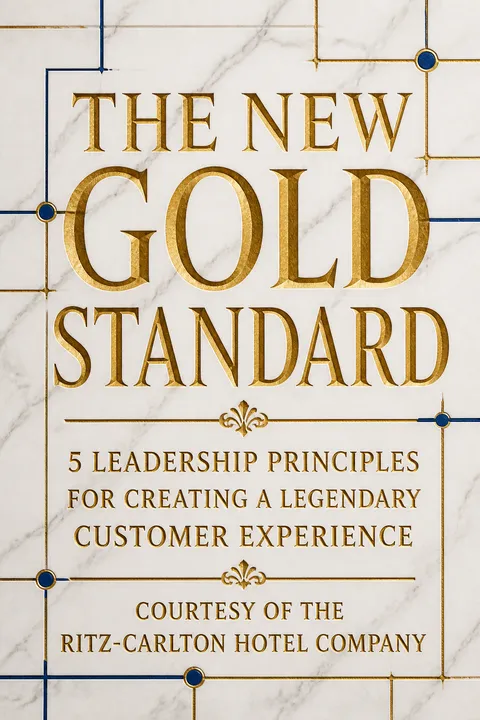


Key Takeaways
Make service a system of care, not a performance script.
Make the promise visible. Ritz-Carlton’s Gold Standards are its shared statements of purpose, service commitments, and operating values. They include a concise description of the guest experience, a statement of mutual respect between staff and guests, and simple guidance for welcoming, anticipating needs, and saying goodbye. Staff carry the standards and revisit them in daily meetings called lineups, where teams discuss a customer story and what it means for their work.
Keep principles alive. The company’s original 20 Basics made expectations explicit, but some staff began treating examples as mandatory scripts. Ritz-Carlton revised them into broader Service Values that emphasized the outcome for the guest and left room for judgment. During Hurricane Katrina, regular staff briefings continued amid the crisis, giving employees a shared source of information and purpose.
What's striking is that repetition and flexibility are not opposites. Shared language gives staff a common direction, while discussion of real cases keeps that language from becoming empty ritual. This resembles good safety practice: teams rehearse principles so they can adapt under pressure, rather than memorize responses for every possible event. Yet repetition works only when leaders model the standards and employees can question how they apply. A daily meeting that becomes recitation can dull attention instead of sharpening it. The book's useful distinction is between a stable promise and adaptable behavior.
Keep your standards steady while adapting the experience to today's guest.
Protect the core, revise the surface. Ritz-Carlton’s leaders faced a brand associated with formal luxury while guests were changing. Some travelers still valued traditional status and consistent rituals; others wanted distinctive places, personal choice, and experiences worth remembering. Research and conversations with luxury brands helped leaders recognize that the same hotel design and service style would not suit every location or guest.
Design for the setting. The company moved toward properties shaped by their surroundings and clientele, rather than repeating one familiar look everywhere. A business hotel could serve different needs from a family resort, and a tropical property need not resemble a city hotel. Service guidance also shifted away from rigid instructions, such as automatically escorting every guest, toward reading what each person actually preferred.
The deeper principle is controlled variation. Customers often want reliability in what a brand promises and freedom in how that promise is delivered. That distinction is useful beyond hospitality: an organization can standardize safety, quality, and respect while adapting tone, format, and local details. The hard part is deciding which elements are genuinely essential rather than merely familiar to managers. Too much consistency can make a brand feel tone-deaf; too much customization can make it unrecognizable. Ritz-Carlton’s approach treats relevance as a design question, not a license to change everything.
Select for service instinct, then teach the craft.
Choose deliberately. Ritz-Carlton distinguishes selecting people from simply filling vacancies. Candidates may meet several managers and frontline employees, with interviews intended to assess both ability and commitment to service. The process can be slow, but the company argues that a careful match reduces costly turnover and supports a consistent guest experience. The book reports turnover around 20 percent at Ritz-Carlton, compared with an industry average near 60 percent at the time.
Begin belonging before job tasks. New employees attend a two-day orientation on the company’s history, purpose, and values before starting work. They then receive job training and certification, with a review around day 21 to surface problems early. The company also marks the employee’s first-year anniversary, combining recognition with a check that job skills remain current.
This sequence treats hiring as the first act of culture, not an administrative step before the real work begins. A careful selection process can signal that service is skilled labor and that employees are not interchangeable parts. Orientation then clarifies what the organization expects and what it owes in return. The model is resource-intensive, and an elaborate process can reward polished interview performance over less visible strengths if criteria are vague. Its most transferable lesson is not to add interviews indiscriminately, but to define the qualities needed, involve people who know the work, and give new hires a genuine path to competence.
Give frontline staff authority that matches the responsibility you expect.
Trust needs practical backing. Ritz-Carlton asks employees to resolve guest problems and create personal experiences rather than passing every decision up a chain of command. Each employee may use judgment to spend up to $2,000 per guest per day when necessary to improve a stay or fix a problem. Training and a clear service culture are meant to help employees use that authority thoughtfully, not as a spending contest.
Model the behavior. Leaders reinforce trust by listening to staff, providing tools, and joining frontline work. At one hotel, a boiler operator raised concerns about an inadequate security system; management investigated and approved a major upgrade. In another example, a general manager served employees in the dining room. These actions communicate that staff expertise matters and that service is a shared responsibility.
Authority without support is abandonment; support without authority is bureaucracy. This model connects employee discretion to training, resources, and a clear purpose, making it more credible than a slogan about empowerment. It also recognizes that the person closest to a problem often has the best information for fixing it quickly. The spending limit is striking, but copying the number without copying the selection, training, and accountability behind it would be reckless. Organizations can begin smaller by naming decisions employees may make independently, then reviewing whether those decisions improve customer outcomes.
Measure guest and employee engagement, then repair the process behind the score.
Look beyond satisfaction. Ritz-Carlton used Gallup’s Q12 to assess whether employees felt equipped, recognized, supported, and able to grow. For guests, it adopted the CE11, a survey designed to assess their emotional connection and likelihood of continued loyalty, not just whether they were pleased with a transaction. Results were shared with hotel teams and used to identify areas needing attention.
Fix causes, not appearances. The company tracked service failures through MR. BIV, a shorthand for mistakes, rework, breakdowns, inefficiencies, and variations. Employees recorded problems so teams could find recurring causes and change procedures. The book reports that highly engaged guests spent 23 percent more than moderately engaged guests, and that a four-point companywide increase in engagement could mean $40 million in additional revenue.
The strongest feature here is the closed loop: collect experience data, make it visible to people doing the work, and use it to change the process. That makes measurement a management tool rather than a dashboard decoration. The reported financial relationships strengthen the business case, but correlation does not prove that a survey score alone causes spending. Scores can also become targets that encourage performative behavior. A sound use of metrics pairs them with concrete observations, staff input, and follow-up on whether the underlying experience actually improved.
Use customer memory to anticipate needs, without turning care into surveillance.
Remember what matters. Ritz-Carlton’s Mystique database stores guest preferences and service history so staff at different properties can recognize returning customers. Employees also use preference pads to note details they observe. Guest-relations staff share relevant information before arrival, helping teams prepare rather than making customers repeat themselves.
Treat clues carefully. A pregnant guest requested extra support pillows before a stay; staff offered different options, including a full-length body pillow, and arranged for her choice. At dinner, reservation staff might ask about allergies or a special occasion so the kitchen can prepare appropriately. But a single request does not always reveal a permanent preference. The company cautions employees to distinguish a lasting choice from a one-time experiment and to protect personal information.
Memory can make service feel human when it saves effort and helps someone feel recognized. It can feel unsettling when the business appears to know more than the customer intended to share. The dividing line is purpose, restraint, and control: information should improve the person’s experience, remain relevant, and be handled discreetly. The example of the body pillow shows how a small advance effort can matter more than a grand gesture. The system still depends on human judgment, because data records what happened, not necessarily why it happened or whether the preference still holds.
Turn service wins into stories that teach judgment, not scripts.
Make excellence concrete. Ritz-Carlton collects employee stories about actions that created unusually thoughtful guest experiences. Selected examples appear in daily lineups, connecting a real event to the company’s values. Employees whose stories are featured receive recognition, and the stories help teams see what service principles look like in practice.
Show collaboration in action. During a rainy Super Bowl, staff at the South Beach hotel coordinated across departments to send warm towels to guests returning from the stadium. The story illustrates how laundry, transportation, guest services, and other teams can work together without waiting for a formal request. The company also shares smaller examples, so service excellence does not seem to require a heroic rescue or an expensive gesture.
Stories give abstract values emotional detail and make successful behavior easier to imagine. They also carry local knowledge: listeners can see how employees noticed a need, coordinated, and acted. The risk is that celebrated anecdotes can be mistaken for minimum expectations, pressuring staff to stage dramatic gestures or compete for attention. Ritz-Carlton’s use of routine examples helps counter that distortion. The most useful story is not merely one that impresses an audience; it reveals a decision process that employees can adapt to circumstances no script anticipated.
Extend your brand only where customers recognize its core promise.
Grow from what you do well. Ritz-Carlton asked loyal guests how they wanted the company to figure into their lives. Their interest in returning for vacations and family experiences supported expansion from hotels into fractional-ownership Clubs and managed Residences. These offerings carried the company’s hospitality and service into longer-term leisure and living arrangements.
Share expertise beyond the hotel. After winning the Malcolm Baldrige National Quality Award twice, Ritz-Carlton built a Leadership Center to teach other organizations about service, quality, and culture. It also developed internal learning programs for its employees. These extensions draw on recognizable strengths rather than attaching the name to unrelated products. The company’s leaders treated expansion as a way to deepen customer relationships and transfer useful knowledge, not simply as a way to add offerings.
A brand extension is strongest when customers can explain why it belongs. Here, service and hospitality provide a bridge from a hotel stay to property ownership or leadership education. This is more disciplined than treating brand recognition as permission to enter any market. Still, a successful extension can consume attention and strain the original operation if the new service is not staffed or governed well. Customer enthusiasm is important evidence, but it must be paired with the capability to deliver the promise consistently in a different context.
Make community stewardship an operating practice, not a seasonal campaign.
Focus the contribution. Ritz-Carlton’s Community Footprints program organized work that had often been handled separately by individual hotels. It concentrated efforts on poverty and hunger relief, the well-being of disadvantaged children, and environmental conservation. Hotels developed local plans while corporate leadership coordinated priorities and tracked results.
Count more than cash. In 2007, the company reported about $7.4 million in donated products, services, and money, alongside more than 40,000 employee volunteer hours. During hurricanes, employees also sheltered guests and, in some locations, children from local orphanages. These efforts show how community support can be built into relationships with employees, guests, and local organizations. The book argues that a company’s impact includes its jobs, its conduct, and the way it responds when neighbors need help.
The approach makes social contribution part of organizational identity while retaining local participation. That combination matters: central priorities prevent scattered efforts, and local choice keeps the work connected to actual community needs. Volunteer programs can also build relationships among colleagues and partners, though those benefits should not displace the needs of the people being served. Counting donations and hours makes activity visible, but good stewardship also asks whether the support addresses a priority identified by the community and whether it is sustained beyond a highly public moment.
Analysis
The book’s central argument is that legendary service is not a personality trait or a collection of charming gestures. It is an operating system: define a promise, select and develop people who can carry it, give them discretion, listen for evidence about the experience, and use that evidence to adapt. The Ritz-Carlton examples make the system tangible, from daily lineups to guest-preference records and employee authority to resolve problems. Its most compelling insight is the link between care and infrastructure. A heartfelt employee cannot reliably anticipate needs if departments do not communicate, training is thin, or the employee must seek permission for every decision. Conversely, systems alone can produce polished indifference. The book argues for both: disciplined processes that protect fundamentals and human judgment that personalizes the encounter.
The model also has limits. Luxury hospitality can support intensive staffing, training, and personalization in ways that many organizations cannot reproduce at the same scale. Some practices, especially storing personal preferences and monitoring engagement, require careful privacy safeguards and employee trust. Metrics can clarify priorities but may distort them when leaders reward the score more than the experience. And exceptional service stories should inspire, not establish an unpaid expectation of limitless emotional labor.
The transferable lesson is therefore not to imitate a hotel’s gestures or spending authority. It is to identify a small set of promises customers value, create the conditions for employees to keep them, and examine honestly where the operating system makes that difficult. The book’s service ideal becomes practical when care is designed into decisions, communication, and accountability, rather than left to individual goodwill.
Review Summary
The New Gold Standard receives mostly positive reviews for its insights into Ritz-Carlton's exceptional customer service and leadership principles. Readers appreciate the practical lessons, inspiring stories, and detailed look into the company's culture. Some find it repetitive or overly promotional, but many praise its valuable frameworks for improving service and company culture. The book is particularly recommended for those in hospitality or customer-centric industries. While some critics desire more technical details, most readers find it a helpful resource for enhancing leadership and customer satisfaction.
People Also Read










Glossary
Gold Standards
Shared service commitmentsRitz-Carlton’s umbrella term for the purpose statements, values, and service guidance that define how the company intends to treat guests and employees. These standards include the Credo, the Motto, and basic service guidance. They are reinforced through employee materials and recurring discussions, and are intended to guide behavior rather than merely decorate company communications.
Credo
Promise of guest experienceA concise statement describing the experience Ritz-Carlton aims to provide: genuine care, personal service, a welcoming atmosphere, and attention to guests’ expressed and unspoken needs. It condenses a longer mission into language employees can remember and discuss. The Credo is one component of the broader Gold Standards.
20 Basics
Original service guidelinesA set of 20 operational and behavioral expectations used to create consistency across Ritz-Carlton properties. They covered such areas as guest greetings, complaint resolution, cleanliness, safety, teamwork, and communication. The company found that some employees treated examples as scripts, so the Basics were replaced by broader guidance emphasizing desired outcomes and judgment.
Service Values
Outcome-focused staff principlesTwelve employee-facing statements introduced to encourage personal responsibility, teamwork, learning, problem resolution, innovation, and tailored guest experiences. Unlike highly specific instructions, the Service Values describe the kind of outcome and conduct expected, leaving employees room to adapt their actions to individual guests and situations.
Lineup
Daily values discussionA short meeting held at the start of work shifts throughout Ritz-Carlton. Employees review company values, discuss a customer-service story, share relevant information, and connect the example to the day’s work. The practice is used across departments and levels of the organization to maintain a shared culture and improve communication.
Mystique
Guest relationship systemRitz-Carlton’s customer relationship management database, which stores relevant guest preferences and service history for use across properties. Staff use the information to prepare for returning guests and personalize their experience. Employees are expected to keep the information accurate, respect privacy, and distinguish lasting preferences from one-time choices.
MR. BIV
Service defect trackerAn acronym for mistakes, rework, breakdowns, inefficiencies, and variations. Ritz-Carlton uses it to make service defects visible and easier to report without treating reports as personal blame. The resulting information helps teams identify recurring problems, correct processes, and reduce repeated failures.
Key Success Factors
Annual business prioritiesA short list of company priorities used to connect daily work to broader results. Ritz-Carlton displays the factors for employees and discusses how individual departments can contribute. The factors include areas such as guest and employee engagement, service and product quality, and financial performance, with priorities reviewed over time.
Gallup Q12
Employee engagement surveyA 12-question survey used to assess workplace conditions associated with employee engagement. Its questions cover expectations, resources, recognition, relationships, opportunities to grow, and whether employees feel their opinions matter. Ritz-Carlton used the results to identify areas where management could strengthen employees’ ability to contribute.
Gallup CE11
Customer engagement surveyAn 11-question instrument used to assess customers’ emotional connection to a company, including trust, fairness, pride, continued choice, and willingness to recommend it. Ritz-Carlton used the measure alongside feedback about specific transactions to understand loyalty and identify service improvements.
Community Footprints
Community impact programRitz-Carlton’s organized approach to community service and environmental stewardship. It focuses company efforts on hunger and poverty relief, support for disadvantaged children, and environmental conservation. Hotels create local activities within those priorities, while company leaders coordinate and measure contributions such as donations, services, and employee volunteer hours.
FAQ
What's The New Gold Standard about?
- Customer Experience Focus: The book delves into how The Ritz-Carlton Hotel Company excels in customer service through five leadership principles.
- Leadership Principles: These include defining the company's core identity, empowering employees, focusing on others, delivering exceptional experiences, and leaving a lasting impact.
- Cultural Insights: It provides a look into the company culture that promotes employee engagement and customer satisfaction, with real-life examples of service excellence.
Why should I read The New Gold Standard?
- Inspiration for Businesses: It serves as a guide for businesses aiming to improve customer service and employee engagement.
- Proven Success: The book details Ritz-Carlton's successful practices, consistently ranking high in customer satisfaction.
- Applicable Lessons: The principles can be applied across various industries, making it a valuable resource for leaders and managers.
What are the key takeaways of The New Gold Standard?
- Five Leadership Principles: The book outlines principles that help organizations create legendary customer experiences.
- Importance of Culture: It emphasizes a strong organizational culture that prioritizes employee and customer satisfaction.
- Empowerment and Trust: Empowering employees and fostering trust are highlighted as keys to exceptional service delivery.
What are the best quotes from The New Gold Standard and what do they mean?
- “The customer is never wrong!”: This reflects Ritz-Carlton's philosophy of prioritizing customer satisfaction and understanding their needs.
- “People like to be served, but invisibly.”: Effective service meets customer needs seamlessly without drawing attention.
- “Luxury is a choice.”: Luxury is defined by the customer's perception and experience, not just the product or service.
What are the five leadership principles outlined in The New Gold Standard?
- Define and Refine: Establish a clear core identity and culture guiding all business decisions.
- Empower through Trust: Create a trusting environment where employees can enhance customer experiences.
- It’s Not about You: Focus on customer and colleague needs, fostering a service-oriented mindset.
- Deliver Wow!: Exceed customer expectations with memorable experiences.
- Leave a Lasting Footprint: Create a positive impact on customers, employees, and the community.
How does Ritz-Carlton empower its employees according to The New Gold Standard?
- Trust and Autonomy: Employees can make decisions to enhance guest experiences, with authority to spend up to $2,000 per guest per day for service recovery.
- Comprehensive Training: Extensive training programs equip employees with necessary skills and knowledge.
- Open Communication: An environment where employees can voice ideas and concerns, ensuring they feel valued.
What is the significance of the "Employee Promise" in The New Gold Standard?
- Commitment to Employees: It outlines Ritz-Carlton's expectations in nurturing and developing staff, emphasizing trust and respect.
- Foundation for Trust: Builds a trusting relationship between leadership and employees, enhancing engagement and loyalty.
- Guiding Principles: Includes principles guiding employee interactions and the work environment, ensuring a consistent culture of excellence.
How does Ritz-Carlton maintain its service excellence as described in The New Gold Standard?
- Quality Processes: Systematic quality improvement processes ensure consistent service delivery.
- Feedback Mechanisms: Actively seeks feedback from customers and employees to identify improvement areas.
- Benchmarking Best Practices: Studies successful practices from other industries to refine service offerings.
What role does customer engagement play in Ritz-Carlton's strategy according to The New Gold Standard?
- Emotional Connection: Critical for building long-term loyalty and satisfaction, beyond mere satisfaction metrics.
- Gallup Q12 Tool: Measures employee engagement, correlating directly with customer engagement and business success.
- Continuous Improvement: Focuses on enhancing customer engagement through ongoing staff training and development.
How does Ritz-Carlton ensure its relevance in a changing market as discussed in The New Gold Standard?
- Adaptation to Trends: Monitors changes in customer demographics and preferences to refine service offerings.
- Listening to Customers: Engages with luxury consumers to understand evolving needs and expectations.
- Innovative Practices: Implements innovative practices based on research and feedback to remain a leader in luxury hospitality.
How does The New Gold Standard address the concept of corporate social responsibility?
- Community Footprints Program: Details Ritz-Carlton's approach to community involvement, focusing on hunger relief, child welfare, and environmental conservation.
- Employee Engagement: Encourages employee participation in volunteer activities, benefiting the community and enhancing team cohesion.
- Long-Term Commitment: Views social responsibility as part of core values, ensuring genuine and impactful efforts.
What is the significance of the "Wow" experience in Ritz-Carlton's service model?
- Emotional Connection: Creates memorable moments that emotionally engage customers, fostering loyalty.
- Anticipating Needs: Employees are trained to anticipate and fulfill both stated and unstated customer needs.
- Storytelling: Emphasizes sharing "Wow" stories among staff to inspire and reinforce the service culture.
About the Author


Download PDF
Download EPUB
.epub digital book format is ideal for reading ebooks on phones, tablets, and e-readers.








