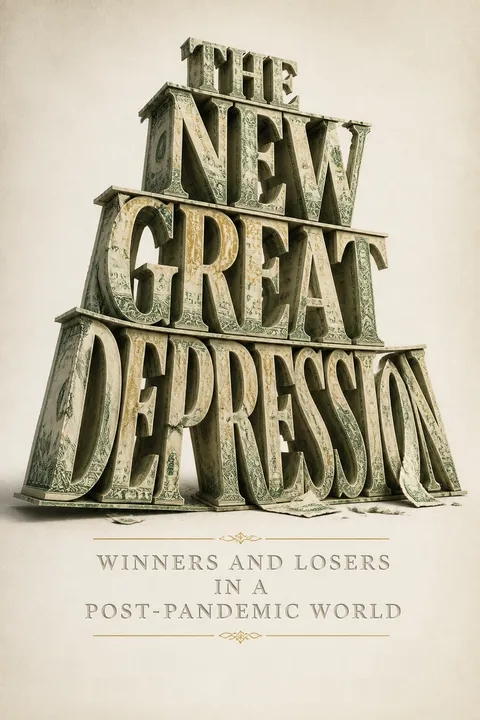


Key Takeaways
A depression is a lasting output gap, not a string of shrinking quarters
Levels matter more than direction. Rickards defines a depression as a prolonged period when an economy grows below its potential, not necessarily one in which output keeps falling. The 1929 to 1940 Great Depression included years of strong growth, yet unemployment stayed high and stocks took until 1954 to regain their 1929 peak. The Long Depression of 1873 to 1897 also contained recoveries and innovation, alongside persistent deflation and financial panics.
A rebound can still leave a hole. If output falls far enough, several years of growth may not restore the old level. Rickards uses this distinction to argue that the 2020 collapse was more than a technical recession: employment, production, and confidence had been damaged so sharply that improvement would not mean a return to normal.
This distinction prevents a common statistical illusion: a positive growth rate can coexist with an economy that remains poorer than before. It is useful to track both the rate of change and the distance from the previous trend, much as clinicians distinguish a patient improving from a patient fully recovered. The author’s definition is conceptually helpful, though “potential” output is itself estimated rather than directly observed. A depression label can clarify persistent shortfalls, but it can also become a forecast disguised as a diagnosis unless the benchmark and time horizon are made explicit.
Keep pandemic-origin claims provisional when investigators cannot inspect the evidence
Two explanations compete. Rickards considers a natural animal-to-human transfer, possibly linked to a wet market, and an accidental release from a Wuhan laboratory studying bat coronaviruses. He notes that the early cases did not all have a known connection to the market, while the laboratory had handled related viruses and faced safety concerns. China’s suppression of information and limits on independent investigation, in his account, make a definitive answer difficult.
The author favors a lab leak. He weighs circumstantial clues, including missing evidence and official secrecy, and concludes that a laboratory accident is more likely. But the book also acknowledges that the origin remained unresolved and that much of the evidence was indirect. Its broader lesson is that origin investigations require access to samples, records, and witnesses, not just confident narratives.
The chapter is strongest when it separates hypotheses from proof and weakest when suspicion is treated as a probability calculation with inputs that cannot be independently checked. Bayesian reasoning can update uncertainty, but it cannot turn unreliable or missing evidence into certainty by mathematical form alone. The useful general principle is institutional: transparent records and independent access make scientific claims more testable. A reader should retain the distinction between “plausible,” “supported,” and “established,” especially when national rivalry gives every side an incentive to frame the story.
Judge shutdown policy by both infections prevented and damage displaced
The central accusation. Rickards argues that the economic depression was caused not by the virus alone, but by policy choices made in response to it, particularly broad business closures and stay-at-home orders. He points to more than 60 million Americans losing jobs during the first months of the crisis, along with lost output, business failures, delayed medical care, and distress associated with isolation. He argues that targeted protection and voluntary precautions could have reduced harm without closing so much of the economy.
This is his interpretation, not a neutral finding. The book’s claim that the lockdown was unnecessary and cost more lives than it saved is stronger than the evidence it presents can settle. Its most durable challenge is narrower: emergency policy should count indirect costs, compare alternatives, and explain uncertainty rather than treating economic and social harms as irrelevant.
The argument usefully insists that public health decisions have consequences beyond infection counts. Any policy with broad effects should consider distribution: who bears the immediate costs, who receives protection, and which harms are likely to persist. Yet costs on both sides are hard to compare, and the counterfactual cannot be observed directly. The book sometimes moves from “costs were not adequately considered” to “the chosen policy was a blunder.” The first claim is a valuable standard for crisis governance; the second requires stronger causal evidence and a careful comparison with realistic alternatives.
Flattening a peak can spare hospitals without guaranteeing fewer total infections
Timing was the stated goal. Rickards explains “flattening the curve” as spreading infections over a longer period so hospitals are less likely to be overwhelmed at once. A lower peak can protect access to care, even if transmission continues. He argues that officials did not communicate this distinction clearly, leaving many people to believe restrictions would necessarily reduce the total number of infections and deaths.
The book disputes the trade-off. It contends that broad closures mainly delayed infections and could postpone population immunity, while targeted measures, temporary hospitals, and extra medical staffing could address surges more narrowly. These were arguments made amid major uncertainty about transmission, severity, and hospital capacity. The practical lesson is to ask whether a measure aims to reduce spread, slow it, protect capacity, or buy time, because these are different objectives.
This section highlights a communication problem that appears whenever policy relies on a technical distinction: the public hears the slogan, but not the mechanism or the limits. Peak capacity and cumulative harm are separate measures, and both matter. However, slowing transmission can also prevent some infections if it allows testing, isolation, treatment, or behavior to change. The book’s assumption that cumulative outcomes would be roughly the same is therefore not automatic. The useful question is not whether flattening “works” in the abstract, but which intervention changes which outcome, for whom, and at what cost.
Watch debt and deflation when new money fails to reach spending
Money can pile up without circulating. Rickards calls the turnover of money “velocity.” If households save rather than spend and banks lend cautiously, additional money may not create much demand or output. He argues that the Federal Reserve’s expanding balance sheet could support financial markets while doing little to restore jobs. The book also describes a liquidity trap: a situation in which people prefer holding cash to spending or investing, particularly when they expect prices or incomes to fall.
Debt makes falling prices dangerous. Deflation raises the real burden of fixed debts, making repayment harder for households, companies, and governments. Rickards questions Modern Monetary Theory, which treats a sovereign government’s spending capacity as less constrained than conventional accounts suggest. His concern is that policy makers may overlook confidence, spending behavior, and the costs of already high debt.
The emphasis on behavior corrects a mechanical view of monetary policy: a central bank can create reserves, but it cannot command households to borrow or firms to invest. That insight connects macroeconomics to expectations and risk management. Still, the argument can understate the ways transfers, credit guarantees, and public purchases support incomes even when private spending retreats. Nor does a high debt ratio alone establish that a crisis is imminent. The sharper diagnostic is whether borrowing sustains productive capacity or merely postpones losses while confidence and demand continue to weaken.
A rising index can conceal a collapsing Main Street economy
The market is not the whole economy. U.S. stocks fell sharply between February and March 2020, then rebounded. Rickards argues that the rebound did not prove a broad recovery: major indices were heavily influenced by a small group of technology companies that were less exposed to closed storefronts and travel restrictions. He nicknames the S&P 500 the “S&P 6” to emphasize the outsized role of its largest firms.
Small firms told another story. Small and medium-sized enterprises accounted for nearly half of U.S. employment and a substantial share of output, according to the book. Many had cash reserves measured in weeks, not months. Restaurant closures, unpaid rent, and bankruptcies could therefore destroy jobs and local supply chains even while a technology-heavy stock index climbed. Prices in financial markets reflect expectations and index composition, not a census of ordinary economic life.
This is a useful warning against treating a single aggregate as a complete report card. Market capitalization weighting can make a handful of winners dominate an index, while unemployment, business survival, and household security deteriorate elsewhere. The same measurement problem appears in averages that hide unequal distributions. But the inverse caution matters too: a weak labor market does not prove that every stock is mispriced, since markets value future earnings rather than current hardship alone. Good analysis asks what an index represents before drawing conclusions from its direction.
Measure a depression by lost capacity and confidence, not GDP alone
Damage can outlast the shutdown. Rickards describes a chain in which a closed restaurant lays off workers, loses suppliers, and reduces demand for nearby businesses. Remote work could also reduce demand for office space, transit, cleaning, and lunch-hour retail. Even after restrictions ease, a business that has failed or a worker who has left the labor force may not return in the same form. These losses can make recovery slower than the first rebound in output suggests.
The human cost is part of the story. The book links isolation, job loss, and fear to mental distress and social conflict. It recalls how Katherine Anne Porter wrote about the 1918 influenza pandemic while many other writers barely mentioned it, suggesting that collective trauma can persist without becoming public conversation. Rickards warns that lost routines and trust may weigh on communities as well as markets.
The focus on capacity and connection broadens economic analysis beyond production totals. Skills, professional networks, neighborhood businesses, and trust are forms of social infrastructure, and they can erode when people are separated from work and one another. These effects are difficult to quantify, which makes them easy to omit rather than unimportant. At the same time, the book sometimes presents a direct causal line from restrictions to social disorder when racial injustice, political polarization, and pre-existing economic fragility also shaped events. Multiple causes can interact without one erasing the others.
Build portfolios around scenarios, not a single confident market story
Forecast, policy, then trade. Rickards’s investing method asks readers to form a view of the economy, anticipate how governments and central banks may respond, and position before markets fully adjust. He combines complexity theory, Bayes’ theorem, historical patterns, and behavioral psychology in a forecasting approach aimed at roughly six months ahead. He recommends revisiting assumptions rather than treating a portfolio as “set and forget.”
Diversify across asset classes. Owning many stocks is not the same as owning assets that respond differently to shocks. His suggested allocation is 30 percent cash, 10 percent gold, 20 percent residential real estate, 20 percent Treasury notes, 10 percent equities, and 10 percent alternatives. He favors cash for flexibility, bonds against deflation, and gold and property as inflation hedges. These are the author’s views from 2020, not guaranteed outcomes or current individualized advice.
Scenario-based investing is more robust than betting everything on one forecast because it forces an investor to ask what would change the thesis. Cross-asset diversification can also reduce dependence on a single market regime. The challenge is execution: frequent revisions can become reactive trading, and a six-month outlook is still a forecast with substantial uncertainty. The allocation is best read as an illustration of the author’s assumptions about deflation and policy, not as a timeless formula. A sound process should include liquidity needs, time horizon, and the possibility that the model is wrong.
Consider gold as Rickards's proposed lever for reversing deflation
The proposed remedy targets the dollar. Rickards argues that the United States could raise the dollar price of gold to weaken the dollar’s purchasing power, encourage spending, and reduce the real burden of debt. He points to Franklin Roosevelt’s 1933 policy: the government bought gold and ultimately changed its official price from $20.67 to $35 per ounce. Rickards interprets the change as a deliberate devaluation that helped reverse deflation. He contrasts it with Richard Nixon’s 1971 suspension of gold convertibility, which he regards as poorly controlled and followed by severe inflation.
Gold is a policy tool in this argument. The proposal is not simply to return to a fixed gold standard. Rickards suggests that central banks could buy gold at progressively higher prices to create inflationary expectations. He sees this as a way out of debt-driven deflation, but acknowledges that managing the currency-gold relationship requires precision and could produce damaging inflation if mishandled.
The proposal has a clear internal logic: if debt is fixed in nominal terms, a measured rise in the price level can reduce its real weight. The historical example gives the idea narrative force, but it does not establish that the same mechanism would reliably produce a controlled recovery under different institutions and conditions. Inflation can ease debt burdens while also reducing purchasing power and destabilizing expectations. The key analytical question is whether authorities could calibrate the policy, then stop it at the right point. Rickards offers a bold alternative to standard stimulus, not a low-risk technical adjustment.
Analysis
The book is best understood as a forceful, time-stamped argument about crisis interpretation, not as a neutral account of pandemic economics. Its narrative moves from the virus’s uncertain origin, through emergency restrictions and the economic collapse, to a claim that debt, deflation, and damaged confidence will prolong the downturn. It then turns the same uncertainty into an investment thesis: markets misread reality, so investors should anticipate policy and diversify across assets. The connective idea is that behavior matters. People can stop spending, trusting, or participating in work, and those shifts can blunt policies designed through financial aggregates alone.
Its strongest analytical contribution is the insistence on looking beyond headline indicators. GDP growth can resume while output remains below its earlier path; a stock index can rise while small businesses and workers remain under severe strain; and money creation does not guarantee spending. Those distinctions are valuable well beyond this specific crisis. The book also asks an important question about policy evaluation: whose losses count, and which counterfactual is being used?
Its weakest move is the tendency to treat disputed causal claims as settled conclusions. The text argues categorically that lockdowns failed, that the economic collapse was principally a policy choice, and that a gold-price strategy could restart inflation. Yet evidence available in 2020 was incomplete, and the book’s own account describes uncertainty about transmission, immunity, and the origin of the virus. Its forecasts also reflect the knowledge and expectations of that moment, rather than timeless facts. The most reliable way to use the book is therefore to separate its durable analytical prompts from its predictions: ask how output compares with trend, how money reaches real activity, and how policies distribute costs, while testing each causal claim against evidence that can distinguish correlation, mechanism, and counterfactual. Its urgency is illuminating; its certainty requires scrutiny.
Review Summary
The New Great Depression receives mixed reviews. Critics praise its economic analysis and historical context but criticize its rushed publication and lack of depth. Some find Rickards' contrarian views insightful, while others see them as biased and unsupported. The book's coverage of pandemic origins and lockdown impacts is controversial. Readers appreciate Rickards' investment advice and predictions, though some find them simplistic. Overall, opinions vary widely on the book's value, with some considering it essential reading and others dismissing it as unsubstantiated conjecture.
People Also Read




Glossary
Depression
prolonged below-trend activityRickards uses depression to mean an extended period of economic growth below the economy’s potential, not simply a long sequence of falling output. An economy can grow during a depression if it remains far below its prior level or trend. The term captures persistent damage to employment, production, and expectations that a short-term recovery may not erase.
Velocity
money's rate of circulationVelocity is the rate at which money is spent or transferred through an economy over a period. In Rickards’s argument, central banks can expand the money supply, but fearful households and cautious businesses can hold onto cash rather than spend it. When circulation slows, money creation may do little to lift demand, output, or employment.
Liquidity trap
cash preference blocks spendingA liquidity trap is a condition in which households and businesses prefer holding cash to spending or investing, even when interest rates are low. Rickards connects this behavior to deflation expectations, uncertainty, and fear of future losses. In that situation, conventional monetary easing may fail to generate enough borrowing and spending to revive economic activity.
Modern Monetary Theory
state-centered account of moneyModern Monetary Theory, or MMT, treats a government that issues its own currency as able to spend without the same financing constraints faced by households or businesses. Rickards critiques this view for underestimating the role of public confidence, inflation expectations, and the speed at which money circulates. He argues that legal authority to issue money does not guarantee stable purchasing power.
Cognitive dissonance
belief conflicts with evidenceCognitive dissonance is the psychological tension that arises when a person’s beliefs conflict with observed reality. Rickards applies the concept to investors who see evidence of economic weakness yet continue to expect a rapid recovery because markets have rallied. The gap can persist until new information or events force beliefs and expectations to change.
Predictive analytic model
framework for uncertain forecastsRickards’s predictive analytic model combines complexity theory, Bayes’ theorem, historical analysis, and behavioral psychology. It uses incomplete evidence to form and revise probabilities, then maps relationships among economic and political factors. The approach is intended to identify risks and market opportunities over a medium-term horizon, rather than to predict daily price movements with certainty.
Financial repression
low rates reduce debt's real burdenFinancial repression describes policies that hold interest rates below the rate of inflation, reducing the real value of debt over time. Rickards presents it as one possible way governments can make large nominal debts more manageable without formally paying them off. The method depends on inflation exceeding borrowing costs and can impose costs on savers.
Bayes' theorem
updates probabilities with evidenceBayes’ theorem is a mathematical method for revising the probability of a hypothesis when new evidence appears. Rickards describes beginning with a provisional estimate, then updating it as additional information changes how plausible the hypothesis seems. The method is useful when evidence is incomplete, but its results depend on the quality of the initial assumptions and the reliability of the evidence.
FAQ
What is "The New Great Depression" by James Rickards about?
- Pandemic-Induced Economic Crisis: The book explores how the global response to the COVID-19 pandemic, rather than the virus itself, triggered a worldwide economic depression.
- Analysis of Policy Choices: Rickards examines the policy decisions—especially lockdowns—that led to economic collapse, arguing they were unnecessary, ineffective, and based on flawed science and economics.
- Historical and Economic Context: The book draws parallels between the current crisis and past depressions, such as the Great Depression of 1929 and the Long Depression, to frame the scale and nature of the current downturn.
- Investment and Recovery Strategies: It provides practical advice for investors and policymakers on how to navigate and potentially prosper in the post-pandemic world.
Why should I read "The New Great Depression" by James Rickards?
- Critical Perspective on Lockdowns: The book offers a contrarian view on the effectiveness and consequences of pandemic lockdowns, challenging mainstream narratives.
- Comprehensive Economic Analysis: Rickards combines history, economics, behavioral psychology, and complexity theory to provide a multidimensional understanding of the crisis.
- Actionable Investment Advice: Readers receive concrete strategies for preserving and growing wealth during prolonged economic turmoil.
- Insight into Policy Failures: The book helps readers understand the interplay between public health decisions and economic outcomes, equipping them to critically assess future crises.
What are the key takeaways from "The New Great Depression" by James Rickards?
- Lockdowns Caused the Depression: The economic depression was primarily a result of policy responses, not the virus itself.
- Long-Term Economic Damage: The depression will have lasting effects, with slow recovery, persistent unemployment, and significant behavioral changes in society.
- Deflation and Debt Risks: The U.S. and global economies face deflationary pressures and unsustainable debt, which traditional monetary and fiscal policies cannot easily resolve.
- Investment Diversification is Crucial: Rickards recommends a diversified portfolio including cash, gold, real estate, Treasury notes, and select equities to weather ongoing volatility.
How does James Rickards define a "depression" in "The New Great Depression"?
- Not Just Prolonged Recession: A depression is not simply a long recession; it is a period of sub-normal economic activity without a clear tendency toward recovery or collapse.
- Depressed Growth Relative to Trend: The key feature is growth that remains below potential for an extended period, even if there are periods of improvement.
- Psychological and Behavioral Impact: Depressions are marked by profound changes in behavior, such as increased saving and reduced spending, which further slow recovery.
- Historical Examples: Rickards references the Great Depression (1929–40) and the Long Depression (1873–97) to illustrate these dynamics.
What is James Rickards' critique of the COVID-19 lockdowns in "The New Great Depression"?
- Unnecessary and Ineffective: Rickards argues that lockdowns did not significantly reduce total infections or deaths and were not justified by the available science.
- Economic and Social Costs Ignored: The lockdowns caused trillions in lost wealth, increased deaths from despair, and widespread social and mental health problems.
- Flawed Policy Origins: The lockdown strategy was based on outdated and untested models, not on sound epidemiological or economic reasoning.
- Alternatives Overlooked: Voluntary measures, targeted quarantines, and better risk communication could have mitigated the crisis without such severe economic damage.
How does "The New Great Depression" by James Rickards compare the current crisis to past economic downturns?
- Worse Than 2008 or 1929: Rickards contends that the speed and scale of job losses and output decline in 2020 surpass those of the 2008 financial crisis and even the early years of the Great Depression.
- Unique Convergence of Crises: Unlike previous downturns, the current crisis combines a pandemic, economic depression, and social unrest simultaneously.
- Historical Patterns of Recovery: The book uses past depressions to show that recoveries are often slow, uneven, and marked by persistent unemployment and behavioral shifts.
- Lessons from History: Rickards emphasizes the importance of learning from past policy mistakes and successes, such as FDR’s use of gold revaluation to break deflation.
What investment strategies does James Rickards recommend in "The New Great Depression"?
- Diversified Portfolio: Rickards suggests allocating assets across cash (30%), gold (10%), residential real estate (20%), Treasury notes (20%), equities (10%), and alternatives (10%).
- Emphasis on Deflation Hedges: Cash and Treasury notes are highlighted as strong performers in a deflationary environment.
- Gold as an Inflation Hedge: Gold is recommended for its potential to protect against currency debasement and as a store of value during crises.
- Selective Equity Exposure: Focus on sectors like natural resources, mining, energy, agriculture, and defense, which are more resilient in downturns.
What is Modern Monetary Theory (MMT) and how does "The New Great Depression" critique it?
- MMT Explained: Modern Monetary Theory posits that governments can create and spend unlimited money as long as they control their currency, with inflation as the only real constraint.
- Rickards’ Critique: The book argues that MMT ignores the psychological limits of confidence and velocity in money, which are crucial for economic stability.
- Inflation and Deflation Risks: Rickards warns that excessive reliance on MMT could first lead to persistent deflation (due to lack of confidence and spending) and later to runaway inflation if confidence collapses.
- Policy Implications: He sees MMT as providing intellectual cover for unsustainable deficit spending, which ultimately fails to stimulate real growth.
How does "The New Great Depression" by James Rickards address the psychological and social impacts of the pandemic and depression?
- Mental Health Crisis: The book documents rising rates of depression, anxiety, substance abuse, and suicide linked to both the virus and the lockdowns.
- Social Disorder: Rickards connects the economic and psychological stress to increased social unrest, protests, and breakdowns in civil order.
- Historical Parallels: He draws comparisons to the aftermath of the Spanish flu, noting long-lasting cognitive and behavioral effects on society.
- Civilization’s Thin Veneer: The book warns that social cohesion is fragile and can quickly erode under sustained economic and psychological pressure.
What are the most important concepts and definitions introduced in "The New Great Depression" by James Rickards?
- Depression vs. Recession: A depression is a prolonged period of sub-normal growth and behavioral change, not just a long recession.
- Velocity of Money: The rate at which money circulates in the economy, which Rickards argues is crucial for growth and is currently collapsing.
- Liquidity Trap: A situation where monetary policy becomes ineffective because people hoard cash rather than spend or invest.
- Deflationary Spiral: A self-reinforcing cycle of falling prices, increased savings, and reduced spending, which deepens economic stagnation.
What are the best quotes from "The New Great Depression" by James Rickards and what do they mean?
- "We cannot blame the virus for the depression; we can only blame ourselves for our response to the virus."
- Emphasizes that policy choices, not the virus itself, caused the economic collapse.
- "Depressions are as much psychological as numeric."
- Highlights the importance of behavioral changes and confidence in shaping economic outcomes.
- "The lockdown was unnecessary and ineffective. It was the ultimate failure of elite expertise."
- Critiques the reliance on flawed models and expert opinion in justifying lockdowns.
- "Civilization is barely skin deep."
- Warns of how quickly social order can break down under stress.
What is James Rickards’ proposed solution to the economic crisis in "The New Great Depression"?
- Dollar Devaluation Against Gold: Rickards advocates raising the dollar price of gold to create controlled inflation, reduce the real debt burden, and break the deflationary cycle.
- Historical Precedent: He cites FDR’s successful use of gold revaluation in 1933 to end deflation and stimulate recovery.
- Skepticism of Conventional Policy: Rickards argues that neither monetary nor fiscal policy, as currently practiced, can resolve the crisis due to high debt and low velocity.
- Personal Action: Even if policymakers do not adopt this solution, individuals can protect themselves by owning gold and diversifying their assets.
About the Author
Other books by James Rickards



Download PDF
Download EPUB
.epub digital book format is ideal for reading ebooks on phones, tablets, and e-readers.








