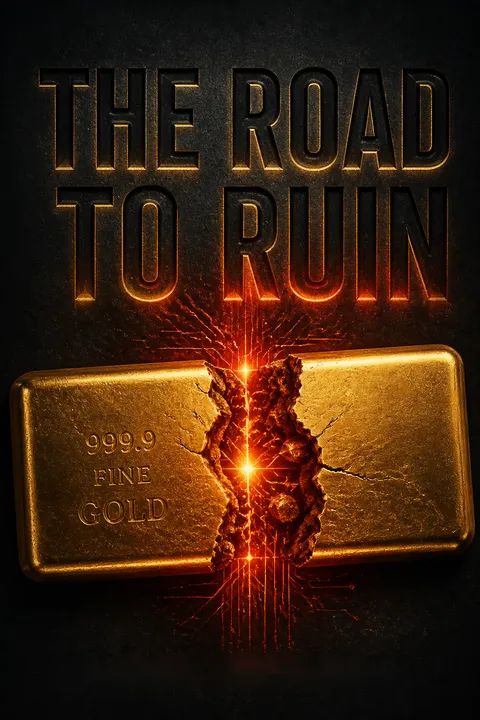


Key Takeaways
Financial crashes behave less like coin tosses than contagious chain reactions
Markets remember shocks. Rickards argues that financial markets are complex systems: many different participants interact, respond to one another, and change their behavior as prices move. Unlike coin tosses, market events are not independent. A loss can provoke selling, which pushes prices lower and prompts more selling. Research cited in the book finds that market movements have a scaling pattern between randomness and perfect order, consistent with complex behavior rather than a random walk.
Forecast risk, not dates. Weather offers the analogy: no model can reliably identify the butterfly that starts a hurricane, but the possibility of hurricanes still matters for people living in their path. Rickards uses this distinction to argue that exact crash dates may be unknowable even when a system is becoming dangerously unstable.
The useful shift is from asking which headline will cause a crash to asking what conditions let a shock spread. That resembles epidemiology, where transmission networks can matter more than the identity of the first infected person. It also makes risk management less dependent on confident forecasts. Still, complexity is not a magic replacement model: describing feedback and contagion does not by itself establish when a system will fail or how large losses will be. The strongest practical lesson is to treat interconnectedness and feedback as vulnerabilities worth monitoring, not as proof that collapse is inevitable.
Update crisis beliefs as evidence accumulates, before datasets become comfortable
Start with a hypothesis. Felix Somary, the banker known as the Raven of Zurich, inferred in 1908 that a European war was becoming likely. An Austro-Hungarian railway proposal through the Ottoman Sanjak of Novi Bazar provoked an unusually fierce French and Russian response. Somary reasoned that if a minor project could trigger such tension, larger disputes might bring war. This is Bayesian reasoning: begin with a provisional belief, then revise its probability as relevant evidence arrives.
Look beyond reassurance. In July 1914, Britain’s King George V reportedly believed war with Germany was impossible. Somary distrusted the confidence of powerful insiders, converted deposits and securities into gold, and invested in Switzerland and Norway. War followed days later. The book’s point is not that every ominous signal predicts disaster, but that history and behavior can matter when statistical datasets are too thin.
Bayesian thinking is especially useful when decisions cannot wait for a long historical record. Its discipline lies not in guessing boldly, but in making assumptions visible and changing them when evidence changes. The risk is that a prior belief can turn into a filter: ambiguous events may be counted as confirmation while contrary evidence is ignored. A careful analyst therefore asks two questions for every signal: how likely is this if the hypothesis is true, and how likely is it if the hypothesis is false? That test helps distinguish cumulative evidence from a compelling story.
Measure systemic exposure by gross connections, not comforting netting
Net can become gross. Long-Term Capital Management, or LTCM, used mathematical arbitrage to profit from small price differences between similar securities. Because expected returns were modest, it borrowed heavily and used derivatives. Its trades appeared diversified and often offset one another on paper. But when investors urgently wanted cash, the shared dependence on market liquidity became visible. If LTCM failed, counterparties could lose the offsetting side of their trades and have to replace positions in falling markets.
Scale changes the danger. Rickards says LTCM’s swap positions eventually exceeded $1 trillion, while its rescue required a $4 billion contribution from major financial firms. He argues that risks can grow faster than the apparent size of a portfolio as positions, counterparties, and possible failure paths multiply. The lesson is to examine who depends on whom, not just whether a portfolio looks hedged in calm conditions.
The distinction between a portfolio’s net exposure and the market disruption caused by replacing its trades is important. A hedge can reduce one firm’s price risk while leaving the wider system dependent on every counterparty continuing to perform. That is a network problem, not merely an accounting problem. Yet gross derivatives notional is not identical to likely loss: contracts differ in collateral, maturity, and closeout terms. The more defensible takeaway is not that every gross dollar is a dollar of danger, but that netting assumptions deserve stress tests for default, illiquidity, and simultaneous exits.
Assume liquidity can vanish before supposedly safe assets can be sold
A freeze is a policy choice. Rickards borrows the term ice-nine from Kurt Vonnegut’s novel, where a substance freezes water on contact, and applies it to emergency financial restrictions. In a panic, authorities might close banks or exchanges, suspend withdrawals, or prevent funds from selling assets. The metaphor describes contagion spreading through markets, followed by quarantine to stop further damage.
History supplies precedents. In 1914, the New York Stock Exchange closed for more than four months as officials sought to contain pressure on gold reserves. In 1933, President Franklin Roosevelt ordered U.S. banks closed temporarily, then required most citizens to surrender gold. More recently, Cyprus and Greece restricted access to bank funds during crises. Rickards argues that modern policies, including bank bail-ins and possible redemption suspensions, make broader freezes conceivable.
The unsettling distinction here is between owning an asset and being able to use it during a crisis. Liquidity is partly a property of markets and partly a promise supported by institutions, rules, and public confidence. Emergency restrictions can prevent disorderly runs, but they also impose losses and undermine trust. The historical examples show that closures are not unimaginable; they do not prove that every proposed safeguard is a coordinated confiscation plan. Readers can use the metaphor to ask practical questions about access, legal protections, and dependence on a single financial channel.
Prepare for instability without pretending anyone can name its exact date
Watch the fault line. Rickards identifies liquidity as a key weak point and presents several market shocks as warning signs. On October 15, 2014, the yield on the U.S. ten-year Treasury note fell 16 basis points in six minutes, then largely reversed, despite no obvious news catalyst. In January 2015, the Swiss franc jumped about 20 percent against the euro in roughly twenty minutes after Switzerland abandoned its currency peg. China’s 2015 yuan devaluation and the 2016 Brexit vote also produced sharp moves in currencies and stocks.
A warning is not a timetable. The author compares these episodes to earthquake foreshocks: they may signal instability, but do not reveal when a larger event will strike. His practical advice is to avoid treating periods of calm as proof that systemic risk has disappeared.
The examples make a strong case that even highly liquid markets can move abruptly, and that calm periods can conceal fragility. Their value is diagnostic, not prophetic. A dramatic price swing can reflect a specific policy decision, changing expectations, or temporary market mechanics; it does not automatically forecast a global breakdown. A sound response is to use unusual moves as prompts to review exposure and liquidity needs, rather than as a countdown clock. That approach preserves the book’s caution while resisting the temptation to turn every anomaly into confirmation of a single crisis narrative.
Track who writes emergency rules, but separate coordination from conspiracy
Institutions shape the response. Rickards argues that global financial bodies could use a crisis to expand coordination. He points to the G20-backed Financial Stability Board’s work on absorbing bank losses, IMF plans involving special drawing rights, and OECD efforts to share tax information through the Base Erosion and Profit Shifting initiative. He also describes the shock doctrine, the use of a crisis to advance policies that were already under discussion.
The author’s larger claim is that influential people and institutions, connected through overlapping professional circles rather than one secret command center, are moving toward common rules for money, taxation, and governance. He predicts that the IMF could issue more SDRs in a future emergency. These policies and proposals are documented in the book; the claim that they form a unified elite plan is Rickards’s interpretation of them.
The distinction between observable policy coordination and inferred hidden purpose is essential. International bodies do publish proposals, and crises do create pressure for rapid rule changes. Institutional economics helps explain how emergency measures can persist: once agencies, standards, and reporting systems are established, reversing them becomes costly. But shared policy preferences do not, on their own, prove a single agenda or deliberate orchestration. The reader gains more by tracing decision-making authority, incentives, and accountability than by assuming either benevolent cooperation or a master conspiracy.
Do not mistake debt-financed asset booms for durable prosperity
Growth can be borrowed. Rickards cites a 2014 Geneva report estimating that global debt, excluding financial firms, rose from 163 percent of GDP in 2000 to 212 percent in 2013. In developed economies, the ratio rose from 310 to 385 percent. The report found that debt kept increasing after the 2008 crisis, despite widespread claims of deleveraging. Rickards argues that borrowing and rising asset prices can make an economy appear stronger without restoring the underlying capacity to grow.
Debt complicates the next shock. Borrowers need income or refinancing to service obligations. Weak growth makes repayment harder, while falling prices can increase the real burden of fixed debts. Policymakers may respond with more money creation, which could eventually add inflationary pressure. The book describes deflation and inflation as competing forces, not as a simple choice between two stable outcomes.
The connection between leverage and weak growth matters because financial fragility is not measured only by the size of a crisis-era rescue. Debt can support demand today while making tomorrow’s economy less flexible. At the same time, debt-to-GDP ratios are not destiny: currency denomination, maturities, interest costs, and what borrowed funds produce all affect sustainability. The book is most persuasive when it asks whether debt is creating productive capacity or merely lifting asset prices. Its broadest collapse forecasts require more evidence than debt totals alone can provide.
Judge economic systems by institutions and distribution, not slogans
Schumpeter’s warning was gradual. The economist Joseph Schumpeter predicted that capitalism could give way to state-directed systems through incremental change, rather than a popular revolution. Rickards connects that idea to a weakening middle class and the growing influence of planners, regulators, and financial elites. He cites U.S. median household income falling from $57,843 in 1999 to $53,657 in 2014, measured in 2014 dollars. A McKinsey study he discusses found that 65 to 70 percent of households across 25 advanced economies had flat or falling real market incomes from 2005 to 2014.
The political risk is concentration. Rickards argues that stagnant wages and concentrated gains erode trust, while crisis policies can enlarge state power. He uses the term neofascism for a system in which private businesses remain but operate under strong state direction. This is a contested political interpretation, not a neutral description accepted by all scholars.
The strongest thread is the link between economic distribution and political legitimacy. When many households feel that growth bypasses them, appeals to expertise and aggregate prosperity become less convincing. That can weaken institutions even without a sudden financial crash. Schumpeter’s historical lens also reminds readers that systems change through accumulated incentives, not only dramatic revolutions. However, labeling varied regulation and public programs as fascism risks blurring important distinctions among democratic policy, authoritarian control, and economic planning. Distributional evidence supports scrutiny; precise political labels require careful definition.
Build wealth that survives a broken market, not only a good forecast
Preserve access and ownership. At a dinner in Rome, Rickards asked how the Colonna family had maintained wealth across centuries. A guest described a traditional mix of land, art, and gold. The point was that tangible property may remain accessible when markets or digital systems are disrupted. Rickards recommends physical gold and silver, some physical cash, real estate, and selected investments outside ordinary bank and brokerage accounts.
Treat the allocation as a proposal. His sample portfolio assigns 10 percent to precious metals, 30 percent to cash, 20 percent to real estate, 5 percent to fine art, 10 percent to early-stage ventures, 5 percent to hedge funds, 10 percent to bonds, and 10 percent to stocks. These are the author’s suggested proportions, not a universal prescription. He emphasizes that such a portfolio requires ongoing judgment, and that illiquid assets carry their own risks.
The underlying principle is diversification across forms of custody and access, not simply across asset labels. A portfolio can appear diversified while every holding depends on the same broker, payment network, or legal mechanism. Physical assets may reduce that operational dependence, but they bring storage costs, valuation uncertainty, theft risk, and limited liquidity. The Colonna example is memorable because it frames wealth preservation across political regimes and generations. It should inspire a personal stress test, not an automatic purchase list or confidence that any one asset is immune to upheaval.
Analysis
The book’s most durable contribution is its insistence that financial risk is systemic. A bank’s positions, a hedge fund’s trades, and investors’ decisions can look manageable in isolation while becoming dangerous through shared counterparties, leverage, and feedback. The LTCM narrative gives this claim force: models treated trades as diversified and nearly risk-free, but a rush for liquidity exposed their common dependence on buyers willing to absorb risk. Rickards therefore asks readers to examine networks and failure paths, not just expected returns.
The book also argues for intellectual pluralism. Behavioral psychology challenges the assumption that people always optimize expected value; complexity theory challenges equilibrium and random-walk models; Bayesian reasoning offers a way to update judgments when data are scarce. These approaches do not guarantee accurate predictions. Their value is that they make uncertainty, path dependence, and human behavior harder to ignore.
The political argument is less secure than the financial one. The text combines documented regulations and institutional proposals with a larger theory that global elites are preparing a coordinated monetary, tax, and governance order. The first category can be investigated directly. The second is an interpretation of motive and direction, and should not be treated as established simply because the institutions exist. The same care applies to claims about state power and fascism: the book raises questions about emergency authority and accountability, but its labels are polemical.
There is also a tension between the warning that complex crises cannot be dated and the chapter title forecasting an earthquake in 2018. That tension is revealing. The book is more useful as a guide to vulnerabilities and emergency preparedness than as a calendar of collapse. Its practical challenge is to stress-test assumptions: can assets be accessed, can counterparties perform, and can policy makers respond without worsening contagion? Those questions remain valuable even when the forecast is wrong or the feared event does not arrive on schedule.
Review Summary
The Road to Ruin receives mixed reviews, with many praising its insightful analysis of the global financial system and predictions of an impending economic collapse. Readers appreciate Rickards' expertise and unique perspective, citing his use of complexity theory and historical context. Some find the book alarmist and criticize his writing style. Many readers value the practical advice for protecting wealth during a crisis, though some question the feasibility for average investors. Overall, the book is seen as thought-provoking, if controversial, in its examination of economic vulnerabilities and potential future scenarios.
People Also Read




Glossary
Complexity theory
Models interacting adaptive systemsA scientific approach to systems whose parts interact, respond to feedback, and adapt. Rickards applies it to markets, where diverse investors react to prices and to one another. These loops can produce collective patterns, sudden transitions, and outcomes that are difficult to predict from the behavior of any single participant.
Bayesian probability
Updates beliefs with evidenceA method for revising the probability of a hypothesis as new evidence arrives. It begins with a prior belief based on available information, history, and judgment, then updates that belief according to how likely the new evidence would be if the hypothesis were true or false. Rickards emphasizes its use when data are scarce.
Ice-nine
Financial system freezeRickards’s metaphor, adapted from Kurt Vonnegut’s novel Cat’s Cradle, for freezing financial transactions during a crisis. The proposed measures include closing banks or exchanges, suspending redemptions, and restricting asset sales. The image conveys how restrictions in one part of a connected system could spread through other markets.
Conditional correlation
Hidden shared crisis exposureA dependence among positions that appears weak or absent during calm markets but becomes important under stress. Rickards uses the term to describe how LTCM’s apparently diversified trades shared an underlying dependence on providing liquidity to counterparties. When many investors sought cash at once, that common exposure became visible.
Value at risk
Estimates portfolio loss limitsA risk measure used by banks and investors to estimate how much a portfolio might lose over a specified period at a chosen probability level. Rickards criticizes its reliance on assumptions such as normally distributed price movements and the offsetting of long and short positions. He argues those assumptions can fail during market stress.
Special drawing right
IMF reserve assetAn international reserve asset created by the International Monetary Fund and allocated to member countries. In Rickards’s account, its value is determined by a basket of major currencies, but it is not backed by those currencies. He argues that expanded issuance could provide global liquidity during a financial crisis.
Shock doctrine
Crisis-enabled policy changeA term from Naomi Klein’s work that Rickards uses for advancing policies during the urgency and confusion of a crisis. The argument is that plans developed before a shock can be presented as emergency responses, then remain in place after the emergency passes. Rickards treats this as a way policy changes can accumulate over time.
Triffin's dilemma
Reserve currency supply conflictThe tension faced by a country whose currency serves as a global reserve. It must supply the world with liquidity, often by running persistent deficits, but prolonged deficits may weaken confidence in that currency. Rickards argues that IMF-issued special drawing rights could ease this tension because the IMF is not a country running national deficits.
FAQ
What is The Road to Ruin: The Global Elites' Secret Plan for the Next Financial Crisis by James Rickards about?
- Systemic risk and collapse: The book explores how global financial systems are fragile, interconnected, and prone to catastrophic collapse, using complexity theory to explain why crises are inevitable.
- Elite strategies and secrecy: Rickards reveals the secret plans of global elites to manage future crises, including asset freezes, negative interest rates, and the creation of a new world monetary order.
- Historical and scientific analysis: The author draws on financial history, behavioral psychology, and advanced statistical methods to critique mainstream economic thinking and forecast future turmoil.
- Warning of future crisis: Rickards predicts a coming financial earthquake, more severe than 2008, and details how governments and institutions are preparing to respond.
Why should I read The Road to Ruin by James Rickards?
- Insider perspective: Rickards offers unique insights from his experience advising political campaigns and interacting with central bankers, providing a behind-the-scenes look at crisis management.
- Interdisciplinary approach: The book integrates economics, history, complexity science, and behavioral psychology, giving readers a comprehensive understanding of financial instability.
- Practical warnings and advice: Readers learn about the erosion of financial freedoms, the risks of government controls, and how to protect their wealth in turbulent times.
- Critical of elite consensus: The book exposes how global elites maintain power through flawed economic dogma and regulatory capture, helping readers understand the political economy behind financial crises.
What are the key takeaways of The Road to Ruin by James Rickards?
- Crises are systemic and inevitable: Due to the complex, interconnected nature of global markets, financial crises are predictable outcomes, not random shocks.
- Elite economic consensus is flawed: Neoliberal beliefs in free markets and rational expectations have failed, leading to repeated disasters and growing inequality.
- Gold’s crucial role: Gold is money, not just a commodity, and its scarcity could trigger a panic in the next crisis.
- Preparation is essential: Wealth preservation requires diversification into physical assets like gold, land, and art, as traditional portfolios may not survive the next collapse.
How does James Rickards use complexity theory in The Road to Ruin to explain financial crises?
- Markets as complex systems: Rickards describes financial markets as complex adaptive systems where small changes can lead to unpredictable, large-scale outcomes, similar to avalanches or earthquakes.
- Critical state and contagion: Financial systems can reach a supercritical state where a minor event triggers a chain reaction, causing systemic collapse.
- Limitations of traditional models: Standard risk models assume independent, random events, but complexity theory shows that feedback loops and path dependence make crises more likely and severe.
- Policy implications: Attempts to fix crises with conventional tools often fail or worsen instability, highlighting the need for new models and approaches.
What is the “ice-nine” financial freeze concept in The Road to Ruin by James Rickards?
- Origin and metaphor: “Ice-nine” is borrowed from Kurt Vonnegut’s Cat’s Cradle and describes a government plan to freeze financial assets during a crisis to halt panic contagion.
- Scope of asset freezes: The plan extends beyond banks to money market funds, asset managers, and even entire countries, involving suspensions of redemptions, exchange closures, and capital controls.
- Consequences for savers: Money would become inaccessible despite being visible, disrupting liquidity and price discovery, and potentially provoking social unrest.
- Government preparations: Authorities are developing emergency powers and facilities to enforce such measures, risking loss of liberty and financial freedom.
How does The Road to Ruin by James Rickards critique mainstream economic theories and risk models?
- Flaws in economic schools: Rickards criticizes Austrian, Neo-Keynesian, and monetarist schools for relying on outdated equilibrium models that ignore complexity and behavioral realities.
- Value at Risk (VaR) limitations: VaR and similar models assume normal distributions and rare extreme events, leading to underestimation of systemic risk.
- Need for new tools: The book advocates for behavioral psychology, complexity theory, and Bayesian statistics as superior frameworks for understanding market dynamics and risk.
- Real-world consequences: Reliance on flawed models contributed to the 2008 crisis and leaves the system vulnerable to future collapses.
What is the role of gold in The Road to Ruin by James Rickards, and why is it important?
- Gold as true money: Rickards argues that gold is fundamentally money, not just a commodity, and is held by central banks as a monetary asset.
- Physical gold scarcity: The floating supply of physical gold is shrinking due to repatriation, leasing, and counterfeiting, making the market fragile.
- Potential for gold panic: A failure to deliver physical gold could trigger a buying panic, price spikes, and broader financial contagion.
- Investment advice: Rickards recommends a 10% allocation to physical gold (coins and bars) as insurance against systemic collapse.
How does James Rickards describe the role of BlackRock and other financial institutions in the next crisis in The Road to Ruin?
- BlackRock as a choke point: BlackRock, managing trillions in assets, is seen as a strategic node through which global funds flow, making it a target for government control during crises.
- SIFI designation and oversight: BlackRock faces pressure to be labeled a Systemically Important Financial Institution, subjecting it to intense regulation and potential asset freezes.
- Government leverage: By controlling major asset managers, governments can indirectly control vast pools of global capital, enabling emergency measures like “ice-nine.”
- Implications for investors: This centralization increases the risk that individual savers and investors could lose access to their assets during a crisis.
What is the global dollar shortage, and what are its implications according to The Road to Ruin by James Rickards?
- Paradox of shortage: Despite massive money creation post-2008, the global system faces a dollar shortage because debt and derivatives have grown much faster than new money.
- Liquidity crises: When many counterparties demand repayment at once, there isn’t enough real money to satisfy all claims, leading to defaults and deleveraging spirals.
- Conflicting market signals: Simultaneous inflationary and deflationary pressures create instability and confusion in global markets.
- Systemic threat: The dollar shortage is a key risk factor for triggering the next global financial crisis.
How does The Road to Ruin by James Rickards critique the elite economic consensus and free trade?
- Elite herd mentality: Rickards describes global elites as sharing flawed beliefs in efficient markets, rational expectations, and free trade, which mask systemic instability.
- Outdated free trade theory: The book critiques Ricardo’s comparative advantage as irrelevant in a world of mobile capital, manipulated currencies, and protectionism.
- Harm to U.S. workers: The consensus has led to job losses, stagnant wages, and inequality, fueling political backlash.
- Policy recommendations: Rickards advocates for tariffs, structural reforms, and worker empowerment to restore sustainable growth.
How does James Rickards relate capitalism, fascism, and democracy in The Road to Ruin?
- Schumpeter’s influence: Rickards draws on Joseph Schumpeter’s analysis of capitalism’s “creative destruction” and its tendency to decline into socialism and fascism.
- Rise of neofascism: Modern fascism is seen as expanding state control over private life, blending government and corporate power, and using surveillance and selective prosecution.
- Erosion of democracy: The book argues that elite consolidation of power and the criminalization of everyday behavior threaten democratic freedoms.
- Warning for the future: Rickards warns that financial crises can accelerate the rise of authoritarianism under the guise of crisis management.
What are the best quotes from The Road to Ruin by James Rickards, and what do they mean?
- “Money is gold, and nothing else.” — J. Pierpont Morgan: Highlights the enduring importance of gold as true money, especially in times of fiat currency fragility.
- “You never want a serious crisis to go to waste.” — Rahm Emanuel: Illustrates how elites use crises to push through controversial agendas, a central theme of the book.
- “The highly abnormal is becoming uncomfortably normal.” — Claudio Borio, BIS: Warns of the increasing frequency of extreme market events, supporting Rickards’ argument about systemic risk.
- Interpretation: These quotes encapsulate the book’s warnings about financial fragility, elite manipulation, and the need for new ways of thinking about risk and money.
About the Author
Other books by James Rickards


Download PDF
Download EPUB
.epub digital book format is ideal for reading ebooks on phones, tablets, and e-readers.








