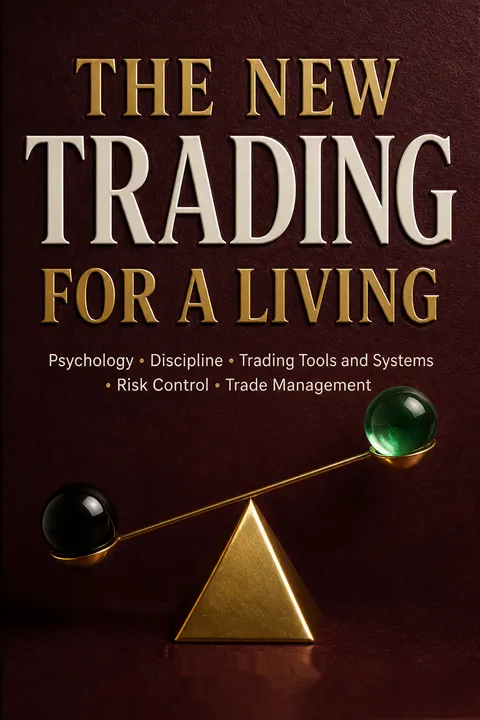


Key Takeaways
Your edge begins with self-command, not a secret indicator.
A costly apprenticeship. Alexander Elder arrived in the United States with little money, trained as a psychiatrist, and discovered trading through a book. Early wins convinced him the markets were easy. Repeated losses, account blowups, and returns to hospital work taught him otherwise. His turning point was recognizing that trading improved when he managed his own thinking, not when he hunted for another clever tool.
Mind before method. Elder treats psychology, market analysis, and risk control as interdependent. A sound system can still fail when a trader gets euphoric after wins, freezes after losses, or breaks rules to chase excitement. The practical test is whether decisions follow a plan when money is on the line. Trading well, rather than feeling brilliant or making a quick score, is the professional standard.
What's striking is the gap between knowing a rule and following it under pressure. Behavioral science describes this as a conflict between reflective judgment and fast, affect-driven responses. A written plan can help because it moves decisions into a calmer moment, when attention is less captured by immediate gains or losses. Elder's psychiatric perspective makes self-observation part of market analysis. Still, psychological discipline cannot create a profitable edge by itself. It protects the edge a trader has tested; it cannot turn a losing method into a winning one.
Treat every trade as a minus-sum contest with costs already working against you.
The house takes a cut. A trade between two participants may look like a zero-sum wager, but commissions and slippage make the overall contest negative-sum. Slippage is the difference between the price expected when placing an order and the actual fill. Elder illustrates the drag with a $20,000 account making one round-trip trade a day, four days a week. At $10 commission each way, annual commissions reach $4,000, or 20% of the account. He also reports that an average trader in his experience pays several times more in slippage than commissions.
Reduce the toll. Compare brokers, trade liquid markets, avoid unnecessary turnover, and prefer limit orders when appropriate. A limit order controls price but may not fill; a market order prioritizes execution, often at a worse price during volatility. Stops are an exception: when risk is breached, getting out matters more than saving a tick.
The key insight is to measure net performance, not the attractive story told by a chart before execution costs. This resembles friction in engineering: small losses at every step can overwhelm an otherwise efficient process. Recording expected and actual fills makes the drag visible and helps distinguish weak analysis from poor execution. The book's slippage estimate is an experience-based generalization, not a fixed law; costs vary by asset, broker, order type, and market conditions. The underlying lesson survives that caveat: an edge must remain positive after realistic costs.
Read price action as crowd behavior, then manage odds instead of predicting headlines.
A market is a crowd. Every transaction records a moment when a buyer and seller agree on a price. Because every completed trade has both sides, prices do not rise simply because there are more buyers than sellers. They rise when buyers become more willing to pay up, or sellers become less willing to accept lower bids. Charts and volume offer clues to these shifting levels of urgency.
Manage, do not prophecy. Elder compares technical analysis to polling: it estimates which side has strength, not what the future must do. The 1630s Dutch tulip boom, retold through Charles Mackay's account, shows how shared enthusiasm can intensify until the crowd reverses into panic. A trader's task is to identify a likely trend, define what would disprove the trade, and act on probabilities rather than dramatic forecasts.
This social view explains why technical patterns can matter without being mystical: shared memories, imitation, and fear can create repeated behavior. It also makes room for uncertainty. A chart is not a transparent record of every participant's motives, and a pattern that worked can weaken as traders adapt or conditions change. Elder's crowd model is most persuasive as a way to interpret pressure, not as a guarantee of prediction. For short-term speculation, the opposing trader is central; longer-term investing also depends on company performance and cash flows.
Use the larger trend to choose direction, then enter on a smaller countertrend move.
Three screens, one decision. Elder's Triple Screen Trading System analyzes a long-term chart first, an intermediate chart second, and an entry chart last. The Factor of Five links neighboring timeframes approximately: a weekly chart provides context for daily trades, while a shorter chart can refine timing. First, a trend-following tool sets the strategic direction. Second, an oscillator identifies a pullback against that trend. Third, a chosen entry method triggers the trade.
For example, if the weekly trend is up, a daily decline may offer a long entry. Daily oscillator sell signals are ignored because they run against the weekly direction. If the weekly trend is down, a daily rally may offer a short. Trades that do not align across timeframes are passed over, not forced.
The system is a hierarchy for resolving conflicting evidence. In control systems, a higher level sets the objective while lower levels make local adjustments; the same architecture can prevent a trader from treating every flicker as a strategic change. The approximate five-to-one relationship is a useful organizing rule, not a natural constant. Different markets and holding periods may require different intervals. The stronger principle is procedural: decide the broad direction before examining the entry chart, so the most emotionally vivid short-term move does not dictate the whole trade.
Match indicators to the market: follow trends in motion, fade extremes in ranges.
Tools have regimes. Trend-following indicators, such as moving averages and the Directional System, help identify persistent movement but produce false signals when prices move sideways. Oscillators, including Stochastic and RSI, can help locate turning points in ranges but may flash premature reversals during strong trends. Elder therefore recommends combining a small number of tools with different jobs, rather than stacking indicators that all calculate variations of the same price data.
A rising exponential moving average suggests bullish trend inertia; a declining one suggests bearish inertia. MACD-Histogram tracks whether that momentum is strengthening or weakening. Divergence occurs when price makes a new extreme but an indicator does not confirm it. Elder's Impulse System combines moving-average slope with MACD-Histogram slope to show when buying or shorting should be prohibited, rather than issuing automatic orders.
The valuable idea is not that one indicator is superior, but that tools answer different questions. This resembles measurement design: a thermometer and a barometer are useful together because they measure different properties, while ten thermometers do not provide ten independent confirmations. Many technical indicators are derived from the same small set of market data, so apparent agreement can exaggerate confidence. Regime classification is also difficult in real time. When signals are muddy, Elder's insistence on standing aside is a meaningful response to uncertainty, not a failure to find a trade.
Cap each trade's risk, and stop opening trades when monthly losses accumulate.
Limit the single hit. The 2% Rule sets a ceiling on the amount at risk in one trade, not on the amount invested. If an account has $50,000, the maximum risk is $1,000. With an entry at $40 and a stop at $38, each share risks $2, so the maximum position is 500 shares before costs. Elder calls this calculation the Iron Triangle of risk control: permitted dollar risk divided by risk per share determines position size.
Limit the losing streak. The 6% Rule blocks new trades when the month's realized losses plus risk in open trades reach 6% of starting monthly equity. If the threshold is reached, the trader pauses instead of trying to win it back. Elder urges risking less than the 2% maximum when possible, especially in volatile or leveraged markets.
These limits address risk of ruin, the possibility that losses become too large for a strategy's statistical edge to recover. The arithmetic is unforgiving: a 50% account decline requires a 100% gain just to return to the starting balance. Position sizing therefore matters as much as entry quality. The rules are still guardrails, not guarantees. Stops can fill poorly during gaps or illiquid conditions, and correlated positions may lose together, making their combined risk larger than it first appears. Risk estimates should include realistic execution costs and portfolio overlap.
Write down entry, target, and stop before the market can bargain with you.
Precommit while calm. Before entering, define the entry price, a realistic profit target, and the stop that invalidates the trade. Elder generally wants potential reward to exceed risk by at least two to one. A trade without those numbers is speculation without a boundary. Stops should sit beyond ordinary market noise, not so close that routine fluctuations trigger them. Once placed, a stop should move only toward reducing risk, never farther away to rescue a losing position.
Make the exit real. Traders often take small gains quickly but tolerate losses in the hope of a rebound. Elder connects this pattern to loss aversion: a realized loss feels worse than an equivalent paper loss, so people gamble to avoid admitting it. Plan how to protect profits as a position moves favorably. If a trade violates its premise, exit and reassess rather than inventing new reasons to stay.
A written trade plan functions like a behavioral commitment device. It reduces the number of decisions made in the most emotionally charged state, much as a checklist protects surgeons from skipping routine but critical steps. The book also usefully separates a good process from a profitable outcome: a disciplined trade can lose, and a reckless one can win by luck. Stops have limits, however. Overnight gaps and thin markets can produce fills beyond the planned price. Planning defines intended risk, while actual risk can still exceed it.
Choose liquid markets and a trading pace your capital and temperament can actually support.
The vehicle changes the game. Elder recommends evaluating liquidity, volatility, leverage, and the broker's incentives before choosing what to trade. Illiquid securities can be hard to exit without moving the price. Futures offer leverage that can magnify small moves into large account swings. Options buyers must be right about direction, size, and timing because time decay works against them. The book also warns that some retail forex and CFD providers may trade against customers, making the contract terms and execution model essential to investigate.
Start at a human speed. Elder favors swing trading for beginners: positions held for days or weeks allow time to plan and review. Day trading demands rapid decisions and leaves little room to think. In Massachusetts records cited for 2000, only 16% of day traders remained profitable after six months. That historical figure is not a current universal rate, but it underscores the difficulty.
Market choice is often treated as a preference, but it is also a design constraint. Leverage, trading hours, liquidity, and settlement mechanics determine how much attention and capital a strategy requires. A product can look familiar on a chart while hiding very different costs or counterparty risks. Because this edition dates to 2014, regulatory rules and product structures should be checked against current conditions. The enduring advice is to understand how the instrument works before risking money, and not to confuse access to fast trading with readiness for it.
Define your A-trade, then let the freedom to wait protect your account.
Trade a recognizable pattern. An A-trade is a setup that a trader has clearly defined, practiced, and found suitable for their method. Elder describes strategies such as a pullback toward moving-average value or a false breakout paired with indicator divergence. A scan can find candidates, but it cannot decide whether a chart truly fits the pattern. The trader still checks the market context, entry, target, stop, and reward relative to risk.
Private traders have a structural advantage over many institutions: they can choose not to trade. Yet amateurs often surrender it by acting from boredom, tips, or fear of missing out. Elder's Trade Apgar scores a planned setup using five strategy-specific questions, each rated from zero to two. Weak or incomplete ideas are discarded; a high score earns further planning, not a promise of profit.
The A-trade idea turns selectivity into a repeatable filter rather than a vague feeling of confidence. It also counters opportunity-cost anxiety: declining a mediocre trade preserves both capital and attention for a better-defined one. Scoring can improve consistency, but a numerical total may create false precision if its criteria are subjective or untested. The score should therefore prompt disciplined comparison, not replace judgment. A candidate must still be evaluated against a record of actual results, including losing trades and transaction costs.
Keep records detailed enough to expose what your memory would rather forget.
Turn experience into evidence. A trade journal records the setup, entry and exit, stop changes, costs, rationale, and outcome. Elder recommends reviewing closed trades after about two months, when the chart's former hard edge has moved into view and decisions are easier to judge. This review can reveal recurring problems, such as stops that are too tight, missed re-entry opportunities, or exits driven by discomfort rather than the plan.
Test before scaling. Backtesting can examine past behavior, but Elder favors manual testing one bar at a time because it forces the trader to make decisions with incomplete information. Paper trading can test work habits, though it lacks the emotions and imperfect fills of real money. Begin with small live positions, record results, and increase size gradually only when execution and performance justify it.
A journal is more than a diary: it is a feedback system that separates what the trader intended from what actually happened. That distinction matters because random wins can reward bad habits, while well-executed trades can lose. Recording process, execution, and outcome separately helps prevent either result from rewriting the memory of the decision. The two-month review also reduces hindsight distortion by comparing original plans with later evidence. Its value depends on honest entries; a polished log that omits rule-breaking merely archives self-deception.
Analysis
The book's central argument is that trading is an applied discipline of decision-making under uncertainty, not a puzzle solved by finding a secret indicator. Its narrative moves from Elder's early wins and repeated account failures to a practical operating system: interpret crowd behavior, choose a method, predefine risk, and record what happened. The parts reinforce each other. Technical analysis supplies hypotheses about trends and reversals; position sizing keeps those hypotheses from becoming existential bets; psychology and records help the trader follow, evaluate, and revise the process.
The strongest organizing idea is the distinction between forecasting and managing. A trader need not know the next price with certainty. The trader needs a conditional plan, a tolerable loss if wrong, and enough capital to continue when a probabilistic method encounters an ordinary losing streak. The 2% and 6% limits make this operational, while the Triple Screen supplies a hierarchy for conflicting signals. These frameworks are memorable because they convert abstractions into rules that can be checked before an order is placed.
The book also contains a productive tension. It warns against black-box certainty, then offers detailed technical interpretations that can themselves invite overconfidence. Indicators are transformations of a small shared data set, and historical chart patterns do not guarantee future advantage. A trader must validate whether a method survives costs, changing regimes, and actual execution. Elder's emphasis on record-keeping and testing is therefore not supplementary housekeeping; it is the necessary correction to the seductive certainty of charts.
Some market-specific claims reflect the 2014 trading environment, and the book's sharp skepticism about certain products should not substitute for current research into brokers, regulations, or contract design. Its durable contribution is broader: trading success depends less on being right about the next move than on structuring decisions so that being wrong remains survivable. The most important edge may be the ability to wait, size conservatively, and learn from evidence without mistaking a lucky result for skill.
Review Summary
The New Trading for a Living is highly praised as an essential resource for traders of all levels. Readers appreciate Elder's insights on trading psychology, risk management, and technical analysis. The book provides practical strategies and tools, with a focus on the importance of discipline and record-keeping. While some find certain sections repetitive, many consider it a comprehensive guide that offers valuable wisdom for both beginners and experienced traders. The book's clear explanations and real-world examples make complex concepts accessible, earning it strong recommendations from readers.
People Also Read




Glossary
Triple Screen Trading System
Multi-timeframe trade filterA method that evaluates a trade through a sequence of timeframes. The long-term chart sets the permitted direction, an intermediate chart identifies a countertrend pullback, and a shorter timeframe or entry rule triggers the position. The system aims to combine trend-following analysis with oscillator timing while rejecting trades that conflict with the larger trend.
Impulse System
Trend-strength censorA market filter combining the slope of a fast exponential moving average, which represents trend inertia, with the slope of MACD-Histogram, which represents momentum. When both rise, the chart is bullish; when both fall, it is bearish; mixed readings are neutral. Its main use is to prohibit trades against strong momentum, not to issue automatic buy or sell orders.
Iron Triangle of risk control
Position-size calculationA three-part method for determining maximum position size. First set the dollar amount permitted to be lost on a trade. Then calculate the dollar risk per share or contract from entry to stop. Divide the permitted total risk by the per-unit risk. The result is the maximum number of units, not a required position size.
2% Rule
Single-trade risk ceilingA risk-control rule that limits the amount potentially lost on any one trade to no more than 2% of the trading account's equity. The limit concerns the distance between entry and protective stop multiplied by position size, plus relevant costs. Elder presents 2% as a maximum, and says experienced traders may choose a smaller percentage.
6% Rule
Monthly risk limitA rule that bars new trades once current-month realized losses plus the risk in open positions reach 6% of the account equity measured at the start of the month. Trading pauses until the month ends or open-position risk declines enough to restore capacity. It is designed to interrupt a damaging losing streak before the account is seriously impaired.
Businessman's Risk
Survivable trade lossElder's term for a planned, limited amount of money a trader can risk without threatening the health or survival of the account. It is set before a trade through position size and stop placement. A normal losing trade within this boundary is treated as a cost of doing business, unlike an uncontrolled loss that endangers future trading.
Trade Apgar
Setup scoring checklistA brief scoring method adapted from the medical Apgar scale to assess a potential trade before entry. The trader answers five questions relevant to a specific strategy, typically scoring each from zero to two. A sufficiently strong total qualifies the setup for further planning; the score is a filter for consistency, not a prediction that the trade will win.
SafeZone
Market-noise stop methodA stop-placement approach that estimates ordinary price movement against the prevailing trend. During an uptrend, it averages downside penetrations over a selected period; during a downtrend, it averages upside penetrations. A multiplier moves the stop beyond typical noise, aiming to reduce unnecessary stop-outs while still limiting loss.
Force Index
Price-volume momentum measureAn indicator developed by Elder that combines the direction and size of a price change with trading volume. Its raw value is volume multiplied by the change in closing price from the prior period. Moving averages smooth the result: a short version helps time entries against brief pullbacks, while a longer version helps assess the broader balance between buyers and sellers.
Kangaroo Tails
Long-bar rejection patternA three-bar chart pattern consisting of an unusually tall bar that protrudes from a compact range, bordered by more ordinary bars. Elder interprets the pattern as a failed attempt to push prices in one direction. An upward-pointing tail may warn of a reversal downward; a downward-pointing tail may signal rejection of lower prices and a possible rally.
FAQ
What's The New Trading for a Living about?
- Comprehensive Trading Guide: The book serves as a detailed resource for traders, covering essential topics such as psychology, discipline, trading tools, risk control, and trade management.
- Focus on Psychology: It emphasizes the psychological aspects of trading, explaining how emotions like fear and greed can impact decision-making and trading performance.
- Practical Strategies: Dr. Alexander Elder provides practical strategies and systems, including the Triple Screen Trading System, to help traders make informed decisions.
Why should I read The New Trading for a Living?
- Expert Insights: Written by Dr. Alexander Elder, a seasoned trader and psychiatrist, the book combines psychological insights with trading strategies, making it unique and valuable.
- Structured Learning: The book is structured to guide readers from basic concepts to advanced trading techniques, making it suitable for both beginners and experienced traders.
- Real-World Applications: It includes practical advice and real-world examples, helping readers apply the concepts to their trading practices effectively.
What are the key takeaways of The New Trading for a Living?
- Risk Management is Crucial: The book emphasizes the importance of risk management, introducing the 2% Rule to limit losses and the 6% Rule to manage monthly drawdowns.
- Psychological Discipline: It highlights the need for psychological discipline in trading, encouraging traders to manage their emotions and stick to their trading plans.
- Multiple Timeframe Analysis: Elder advocates for using multiple timeframes in analysis, particularly through the Triple Screen Trading System, to make more informed trading decisions.
What are the best quotes from The New Trading for a Living and what do they mean?
- "Emotional trading is lethal.": This quote underscores the dangers of allowing emotions to dictate trading decisions. It serves as a reminder to maintain discipline and objectivity.
- "You can succeed in trading only if you handle it as a serious intellectual pursuit.": This emphasizes the need for a thoughtful and analytical approach to trading, rather than treating it as a game of chance.
- "A trader must support his broker and the machinery of exchanges before he collects a dime.": This highlights the inherent costs of trading, such as commissions and slippage, which can erode profits if not managed properly.
How does The New Trading for a Living address trading psychology?
- Understanding Emotions: The book delves into the psychological aspects of trading, explaining how emotions like fear and greed can lead to poor decision-making.
- Discipline and Control: It stresses the importance of discipline in trading, encouraging traders to stick to their plans and avoid impulsive decisions based on emotions.
- Self-Assessment Tools: Elder provides self-assessment tools, such as a psychological self-test, to help traders evaluate their readiness and emotional state before trading.
What is the Triple Screen Trading System in The New Trading for a Living?
- Three Screens for Trading: The Triple Screen Trading System involves analyzing three different timeframes: a long-term chart for trend direction, an intermediate chart for timing, and a short-term chart for entry points.
- Combining Indicators: It combines trend-following indicators on long-term charts with counter-trend oscillators on intermediate charts, allowing traders to filter out false signals.
- Strategic Decision Making: By starting with the long-term trend, traders can make strategic decisions that align with the overall market direction, increasing the likelihood of successful trades.
What are the 2% and 6% Rules in The New Trading for a Living?
- 2% Rule: This rule limits the maximum risk on any single trade to 2% of the trader's account equity, helping to prevent significant losses.
- 6% Rule: This rule prohibits opening new trades if the total losses for the month, combined with the risks of open trades, reach 6% of the account equity, encouraging traders to step back during losing streaks.
- Risk Management Framework: Together, these rules create a framework for effective risk management, ensuring traders protect their capital and maintain long-term viability in the markets.
How does Dr. Elder suggest managing risk in trading?
- Two Percent Rule: Dr. Elder introduces the "Two Percent Rule," which states that a trader should never risk more than 2% of their total account on a single trade. This helps protect capital and allows for long-term survival in the market.
- Setting Stops: The book discusses the importance of placing protective stops to limit potential losses. Traders should determine their stop-loss levels before entering a trade to avoid emotional decision-making.
- Emotional Awareness: Understanding the psychological aspects of risk management is crucial. Dr. Elder emphasizes that emotions can cloud judgment, leading to poor risk management decisions.
What is the Impulse System described in The New Trading for a Living?
- Market Movement Analysis: The Impulse System uses two indicators—an exponential moving average (EMA) for inertia and the MACD-Histogram for power—to assess market movements.
- Color-Coded Signals: It colors price bars based on the relationship between these indicators: green for bullish, red for bearish, and blue for neutral, guiding traders on when to enter or exit trades.
- Censorship Approach: Rather than providing direct buy/sell signals, the Impulse System acts as a censorship tool, prohibiting trades that go against the prevailing market trend.
What are kangaroo tails, and how are they used in trading as per The New Trading for a Living?
- Definition of Kangaroo Tails: Kangaroo tails are a specific chart pattern characterized by a tall bar flanked by two smaller bars, indicating a potential reversal. They signal that the market has rejected a certain price level.
- Trading Signals: An upward-pointing kangaroo tail suggests a failed bullish attempt, signaling a potential sell opportunity. Conversely, a downward-pointing kangaroo tail indicates a failed bearish attempt, suggesting a potential buy opportunity.
- Importance of Context: Dr. Elder emphasizes that kangaroo tails should be analyzed within the context of the overall market trend. They are more reliable when they occur at significant support or resistance levels.
How can I improve my trading discipline as suggested in The New Trading for a Living?
- Set Clear Rules: Establishing clear trading rules and sticking to them is essential for maintaining discipline and avoiding impulsive decisions.
- Keep a Trading Journal: Documenting trades, including the rationale behind each decision, helps traders reflect on their performance and learn from mistakes.
- Regular Self-Assessment: Conducting regular self-assessments, such as the psychological self-test mentioned in the book, can help traders gauge their readiness and emotional state before trading.
What is the significance of record-keeping in trading as discussed in The New Trading for a Living?
- Learning from Mistakes: Keeping detailed records of trades allows traders to analyze their performance, identify patterns, and learn from both successes and failures.
- Enhancing Discipline: A well-maintained trading journal promotes discipline by encouraging traders to follow their plans and reflect on their decisions.
- Tracking Progress: Regularly reviewing trade records helps traders track their progress over time, providing insights into their trading strategies and areas for improvement.
About the Author
Download PDF
Download EPUB
.epub digital book format is ideal for reading ebooks on phones, tablets, and e-readers.








