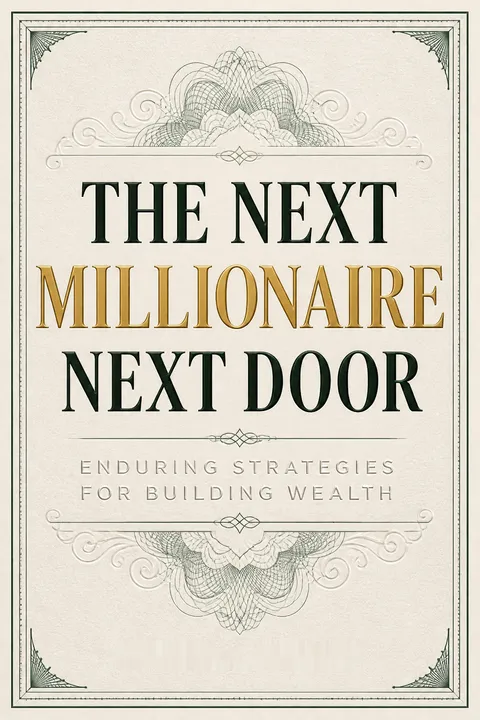


Key Takeaways
Measure wealth by what remains, not by what arrives.
Income is a flow. Income is money received over a period; wealth is the value of assets minus debts. A household can earn $1 million in a year and spend $1.2 million, leaving its balance sheet $200,000 worse off. A high salary can fund wealth, but it does not prove wealth exists. The book argues that media attention to earnings and visible spending confuses the two, encouraging people to imitate lifestyles they may not be able to afford.
Use the typical figure. In 2016, the average US household net worth was reported as about $692,100, but the median was about $97,300. The average is pulled upward by very wealthy households; the median better describes the midpoint household. In the authors’ millionaire survey, the median net worth was $3.5 million, but the sample was affluent by design.
The distinction is useful because it replaces a status question, how much someone earns, with an accounting question, what they retain. That makes progress measurable and can expose lifestyle inflation hidden behind a prestigious job. Still, net worth is not the whole story: assets can be hard to sell, debts can carry different risks, and home equity does not pay ordinary bills without additional steps. A balance sheet is a clearer gauge than a car or salary, but it is not a complete measure of resilience or well-being.
Give someone clear ownership of the household's financial operating system.
Make the work visible. The authors treat personal finance as a job, not a single decision. The person they call the Household CFO oversees spending, budgeting, bill payment, taxes, saving, investment decisions, and financial conversations with family members. Some tasks can be delegated, but someone still has to make sure they are done and that outside professionals are acting in the household’s interests.
Measure the gap. About 70% of millionaires in the latest survey knew how much they spent on food, clothing, and shelter each year, and more than 65% said they budgeted. In the authors’ broader research, the group with high wealth-building potential saved about 2.5 times as much as the low-potential group. Their benchmark for expected net worth is age multiplied by income, then by 0.10, a way to compare accumulation with age and earnings.
Calling this a job makes routine administration count as real work, rather than a tedious prelude to investing. It also invites a practical division of labor: one partner may track bills while another researches retirement accounts, provided both understand the plan. The risk is treating financial management as one person’s private burden. A household can have a diligent CFO and still fail if other members undermine the budget or avoid honest conversations. Clear ownership works best alongside shared goals and transparency.
Stop letting neighbors and feeds set the price of belonging.
Practice social indifference. The book uses this term for resisting pressure to match what other people buy, drive, wear, or display. Its surveys associate this behavior with higher net worth, regardless of age and income. The point is not to reject every trend or purchase; it is to decide based on personal goals rather than the spending cues of a peer group.
Guard your attention. The authors report that millionaires in their survey spent about 2.5 hours a week on social media, compared with roughly 14 hours for the average American. They argue that feeds and targeted marketing make comparison unusually constant: a stream of other people’s homes, holidays, and purchases can make an exceptional lifestyle look normal. The chapter’s lesson is to notice whose interests a message serves before treating it as a cue to spend.
Comparison is especially potent because it turns consumption into a social test. A purchase can feel necessary not for its practical use, but because it signals that someone belongs. The book’s attention to marketing adds another layer: repeated exposure can quietly redefine what counts as ordinary. Yet low social-media use is not itself a wealth plan, and connection has genuine value. The more useful test is whether a particular stream of comparison is shaping decisions that conflict with a household’s own priorities.
Choose a home that leaves room for savings, not just status.
Housing sets the backdrop. A home’s price affects more than the mortgage. The neighborhood can bring pressure to spend on cars, schools, activities, and renovations that fit in. The authors report that most millionaires they studied did not buy homes costing more than three times their annual income, while emphasizing that affordability depends on more than a lender’s approval.
Ken changed the equation. He and his wife moved from Manhattan to suburban Atlanta after a long-term plan showed how difficult it would be to build wealth in an expensive city. They bought a home for about $300,000, while a similar home near New York would have cost about $1 million. They stayed for decades, chose public schools, and Ken retired at 55 as a decamillionaire. The example illustrates how location can preserve money for other goals.
Housing is a financial choice that also shapes daily routines, identity, and social circles, which helps explain why a spreadsheet alone may not settle it. Ken’s move worked because it matched his work arrangement, family plans, and long horizon. That is not a universal prescription to move somewhere cheaper: commute, care responsibilities, safety, and community matter too. The useful question is whether the home supports the life being built, or whether its costs require the household to keep earning at any price.
Let your upbringing inform your money habits, not dictate them.
Children learn by watching. The book connects parental frugality and money management with children’s later financial behavior. One interviewee, John C., described parents who explained credit-card rules, required their children to work, and expected them to help pay for college. He carried those practices into his own family, giving his children work and savings responsibilities rather than simply buying what they wanted. The authors cite research suggesting that observed family behavior can teach more than lectures alone.
The past is not a sentence. Other interviewees described parents who spent more than they earned, then deliberately built different habits as adults. The book also points to marriage as a major influence: 93% of its millionaire respondents were married or remarried, and more than 80% said a supportive spouse contributed to their success. These are associations, not guarantees, but they underline the value of discussing money honestly with a partner.
The strongest implication is that money habits are learned in ordinary moments: whether adults budget, borrow, save, or explain a purchase. That makes financial socialization less like a one-time class and more like a household culture. It also leaves room for change. A person can identify inherited scripts and choose different routines, though awareness alone may not erase them. The emphasis on supportive marriages is persuasive as a description of the sample, but it should not imply that single people cannot build wealth or that marriage automatically creates it.
Choose work that fits your strengths and leaves room to pivot.
Income needs a source. The authors argue that investment returns usually begin with money generated through work, a business, or another revenue stream. Successful earners look for work that uses their abilities and meets a real market need. Sales roles can build customer knowledge and confidence; moonlighting can test a business idea while a regular paycheck remains in place.
Test before leaping. Murray, a teacher, began painting neighbors’ houses during summer after seeing how expensive professional bids were. Demand grew through referrals, and he kept teaching while developing the side business. But self-employment is not a shortcut: the book reports that half of small businesses failed within five years, and the average net income of self-employed sole proprietors was only about $13,154 in 2015. A good idea still needs customers, cash flow, and persistence.
The focus on fit and market need counters two common fantasies: that passion alone guarantees a living, or that a prestigious title guarantees security. Murray’s story also illustrates an advantage of small experiments. A side project can reveal whether people will pay before a household gives up stable income. The caution matters just as much: business ownership concentrates risk, and a large share of ventures do not provide enough income. A pivot is strongest when backed by evidence and financial breathing room.
Buy investments you understand, not cleverness you cannot explain.
Keep the plan comprehensible. Millionaires in the survey mostly held conventional assets, especially retirement accounts and real estate; exotic investments were uncommon. The authors cite Warren Buffett’s preference for a low-cost S&P 500 index fund as a contrast to expensive, complex strategies marketed as special access. They also compare a simple three-fund portfolio’s reported ten-year returns with those of college endowments, arguing that complexity and high fees do not guarantee better results.
Confidence needs restraint. More than 70% of surveyed millionaires believed they knew more about investing than most people, yet over 60% had sold a winning stock too early, over 73% had held a losing stock too long, and nearly 40% had tried to time the market. The book favors learning, diversification, and composure over frequent action, while recognizing that investors make mistakes.
This section’s sharpest insight is that complexity can function as a status good: paying for an intricate strategy may feel more sophisticated than accepting a plain one. The comparison with endowments makes that point memorable, though past performance does not prove that the simple portfolio will always lead. Confidence also cuts both ways. Investors need enough knowledge to act, but the reported mistakes show why confidence should be paired with humility, cost awareness, and a willingness to follow a plan through uncomfortable markets.
Build wealth for the freedom to refuse a life you cannot afford.
Options are the payoff. In this book, financial independence means being able to live for some period without an employer’s paycheck or other earned income. The value is not only a larger balance sheet; it is the ability to leave a bad job, change careers, start a business, or spend more time with family without immediately losing financial stability.
Small habits can widen choices. Allison Lamar began saving 10% of her earnings as a teenager, including when she made $6.50 an hour. She became a millionaire around age 35 and later reported about $2 million in net worth. She said her savings helped her see options after divorce and made work a choice rather than a necessity. Her story is not a promise that everyone will reach the same outcome, but it shows how repeated behavior can create flexibility.
This is a more grounded definition of wealth than a collection of luxury goods: money becomes valuable because it changes which decisions are available. Allison’s example links a modest early habit to later autonomy, making the long delay between saving and payoff easier to picture. The account should not be read as proof that discipline overcomes every barrier. Income, health, family duties, and economic conditions constrain choices. Still, the underlying aim is useful: build enough margin that one setback or unwanted job does not dictate every next move.
Analysis
The book’s central contribution is a change of unit. Wealth is not treated as a type of person, neighborhood, or profession, but as an outcome of repeated decisions that convert income into retained assets. That makes its advice unusually practical: track spending, limit fixed costs, build earning power, and invest with care. The everyday stories give those ideas human scale, from a teenager saving a small share of wages to Ken relocating to lower the cost of a long career.
The evidence needs to be read with care. The principal millionaire survey drew from addresses and business records selected to find affluent households, and its response rate was about 9%. Its comparisons can reveal patterns among respondents, but they do not establish that the behaviors caused wealth or represent every American household. The book’s PAW and UAW groups are also defined relative to age and income within a particular sample, not by a universal threshold. Personal stories illustrate possible pathways; they cannot show how often those pathways succeed.
There is a productive tension between agency and circumstance. The book acknowledges rising education and health costs, uneven starting conditions, and the role of income, but gives its strongest emphasis to choices individuals can control. This emphasis is useful when it identifies leverage, but it can become misleading if interpreted as proof that financial outcomes are simply a matter of discipline. A fair reading treats the habits as tools, not moral judgments or guarantees.
The most actionable application is modest: calculate assets minus debts, learn where income goes, decide which costs are worth locking in, and make an investment plan understandable enough to follow. Then assess whether work and spending are creating options or consuming them. The book’s promise is not effortless wealth. It is greater financial room to maneuver, built through decisions that are often unglamorous and cumulative.
Review Summary
The Next Millionaire Next Door receives mixed reviews. Some readers appreciate its updated research on wealth-building strategies, emphasizing frugality and disciplined financial habits. However, many find it repetitive, dry, and lacking substantial new insights compared to the original book. Critics note its defensive tone, political bias, and disjointed structure. While some value its reminders about financial discipline, others feel it fails to address modern economic challenges and overemphasizes frugality at the expense of quality of life. Overall, opinions are divided on its relevance and effectiveness.
People Also Read








Glossary
Millionaire next door
Unshowy wealth builderThe book’s archetype of a person or household that has accumulated substantial net worth without necessarily displaying luxury. The archetype spans many occupations, including business owners and salaried professionals. Its defining pattern is not a particular job title or purchase, but a sustained ability to spend less than income, save, and manage money toward financial independence.
Income-statement affluent
High income, low accumulationA household that earns a high income but has accumulated relatively little wealth for its age and earnings, often because spending absorbs much of the income. The term contrasts a flow of earnings with the balance-sheet value of assets minus liabilities. It describes a financial pattern, not simply a salary level.
Balance-sheet affluent
Substantial accumulated wealthA household whose accumulated net worth is high relative to its income or comparison group. In the book, this label emphasizes retained assets rather than earnings or visible consumption. Balance-sheet affluent households are presented as more likely to preserve income through saving and investing, though net worth alone does not indicate how liquid or secure every asset is.
Social indifference
Resistance to spending pressureA pattern of not allowing other people’s purchases, clothing, vehicles, or lifestyle signals to determine one’s own consumption. The authors associate social indifference with wealth accumulation because it can reduce pressure to match peers. It does not require avoiding relationships or rejecting every popular product; it means making spending choices according to personal goals.
Household CFO
Household finance leadThe person, or team, responsible for managing the household’s financial work. Tasks can include budgeting, monitoring spending, paying bills, filing taxes, planning for large expenses, investing, and coordinating with a spouse or professional advisors. The label emphasizes that these responsibilities exist whether or not anyone has formally accepted them.
Expected net worth
Age-income wealth benchmarkA comparison measure used in the book to estimate net worth in relation to age and income. The authors calculate it by multiplying age by income and then by 0.10. They compare actual net worth with this estimate to identify people who have accumulated more or less wealth than peers in their sample. It is a research benchmark, not a guarantee or required target.
Prodigious Accumulator of Wealth
High relative wealth accumulatorA person classified within the top quartile of an affluent research sample according to the difference between actual and expected net worth. The authors use the category to study people who have accumulated substantially more wealth than expected given their age and income. The label is relative to the particular sample and is not a universal wealth threshold.
Under Accumulator of Wealth
Low relative wealth accumulatorA person classified within the bottom quartile of an affluent research sample according to the difference between actual and expected net worth. The category identifies respondents who have accumulated less wealth than expected given their age and income. It is used as a comparison group in behavioral analyses, not as a fixed diagnosis that applies across all populations.
Economic outpatient care
Financial gifts to relativesMoney or other financial support given by relatives, commonly from parents to adult children. The book examines how recurring or substantial gifts can affect recipients’ independence and financial behavior. It distinguishes such transfers from wealth built through the recipient’s own saving, earning, or investing, while noting that family gifts occur among some affluent households.
FAQ
What's The Next Millionaire Next Door about?
- Focus on Wealth Building: The book emphasizes that financial independence is achieved through disciplined behaviors, not luck or inheritance.
- Research-Based Insights: It builds on Thomas J. Stanley's previous works, updating data and case studies to reflect current economic conditions.
- Behavioral Patterns: The authors analyze millionaire habits, stressing the importance of living below one's means and making prudent financial decisions.
Why should I read The Next Millionaire Next Door?
- Practical Strategies: Offers actionable advice for improving financial situations, regardless of income level or background.
- Debunking Myths: Addresses misconceptions about wealth, such as the idea that high income equals wealth.
- Inspiration and Motivation: Provides encouragement through stories of self-made millionaires who succeeded through discipline and smart choices.
What are the key takeaways of The Next Millionaire Next Door?
- Discipline is Crucial: Emphasizes the importance of disciplined spending, saving, and investing for wealth building.
- Ignore Social Pressures: Advocates for frugality and simplicity, resisting the urge to keep up with peers.
- Wealth vs. Income: Distinguishes between wealth (net worth) and income (earnings), highlighting the importance of the former.
What are the best quotes from The Next Millionaire Next Door and what do they mean?
- "Believe it can be done.": Highlights the importance of a positive mindset in achieving financial goals.
- "Living below your means is just another way of expressing a mathematical equation.": Emphasizes that wealth accumulation requires spending less than one earns.
- "Money should never change one’s values.": Suggests that true wealth is about values and principles, not material possessions.
What are the common myths about wealth discussed in The Next Millionaire Next Door?
- Income Equals Wealth: Debunks the myth that high income leads to wealth, noting that many high earners fail to accumulate net worth due to spending.
- You Are Your Group: Challenges the idea that financial success is determined by demographic group, emphasizing individual choices.
- The Rich Don’t Pay Their Fair Share: Argues that many wealthy individuals contribute significantly to the economy through taxes and donations.
How does The Next Millionaire Next Door define frugality?
- Frugality as a Lifestyle: Defined as living simply and economically, consistently spending less than one earns.
- Behavioral Patterns: Frugal individuals prioritize saving and investing over consumption.
- Key to Wealth Accumulation: Frugality is a cornerstone of wealth-building, allowing more resources for investments and savings.
What influences wealth according to The Next Millionaire Next Door?
- Parental Influence: Individuals raised in frugal households often develop positive financial habits.
- Social Environment: Neighborhood and peer group can impact spending behaviors, encouraging wise social circle choices.
- Personal Choices: Personal decisions on spending, saving, and investing are crucial for wealth accumulation.
How can I apply the lessons from The Next Millionaire Next Door to my life?
- Create a Budget: Track income and expenses to save regularly.
- Live Below Your Means: Reduce unnecessary expenses, prioritize saving and investing.
- Educate Yourself: Continuously learn about personal finance and investment strategies.
What are the characteristics of millionaires discussed in The Next Millionaire Next Door?
- Frugality and Discipline: Millionaires live below their means and make conscious spending choices.
- Education and Knowledge: Many have at least a college degree and continue learning about financial management.
- Supportive Relationships: A supportive spouse or partner is often critical for financial success.
What is the role of the Household CFO as described in The Next Millionaire Next Door?
- Comprehensive Financial Management: Oversees all financial aspects, including budgeting, saving, and investing.
- Team Collaboration: Works with family to align on financial goals and strategies.
- Outsourcing When Necessary: May outsource tasks to professionals to prioritize household interests.
How does The Next Millionaire Next Door address the impact of technology on wealth-building?
- Increased Consumerism: Technology and social media can lead to increased consumerism, challenging frugal habits.
- Marketing Influence: Highlights the power of targeted marketing, urging mindfulness of these influences.
- Need for Discipline: Emphasizes maintaining discipline in spending and saving in the age of technology.
How does The Next Millionaire Next Door address the relationship between income and wealth?
- Income vs. Net Worth: Clarifies that high income doesn't equate to high net worth; many high earners live paycheck to paycheck.
- Wealth Accumulation Strategies: Wealth is built through disciplined saving and investing, regardless of income level.
- Behavioral Focus: Emphasizes behaviors and habits leading to wealth accumulation, accessible to all.
About the Author
Other books by Thomas J. Stanley






Download PDF
Download EPUB
.epub digital book format is ideal for reading ebooks on phones, tablets, and e-readers.








