

Key Takeaways
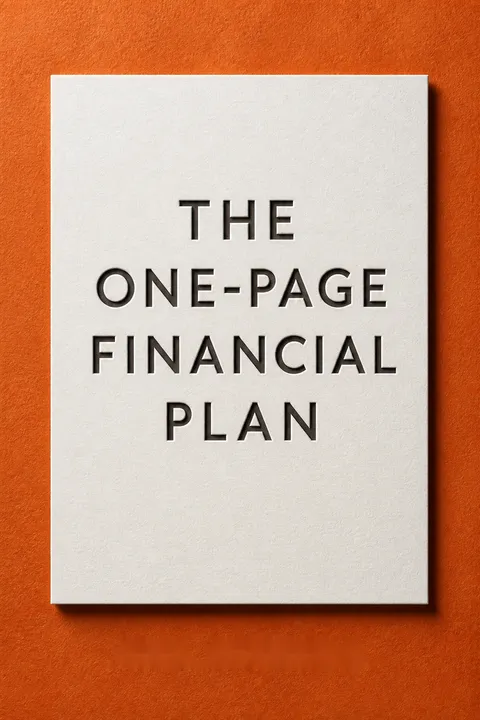
Put your values and three concrete money decisions on one page.
Start with the reason. Financial advisor Carl Richards learned the cost of ignoring his own judgment when he bought a home far beyond his original budget, borrowed the full purchase price, and later had to sell at a loss. The point is not to build a perfect forecast. It is to connect money choices to what matters most, then make a few practical commitments that support it.
Keep the plan small. Richards and his wife wrote down why money mattered to them, then named three priorities: fund retirement accounts, contribute to their four children’s education funds, and save remaining money toward a home. The one-page plan is a revisable snapshot, not a lifetime contract. Its brevity helps bring the important choices back into view when details and temptations pile up.
What's striking is that the page is less a miniature spreadsheet than a decision aid. In cognitive science, externalizing a choice can reduce the mental burden of repeatedly reconsidering it, while clear priorities make trade-offs easier to recognize. The format also resists the illusion that a thicker plan is necessarily a wiser one. Still, compression has limits: a short statement cannot replace cash-flow calculations, tax planning, or legal advice. Its strongest use is as a compass for those technical decisions, and as a reminder that financial efficiency is not the same as a life well spent.
Keep asking why until money points to a real life, not a slogan.
Translate abstractions. When Richards asked clients Sara and Mark why money mattered, Sara first answered that she wanted freedom. Repeated questions made the idea more concrete: freedom meant flexibility, flexibility meant time, and time meant having space to start a family. That answer changed what financial advice would be useful. A strategy aimed at maximizing wealth could have worked against her actual priority.
Look for evidence. If the answer is hard to find, Richards suggests examining how time and money are already spent. Those patterns can reveal what someone values, or expose a gap between stated priorities and daily choices. Partners should answer separately before comparing views. Money also competes with other resources: time, energy, and skills. A higher income may not be worth its hidden costs if it consumes the very time a person hopes money will buy.
This questioning resembles the distinction between abstract goals and valued activities in motivational psychology. A word such as security can mean an emergency fund to one person and the freedom to leave a punishing job to another. Asking for the concrete scene behind the word improves the quality of the plan because it clarifies what a financial choice is meant to enable. The checkbook and calendar are useful clues, but not perfect measures: spending can reflect obligation, habit, or constraint, rather than genuine preference. Treat them as evidence to interpret, not a verdict on character.
Make specific financial guesses, then revise them as life changes.
Plan without pretending. Long-range forecasts often demand details nobody can reliably know, from future utility bills to decades of market returns. Richards recommends making informed guesses instead. For each goal, ask what it is, when it might happen, and what it could cost. A retirement aim becomes more workable when expressed as a hoped-for monthly income, even if the estimate is imperfect.
Let the destination surprise you. Clients Henry and Elizabeth assumed saving for their children’s education was their central goal. Further conversation revealed a stronger wish: take six months to travel around the country with their children in an RV. They checked whether the idea seemed feasible and decided it deserved consideration. Goals can be ranked against values, then adjusted as circumstances change. The commitment is to keep making and revising estimates, not to defend an old number at all costs.
The useful distinction here is between a forecast and a working hypothesis. A forecast claims more knowledge than the future permits; a hypothesis gives present action a direction and invites correction. This is close to adaptive planning in fields where conditions change: a useful plan contains feedback, not just targets. Specific estimates still matter because vague wishes cannot guide saving. But precision can become theater when assumptions are unstable. A range, a review date, and a clear account of what would change the plan can preserve direction without disguising uncertainty.
List what you own and owe before judging your financial position.
Get the facts on paper. A personal balance sheet is a simple list of assets and liabilities. Assets include bank accounts, retirement investments, and an estimated home value. Liabilities include the actual balances on mortgages, credit cards, student loans, and other debts. Subtract what is owed from what is owned to calculate net worth. Richards advises using reasonable estimates for assets, but getting exact debt figures from lenders.
Face the number without blame. One woman avoided a student loan originally around $6,000 for years; when she finally checked, the balance had grown to about $34,000. Avoidance had made a solvable problem more daunting. Richards also describes finally acknowledging he could not afford his home or a planned new car. The clarity was painful, but it helped him make practical choices. For couples, the balance sheet can include less visible contributions such as caregiving and household work.
Putting a number to a problem can convert diffuse anxiety into a defined task, a pattern familiar from clinical approaches that reduce avoidance through gradual exposure. The balance sheet also counters a common cognitive error: people often remember the threatening part of their finances and overlook savings or debt reduction already underway. Yet net worth is only a snapshot. It says little about income stability, liquidity, or whether a household can meet near-term obligations. The exercise is most useful when it begins a nonjudgmental conversation, not when a single figure is treated as a complete measure of financial health.
Track spending to test whether your dollars match your stated priorities.
Budget for awareness. Richards reframes budgeting as a way to see where money actually goes, not as a punishment for spending. He recommends recording purchases for a month or two and reviewing them regularly. Even small transactions matter because they are easy to misremember. Fixed bills and planned savings can be automated, while discretionary spending can be checked against what the household says matters.
Let the evidence surprise you. His friends Dallas and Melissa Hartwig tracked their food spending and were startled by how much they spent on groceries and eating out. Rather than automatically cutting the amount, they asked whether it reflected a genuine priority. It did. They also realized that owning a home, a goal they had assumed they should pursue, mattered less to them than the flexibility of keeping costs low. Tracking can reveal misalignment, or confirm that an unusual budget reflects a deliberate choice.
Self-monitoring is a well-established behavior-change tool because it makes actions visible before asking people to change them. This section’s important refinement is that visibility need not lead to austerity. A large expense can be irrational leakage, or a fair expression of what gives a household pleasure and purpose. That distinction protects budgeting from becoming moral accounting, where every purchase is labeled virtuous or wasteful. The method still has a blind spot: tracking alone cannot reveal whether spending is shaped by limited choices, unequal responsibilities, or rising essential costs. Interpretation matters as much as the ledger.
Automate reasonable savings and delay impulse purchases by 72 hours.
Choose a sustainable amount. Richards pushes back on treating a fixed savings rule, such as saving 15 percent of every paycheck, as universally appropriate. The right amount depends on a person’s income, goals, obligations, and capacity. His practical standard is to save as much as is reasonably possible, then automate the transfer so the choice does not have to be remade every month. Windfalls can also go toward savings, unless high-interest debt needs attention first.
Put time between urge and purchase. Richards used a 72-hour waiting period for books he wanted to buy online. Many items lost their appeal while sitting in his cart. The delay does not require an immediate rejection; it creates room to decide with less urgency. This is especially useful for discretionary purchases that repeatedly appear as surprises in spending records. If savings still fall short after impulse spending is addressed, bigger trade-offs may be necessary.
Automation and delay work on opposite sides of the same behavioral problem: people are better at following through when a decision is made before the tempting moment arrives. Automatic transfers establish a default, while a waiting period interrupts the immediate reward loop of shopping. Neither device requires perfect self-control. However, advice to save more must remain sensitive to material circumstances. For a household struggling to cover essentials, the problem may not be discipline but inadequate income or high fixed costs. A realistic savings amount should create progress without making a fragile budget more brittle.
Pay high-interest debt before chasing uncertain investment returns.
Compare guaranteed costs. Richards points out that paying down costly debt produces a return equal to the interest no longer owed. If a credit card charges more than 15 percent while investments might earn around 7 percent, reducing that balance is financially compelling and avoids market uncertainty. His suggested debt avalanche means directing extra payments to the highest-interest debt first, while maintaining required payments on the others.
Protect the plan from new borrowing. The arithmetic only helps if the balance stops growing. Richards cautions against continuing to use a card that cannot be paid in full each month. Debt choices should also be judged against the household’s priorities: declining a purchase on credit can preserve room for a more important future goal. Not all borrowing is necessarily foolish, but high-rate consumer debt can quietly consume money that could otherwise support those goals.
This is one of the book’s clearest examples of replacing an emotionally appealing story with a comparison of alternatives. Avoiding a known 15 percent cost is not equivalent to earning a risky 15 percent return, but the household balance improves either way, without depending on a forecast. The caveat is liquidity: using every available dollar to repay debt can leave someone exposed to an emergency and forced to borrow again. The best sequence depends on the rate, minimum payments, and cash reserves. Still, expensive revolving debt is a unusually difficult hurdle for ordinary investing to overcome.
Diversify cheaply, rebalance annually, and stop treating stock tips as research.
Invest by evidence. Richards distinguishes investing from speculation. Liking a company’s products or hearing a persuasive market prediction does not establish that its stock belongs in a portfolio. He recalls putting $10,000 into InfoSpace during the technology boom; the shares later returned only about $81. His alternative is a diversified portfolio with low costs, rather than concentrated bets or attempts to time the market.
Use a plan you can hold. Richards offers a 60 percent stock, 40 percent bond allocation as a rough default for long-term money, not a universal prescription. Money needed within ten years should generally remain in safer cash-like holdings. Annual rebalancing restores the intended mix after markets move. In his illustration, adding bonds to a stock portfolio reduced historical volatility by 37 percent while lowering returns only modestly. That example demonstrates a trade-off, not a guarantee of future performance.
Diversification addresses a problem that individual expertise rarely solves: even a perceptive observer cannot reliably know which risks are already reflected in a stock’s price. Low fees matter because they reduce the return investors keep regardless of how markets perform. Rebalancing also turns an abstract discipline into a rule for acting against recent momentum. The qualification is essential: a 60/40 mix is a starting point, not a magic allocation. Time horizon, income needs, and tolerance for losses affect whether someone can stay invested. Historical volatility can describe past variation, but it cannot promise a smooth future.
Buy a home only when the numbers and your life fit.
Ignore market theater. Richards challenges the assumption that buying a home is automatically the best investment. He cites long-run U.S. home-price growth of roughly 3 percent, around the rate of inflation, and notes that taxes, maintenance, transaction costs, and relocation can alter the calculation. A purchase should make sense without relying on a future price surge.
Test the decision against your situation. Consider whether the down payment and full monthly costs are affordable, whether you can qualify for a loan, and how long you expect to stay. Richards suggests that a stay under five years makes buying especially difficult to justify, while longer stays can improve the case. His friend Rick rented while uncertain about his location and saved the difference in a dedicated house account. Renting gave him flexibility rather than merely throwing money away.
Housing decisions bundle investment, consumption, and lifestyle in a way that slogans often conceal. A home provides shelter and stability, but also ties capital to one location and exposes the owner to maintenance and local market risk. The book’s emphasis on personal circumstances is therefore stronger than a simple rent-versus-buy rule. The historical 3 percent figure is a broad average, not a forecast for any particular city or property. A sound decision compares total costs and nonfinancial benefits, then asks whether the household can live comfortably with the choice if prices do not rise as hoped.
Build guardrails that keep fear and greed from rewriting your plan.
Prepare before panic. An investment policy statement, or IPS, is a brief record of why a portfolio was chosen, how it supports the household’s goals, and when it will be reviewed. Richards recommends writing it while the decision is calm, so it can serve as a reference during a market decline or boom. Automation can reinforce the same plan by handling regular savings, contributions, and rebalancing without repeated emotional choices.
Borrow an outside perspective. A friend of Richards struggled to sell individual stocks she had chosen partly because she liked the companies’ brands. She recognized that her attachment was not an investment rationale. A trustworthy advisor can help expose such blind spots, but should first learn the client’s priorities and explain fees and conflicts of interest. The aim is not to surrender judgment, but to create a check against predictable mistakes.
The plan, automation, and outside perspective act as behavioral guardrails: they make the desired action easier to repeat and impulsive action harder to justify. This is a practical response to the gap between knowing what to do and doing it under stress. Delegation, however, is not automatically protection. Advisors have incentives too, so transparent compensation and clear explanation of conflicts are essential. The strongest arrangement preserves client agency while making emotional trading less likely. A written rationale can help, but it works only if the investor trusts the process enough to consult it when the market feels most threatening.
Analysis
Richards’s central move is to treat financial planning as a problem of alignment before optimization. Rather than beginning with asset selection, he begins with the life money is supposed to support. That ordering matters: the same dollar can fund security, time with children, a career break, or a house, and no universal portfolio can rank those purposes for every household. The stories make the argument memorable because the advisor is not presented as immune to error. His costly home purchase and InfoSpace loss show how expertise can be defeated by crowd behavior, status, and excitement.
The one-page plan is best understood as a compact operating rule, not a substitute for detailed financial work. Its value comes from reducing repeated reconsideration and making trade-offs visible. The book extends this logic into spending records, automatic saving, debt repayment, diversification, rebalancing, and an investment policy statement. Each technique moves a decision away from a moment when fear, social comparison, or instant gratification can dominate. The approach is coherent because it treats behavior as part of the financial system rather than as a character flaw.
Its restraint is also its limitation. Values conversations cannot erase inadequate wages, medical costs, unstable employment, or unequal access to financial products. Nor can a broad investing default fit every tax situation, time horizon, or need for liquidity. Richards acknowledges personalization, but a reader should not mistake rules of thumb for individualized advice. The book is most persuasive when it encourages informed action under uncertainty, and less complete when it implies that awareness and discipline alone can close every gap. Its durable lesson is modest but powerful: make a good-enough plan around real priorities, build routines that support it, and revise it when the facts of life change.
Review Summary
The One-Page Financial Plan receives mostly positive reviews for its simple, accessible approach to financial planning. Readers appreciate the focus on aligning money with personal values and goals rather than providing a one-size-fits-all solution. Many find it helpful for beginners or those intimidated by financial planning. Some criticize the lack of specific advice or new information for experienced planners. The book's straightforward tone, relatable examples, and emphasis on psychology over technical details are frequently praised. Overall, it's seen as a good starting point for developing a personalized financial plan.
People Also Read







Glossary
One-Page Financial Plan
Values-linked money prioritiesA brief, revisable summary of why money matters to a person or household and the few financial actions most important now. It is intended to guide choices, not forecast every detail or prescribe a permanent course. Richards frames it as a snapshot that can be reconsidered when priorities or circumstances change.
Discovery meeting
Values and goals conversationThe opening stage of Richards’s planning process. It helps people clarify why money matters, estimate the goals connected to those values, and understand their current financial position. The discussion is meant to precede recommendations, so the plan responds to a diagnosed need rather than a generic product or investment solution.
72-Hour Test
Delay before buyingA pause Richards uses for discretionary online purchases. Instead of checking out immediately, he leaves an item in his shopping cart for 72 hours and returns to the decision later. The waiting period interrupts impulse and gives desire time to fade, without requiring an immediate permanent refusal.
spending cleanse
Temporary spending pauseA short period, ranging from several days to a few weeks, during which a person or household avoids nonessential purchases. Richards describes using the pause to expose spending habits and discover inexpensive ways to spend time. It is an awareness exercise, not a permanent ban on discretionary spending.
debt avalanche
Highest-rate debt firstA debt repayment method that directs extra payments to the balance with the highest interest rate while required payments continue on other debts. Once that balance is cleared, the extra payment is directed to the next-highest rate. Richards emphasizes it because eliminating expensive interest can outperform uncertain investment gains.
investment policy statement
Written investing rationaleA short document recording why an investor chose a particular portfolio, how it serves their goals, and how it will be maintained or reviewed. Richards presents it as a commitment to consult before making emotional changes during market swings. It can also record intended allocation and rebalancing practices.
human capital
Resources beyond moneyRichards uses this term to include time, skills, and energy alongside financial resources. Work and spending decisions exchange these forms of capital: earning more money may consume time or energy, while unpaid caregiving may contribute substantial value to a household. A complete plan considers those trade-offs rather than measuring every choice in dollars alone.
Big Mistake
Buying high, selling lowRichards’s label for the damaging pattern of buying investments after enthusiasm has driven prices up, then selling after fear and falling prices take hold. He argues that speculation, crowd behavior, and emotional reactions make the pattern more likely. A diversified plan, an investment policy statement, and behavioral guardrails are intended to reduce that risk.
FAQ
What's "The One-Page Financial Plan" about?
- Simplified Financial Planning: The book offers a straightforward approach to financial planning, emphasizing the creation of a concise, one-page financial plan.
- Focus on Values: It encourages readers to align their financial decisions with their personal values and goals, rather than following complex financial strategies.
- Behavioral Insights: The author, Carl Richards, integrates behavioral finance principles to help readers understand and overcome emotional barriers to financial success.
- Practical Steps: It provides actionable steps for budgeting, saving, investing, and avoiding common financial mistakes.
Why should I read "The One-Page Financial Plan"?
- Clarity and Simplicity: The book demystifies financial planning, making it accessible to those who feel overwhelmed by traditional financial advice.
- Personalized Approach: It emphasizes creating a financial plan that is unique to your personal values and life goals.
- Behavioral Focus: Richards addresses the emotional aspects of money management, helping readers make more rational financial decisions.
- Actionable Advice: The book offers practical tips and exercises to help readers implement their financial plans effectively.
What are the key takeaways of "The One-Page Financial Plan"?
- Start with "Why": Understanding why money is important to you is crucial for creating a financial plan that aligns with your values.
- Guess and Adjust: Financial planning involves making educated guesses about the future and being willing to adjust as circumstances change.
- Focus on Behavior: Successful financial planning is more about consistent behavior over time than about finding the perfect investment.
- Simplify and Automate: Simplifying financial decisions and automating savings and investments can help you stick to your plan.
How does Carl Richards suggest creating a one-page financial plan?
- Identify Core Values: Begin by asking why money is important to you and identify your core values.
- Set Clear Goals: Based on your values, set specific financial goals that you want to achieve.
- List Action Items: Write down three to four key actions that will help you reach your goals.
- Use a Sharpie: Richards suggests using a Sharpie to write your plan on card stock, forcing you to focus on what's truly important.
What is the "Discovery" process in "The One-Page Financial Plan"?
- Initial Conversation: The Discovery process involves a conversation to clarify where you are financially and where you want to be.
- Three Parts: It includes understanding your values, guessing your financial goals, and assessing your current financial status.
- Emotional Awareness: This process helps uncover emotional barriers and align financial decisions with personal values.
- Foundation for Planning: It serves as the foundational work for creating a financial plan tailored to your needs.
How does Carl Richards address budgeting in "The One-Page Financial Plan"?
- Budgeting Equals Awareness: Richards emphasizes that budgeting is about becoming aware of how you spend money, not about restricting yourself.
- Track Spending: He advises tracking every penny spent to understand spending habits and align them with values.
- Automate Fixed Expenses: Automate payments for fixed expenses and savings to simplify financial management.
- Spending Cleanse: Richards suggests a "spending cleanse" to reset spending habits and focus on what's truly important.
What investment advice does Carl Richards offer in "The One-Page Financial Plan"?
- Invest Like a Scientist: Richards encourages a disciplined, evidence-based approach to investing, avoiding speculation.
- Diversification: He stresses the importance of diversifying your portfolio to manage risk effectively.
- Keep Costs Low: Low-cost investments are recommended to maximize returns over time.
- Behavioral Consistency: The key to successful investing is consistent behavior, sticking to your plan despite market fluctuations.
How does Carl Richards suggest dealing with debt in "The One-Page Financial Plan"?
- Debt as Investment: Paying down high-interest debt is one of the best investments you can make, offering guaranteed returns.
- Prioritize High-Interest Debt: Focus on paying off debts with the highest interest rates first.
- Avoid Unnecessary Borrowing: Be cautious about taking on new debt, ensuring it aligns with your financial goals.
- Reevaluate Borrowing Decisions: Regularly assess whether existing debts still fit within your financial plan.
What role does insurance play in "The One-Page Financial Plan"?
- Economic Loss Replacement: Insurance is primarily about replacing economic loss, not emotional loss.
- Term Insurance: Richards recommends term life insurance for its cost-effectiveness and simplicity.
- Assess Dependence: Determine if someone depends on you economically to decide if you need life insurance.
- Avoid Over-Insurance: Buy only as much insurance as you need, avoiding unnecessary coverage.
What are the best quotes from "The One-Page Financial Plan" and what do they mean?
- "Why is money important to you?" This question is central to the book, encouraging readers to align financial decisions with personal values.
- "Behave, for a really long time." Richards emphasizes the importance of consistent behavior over time for financial success.
- "The calendar and the checkbook never lie." This quote highlights the importance of tracking time and money to understand true priorities.
- "It's easy to say 'no!' when there's a deeper 'yes!' burning inside." Knowing your core values makes it easier to make financial decisions that align with them.
How does Carl Richards address the emotional aspects of financial planning?
- Acknowledge Emotions: Richards acknowledges that financial decisions are often emotional and encourages readers to confront these feelings.
- Behavioral Insights: He integrates behavioral finance principles to help readers understand and overcome emotional barriers.
- No Shame, No Blame: The book promotes a "no shame, no blame" attitude, encouraging readers to learn from past mistakes without guilt.
- Focus on Values: Aligning financial decisions with personal values helps mitigate emotional decision-making.
What strategies does Carl Richards suggest for avoiding common financial mistakes?
- Hire an Advisor: Consider working with a financial advisor to provide an objective perspective and help avoid emotional decisions.
- Automate Decisions: Automate savings and investments to reduce the temptation to deviate from your plan.
- Create an Investment Policy Statement: Document your investment strategy to remind yourself of your goals during market fluctuations.
- Rebalance Regularly: Periodically rebalance your portfolio to maintain your desired asset allocation and manage risk.
About the Author
Other books by Carl Richards
Download PDF
Download EPUB
.epub digital book format is ideal for reading ebooks on phones, tablets, and e-readers.








