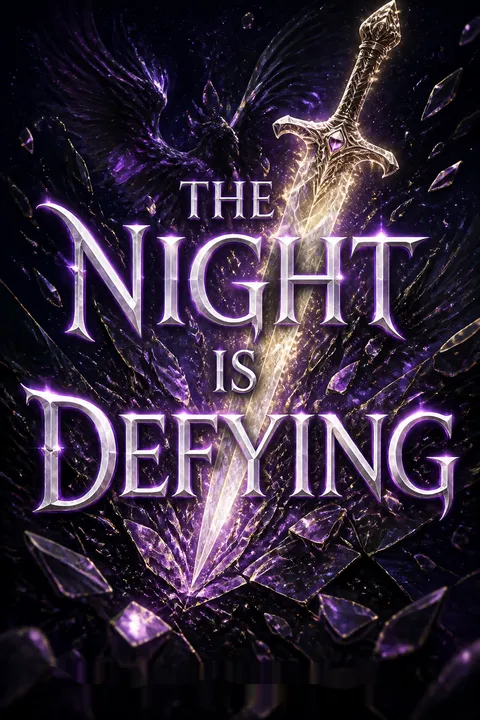


Plot Summary
The Star-Maiden's Prison
In the past, Nyte, a feared vampire commander known as Nightsdeath, frees a wagon of captured fae, killing those who threaten the others and directing the survivors to safety. News that the star-maiden is imprisoned draws him to Astraea, ruler of Solanis and daughter of Dusk and Dawn. She is not truly helpless: she came seeking the cause of the quakes that have shaken the world for generations.
Astraea explains that the stars are failing, which will eventually ruin celestial magic, starve the human world, and unleash the vampires' most savage kind. Nyte recognizes the danger but distrusts her motives. Their first meeting brings an impossible pull between two sworn enemies, while the worsening quakes make an alliance necessary.
The opening makes Nyte's violence more than a mark of villainy: he uses it both to control a brutal world and to protect people without pretending his choices are clean. Astraea enters not as a rescued captive but as a political actor willing to approach her enemy because the ecological crisis crosses species boundaries. Their attraction complicates the alliance before either has earned trust. The quakes place private desire inside a public emergency, so their connection immediately carries consequences beyond the couple.
A Bargain Under Bars
In the present, after the Libertatem, Nyte has confined Astraea and taken her celestial key. She resents his claim that the cage protects her, especially because vampires want to exploit the fact that her survival weakens the celestials. Nyte reveals that he is her Bonded, though she also has a Bonded in Auster, a celestial from another world.
He explains that their connection is dangerous, but cannot make her accept his control. Astraea agrees to bond with him for political cover and training, while insisting that she will choose her own course. Nyte releases the blood bargain that had compelled her, and she proves she can retrieve her stormstone dagger from the Void, threatening him if he cages her again.
Astraea's agreement is tactical, not romantic surrender. She can recognize the bond while refusing to let its supernatural force settle questions of consent, safety, or allegiance. Nyte's tenderness remains entangled with coercion: he wants to protect her, yet his first solution is confinement. Her recovered ability to summon a weapon gives the scene a concrete shift in power. She is still dependent on what Nyte knows, but no longer accepts dependence as a reason to obey him.
The Other Bonded
Auster, Astraea's other Bonded, visits her secretly and asks her to return with him to Althenia, the celestial homeland beyond the veil. Astraea's missing memories leave her unsure how to respond to his familiarity, but she agrees to meet him again.
Her friend Rosalind, called Rose, supports the chance to learn about her people, while Zathrian, her loyal companion, remains close despite having concealed Nyte's identity during the Libertatem. Davina, once disguised as Astraea's human handmaiden, reveals her place in a fae resistance.
At its meeting Astraea hears anger at the vampires and distrust of the celestials, then asks the fae to fight for coexistence. Nyte's public killing of a vampire who threatened her shows the danger of his protection.
Astraea's memory loss makes other people competing narrators of her identity. Auster offers history and belonging, Rose offers a path away from Nyte, and the resistance offers a political reality neither romance can erase. Astraea's appeal to the fae is her first attempt to lead without relying on inherited authority. Their skepticism is earned by centuries of abandonment. Nyte's violent intervention protects her in the moment but also dramatizes the cost of his reputation: his power can command a room, yet cannot by itself win trust.
Across the Veil
Auster carries Astraea and Rose into Althenia, where four High Celestials govern separate provinces. Astraea learns that she once ruled from Vesitire rather than living among them, and that her people have been cut off from Solanis for centuries. Auster welcomes her as a returning symbol, but his brothers Notus and Aquilo regard her with suspicion.
The celestial leaders discuss rebuilding their strength and preparing for war, while Astraea sees that peace on their side of the veil rests beside suffering on the mainland. Auster urges her to stay and offers his protection. Her unease grows when a sudden memory links him to an intimate past she cannot recall, and she leaves without choosing him or abandoning her responsibilities at home.
Althenia is not a simple refuge. Its beauty and order expose the political privilege of a people insulated from the consequences of their absence. Astraea's return makes her a symbol before she can recover her personal history, and Auster's protection risks repeating the same pattern as Nyte's: deciding what is safest for her. Her bodily unease matters because memory has been withheld, not erased from every level of experience. The section asks whether belonging is a place offered by others or a relationship one can freely inhabit.
The Compass Points Inward
To help Astraea recover, Nyte begins sharing memories from their former lives. They show an alliance formed to investigate the quakes, a magical compass that points toward both of them, and the discovery that Nyte came from another realm and bears the power of a star goddess. Their shared magic may be destabilizing Solanis, yet neither can simply stop caring for the other.
Nyte also reveals that he fully bonded Astraea after she was mortally wounded by her own key, choosing to save her despite the danger to himself. The memories make their intimacy more legible but do not answer who attacked her. Astraea's past becomes evidence she must interpret, not a story she can accept unquestioningly from Nyte.
Memory here is both testimony and influence. Nyte gives Astraea access to experiences she cannot verify independently, but his willingness to expose his own fear and guilt makes the transfer more than a bid for control. The compass turns their private connection into a measurable clue: the crisis is not merely political but bound to their existence. The earlier bond's life-saving origin also complicates their present consent. Love can explain why Nyte acted, but the narrative does not treat good intention as proof that his choice was harmless.
The Dragon in Ruins
In another recovered memory, Nyte, Astraea, and Nyte's younger brother Drystan find a wounded celestial dragon in an abandoned library. Astraea calms it and refuses to treat its suffering as proof that it must be destroyed. She asks Nyte to end its pain gently, while Drystan carries away its black-and-silver egg.
In the present, Astraea learns the egg requires moonlight and a willing name to hatch. It opens into Eltanin, a feathered dragon who chooses her and grows rapidly with each full moon. Nyte's guarded joy at seeing them together softens his habitual isolation. The dragon offers a new link to the lost past, but its existence also gives the coming conflict a powerful and vulnerable participant.
Astraea's response to the dragon reveals a governing ethic in action: she distinguishes a creature's violence from the injuries that produced it. Nyte's willingness to perform the mercy she cannot bring herself to enact shows how their moral roles can complement without becoming interchangeable. The egg carries that encounter into the present, making care a form of historical continuity. Eltanin is not just a weapon or heirloom. His trust has to be earned, and his rapid growth ensures that nurturing him will soon require choices with political consequences.
The Maiden Takes Command
The vampires expect Astraea's formal bond to secure her as their ally. Instead, she uses a feather from Nyte's wing and their mingled blood to make a stronger bargain, temporarily commanding him. She orders the vampires to kneel, requires Nyte to protect her companions, and has Calix released.
Then she leaves with Rose and Zath, making the court believe Nyte has been forced to let her go. Her plan gives her space to reach Alisus and confront her past, but it wounds Nyte and leaves her uncertain whether the bargain can hold. Nyte accepts the public humiliation because he understands its strategic value, even as his attention remains fixed on where she will go.
Astraea turns the language of possession against the institution that expects to possess her. The bargain is not an uncomplicated liberation: she uses coercive magic on Nyte, the same kind of power she resents when he uses it on her. The scene's tension comes from that ethical symmetry. Her act creates political room but cannot erase emotional dependence or danger. Nyte's acceptance signals that their relationship is becoming a contest in which he can respect her agency even when it costs him control.
Alisus Becomes a Trap
Astraea returns to Alisus with Rose, Zath, and Calix, hoping to see Cassia's father, Reihan. She finds a ruler who appears welcoming but soon captures her and her companions. A celestial woman named Katerina is held in a suspended cage nearby, and Astraea learns that captors have been taking celestial blood and wings.
The revelation reframes the silver wings she glimpsed in Reihan's office. Blood from Astraea had also been sold to prolong Cassia's life, a secret that makes her grief for her dead friend collide with her anger at being used. Calix appears to have betrayed her again, while Reihan insists that the imprisonment serves a larger purpose.
Alisus turns affection into a site of moral injury. Astraea's relationship with Reihan and her grief for Cassia make the exploitation harder to dismiss as ordinary villainy. Her blood did help preserve Cassia's life, yet its value was extracted without her consent. The narrative refuses an easy balance sheet in which a good outcome cancels the violation. Katerina's captivity broadens the harm beyond Astraea, transforming a personal betrayal into a system built around bodily ownership.
The Cages Come Apart
Though Nebulora poison and blood loss weaken her, Astraea reaches her magic and cuts through her suspended cage. She frees Katerina, then breaks the locks holding dozens of captive celestials. Rose and Zath are alive, and Calix reveals that he secretly kept them from being killed.
In the battle above, the ruler's disguise is exposed as Nyte's father, who has taken Reihan's appearance and killed the real ruler. Calix stabs the impostor, but the king kills Calix before Astraea can stop him. Astraea blasts the king with her key, destroying the chamber, and Nyte arrives to carry her away. Her escape saves many prisoners but leaves her grieving and the king still at large.
Astraea's rescue marks the transition from recovering power to exercising responsibility under constraint. She cannot free the captives through strength alone; she has to press through poison, exhaustion, and imperfect control. Calix's last choices complicate her judgment of him without erasing his earlier betrayals. The king's impersonation shows how authority can survive by borrowing the face of someone loved and trusted. Astraea's victory is real but incomplete: she opens the cages, loses Calix, and fails to capture the architect of the deception.
The Guardians' Warning
At a Guardian Temple, Astraea meets the spirits who raised her and hears that she once helped create a Golden Age, but that her bond with Nyte threatens the world's balance. They urge her to kill him; she refuses to let either gods or prophecy dictate her choice. As she leaves the temple, a fall and a desperate effort to survive awaken her silver wings.
Auster's forces attack Nyte outside, using a new substance that incapacitates him and striking his friends. Astraea returns through the sky, drives off the attackers, and helps Nyte survive. The encounter confirms that her celestial heritage gives her power, but it also reveals that even her own people may use force to make her obey.
The guardians offer love and counsel, but their warning is still shaped by the same predetermined logic as the gods' expectations. Astraea's refusal is not proof that she knows the future; it is a refusal to reduce a person to the catastrophe others predict. Her wings emerge through an act of survival rather than ceremonial approval. The attack then tests that new capacity immediately. Power arrives as responsibility, and the celestials' violence makes it impossible to equate their claim of righteousness with moral innocence.
Auster's Winter Court
Astraea continues visiting Althenia, where Auster asks her to commit to him and bond with him rather than remain emotionally tied to Nyte. She cannot return his feelings, though their shared history and his longing make refusal painful. She also learns that Katerina, whose wings were torn away in captivity, has been exiled under celestial law.
Zephyr quietly opposes the cruelty of that rule and shelters the outcasted, while Astraea begins to understand that Althenia's polished peace hides its own hierarchy. During the Star-Maiden festivities, she gives the people small lights bearing their wishes. A child's wish for her mother's lost wings turns the ritual into a reminder of the lives her people still need to repair.
Auster's request places private affection inside a system of dynastic expectation. Astraea's refusal is painful because she does care about him, but she cannot manufacture desire to satisfy a bond or a political ideal. Katerina's exile gives that conflict a material counterpart: celestial purity rules punish people for injuries inflicted on them. The ritual lights briefly make Astraea an accessible person to her people, yet the child's wish exposes the distance between symbolic hope and restitution. Her leadership begins with learning what the pageantry cannot fix.
The Solstice Ambush
During the Winter Solstice, Nyte's closest fighters are ambushed by nightcrawlers and his father, who is using a disguise. Sorleen, Zeik, and Kerrah are killed; Elliot survives badly wounded, and Nadia helps protect him. Nyte finds a celestial-made arrow among the attackers and, fearing Auster's involvement, leaves to reach Astraea.
At her celebration in Althenia, he appears in disguise and dances with her beneath an illusion of clouds. He reveals that he created the veil to protect her people after her death, and that the worsening quakes are killing him. Then he tells her his friends are dead and sets out to confront Auster, convinced revenge is the only answer left.
The ambush strips Nyte of the social circle that had begun to make life outside Astraea imaginable. His grief revives the identity he has been trying to control, while the arrow gives him a plausible but unproven explanation for who is responsible. The dance with Astraea becomes a brief refuge in which love and political reality finally meet without disguise. His confession about the veil recasts his earlier separation as sacrifice, but his decision to pursue Auster shows how grief can turn protection into retaliation.
The Veil Gives Way
Nyte attacks the Nova stronghold, and Astraea blocks his magic long enough to evacuate the ballroom. A vampire force then pours across the veil into Althenia, confirming that the world's boundary has fallen. Astraea refuses to believe Nyte brought the army and searches for the real source of the invasion.
She fights from Eltanin's back, while Drystan arrives on a second celestial dragon and Nadia brings transitioned vampires loyal to him. The fae resistance joins the defense under Davina and Lilith. Amid the attack, Drystan wounds Astraea with a small blade as part of a plan she does not yet understand. Nyte and Drystan begin fighting, while Astraea sees that the crisis has been engineered to make every faction blame the others.
The breached veil makes the novel's abstract imbalance brutally visible: the people who hid from war are suddenly inside it, and no faction can preserve its innocence. Astraea's decision to defend Althenia despite its hostility demonstrates that she is not simply choosing Nyte over her people. The alliance of fae, transitioned vampires, and dragons suggests a different political future, but it arrives through violence and secrecy. Drystan's unexplained wound is a reminder that even a necessary strategy can resemble betrayal to those kept outside it.
Auster's Original Betrayal
The confrontation exposes Auster as the person who killed Astraea in her former life by wielding her key. He has worked with Nyte's father, helped engineer the attack, and wants the completed bond because Astraea's blood can kill Nyte once it enters their shared bond. The king and Auster imprison the pair behind a magical barrier, stab Astraea with the key, and force Nyte to watch.
Drystan's wound proves fatal, but Astraea had agreed to the plan with Nadia: her death will summon the God of Death, who can spare Drystan. As Astraea's memories return, she understands that the betrayal that killed her before has followed her into this life, and that the forced bond is also her only chance to act.
Auster's betrayal collapses the distinction between a benevolent protector and a controlling authority. His grievance is genuine, but he converts rejection into a doctrine that justifies murder and political domination. The key becomes an instrument of intimacy turned against its owner: Astraea's own power is used to make her vulnerable. Drystan's planned death adds a countercurrent of chosen sacrifice, showing that the same act can be coercive or self-directed depending on who controls it. Astraea's recovered memory changes the meaning of her present fear without making the past easy to accept.
Lightsdeath Breaks the Key
As Astraea is dying, she accepts the God of Death's power in exchange for Drystan's life and becomes Lightsdeath, a counterpart to Nyte's Nightsdeath. Nyte bonds with her to keep her alive, even though their blood now gives their enemies a way to kill them. Astraea then turns her new power on the captors, shatters the celestial key into pieces, and destroys the barrier that separated her from Nyte.
The key fragments are scattered toward the hidden dragons. Auster's forces and the king's surviving allies are driven back, but Astraea is buried beneath the collapsing temple. Drystan survives, while Zephyr carries Astraea away before Nyte can reach her. Their reunion is postponed just as their bond becomes permanent.
Astraea's transformation is not a triumphant upgrade without cost. She survives by accepting a power that changes her allegiance and makes her newly feared, while the act of bonding renews a vulnerability her enemies can exploit. Breaking the key rejects the gods' monopoly over her agency, but it also scatters the instrument she needs to restore the world. The rescue's aftermath prevents emotional closure: Drystan lives, yet Astraea and Nyte are separated again. Their victory is therefore a beginning with consequences, not a completed resolution.
The Last Dying Light
Zephyr brings Astraea to a refuge for exiled celestials, wingless survivors, and Nephilim, including people rejected by the ruling High Celestials. Astraea discovers that Auster has branded her and her allies as fugitives, then publicly wounds Aquilo to announce resistance. She searches for Nyte, whose torn wings leave him unable to travel safely.
At sunset she reaches him on a snowy mountainside. The light disappears, a final quake strikes, and Nyte collapses with his heartbeat faint and slow. Astraea holds him, promising to meet him again in darkness. The book ends without confirming whether he is dead or merely suspended in the curse's eternal night. The key is broken, the war is widening, and Astraea now claims the power of Death.
The ending turns the familiar promise of reunion into an immediate test of whether love can survive bodily separation and political defeat. Astraea has found a community that makes a broader future imaginable, yet she reaches Nyte only as his curse takes effect. Her retaliation against Aquilo signals the danger that grief and new power may reshape her into the kind of ruler she once resisted. The unresolved heartbeat refuses reassurance. The book closes at the threshold between death and continuation, with Astraea's next choices carrying the burden of both intimacy and revolution.
Analysis
The novel treats identity as contested territory. Astraea's missing memories make her vulnerable to people who claim to know what she once chose, but her body, instincts, and decisions repeatedly challenge their accounts. Nyte's memories offer intimacy and information, while Auster's version of celestial duty recasts her as a role whose private desires are obstacles. The story's central ethical question is not whether love can overpower duty, but whether duty has any legitimacy when it denies the person it claims to serve.
Nyte's arc complicates the familiar villain-redemption pattern. He is not absolved because he loves Astraea; he remains capable of brutality, and his attempts to protect her can become coercive. What changes is his capacity to acknowledge dependence and to let Astraea's choices matter, even when they frighten him. Astraea likewise does not become a moral ideal by inheriting a title. Her resistance to annihilating vampires, her defense of celestial captives, and her treatment of Calix show that justice requires seeing motives without excusing consequences.
The factions are deliberately imperfect. The vampires have victims and would-be allies; the celestials preserve a beautiful homeland through exclusion; the fae resistance risks turning grief into collective revenge. Each group tells a story that makes its violence seem necessary. Astraea's attempt at coexistence is therefore not naive optimism but a difficult refusal to let political categories decide whose life counts. The dragon and the broken key carry that argument into the material world: old histories can be hidden, weaponized, or recovered, but recovery always demands risk.
The ending withholds the comfort of a completed victory. Astraea has become a power feared by gods, Nyte is suspended at the edge of death, and Auster controls the public account of the war. The final question is whether the pair can convert their private bond into a just political order without reproducing the domination they oppose. Their love offers no automatic solution. It offers a reason to keep choosing, and a responsibility to make those choices answerable to everyone beyond themselves.
Review Summary
People Also Read



Characters
Astraea
Amnesiac star-maidenAstraea is the ruler of Solanis, created by the gods and raised by guardians from different species to lead without prejudice. When the story opens, she has lost most of her memories and has been treated as a fragile, valuable object by people who claim to protect her. She is observant, stubborn, and more compassionate than her self-doubt allows her to recognize. Her strongest instinct is to resist being reduced to a title, weapon, or romantic prize. As fragments of her history return, she must decide which parts of her past deserve trust and what kind of leader she wants to become.
Nyte
Villainous protectorNyte, whose full name is Rainyte, is a fae-born, vampire-made warrior marked by the God of Death. His shadow magic, ability to manipulate minds, and fearsome reputation make him the strongest military force in Solanis. He is also fiercely protective of his younger brother, Drystan, and capable of tenderness toward the few people he trusts. Years of serving a cruel father taught him to treat violence as ordinary and vulnerability as dangerous. Astraea unsettles that logic: he wants to keep her safe, but must learn that protection without her consent can become another form of possession.
Auster
Celestial rival BondedAuster is a High Celestial of the House of Nova and Astraea's other Bonded. He carries the authority of a ruler and the confidence of someone accustomed to being seen as a natural partner for her. Their long shared history gives his longing real emotional weight, even though Astraea no longer remembers it clearly. Auster is disciplined, protective, and invested in restoring celestial power. He expects duty and affection to align, which makes Astraea's independent choices difficult for him to accept.
Drystan
Nyte's wounded brotherDrystan is Nyte's younger half brother, a clever prince whose curiosity once made him a welcome companion on Nyte's travels. He has become guarded and strategic after years shaped by their father's ambitions and the loss of people he loved. His work with maps, ancient texts, and celestial dragons gives him knowledge that the others lack. Drystan's resentment toward Nyte is bound up with grief and abandonment, not merely rivalry. Beneath his cold manner, he still longs for loyalty, purpose, and a chance to make his own choices.
Rosalind
Astraea's thorny friendRosalind, usually called Rose, is Astraea's friend and a survivor of the brutal Libertatem. She is sharp-tongued, skeptical of Nyte, and protective of Astraea, especially when she suspects manipulation. Her resentment and grief over Cassia are not simple obstacles: they inform her fierce loyalty and her readiness to fight. Rose begins to let others see the vulnerability beneath her guarded manner, particularly in her growing closeness to Zathrian.
Zathrian
Astraea's steadfast allyZathrian is Astraea's trusted companion, a warm, loyal presence who often steadies her when her memories and surroundings become overwhelming. He once worked in Nyte's orbit, a secret that complicates Astraea's trust without erasing their bond. Zathrian is brave but not invulnerable, and his humor helps soften tense groups. His connection with Rose develops through mutual challenge and care, while his own hidden history makes him more than a reliable guard.
Cassia
Astraea's absent compassCassia is Astraea's closest friend from Alisus and the daughter of its reigning lord. She is a spirited, star-loving young woman whose courage and humor shape Astraea's sense of loyalty long after she is gone. Her diary preserves her private hopes, while her memory helps Rose and Astraea build a friendship of their own. Cassia's presence in the story is not only grief: her insistence that life be lived fully gives Astraea a model for compassion that does not require obedience.
Calix
A guard burdened by guiltCalix is a former guard of Alisus and Cassia's beloved. His loyalty to her drove him into choices that endangered Astraea, leaving him burdened by guilt and uncertain whether he deserves forgiveness. He can be sullen and self-punishing, but his sense of duty remains strong. Astraea sees both the harm he caused and the love that motivated him, refusing to let either fact erase the other.
Reihan
Cassia's grieving fatherReihan is the ruler of Alisus and Cassia's father, a man whose grief over his daughter makes him both compassionate and difficult to read. He has treated Astraea like family, which gives their connection deep emotional significance. His authority requires him to make choices that affect the whole kingdom, while his personal losses make those choices vulnerable to fear and desperation.
The King
Nyte's ruthless fatherNyte and Drystan's father is a vampire king who treats his sons as instruments of power. His obsession with overthrowing the celestials shapes Nyte's military career and Drystan's painful childhood. He is patient enough to conceal his intentions and ruthless enough to exploit the loyalties between people. His rule depends on fear, manipulation, and the promise of a vampire empire.
Davina
Fae resistance leaderDavina is a skilled fae warrior who once posed as Astraea's human handmaiden. She leads resistance efforts in Vesitire, coordinating fae and human fighters against vampire attacks. Her bright manner can conceal a decisive, authoritative leader who has endured devastating losses. Davina believes organized resistance matters more than personal glory, and she is willing to put herself in danger for the communities she serves.
Nadia
Rogue vampire strategistNadia is a transitioned vampire who refuses to settle into anyone else's command. Bold, seductive, and quick to read a power imbalance, she joins Nyte's circle because she wants freedom from the blood bond connecting her to Drystan. Her anger protects a history of loss, but she is not simply cruel: she weighs the harm she might cause and searches for a way to reclaim her autonomy.
Zephyr
Auster's gentler brotherZephyr is the High Celestial of the House of Luna, associated with winter and the northern wind. He is an old friend of Astraea's, though her missing memories make their closeness hard to recover. Unlike his more rigid brothers, Zephyr listens before judging and has a strong instinct for protecting people cast out by celestial law. His patience makes him a quiet source of support in a world where loyalty is often demanded rather than earned.
Katerina
Wingless celestial captiveKaterina is a celestial who has endured captivity and the loss of her wings. Her old connection with Astraea is obscured by Astraea's amnesia, but she offers knowledge and encouragement when Astraea is imprisoned. Katerina's fear that her injury makes her unworthy of love exposes the cruelty of celestial purity laws. She is resilient without being untouched by trauma.
Lilith
Fae resistance fighterLilith is a fae warrior and a member of the resistance, known to Astraea from an earlier refuge in the woods. Her confidence grows as she steps into the work of defending her people. She is close to Davina, and their shy tenderness contrasts with the violence surrounding them. Lilith's loyalty is practical: she turns up when someone needs help, even when the danger is immediate.
Eltanin
Astraea's young dragonEltanin is a celestial dragon hatched from the black-and-silver egg Astraea finds in the maze. He is feathered, curious, affectionate, and grows quickly with the cycles of the moon. His bond with Astraea links her to a nearly lost species and to the old alliance between dragons and the celestial world. His size and power will soon exceed his playful, dependent beginnings.
Zadkiel
Auster's courteous companionZadkiel is a celestial close to Auster who once encountered Astraea before either understood her full identity. He is warm, socially graceful, and more approachable than the High Celestials who dominate Althenia. His welcome helps Astraea explore the celestial world, though his loyalty remains tied to its leadership.
Tarran
Ancient vampire power brokerTarran is an ancient soul vampire whose influence predates Nyte's return. He is patient, perceptive, and skilled at turning political information into leverage. Rather than relying on open force, he studies the fault lines between Astraea, Nyte, and the vampire factions, hoping to benefit from their instability.
Goldfell
Astraea's former keeperGoldfell was the powerful human who kept Astraea hidden and controlled in her earlier life. His authority and polished manners helped conceal the ways he restricted her choices. His arrangements with Alisus reveal how vulnerable people can be used as currency by those who claim to offer shelter.
Elliot
Golden Guard survivorElliot is one of Nyte's Golden Guard, a capable fighter with a teasing, social manner. He is observant about vampire behavior and remains attentive to Sorleen's quiet presence.
Zeik
Golden Guard bruiserZeik is a broad, physically imposing member of the Golden Guard. His blunt humor and confidence soften the group's martial discipline, and his closeness to Kerrah is clear in their constant banter.
Kerrah
Golden Guard challengerKerrah is a sharp-witted Golden Guard member who is comfortable challenging Nyte directly. Her confidence and quick temper are balanced by her steady affection for Zeik.
Sorleen
Quiet Golden Guard fighterSorleen is a reserved member of the Golden Guard whose past is marked by severe loss. She rarely speaks, but her presence and discipline earn the loyalty of her companions, especially Elliot.
Aquilo
Hostile celestial rulerAquilo is the High Celestial of the House of Sera. He is proud, severe, and openly distrustful of Astraea's willingness to question celestial authority. His ideas of order leave little room for those who do not fit the rules of his people.
Plot Devices
The Celestial Key
Amplifies Astraea's magicThe key is Astraea's unique weapon and an amplifier for her magic. It can change form, allowing her to fight with a blade, staff, or bow, and its power is most dangerous in her hands. Other people can attempt to use it, but doing so risks corrupting them. The key is tied to Astraea's vulnerability as well as her authority: its magic can protect her, expose her, or be turned against her. Its fragments and location become central to the characters' efforts to prevent further catastrophe.
The Bond
Makes love a shared riskA Bond joins two souls in a life partnership built around protection and mutual strength. Astraea's connection to Nyte is complicated by her separate Bond with Auster, and by the fact that Nyte once claimed her Bond to save her life. Bonding can intensify magic and make the partners' lives inseparable, but it also creates vulnerabilities enemies can exploit. The story repeatedly distinguishes a bond's supernatural pull from a person's right to choose what that bond means.
The Starlight Void
Moves characters through spaceThe Starlight Void is a magical passage Astraea and Nyte use to travel across Solanis and between distant places. Astraea gradually learns to summon objects through it and, later, travel through it herself. The ability makes escape and pursuit possible, but it is not an answer to every obstacle: wards can block it, and traveling with another person requires skill. Its recurring use gives the story a physical expression of the pair's connection, as they repeatedly cross distances that political borders try to make absolute.
The Veil
Separates two warring worldsThe celestial veil divides Althenia from the mainland, keeping celestials safe while preventing ordinary passage between their world and Solanis. Its protection has allowed Althenia to preserve its power, but also to remain distant from the suffering beyond it. The veil's instability reflects the weakening of magic and the conflict between Astraea and Nyte. Its presence makes every secret visit a political risk, while its destruction transforms a contained struggle into an open war.
Dragons and the Prophecy
Links hidden history to revoltThe celestial dragons connect Astraea's present to an older magical order. The egg she carries, the ancient diary, the map, and a constellation overlay gradually reveal that dragons have been hidden rather than simply lost. The prophecy concerning a Godkiller gives the characters a possible answer to powers that seem impossible to defeat, but its meaning remains dangerous and incomplete. The dragon thread transforms an endangered species into both a source of hope and a practical route toward recovering the scattered pieces of the key.
Download PDF
Download EPUB
.epub digital book format is ideal for reading ebooks on phones, tablets, and e-readers.








