

Plot Summary
Betrayal Leaves Five Afloat
The five survivors of King Joon’s failed assassination scheme sail toward Khitan with a new plan: persuade Queen Quilimar to make war on Yusan, draw Joon from his palace, and kill him. Their loved ones remain hostages, and they have only the monsoon season to act. Sora tries to unite the group, but Mikail’s argument with Euyn exposes a deeper betrayal.
Euyn hunted convicts for sport and recognizes Sora’s father, Chul, as the man he once pursued. Sora realizes Euyn knew who Chul was and kept silent. She lunges at him, and Royo and Mikail restrain her. The voyage ends not with a repaired alliance, but with Sora’s grief and Euyn’s shame traveling beside them.
The crew’s first obstacle is not Khitan’s law or Joon’s power, but the moral debt they carry into the mission. Sora has been the group’s source of cohesion, yet Euyn’s concealment makes her care feel suddenly exploitable. Mikail’s defense of Euyn is equally compromised: he values their shared objective, but his loyalty repeatedly asks other people to absorb the cost of Euyn’s choices. The ship becomes a narrow test of whether common danger can hold people together when trust has already failed.
A Bloody Welcome to Quu
In Quu, Yusan’s former royal spymaster Mikail slips away to meet Fallador, an exiled Gayan prince and longtime source. Fallador reports that an assassin recently tried to kill Quilimar, making an audience even harder to obtain. A coded palace message then tells Mikail that Joon has left Qali, though no one knows where he went.
On his way back, Khitanese spies surround Mikail; he kills them and suspects General Vikal sent them. He later coerces Yusan’s ambassador, Zeolin, into revealing that General Salosa ordered both Mikail’s capture and the attack on Quilimar, hoping to become Count of Tamneki. Seok, Sora’s former owner, is also in Khitan. The group now faces a plot whose competing sponsors remain hidden.
Mikail treats information as both weapon and shelter, but each discovery shows how little control his expertise actually buys. The coded message confirms that Joon is moving beyond the safety of Qali, while the ambassador’s testimony links the assassination attempt to Yusanian ambition. Yet the facts do not resolve the central contradiction: Joon sent the group toward Quilimar while his agents tried to kill her. The chapter turns espionage from a path to certainty into a map of overlapping betrayals, where every answer creates a more dangerous question.
Aeri's Inherited Wounds
When Mikail describes Prince Omin’s abuse and murder of young girls as one more Baejkin crime, Aeri leaves the room. She tells Sora that Omin attacked her when she was twelve and that she killed him to stop him. In the fire that followed, servants also died; Aeri has carried their deaths and her mother’s later loss as private punishment.
She reveals neither the time-stopping amulet she took from Omin nor its cost. Sora responds by proposing that Aeri, rather than Euyn, should eventually rule Yusan: Aeri’s birth gives her a claim, and Euyn’s habits threaten to reproduce Joon’s rule. Meanwhile, Mikail traces Royo’s old case to Count Bay Chin, who controls the gangs that killed Royo’s beloved Lora and framed her father, Hwan.
Aeri’s confession makes survival distinct from innocence. She stopped an assault, but the fire that enabled her escape killed people who had not harmed her, leaving her to interpret childhood self-defense as a debt she can never repay. Sora does not erase that guilt; she offers a different measure of character, one based on what Aeri chooses now. Her succession proposal also challenges the assumption that political legitimacy must pass through Euyn. Royo’s discovery connects private grief to state power: Bay Chin’s influence turns an old tragedy into part of Joon’s larger machinery.
Seok's Cruel Waltz
At Khitan’s monsoon banquet, Sora and Aeri fail to secure a private conversation with General Vikal. Count Seok appears and cuts in while Sora is dancing with Zeolin. He tells her that he no longer keeps track of his brother’s affairs, letting her understand that Daysum has been sold into a pleasure house. Sora collapses under the news.
As guards rush to protect Vikal and the hall erupts, Aeri uses the Sands of Time amulet to freeze the room, load Sora onto a dessert cart, and get her outside. The magic leaves Aeri dangerously exhausted. Seok’s alarm brings guards toward their inn, so Aeri leads Sora out through a basement exit. Sora regains enough resolve to flee, and a tiny owl follows them into the rain.
Seok’s cruelty is effective because he weaponizes uncertainty rather than simply announcing violence. Sora must infer what has happened to Daysum, and that inference destroys the future she has been enduring toward. Aeri’s intervention turns her concealed magic into practical care: she spends years of her life, in effect, to move one friend out of danger. The rescue does not cure Sora’s despair, however. The owl’s small, unexplained decision to follow them offers no solution, only evidence that connection can persist when a person can no longer feel hopeful.
The Door Beneath Cerome
Mikail leads Euyn and Royo to Lake Cerome, where a priest vanishes through an invisible entrance beneath the ice. Aeri and Sora catch up, and Aeri recognizes that Mikail’s ornate key is made of veritite, a stone that reveals matching material. Striking it against the ice exposes a glass door. Royo turns the lock, which responds to his blood, and the five descend into the underwater Temple of Knowledge.
They find nine murdered priests and hundreds of damaged records. The surviving priest, Luhk, guides them to the texts they need: only someone who brings Quilimar an amarth egg or the head of the Marnan leader Staraheli may approach her. The records also reveal that the Golden Ring weakens its wearer and that Quilimar cannot wield it.
The temple makes knowledge physical: its doorway is concealed, its records are vulnerable, and access depends on a key that recognizes a lineage Royo does not know he carries. The murder of the priests demonstrates that history is not a neutral archive but a resource rulers destroy when it threatens them. Their research offers a route to Quilimar, yet each route demands desecration or exposure to lethal creatures. The discovery that Quilimar cannot use her own ring shifts the political problem again: the group’s access may depend on a weakness the queen is willing to kill to conceal.
Idle's Living Ghost
In Yusan, Tiyung is held in Idle Prison as leverage against Sora. A woman he recognizes as Hana, a poison-school survivor presumed dead, visits under the spy identity Zahara. She brings light and food, then tells him that Joon has ordered his quiet death.
Tiyung admits that he secretly freed Hana’s brother Nayo, and Hana begins to trust that his compassion is real. She later reports that Daysum died of a laoli overdose after Seok sold her to a pleasure house; Hana arranged for her body to be brought back and burned.
Tiyung’s cellmate, Ailor, turns out to be Mikail’s adoptive father. When assassins come for Tiyung, Ailor gives them his noble collar and lets them mistake him for their target. Hana then disguises Tiyung as a guard and escapes with him and Nayo.
Tiyung’s imprisonment strips rank of its usual protections, but it does not make him morally blank. His earlier, secret effort to free Nayo gives Hana evidence that he can act against his family’s interests without demanding credit. Ailor’s sacrifice makes that question sharper: kindness becomes an action with an irreversible cost, not a self-image. Hana’s assistance is also shaped by grief. She refuses to let Daysum’s death become an excuse for passivity, even as she must carry the news to Sora. Tiyung leaves the prison alive, but the person he most wants to save still does not know her sister is gone.
The Avalanche's Confession
On the western pass, Mikail, Euyn, and Sora are caught beneath an avalanche. Sora recognizes a narrow cut in the cliff and gets all three out of the sleigh and against the rock, where the snow pours around rather than over them.
After they survive, Euyn finally tells her that Chul never signed the indentures for Sora and Daysum. Seok threatened the family, then forged Chul’s signature through a corrupt magistrate; Chul later killed the magistrate.
Sora strikes Euyn for withholding the truth, because learning it might not have freed Daysum in court, but it changes what her parents meant to her. Euyn explains that he withheld it because he believed it would not alter the outcome. Sora walks away, no longer willing to confuse his reasoning with innocence.
The avalanche makes Sora’s knowledge of the mountains more valuable than Euyn’s royal training or Mikail’s tactical thinking. Her survival instinct saves the very men whose choices have wounded her. Euyn’s confession then reveals the limit of his pragmatism: he treats information as useful only when it changes an immediate outcome, while Sora understands truth as part of a person’s history and identity. His explanation may be accurate about the courts, but it cannot restore the years she spent believing her parents sold her. Survival and repair remain separate tasks.
The Owl's Bargain
Aeri and Royo travel north for the amarth egg. At a hot spring, Aeri slips into deep water and nearly drowns; Royo remembers a rescue he once witnessed and revives her. The near loss breaks through his guardedness, and they begin to choose each other. On the mountain, they find a colony of enormous, humanlike birds.
Aeri freezes time to take an unattended black egg, but an amarth intercepts them and knows her identity and Royo’s parentage. It warns of war and an approaching choice between love and power. When Aeri prepares to surrender the egg, Dia, the little owl she rescued in Quu, distracts the amarth. The creature lets them leave with the egg and takes Dia into its care, allowing the pair to reach the rendezvous alive.
The paired rescues reverse the roles Aeri and Royo expect of themselves. Royo saves Aeri’s body, while Aeri’s earlier care for an insignificant owl becomes the reason the amarth spares them both. Their intimacy grows through dependence, but the prophecy introduces a threat their affection cannot simply solve. Aeri’s power is useful precisely because she acts quickly, yet every use carries a personal cost and every secret threatens the trust she is building. Dia’s intervention makes kindness consequential without making it safe or predictable.
Staraheli's Empty Tomb
Mikail, Euyn, and Sora reach the Marnan caves to steal Staraheli’s head, only to find an empty mausoleum rigged with a metal net. Sora frees the men, but alarm bells summon Marnan fighters. Their horses are gone, and Euyn is wounded. Gambria and her Marnan wife Lyria arrive with a sleigh and carry the group away.
The failed mission has an added cost: during the approach, Sora used poison to disable a guard, then secretly gave him an antidote. Mikail realizes the man survived and challenges her choice, since the delay helped alert the Marnans. Sora counters that Mikail has his own concealed plans. The group reaches Loptra without the head, but with its trust no more secure than before.
Sora’s mercy is not presented as a cost-free virtue. She chooses to save a guard who showed her kindness, and that choice compromises the group’s escape. Yet the alternative, killing someone who had offered help, would make survival depend on surrendering the very limits she is trying to preserve. Mikail judges consequences; Sora also judges what a person becomes by accepting them. Their conflict is not between competence and sentiment, but between two ethical calculations under pressure. Gambria’s rescue prevents either calculation from becoming final.
Bloodlines at the Queen's Table
In Vashney, Aeri and Royo rejoin the others with the egg. Mikail has learned that Yusan is mobilizing, and a message reaches Tiyung and Hana that Count Seok has seized Qali Palace. At the Sky King’s palace, the amarth egg earns the group an audience with Quilimar. She reveals that she and Euyn are both illegitimate: the old king fathered neither of them, and Euyn has concealed what his mother told him.
Sora offers an alliance against Joon, while Mikail warns that a war among the realms is coming. The revelation that Quilimar cannot wield the ring, combined with Aeri’s ability to remove Joon’s crown, makes Aeri central to every ruler’s plans. Euyn accepts a wager to prove his royal blood by turning the egg to gold.
The court scene dismantles the group’s political plan by exposing its premise as false: Euyn may not be entitled to the throne he has pursued. Yet his hidden lineage does not settle his identity, because the ring’s power will test it in public. Quilimar’s revelation also places women’s legitimacy under scrutiny while leaving the men’s claims no less violent. Meanwhile, Seok’s seizure of Qali shows that personal and imperial power struggles are converging. The promised audience gives the group access, but it also gathers their secrets before witnesses who can turn them into weapons.
The Prince's Golden Wager
When war drums announce the attack on Khitan, Quilimar orders the visitors detained for their earlier supposed attempt on Vikal. Euyn gambles for a way to free them. He puts Quilimar’s ring on his finger and turns the amarth egg to gold, proving that he has royal blood after all. As Quilimar draws a hidden saber, Euyn touches the ring to her and turns her body to gold, but she drives the blade into his heart.
Euyn dies beside Mikail, who holds him as the palace guards close in. Sora blows poison dust across the attackers, and Mikail and Royo fight their way through the room. They burn Euyn’s body on a pyre made from the banquet table, then leave the chamber to find the palace empty and the armies gathered at the harbor.
Euyn’s wager converts a private uncertainty into a public act with an immediate price. The ring confirms that his claim was not empty, but proof arrives too late to make him safe or undo the betrayals he has committed. His final risk buys the others a chance to escape, a choice different from the entitlement that once shaped his ambitions. Mikail’s grief interrupts the spy’s practiced control, while Sora’s poison keeps the group alive long enough to mourn. The improvised pyre refuses to let a dead prince become a trophy, even in an enemy palace.
The Harbor Becomes a Weapon
At the harbor, the group finds Khitan facing the navies of Yusan and Wei. During the parley, Bay Chin and General Salosa move against Royo; Aeri uses the Golden Ring to turn both men to gold before they can strike. She then joins the ring’s power to her hidden time relic and sinks the Yusanian and Weian flagships, collapsing from the effort.
Mikail recovers his Flaming Sword, reaches the exposed Water Scepter, and kills its young bearer, allowing the harbor water to fall. He and the others escape in a small boat with Aeri unconscious. During the battle, Tiyung and Hana learn that Seok has taken Qali Palace, adding a coup to the conflict among the realms. The kings’ fates remain uncertain as the survivors reach Gaya.
Aeri’s intervention is both rescue and escalation. She saves Royo from the men who engineered his suffering, but her power transforms a parley into a battle whose consequences extend far beyond the immediate attackers. Mikail faces a parallel choice when the Water Scepter becomes available: taking it may advance Gaya’s freedom, but it also risks everyone beside him. The chapter’s victories are therefore unstable. The old rulers are not confirmed dead, Seok has taken Qali, and the surviving characters carry new weapons into a world already at war.
Epilogue
Aeri wakes on a beach in Gaya, with Royo beside her. He sees the Sands of Time fused into her skin and realizes she lied when he asked about her necklace. He leaves, unable to trust her again, while Aeri admits that she would hide the relic again if doing so protected him.
Mikail tells her that Sora survived and that they escaped with the Water Scepter. He also reveals that Gaya is his home and that he is its rightful royal heir. Aeri has lost Royo’s trust just as she has gained access to several Dragon Lord relics. Mikail’s answer to what comes next is rest first, then revenge.
The ending refuses to make survival synonymous with reconciliation. Aeri’s lie protects Royo in her own moral accounting, but from his perspective it repeats the betrayal that nearly ended their relationship before it began. Neither is simply wrong: she treats secrecy as a form of care, while he needs truth as the condition of intimacy. Their separation leaves the romance unresolved at the moment the political story expands dramatically. Mikail’s royal identity and the relics in Gaya turn refuge into a new front, while Aeri’s choice has already begun to cost her the person she hoped to protect.
Analysis
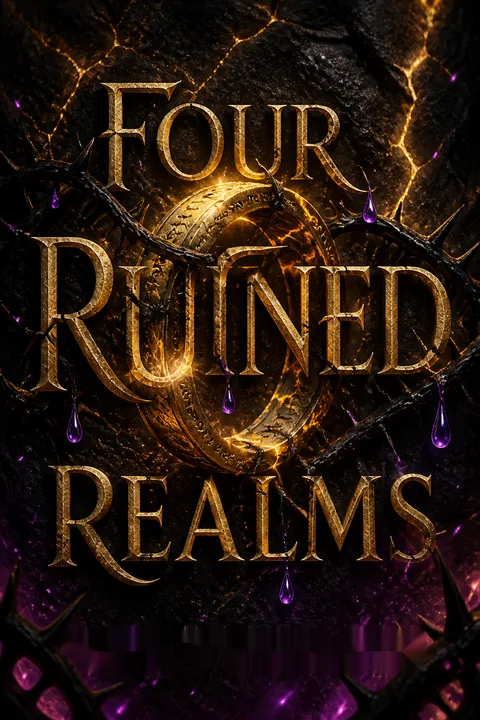
Four Ruined Realms treats political power as a system that recruits private love into public violence. Joon’s threats work because each protagonist has someone vulnerable: Sora has Daysum, Tiyung has Sora, Royo has Hwan, and Mikail has Euyn and the lost possibility of Gaya. Their loyalties are not distractions from the plot; they are the channels through which rulers govern people who cannot be controlled directly. The result is a world where the most intimate decisions, whom to protect, what to conceal, when to forgive, become strategic acts.
The novel is also skeptical of moral purity as a useful standard. Sora poisons people and still tries to spare a guard. Royo has killed for money yet understands the cost of injustice. Euyn can risk himself for others without undoing his earlier cruelty. These contradictions matter because redemption is not granted by remorse alone. The characters must act differently while the old consequences remain active, often at terrible cost. Aeri embodies the book’s most difficult tension. She uses concealment to keep herself and others alive, but intimacy requires the very truth she fears will endanger them. Her final separation from Royo is therefore not a misunderstanding easily solved by affection. It is the predictable result of two incompatible definitions of care: protection through secrecy, and trust through disclosure.
The relics literalize the danger of concentrated authority. Their power offers immediate solutions, but each use makes the wielder more valuable to every ambitious ruler. Aeri’s ability to wield multiple relics does not conclude the struggle; it enlarges it. The ending moves the cast to Gaya with new power, unresolved grief, and a political reckoning still ahead. Survival is a beginning, not proof that the world has changed.
Review Summary
People Also Read










Characters
Aeri
Thief with a hidden pastAeri is a clever Yusanian thief whose humor and restless curiosity disguise a long practice of surviving alone. She reads rooms, locks, and people with equal speed, but mistrust is so habitual that she often treats concealment as safer than honesty. Her complicated relationship with her family shapes her view of power: she wants affection from them, yet recognizes the harm their authority causes. Aeri’s bond with Royo challenges her self-sufficiency, while Sora offers a rare experience of being cared for without having to earn it. Her defining tension is between wanting a home and believing that anyone she loves must be protected from the truth.
Royo
Scarred fighter seeking justiceRoyo is a formidable strongman from Umbria, direct in speech and more perceptive than he gives himself credit for. He measures himself by the people he has failed to protect, especially Hwan and the memory of Lora, and often mistakes guilt for responsibility. His loyalty is physical and practical: he guards, carries, fights, and stays when retreat would be easier. Aeri unsettles him because she asks for tenderness from someone who expects to be valued only for his strength. Royo’s suspicion is not cynicism for its own sake; it is a defense against being used again. Beneath it is a persistent capacity for mercy and attachment.
Sora
Poisoner protecting her sisterSora is a trained poisoner whose composure and polished beauty conceal the discipline required to survive indenture and violence. Her strongest loyalty is to Daysum, the sister she has spent years trying to protect, and that devotion can make her both courageous and frighteningly ruthless. Sora believes kindness matters, but she does not confuse goodness with harmlessness; she can choose vengeance and still grieve the people harmed by her choices. Her relationship with Tiyung is complicated by childhood history and unequal power, while her growing care for Aeri gives her another reason to risk herself. She is often the group’s moral center, though never an uncomplicated one.
Mikail
Yusan's former spymasterMikail is an agile strategist who survives by collecting secrets, reading motives, and making himself useful to powerful people. His wit and apparent ease conceal grief, displacement, and a deep fear of being powerless again. He loves Euyn, but he is increasingly unwilling to excuse the prince’s political instincts when they threaten others. Mikail’s moral code is narrower than Sora’s and more demanding than his reputation suggests: he can be ruthless, yet he refuses some acts even when they would be expedient. His search for a future for Gaya gives his private loyalties a political scale, forcing him to decide whether affection can coexist with opposing the person he loves.
Euyn
Banished Yusanian princeEuyn is a skilled hunter and the former crown prince of Yusan, shaped by palace privilege, exile, and an intense desire to reclaim political standing. He can be tender with Mikail and capable of courage, but he also carries the Baejkin conviction that Yusan’s interests justify almost any cost. His history of hunting people for amusement sits uneasily beside his attempts to become a better man. Euyn’s secrecy is often self-protective: he withholds information when he fears it will expose him or complicate his plans. His relationships with Mikail and Sora reveal the distance between loving someone and understanding what one’s choices have done to them.
Tiyung
Count Seok's estranged sonTiyung is a young nobleman raised inside the privileges and cruelties of Count Seok’s household. He has participated in his family’s world, yet he has also tried to counter its worst practices by secretly buying indentures’ freedom. His feelings for Sora are entwined with childhood guilt and a genuine wish to make amends, though remorse cannot erase what he once permitted. In prison, status becomes a thin defense, and his survival depends on patience, honesty, and accepting help. Tiyung’s central struggle is whether a person can become more than the inheritance of a violent family without pretending that the inheritance caused no harm.
Queen Quilimar
Khitan's embattled regentQuilimar rules Khitan as regent for her young son while navigating a court that doubts her authority. She is politically shrewd, formidable in public, and protective of the child whose position anchors her reign. Her past in Yusan leaves her with a fierce understanding of how royal women are traded and underestimated. She has a history with Gambria and a close bond with General Vikal, but neither intimacy nor motherhood makes her politically gentle. Quilimar treats power as something that must be defended continuously, and she is prepared to make severe choices to preserve her position.
King Joon
Yusan's immortal rulerJoon is the God King of Yusan, protected by the Immortal Crown and accustomed to treating people as pieces in a larger design. He can perform paternal warmth when it serves his purposes, which makes his neglect of Aeri especially difficult for her to disentangle. His ambitions reach beyond his own realm, and he regards the lives of common people as expendable beside Yusan’s power. Joon’s authority depends on both supernatural protection and the belief that no one can safely oppose him.
General Vikal
Khitan's military commanderVikal is the disciplined general of Khitan’s armed forces and one of the few people with direct access to Quilimar. She is a practical soldier whose authority rests on demonstrated competence rather than inherited rank. Her relationship with the queen is intimate, but she must balance private devotion with the defense of a fragile government. Vikal is alert to threats and unimpressed by charm or status, making her difficult for Mikail’s group to manipulate.
Count Seok
Sora's former ownerSeok is the powerful Count of Gain and Tiyung’s father. He presents himself with the polish of a courtier while using indenture, threats, and political influence to control the people around him. His hold over Sora and Daysum turns family bonds into instruments of coercion. Seok’s power is not only personal; it is supported by a legal system that gives nobles more credibility than commoners.
Daysum
Sora's beloved younger sisterDaysum is Sora’s younger sister and the person for whom Sora has endured years of poison training and indenture. She is gentle, book-loving, and frequently ill, but she is more than the fragile figure Sora tries to shield. Her relationship with Sora gives the assassin her deepest source of purpose and her most vulnerable point.
Hana, also known as Zahara
Survivor turned royal spyHana is a survivor of the poison school where Sora and other girls were trained for lethal service. As a spy, she is observant, controlled, and willing to use a false identity when it grants her room to act. Her history gives her a particular understanding of the harm inflicted by powerful families, while her loyalty to Sora complicates her service to the crown. She approaches compassion cautiously, testing whether people’s good intentions survive contact with danger.
Fallador
Exiled prince of GayaFallador is an exiled Gayan prince who has built a life in Khitan and serves Mikail as a source of information. Charming and politically perceptive, he understands the comfort and estrangement of living among people who are not his own. His connection to Mikail is shaped by shared childhood loss and a longing for home that neither man expresses easily.
Gambria
Gayan court survivorGambria is Fallador’s cousin, a survivor of Gaya’s destruction, and an independent political actor in Khitan. She is sharp, candid, and protective of the people she loves, though her judgments can be as uncompromising as Mikail’s. Her history with Quilimar gives her access to a relationship the group cannot reach through diplomacy alone. Gambria resists being defined by her royal connections or by the past she shares with others.
Ailor
Mikail's adoptive fatherAilor is a former royal guard who raised Mikail after the destruction of Gaya. He is reserved about his past and carries the weight of choices made during military service. His plain manner offers Tiyung a rare example of a man who can acknowledge wrongdoing without turning it into an excuse. Ailor values practical care over declarations.
Count Bay Chin
Umbria's northern power brokerBay Chin is the Count of Umbria and a political operator with influence over the city’s criminal gangs. He uses patience and money to pursue interests that may remain hidden for years. His involvement in Royo’s history shows how a nobleman can shape a commoner’s life without ever facing the consequences directly.
Chul
Sora's determined fatherChul is Sora and Daysum’s father, a poor village man whose family comes under Count Seok’s control. His decisions are shaped by the need to protect his wife and children in a system where nobles can force compliance.
Luhk
Keeper of the templeLuhk is a priest of knowledge who survives the attack on the temple beneath Lake Cerome. Bound by a vow of silence within its halls, he communicates through gestures and written records. His commitment to preserving knowledge persists despite the danger.
Nayo
Hana's freed brotherNayo is Hana’s brother, once sold as a pleasure indenture and secretly freed by Tiyung. His history connects Tiyung’s private acts of conscience to the people harmed by the Seok family.
Uol
Priest King of WeiUol is the Priest King of Wei, whose authority is reinforced by religious devotion and the Water Scepter’s control over the sea. His presence represents a rival form of sacred political power.
General Salosa
Joon's palace commanderSalosa commands the Yusanian palace guards and carries out the king’s interests beyond the palace walls. His rank gives him access to political schemes that ordinary soldiers would never see.
Ambassador Zeolin
Yusan's self-serving envoyZeolin is Yusan’s ambassador in Khitan, proud of his position and eager to trade proximity to power for personal advancement. His loyalties bend toward whoever can improve his standing.
Prince Omin
A violent Baejkin princeOmin is Joon’s brother, remembered for abusing and killing young girls. His charm and royal status helped conceal the violence he inflicted on people with little power to resist.
Lora
Royo's lost loveLora was the daughter of a merchant and the girl Royo loved. Her death shaped his guilt and his determination to free her father, Hwan.
Plot Devices
Dragon Lord Relics
Power with a priceThe relics are objects of divine power tied to royal blood. The Immortal Crown protects Joon, the Flaming Sword burns, the Golden Ring turns what its wearer intends into gold, and the Water Scepter commands the sea. A separate amulet controls time. Each relic carries risks, and the temple records warn that combining them amplifies their power and can bring a human closer to godhood. Joon’s desire to collect them drives the political crisis, while Aeri and Mikail’s possession of relics makes them targets even after they escape Khitan.
Sands of Time
Escape at a costThe amulet Aeri took from Omin can stop time, letting her cross a room or move someone without being seen. Its use drains her and accelerates her aging, so it is not a limitless escape route. Aeri uses it to get Sora out of the banquet and to take the amarth egg. She keeps the relic secret from Royo, partly because she fears what her family would do to anyone who knew she possessed it. The amulet turns secrecy into both a survival tactic and a source of intimate damage.
Rule of Distance
A palace kept out of reachAfter an earlier assassination attempt, Khitan’s royal court enforces a hundred-foot boundary around the throne. The group cannot simply request an audience or get close enough for Sora to poison Quilimar. Records in the Temple of Knowledge reveal two exceptions, each requiring a dangerous offering: an amarth egg or Staraheli’s head. The rule transforms access into the story’s immediate objective, while the exceptions force the team into separate expeditions and test the limits of their skills and trust.
Indenture and Idle Prison
Loved ones as leverageIndenture gives nobles legal control over people who cannot safely refuse them. Seok uses Sora’s and Daysum’s contracts to force Sora into the assassination mission, while Joon imprisons Tiyung to keep the group compliant. The system’s injustice persists even when a contract is forged, because a commoner’s testimony cannot easily defeat a count’s word. Idle Prison extends that power through isolation, spoiled food, and the threat of a concealed execution. These institutions make political choices personal by placing the people the characters love inside the machinery of power.
The Amarth and Dia
Kindness opens a pathThe amarth are enormous, intelligent, humanlike birds whose black egg can earn an audience with Quilimar. Their keeper recognizes Aeri and Royo, warns of war and a choice tied to love, and initially refuses to release the egg. Dia, the tiny owl Aeri rescued and fed in Quu, intervenes at a crucial moment. The amarth spares the pair and takes Dia into its care. This encounter makes an earlier act of tenderness consequential, while its prophecy frames the coming conflict without explaining how the characters should respond.
The Broken Blades Series



About the Author

Download PDF
Download EPUB
.epub digital book format is ideal for reading ebooks on phones, tablets, and e-readers.








