

Key Takeaways
Use the whole birth chart, not a Sun-sign label, to read yourself
The Sun is a starting point. In Woolfolk’s system, your Sun sign is the zodiac sign the Sun occupied at your birth. It sketches individuality, style, and the drive to pursue goals. It can suggest how someone approaches responsibility or relationships, but it is not a complete personality description.
The rest changes the picture. Someone who finds a generic description inaccurate may have a different Moon sign, Ascendant, and planetary placements. Woolfolk presents the full birth chart as a layered portrait, including the houses and relationships between planets. Astrology, in her account, offers clues for self-understanding, not a force that changes life or fixes a person’s character.
The book’s strongest organizing choice is also its most useful caution: a category is not a person. Personality psychology likewise distinguishes broad traits from the ways they vary across situations, roles, and relationships. There is an important limit, however. Astrology descriptions can feel uncannily personal partly because readers notice fitting details and overlook mismatches, a pattern known as the Barnum effect. A productive reading treats each description as a question to test against lived behavior, not as proof that the chart has diagnosed an essence.
Treat Sun, Moon, and Ascendant as distinct layers, not competing identities
Three different signals. The Sun sign describes the chart’s broad expression of individuality. The Moon sign concerns instinctive reactions, emotions, and what feels secure. The Ascendant, also called the Rising sign, is the sign coming up on the eastern horizon at birth; Woolfolk uses it to describe outward demeanor and first impressions. Finding it requires accurate birth time and place.
One chart, not three selves. Oprah Winfrey’s chart combines an Aquarius Sun with a Sagittarius Moon and Sagittarius Ascendant. In the book’s reading, Aquarius emphasizes ideas and public-mindedness, while Sagittarius adds an expansive, exploratory quality. The combination helps explain why a single Sun-sign summary cannot represent every part of a person, even within astrology’s own framework.
The three-layer model resembles a useful distinction in social psychology: a person’s enduring self-concept, emotional responses, and public presentation do not always match. That distinction can help readers notice when they act differently in private and public without labeling one version false. The chart’s precision should not be confused with demonstrated predictive accuracy, though. Exact birth time makes an Ascendant calculation more specific within the system, but specificity alone does not establish that the interpretation is objectively true.
Combine element and quality to see how each sign behaves
Two organizing lenses. Woolfolk groups signs by element and quality. Elements describe a broad temperament: fire is energetic, earth practical, air intellectual and communicative, and water emotional and intuitive. Qualities describe how a sign engages with change: cardinal signs initiate, fixed signs persist, and mutable signs adapt. Each sign combines one element with one quality, producing a distinct blend.
Opposites add context. The zodiac also pairs signs as polarities, such as Aries and Libra, which the book frames around self and partnership. Aries and Leo both combine fire with a masculine duality, but Aries is cardinal while Leo is fixed, so the system distinguishes initiation from persistence. These classifications offer a quick way to compare signs without treating every member of one sign as identical.
The framework’s appeal lies in compression: a few categories make a complicated chart easier to scan and remember. That is a familiar strength of typologies, from classical temperaments to modern personality inventories. The difference is that contemporary research generally measures traits along continua and evaluates whether scores reliably predict behavior. Astrology’s categories are better treated as interpretive prompts than validated measurements. Their value depends on whether they help a reader describe real patterns more accurately, rather than simply sort people into memorable boxes.
Let each planet name a different drive in the personality
Planets divide the work. Woolfolk assigns each planet a distinct psychological role. The Sun signifies vitality and individuality; the Moon, emotion and instinct; Mercury, thought and communication; Venus, affection and pleasure; and Mars, energy and assertion. Jupiter is associated with expansion and opportunity, while Saturn represents responsibility and limits.
Outer planets widen the lens. Uranus signifies change and originality, Neptune imagination and spirituality, and Pluto transformation. Astrology counts the Sun and Moon among the planets, though astronomy calls them luminaries. A chart’s interpretation depends on how these influences combine with signs and houses. For example, Venus describes a different part of personality from Mars: one concerns relating and enjoyment, the other desire and action.
Dividing a person into motives, emotions, communication, attachment, and ambition offers a practical vocabulary for reflection. It also echoes psychological models that distinguish cognition, affect, and motivation. The risk is reifying the labels, as if a planet causes a trait or a difficult placement predicts a fixed fate. A more careful use asks what behavior the symbol brings to mind, then checks that interpretation against actual choices, relationships, and circumstances.
Read houses as life arenas, then locate planets within them
Houses answer where. The twelve houses divide a chart into areas of life. The First concerns self and presentation; the Second, money and possessions; the Third, communication and nearby relationships; the Fourth, home and family; the Fifth, creativity and pleasure; and the Sixth, work and health. The remaining houses cover partnership, shared resources, higher learning, career, friends and aspirations, and private difficulties or retreat.
Placement narrows the reading. Woolfolk also groups houses as angular, succedent, or cadent, describing prominence, stability, or mental activity. In Oprah’s chart, her Sun, Mercury, and Venus appear in the Second House. The book reads that concentration through resources and earning, linking her communication and public appeal to material success. A house does not replace a planet’s meaning. It gives that meaning a setting.
The house system works like a map of life domains, directing attention from abstract personality language toward concrete questions: where does someone invest effort, and what kinds of events matter most? This can make a reading more coherent. Yet broad domains such as money, family, and career contain many possible outcomes. An interpreter can easily retrofit a placement to almost any biography. The best safeguard is to state a reading in advance and examine counterexamples, rather than selecting only life events that confirm it.
Use planetary aspects to spot ease, friction, and concentrated force
Aspects describe relationships. An aspect is the angular distance between planets in a chart. Woolfolk treats some angles as harmonious and others as challenging, with conjunctions especially concentrated. A trine, about 120 degrees, is associated with ease; a sextile, about 60 degrees, with opportunity that still takes effort. A square, about 90 degrees, suggests strain or obstacles, while an opposition, about 180 degrees, highlights tension between competing influences.
Interpret combinations, not verdicts. The book gives examples such as Sun-Jupiter links associated with optimism or excess, depending on the aspect. It presents difficult aspects as possible sources of pressure that can develop persistence, rather than as automatic misfortune. The reader first needs the exact planetary degrees; modern chart software can calculate the aspects and display them alongside the signs and houses.
Aspect interpretation adds interaction to what might otherwise be a list of disconnected symbols. That is a genuine conceptual advance: human behavior often emerges from competing motives, not a single trait. But assigning fixed meanings to angles remains a symbolic model, not an established causal mechanism. Its strongest use is comparative and reflective: identify where a person experiences tension, then ask what concrete situations produce it. The chart can structure that conversation without being mistaken for an independent measurement of the person.
Check cusps and decanates before calling a birthday a simple sign
Birth dates have boundaries. A cusp is the point where a zodiac sign or house begins. Because the Sun enters a new sign at slightly different times from year to year, people born near a sign boundary should check their exact birth date and time rather than rely on a calendar range. Woolfolk’s general rule is that people born close to a boundary may feel traits associated with both signs, though the Sun occupies only one sign at a time.
Decanates add finer divisions. A decanate is one of three roughly ten-degree sections within a sign. Woolfolk assigns each a subruler and a constellation, using these influences to refine the sign’s description. These subdivisions add detail inside the astrological system; they do not replace the full chart, which also depends on the Moon, Ascendant, planets, houses, and aspects.
This emphasis on exact birth data shows how astrology tries to move beyond simple month-based horoscopes. It also illustrates a general principle in measurement: finer divisions can improve internal precision without improving external validity. A detailed map may locate a symbolic boundary accurately while leaving open whether the categories predict personality. Readers can still find the distinctions useful, provided they separate technical precision within the system from evidence that the system describes people reliably.
Compare full charts for relationship dynamics, not just Sun-sign compatibility
Synastry compares two charts. Woolfolk uses this term for examining how one person’s planets relate to another’s. Her method looks beyond Sun signs to the Moon, Ascendant, Venus, Mars, houses, and aspects. For instance, she regards one person’s Moon matching the other’s Sun sign as a promising sign of emotional understanding. Venus and Mars placements help her discuss affection, desire, and sexual chemistry.
Compatibility is not a verdict. The book’s sign-by-sign love chapters describe likely attractions and conflicts, but repeatedly caution that Sun signs alone cannot decide whether two people should date or marry. The full chart supplies more context, and real knowledge of the partner matters. Woolfolk’s advice is to treat astrological patterns as clues about possible dynamics, not as a substitute for seeing how people actually behave together.
Relationship astrology is most constructive when it helps people ask better questions about closeness, autonomy, conflict, and shared goals. Those issues are also central to couples research, where communication patterns and responsiveness matter more than a single personality label. The book’s older chapters often divide men and women into conventional roles, a limitation worth noticing. Attraction and partnership are more varied than those scripts allow, so chart language should clarify a couple’s experience rather than prescribe who must lead or yield.
Use astrological health claims as folklore, never diagnosis or treatment
The book links signs to the body. Its medical astrology chapters associate each sign with anatomical regions, then connect planetary placements to health tendencies, diet, minerals, and erogenous zones. Aries, for example, is linked to the head, while Gemini is linked to the arms, hands, and lungs. The historical section explains that astrology once influenced medical training, but the author also notes that modern Western doctors do not use it to treat illness.
Keep reflection separate from care. Woolfolk presents astrology as a possible aid to awareness, not a way to change life itself. That distinction is especially important in health matters: the book’s dietary and bodily correspondences should not be treated as medical evidence. Symptoms, nutrition, and treatment belong with qualified health professionals and evidence-based care.
The health chapters reveal the difference between a symbolic tradition and clinical medicine. A body map can invite attention to habits or sensations, but it cannot establish that a planet caused a symptom or that a sign requires a particular nutrient. Modern medicine depends on testing, diagnosis, and evidence about outcomes. Respect for astrology’s history therefore does not require accepting its health claims. The safest boundary is clear: use symbols for personal reflection, and rely on clinicians for prevention, diagnosis, and treatment.
Read the Age of Aquarius as a cultural forecast, not settled fact
Astrology has a long history. Woolfolk traces its roots through ancient observations of the sky, Babylonian and Egyptian traditions, Greek system-building, Roman practice, and modern discoveries of Uranus, Neptune, and Pluto. She explains that astrological ages arise from the slow shift of the equinoxes through zodiacal constellations. An Age lasts roughly 2,150 years, while the full cycle through twelve signs takes about 25,800 years.
A forecast reflects its era. The book presents the Age of Aquarius as a transition toward science, communication, humanitarian ideals, and broader cooperation. Astrologers disagree about its exact beginning, and the predictions are interpretations of a cultural symbol, not established astronomical consequences. The framework is useful for seeing how societies project hopes and anxieties onto the sky, while keeping forecast and fact distinct.
The historical narrative shows astrology changing alongside institutions, technology, and religious ideas. Its account of the equinoxes points to a real astronomical phenomenon, while its claims about what an age means for civilization belong to interpretation. That distinction matters: a celestial cycle can be measured, but a prediction of peace or social reform needs independent evidence. The Age of Aquarius can still serve as a revealing cultural metaphor, especially when readers ask which hopes for the future are being attached to it.
Analysis
Woolfolk’s book is best understood as an accessible reference system organized around one central correction: a Sun sign is only one component of a birth chart. The structure steadily expands the reader’s field of view, from twelve sign portraits to Moon signs and Ascendants, then planets, houses, aspects, chart comparison, history, and practical tables. This breadth is the book’s distinctive value. A beginner can move from a newspaper horoscope to a vocabulary for describing several kinds of astrological influence, and the Oprah Winfrey chart demonstrates how the pieces are meant to be synthesized.
The system’s interpretive strength is also its epistemic weakness. Nearly every life outcome can be linked to multiple placements, positive or negative, which makes the reading flexible but difficult to falsify. Confirmation bias and the Barnum effect can make broad descriptions feel uniquely accurate. Controlled research has not established reliable, reproducible evidence that natal charts predict personality or relationship outcomes. Astrology may still function as a narrative prompt, helping readers name experiences, reflect on motives, or begin a conversation, but those uses should not be confused with demonstrated prediction.
The book’s confident treatment of health is the clearest boundary case. Its sign-to-body correspondences and dietary mineral advice are part of an inherited symbolic tradition, not a basis for diagnosis or treatment. The relationship chapters also reflect older gender assumptions, particularly in their divisions between men’s and women’s roles. A modern reading preserves the useful questions about attachment, independence, and conflict while discarding prescriptions that narrow people’s identities.
The result is a substantial cultural guide rather than an empirically validated personality science. Its most durable contribution is the layered chart as a way of organizing reflection. Readers gain the most when they use that structure with curiosity, compare it against lived experience, and keep symbolic meaning distinct from medical or predictive certainty.
Review Summary
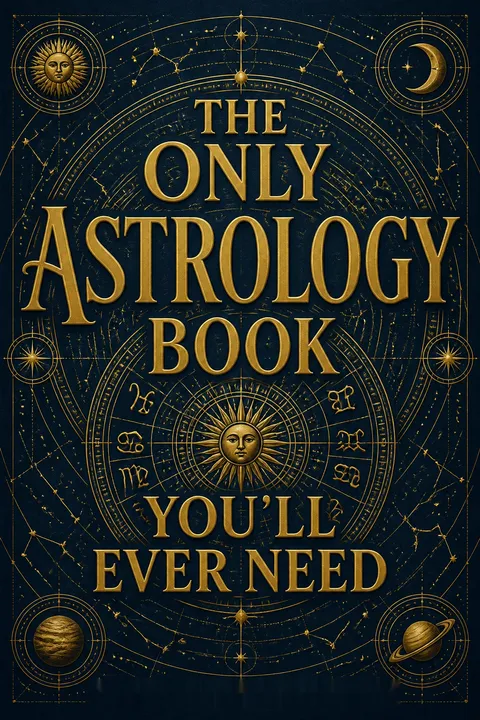
The Only Astrology Book You'll Ever Need receives mostly positive reviews for its comprehensive coverage of astrology basics. Readers praise its in-depth information on sun signs, moon signs, and birth charts. Many find it accurate and user-friendly, particularly for beginners. Some criticize outdated perspectives and tables, while others note its limitations for advanced study. Despite mixed opinions on certain sections, most reviewers agree it's a valuable reference for those interested in astrology, living up to its ambitious title for many readers.
People Also Read
Glossary
Sun sign
Astrological solar placementThe zodiac sign occupied by the Sun at the moment of birth. In Woolfolk’s framework, it describes broad features of individuality, style, and the drive to pursue goals. It is one part of a birth chart, not a complete account of personality; Moon sign, Ascendant, planets, houses, and aspects add further layers.
Moon sign
Emotional response patternThe zodiac sign occupied by the Moon at birth. Woolfolk associates it with emotion, instinct, unconscious reactions, memory, and sensitivity to one’s surroundings. The Moon sign can differ from the Sun sign, adding traits that may be less visible to others. It is an interpretive component of the chart, not a clinical measure.
Ascendant
Eastern horizon signThe zodiac sign rising on the eastern horizon at the exact time and place of birth. Also called the Rising sign, it marks the beginning of the First House and is used to interpret outward demeanor, first impressions, and a person’s approach to new situations. Its calculation depends on accurate birth information.
Elements
Four sign temperamentsThe four groups used to classify zodiac signs: fire, earth, air, and water. Woolfolk associates fire with energy and enthusiasm, earth with practicality and stability, air with intellect and communication, and water with emotion and intuition. Each sign belongs to one element, which combines with its quality to distinguish its style.
Qualities
Three modes of actionThe three classifications of zodiac signs: cardinal, fixed, and mutable. Cardinal signs are associated with initiative and action, fixed signs with persistence and resistance to change, and mutable signs with adaptability. Each sign has one quality. Combined with the element, the quality helps astrologers describe how a sign engages with its surroundings.
Houses
Life areas in a chartThe twelve divisions of a birth chart, each associated with a different area of life. They include self, resources, communication, home, creativity, work and health, partnership, shared resources, higher learning, career, friends and aspirations, and private or hidden matters. A planet’s house is interpreted as the life arena where its symbolism operates.
Aspects
Angles between planetsThe angular relationships between planets in a horoscope. Major aspects include conjunctions, trines, sextiles, squares, and oppositions. Traditional interpretations associate them with concentrated influence, ease, opportunity, tension, or challenge. The aspect’s meaning depends on which planets form it and how it fits with the rest of the chart.
Decanate
Ten-degree sign subdivisionOne of three subdivisions within each zodiac sign, each covering about ten degrees of the zodiac and roughly ten days of the Sun’s passage. Woolfolk assigns each decanate a subruler and a constellation, using them to refine the traits associated with the broader sign. Decanate interpretations supplement, rather than replace, the full chart.
Synastry
Comparison of birth chartsThe comparison of two people’s birth charts to examine possible compatibility and relationship dynamics. The method considers how planets in one chart relate by aspect to planets in the other, along with signs, Ascendants, and houses. In Woolfolk’s approach, it broadens relationship interpretation beyond comparing Sun signs alone.
Precession of the Equinoxes
Slow shift of equinox positionsThe gradual change in the direction of Earth’s rotational axis, which slowly shifts the positions of the equinoxes against the background constellations. Astrologers use this long cycle to describe astrological ages, each associated with a zodiacal sign. The astronomical shift is observable; cultural meanings assigned to each age are interpretations.
Age, Astrological
Roughly 2,150-year eraA period of about 2,150 years associated with the sign of the constellation through which an equinox gradually moves. Woolfolk links each age to broad cultural themes and describes a transition from Pisces to Aquarius. Astrologers differ about the precise beginning of an age, and forecasts tied to it are symbolic claims rather than settled facts.
FAQ
1. What is [The Only Astrology Book You'll Ever Need] by Joanna Martine Woolfolk about?
- Comprehensive astrology resource: The book is a thorough guide to astrology, covering Sun signs, Moon signs, Ascendants, planets, houses, aspects, and chart interpretation.
- Practical tools and tables: It includes detailed tables for planetary positions, moon phases, and ascendants, as well as practical methods for casting and interpreting birth charts.
- Historical and cultural context: Woolfolk explores astrology’s history, its role in various cultures, and its mythological and astronomical connections.
- Application to life: Readers learn how to use astrology for self-understanding, relationship insights, health, and career guidance.
2. Why should I read [The Only Astrology Book You'll Ever Need] by Joanna Martine Woolfolk?
- Authoritative and accessible: Woolfolk’s book is known for making complex astrology concepts understandable for both beginners and advanced readers.
- All-in-one reference: It covers a wide range of topics, from basic zodiac sign traits to advanced chart interpretation, making it a single resource for most astrology needs.
- Practical chart-casting tools: The book provides unique tables and shortcut methods for finding your Ascendant and planetary positions, enhancing hands-on learning.
- Holistic perspective: It integrates astrology with mythology, history, and psychology, offering a well-rounded approach to understanding yourself and others.
3. What are the key takeaways from [The Only Astrology Book You'll Ever Need] by Joanna Martine Woolfolk?
- Astrology is multi-layered: True understanding comes from looking beyond Sun signs to include Moon signs, Ascendants, planets, houses, and aspects.
- Personalized insights: The book emphasizes casting and interpreting your own birth chart for tailored self-knowledge and life guidance.
- Practical application: Astrology can be used to understand relationships, health tendencies, career paths, and emotional needs.
- Historical depth: Woolfolk provides context on astrology’s evolution, showing its relevance across cultures and eras.
4. How does [The Only Astrology Book You'll Ever Need] by Joanna Martine Woolfolk explain Sun signs and their importance?
- Definition and influence: The Sun sign is determined by the Sun’s position at your birth and is the most powerful influence in your horoscope, shaping your core personality and life drive.
- Role in self-expression: It represents your individuality, general character, and how others perceive you.
- Limitations: Woolfolk stresses that Sun sign descriptions are only part of the picture; full understanding requires considering other chart factors.
- Further refinement: The book introduces decanates and cusps to explain why people with the same Sun sign can differ significantly.
5. What are decanates and cusps in Sun signs according to [The Only Astrology Book You'll Ever Need] by Joanna Martine Woolfolk?
- Decanates defined: Each Sun sign is divided into three decanates, each about ten days long, with its own planetary subruler and constellation, adding nuance to personality traits.
- Cusps explained: Being born on a cusp (within about five days of a sign change) means you may exhibit traits of both neighboring signs, though the actual Sun sign is dominant.
- Practical advice: Woolfolk recommends using Sun Tables or casting a chart to determine your exact Sun sign if born on a cusp.
- Individual differences: These concepts help explain the diversity within each zodiac sign.
6. How does [The Only Astrology Book You'll Ever Need] by Joanna Martine Woolfolk describe Moon signs and their significance?
- Emotional and instinctive self: The Moon sign governs your emotional needs, instincts, and subconscious reactions, often hidden from others.
- Contrast with Sun sign: While the Sun sign is your outward, conscious self, the Moon sign reveals your inner world and emotional responses.
- Relationship impact: Understanding your Moon sign helps explain your moods, relationship needs, and deeper motivations.
- Chart depth: Woolfolk emphasizes that knowing your Moon sign adds crucial depth to self-understanding.
7. What is the role of the Ascendant (Rising sign) in [The Only Astrology Book You'll Ever Need] by Joanna Martine Woolfolk?
- First impression and demeanor: The Ascendant is the sign rising on the eastern horizon at your birth, shaping your outward personality and how others see you.
- Physical traits and coping style: It influences your appearance, mannerisms, and approach to new situations.
- Blending with Sun sign: The combination of Sun, Moon, and Ascendant creates your unique personality profile.
- Finding your Ascendant: The book provides tables and shortcut methods for determining your Rising sign.
8. How does [The Only Astrology Book You'll Ever Need] by Joanna Martine Woolfolk explain the qualities and elements of zodiac signs?
- Qualities defined: Signs are grouped into cardinal (initiators), fixed (stabilizers), and mutable (adapters), each representing a mode of expression.
- Elements described: The four elements—fire (passionate), earth (practical), air (intellectual), and water (emotional)—define the temperament of each sign.
- Sign examples: Woolfolk provides clear examples, such as Aries (cardinal fire) and Taurus (fixed earth), to illustrate these groupings.
- Personality insights: Understanding your sign’s quality and element helps clarify your strengths, challenges, and interaction style.
9. What are the astrological houses and their significance in [The Only Astrology Book You'll Ever Need] by Joanna Martine Woolfolk?
- Twelve life areas: Each house represents a specific area of life, such as self, money, communication, home, creativity, health, relationships, transformation, travel, career, friendships, and secrets.
- House groupings: Houses are categorized as Angular, Succedent, or Cadent, each with distinct energies and importance.
- Rulership and interpretation: Every house is ruled by a zodiac sign and planets, influencing how planetary energies manifest in your life.
- Chart analysis: Understanding house placements is essential for detailed horoscope interpretation.
10. How does [The Only Astrology Book You'll Ever Need] by Joanna Martine Woolfolk address planetary influences and aspects?
- Planetary roles: Each planet governs specific personality traits and life areas, such as Mercury for communication and Venus for love.
- Aspects explained: Aspects are the angular relationships between planets, indicating harmony or tension and shaping personality dynamics.
- Major and minor aspects: The book details conjunctions, trines, sextiles, oppositions, squares, and minor aspects, explaining their meanings and influence.
- Practical use: Aspects are used in both personal chart interpretation and relationship analysis (synastry).
11. What practical methods and tools does [The Only Astrology Book You'll Ever Need] by Joanna Martine Woolfolk provide for casting and interpreting charts?
- Extensive tables: The book includes Sun, Moon, Ascendant, and planetary tables from 1900 to 2100 for accurate chart calculation.
- Shortcut methods: Woolfolk offers simplified techniques for approximating your Ascendant and planetary positions without complex math.
- CD-ROM and digital tools: Earlier editions include a CD-ROM for quick chart casting; readers are encouraged to use these for precision.
- Step-by-step guidance: The book walks readers through listing planets, signs, and houses, then synthesizing the information for a full personality profile.
12. How does [The Only Astrology Book You'll Ever Need] by Joanna Martine Woolfolk explore relationship compatibility and synastry?
- Synastry defined: The book explains how to compare two birth charts to assess compatibility and relationship dynamics.
- Key factors: It highlights the importance of Sun, Moon, Ascendant, Venus, and Mars placements in understanding attraction and emotional connection.
- Positive and challenging aspects: Woolfolk details which planetary aspects indicate harmony or tension between partners.
- Practical advice: Readers learn how to use synastry for evaluating romantic, friendship, and family relationships.
Download PDF
Download EPUB
.epub digital book format is ideal for reading ebooks on phones, tablets, and e-readers.








