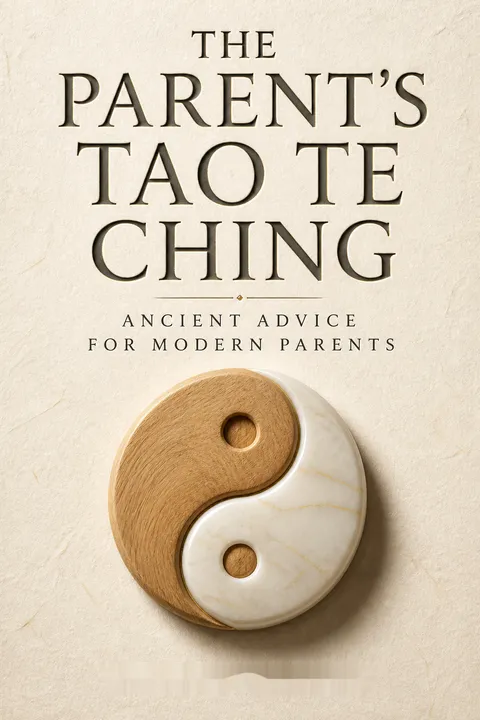


Key Takeaways
Treat parenting as accompaniment, not authorship of another person's life.
Care without ownership. Martin adapts ideas from the Tao Te Ching, an ancient work of Chinese philosophy, into brief reflections for parents. Its central idea is the Tao, or the Way: the mysterious order through which life unfolds, which cannot be fully captured in rules or words. A parent can nurture a child, but cannot design that child's nature or future. The work asks parents to shift from controlling outcomes to being attentive companions as children grow.
Guide, then make room. Martin compares good care to water nourishing what it touches without demanding a particular shape. This is not a call to abandon responsibility. It is a reminder that protection and guidance need not become possession, and that love can remain steady even when a child chooses differently than a parent hoped.
What's striking is how this view challenges the quiet assumption that parental effort should produce a particular kind of child. It treats the child as a person with an inner life, not a project whose results certify the parent's worth. That shift can ease pressure on both sides. Yet the metaphor of natural unfolding cannot, by itself, tell a parent when to step in. Care still requires judgment, especially where safety, health, or a child's limited capacity is involved. The useful principle is not to withdraw, but to distinguish support from control.
Trade lectures for a model your child can actually observe.
Children notice conduct. Martin argues that parents teach less through speeches than through the way they live. A child sees whether a parent enjoys ordinary pleasures, handles a mistake honestly, and treats other people with care. The book urges parents to show their own sadness or anger appropriately, rather than pretending difficult feelings do not exist. That gives children a visible example of having emotions without making those emotions frightening or shameful.
Let imperfection teach. The parent's failures can also be useful, provided they are faced rather than hidden. A parent who admits an error and tries to repair it demonstrates how to take responsibility. Martin's standard is demanding in a practical way: the lesson is not to perform virtue, but to make everyday actions consistent with what the parent hopes the child will learn.
This is a social-learning account of parenting: children absorb patterns by watching how adults behave, not only by hearing what adults endorse. It also turns self-improvement into a family practice. A parent's apology, for instance, can show that authority and accountability are compatible. The important qualification is that children should not become an audience for every adult feeling. Honest modeling means expressing emotions with care, not asking a child to comfort the parent or manage the parent's distress.
Correct dangerous behavior without turning it into a verdict on character.
Separate the act from the child. Martin asks parents to notice behavior without making it the whole story of who a child is. Labels such as good, bad, success, or failure can make ordinary differences look like moral rankings. When a child acts in a way that worries a parent, the book recommends looking for the need or feeling beneath the behavior before deciding how to respond.
Protect without shaming. This approach does not require ignoring harmful conduct. Martin explicitly distinguishes addressing a dangerous act from attacking the child. A parent can set a limit, explain the risk, and protect others while continuing to treat the child with respect. The aim is to preserve the relationship and the child's dignity while making clear that some actions cannot continue.
The distinction between behavior and identity offers a useful middle ground between permissiveness and condemnation. It leaves room for accountability while resisting the idea that one mistake defines a person. This can also help parents respond to the actual problem rather than escalating a conflict over disrespect or status. The harder question is how to read the behavior accurately: a generous interpretation should prompt curiosity, not excuse repeated harm. Compassion works best when paired with clear, proportionate limits.
Let children meet manageable failure before rushing in to rescue them.
Mistakes can build judgment. Martin argues that constant correction and protection can prevent children from learning responsibility. He recalls his father monitoring each task to ensure it was done properly; Martin says he did not truly learn responsibility until he experienced the results of doing something incorrectly. The lesson is not to manufacture failure, but to resist stepping in whenever a child might struggle.
Keep the risk proportionate. When a mistake is reversible and safe, a parent can stay nearby, let the child experience its consequences, and offer another chance to act responsibly. Martin sees this as a way for children to discover that failure is survivable. That confidence is difficult to build if adults remove every obstacle or treat each setback as proof that the child cannot cope.
The book's emphasis on experience makes responsibility something practiced, not merely demanded. It also challenges a common parental impulse: preventing discomfort can feel like care even when it blocks learning. The key distinction is between manageable consequences and serious danger. A child should not have to incur lasting harm to learn a lesson. Parental restraint is valuable when it gives a child room to act while preserving a safety net, rather than treating every risk as either harmless or catastrophic.
Let contentment, not achievement pressure, shape your family's climate.
Don't make worth a contest. Martin warns against measuring children against celebrity, athletic, or academic ideals and against treating acquisition as a route to lasting happiness. He argues that relentless pressure to achieve can teach children to chase approval rather than discover what genuinely interests them. Instead, parents can notice the activities that bring a child sustained joy and encourage patience, curiosity, and effort without making status the prize.
Show what enough feels like. The parent has a role in this lesson. Martin recommends finding real pleasure in simple experiences, from eating ordinary food to sharing time without a performance attached. He also points to advertising and social pressure as forces that keep people wanting more. His alternative is not to condemn achievement, but to stop treating achievement as the condition for being satisfied or loved.
This argument is strongest when read as a warning against making love contingent on performance. It gives parents a way to resist comparison culture without having to reject a child's ambition. Contentment and aspiration can coexist: a child may work hard while knowing that a result does not determine personal worth. The practical test is whether a family's praise makes room for the child's own interests, or mainly rewards outcomes that reflect the parent's hopes.
Protect unhurried space where curiosity can outrun the schedule.
Attention needs breathing room. Martin worries that constant entertainment, gadgets, activities, and noise can crowd out a child's ability to notice what is already nearby. He describes children becoming absorbed in small details that adults might overlook, while adults often hurry mentally toward the next task. The parent can learn by slowing down, following the child's attention, and letting curiosity set the pace for a while.
Leave some time unclaimed. The book recommends quiet walks, simple games, reading, daydreaming, and play without a fixed purpose. These are not presented as productivity tools. They give children space to explore their own interests and give parents a chance to be present rather than constantly instructing or arranging. Martin also asks parents to quiet their own crowded lives before expecting children to welcome calm.
This section treats attention as something shaped by the conditions of daily life. A child who can linger over an ordinary sight is not necessarily wasting time; the child may be practicing observation and self-directed interest. The idea also applies to adults, whose distraction can quietly set the household's tempo. Still, quiet should not become another parental ideal imposed on every child. The point is to make room for varied forms of attention, not to demand that children enjoy stillness on command.
Hold firm on safety without turning disagreement into a contest.
Yield without surrendering guidance. Martin uses the image of martial arts, especially T'ai Chi Ch'uan, to describe responding to opposition with flexibility rather than force. A parent can keep a clear position while avoiding a battle designed to prove who is stronger. In practice, that means listening, lowering the temperature, and choosing words that guide rather than humiliate.
Know when to intervene. The book rejects winning and losing as the organizing logic of family life, but it does not say children should always get their way. Martin says parents may need to impose their will for safety, particularly when children are young. The distinction is between a limit that protects a child and a power struggle that serves the parent's pride. Firmness can remain calm, specific, and proportionate.
The image of yielding offers a valuable alternative to escalation: flexibility can preserve influence when force would produce resistance or fear. It also reminds parents that authority need not be theatrical. But a peaceful tone is not a substitute for a clear boundary, and not every conflict can be dissolved through calm conversation. The strongest reading combines de-escalation with decisive action when safety requires it. A parent can refuse a fight while still making a difficult decision.
Parent from your own center, not from fear or borrowed ambition.
Don't ask a child to complete you. Martin warns that parents can load children with the job of making adult life meaningful, proving the parent's success, or fulfilling ambitions the parent did not achieve. That burden can turn care into pressure. He encourages parents to live their own lives with attention and purpose, so they can meet a child's struggles without treating them as a verdict on the parent's identity.
Face what cannot be controlled. Martin recounts that his teenage son nearly died. He remembers accepting that the boy might not survive, grieving, and then returning to the rest of his life and relationships. The story is not offered as a technique for preventing danger. It illustrates the book's larger counsel: love deeply, act where possible, and recognize that a parent's control has limits.
The account of the son's near-death gives emotional weight to the book's spiritual language. Letting go here is not indifference; it is an attempt to keep fear from consuming the parent when outcomes cannot be guaranteed. That distinction matters because reassurance about life's larger order can comfort some families but cannot replace practical care, medical attention, or help from others. The grounded application is to respond to real needs while refusing to confuse vigilance with control over every future event.
Learn from children, then let them leave with their own lives.
Make the relationship reciprocal. Martin says children can teach adults to attend closely, play freely, move between interests, and release what has passed. A parent who listens rather than assuming every exchange must be a lesson may discover how much a child notices and understands. This does not reverse the roles of parent and child; it asks the adult to remain teachable.
Prepare for separation through respect. The book treats growing up and leaving home as part of the child's own journey, not a betrayal of the family. If parents have encouraged confidence, simple pleasures, and independence, they can miss their children without needing to keep them close. Martin's image of family life is therefore not permanent togetherness, but a bond that can remain meaningful as lives change.
The reciprocal emphasis prevents parenting from becoming a one-way project of correction. A parent who learns from a child models humility and signals that the child's perspective matters. At the same time, children should not be made responsible for teaching, inspiring, or emotionally sustaining adults. Their freedom depends on the adult retaining the adult role. The book's account of separation is most persuasive when understood as secure connection without ownership, rather than an expectation that parents feel no grief when a child leaves.
Analysis
The book is a sequence of 81 short meditations, not a step-by-step parenting manual. Its repetition is part of its method: again and again, Martin redirects attention from managing the child to examining the parent. The Tao is presented as an underlying way life unfolds, and parenting becomes a practice of seeing clearly, responding gently, and accepting that a child remains partly unknowable. That framing makes the book less about techniques than about the adult's stance.
Its most durable insight is that a parent's behavior is both influence and limitation. Children are affected by what adults model, but they are not products adults can manufacture. This guards against perfectionism and the urge to treat a child's outcome as a score for parental success. It also gives practical coherence to the book's counsel on failure, conflict, achievement, and independence: reduce needless interference, while remaining available and responsible.
The central tension is between trust and intervention. Martin sometimes describes children's goodness and life's unfolding in sweeping spiritual terms. These ideas can loosen fear, but they are not reliable rules for deciding when to intervene. A child's risk, age, needs, and circumstances matter. Read literally, noninterference could excuse neglect or leave serious problems unaddressed. Read more carefully, the book argues against intervention driven by anxiety, vanity, or control, not against protection and guidance.
The book also resists the assumption that more activity, instruction, or achievement necessarily means better development. Its alternative is not a rigid program of quiet simplicity, but more room for ordinary experience, curiosity, and self-direction. The strongest way to use these reflections is as questions rather than commandments: Is this limit protecting the child, or protecting parental pride? Is this activity serving the child's interest, or the parent's anxiety? In that form, the Tao becomes a discipline of attention, not an excuse to stop thinking.
Review Summary
The Parent's Tao Te Ching receives high praise for its wisdom and peaceful approach to parenting. Readers appreciate its focus on simplicity, presence, and letting children develop naturally. The book encourages parents to model desired behavior, avoid controlling their children, and find joy in ordinary moments. While some find it overly hands-off or New Age-oriented, many consider it a valuable resource for reflection and maintaining perspective in parenting. The poetic, bite-sized entries make it easy to revisit regularly for guidance and centering.
People Also Read
Glossary
Tao
The Way of lifeIn Martin's use, the Tao is the mysterious underlying way through which life and nature unfold. It is not a fixed rulebook or a concept that can be fully defined. The book uses it to encourage parents to observe, nurture, and respond without assuming they can control a child's nature or future.
natural spirituality
Wonder grounded in experienceMartin uses natural spirituality to describe a sense of the sacred that grows from directly noticing life and its wonders, rather than relying chiefly on prescribed beliefs or religious instruction. He encourages parents to share experiences of awe and attention, trusting that a child's spiritual understanding can develop through encounter with the world.
Download PDF
Download EPUB
.epub digital book format is ideal for reading ebooks on phones, tablets, and e-readers.








