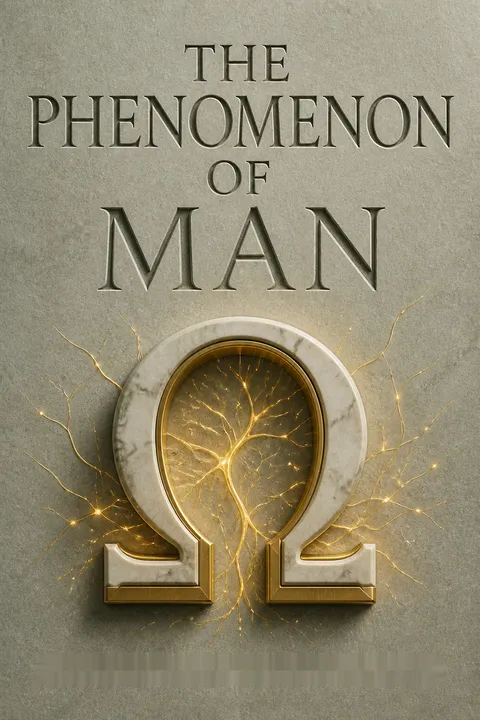


Key Takeaways
Trace the universe from matter, through life, to reflective human thought
One unfolding story. Teilhard asks readers to view humanity not as an isolated creature, but as a phase in a single evolutionary process. The book follows that process from matter, to living organisms, to beings capable of reflection, then asks what direction this new human phase might take. Its title signals the method: study humanity as a phenomenon within nature, rather than explaining it away as an exception or treating it only as a theological mystery.
A changed vantage point. Humans observe the universe from within it, and their knowledge changes what they can do in it. Teilhard therefore treats thought and social life as part of the world’s history, not commentary added from outside. His central claim is that evolution’s story becomes visible in human consciousness.
What's distinctive is the refusal to split natural history from human history. This resembles systems thinking, where a system's observer is also one of its components, and knowledge can alter the system being studied. That perspective is useful for climate science, technology, and public health, where human choices are causal forces, not external commentary. The risk is that making humanity evolution's apparent summit can slip into anthropocentrism. Teilhard's strongest version avoids simple human supremacy: it treats people as responsible participants in a larger process, not owners of the universe.
Treat complexity and consciousness as linked dimensions, not separate worlds
Inside and outside. Teilhard calls the measurable, observable aspect of things their “without,” and their inward aspect their “within.” Conscious experience is undeniable in humans, he argues, so it should not be treated as a freak exception unrelated to the rest of nature. He proposes that some rudimentary interiority accompanies matter throughout the universe, becoming more pronounced as material organization grows more complex.
A proposed pattern. In living things, greater organization often accompanies more elaborate nervous systems and richer behavior. Teilhard extends that observed relationship into a broad “law of complexity and consciousness.” The claim is not that atoms think like people, but that human consciousness has roots in a much longer history of organization. This extrapolation is central to his vision, but exceeds what observation alone can establish.
The proposal anticipates a live philosophical problem: how subjective experience relates to physical organization. Neuroscience links changes in brain organization with changes in cognition, while open-system science shows how complex structures can form while releasing energy into their surroundings. Those connections make Teilhard's intuition worth examining, not proven. The move from conscious animals to an interior aspect in all matter remains speculative; a correlation between complexity and consciousness does not by itself show that consciousness is a universal property. The distinction between a suggestive organizing idea and a demonstrated scientific law matters.
Expect evolutionary thresholds: continuity can produce genuine changes of kind
Gradual preparation, sharp transition. Teilhard sees evolution as continuous overall, yet punctuated by thresholds at which organization takes on a new character. The emergence of cells from complex pre-living chemistry is one example in his account; reflective thought is another. He argues that life’s beginnings are difficult to observe because they occurred in the remote past and at microscopic scales, but their obscurity does not make the transitions unreal.
A useful distinction. He calls this pattern continuity with discontinuity: a long buildup can culminate in a qualitative change. Reflection, for example, is not merely more animal learning. It is the ability to turn awareness back upon itself, to know that one knows. His model makes room for both gradual evolutionary preparation and consequential change.
Threshold models are powerful because they explain why a small quantitative shift can reorganize a system: water changes state, and accumulated social coordination can produce institutions no individual planned. The analogy helps clarify Teilhard's argument, but it does not establish that biological transitions follow the same mechanism as physical phase changes. Modern accounts of life's origin remain unresolved in detail, and the first reflective hominins cannot be cleanly separated by one observable instant. The framework is best used to ask what new capacities emerge, rather than to assume every transition has a single precise boundary.
Read life's history as branching experiments, not a ladder of winners
A branching tree. Life does not advance as a straight line toward humanity. It proliferates into many forms, some of which flourish, specialize, or disappear. Teilhard uses the image of a tree whose early branches are hard to see: fossils preserve only fragments, while fragile beginnings are especially likely to vanish. The surviving forms can therefore look more isolated and fully formed than they were.
Direction without a simple ranking. Teilhard finds a broad rise in nervous-system development along some lineages, especially among vertebrates and primates. He interprets this as a trend toward greater consciousness, not proof that every species is “better” than another. In his account, insects and mammals represent different evolutionary solutions, and specialization can both enable success and limit future flexibility.
This is a helpful antidote to the popular picture of evolution as a staircase with humans at the top. Evolutionary biology instead emphasizes branching descent, contingency, extinction, and adaptation to particular environments. Teilhard's attention to fossil gaps also captures a real problem of historical inference: absence of evidence can reflect preservation, not absence of a transitional population. His proposed universal direction toward consciousness is much more debatable. Evolutionary change can produce greater complexity in some contexts, but it can also favor simplification when simpler forms succeed.
Use reflection to turn evolution from an inherited process into a human responsibility
The reflective threshold. For Teilhard, reflection is more than intelligence or problem-solving. It is awareness able to recognize itself as awareness. That capacity opens new domains of abstraction, deliberate choice, invention, art, and shared learning. Human anatomy may differ only modestly from that of other primates, but the ability to build cumulative culture changes the scale and speed of human influence.
A new medium of change. Teilhard argues that human development increasingly proceeds through teaching, tradition, and collective memory, not only through bodily inheritance. Tools and ideas can be passed between people and generations, then adapted deliberately. This gives humans some power to guide their development, while also making them answerable for the consequences. Evolution is no longer simply something that happens to the species; reflective beings can participate in shaping its conditions.
The distinction between biological inheritance and cultural transmission is crucial. Writing, education, and institutions allow knowledge to accumulate faster than genetic change, while also making collective choices consequential across generations. Contemporary debates about artificial intelligence and biotechnology sharpen Teilhard's point: new capacities bring responsibility as well as power. But conscious control is never total. Culture can preserve errors, and planned interventions can create harms that were not anticipated. Human agency should therefore mean accountable, revisable stewardship, not the fantasy that society can engineer evolution without uncertainty.
Build planetary unity that deepens persons instead of standardising them
The noosphere. Teilhard names the “noosphere” the sphere of human thought and its interconnections, layered over the earth's living systems. He sees its growth in the long movement from scattered communities toward denser exchange: settled agriculture, civilizations, transport, and communications. As people and ideas encounter one another more often, humanity becomes increasingly interdependent.
Connection has two outcomes. Teilhard expects this planetary linking to enable a more coordinated collective intelligence, but he warns that organization can also become mechanical. A society that merely packs people together, standardizes them, or suppresses difference is not the unity he seeks. For him, genuine convergence must bring distinct people into meaningful relation while preserving their individuality. The goal is not sameness, but a shared world capable of learning and acting together.
The noosphere is a striking precursor to thinking about humanity as a network whose shared knowledge can exceed any one person's. Digital communication makes the intuition vivid, but connection is not the same as understanding: networks can spread insight, misinformation, solidarity, and hostility alike. Teilhard's insistence that unity preserve difference offers a useful democratic test. Does coordination increase people's capacity to think and act, or make them more interchangeable and controllable? That question keeps planetary integration from being mistaken for progress simply because it is large or technologically advanced.
Use love to make cooperation intimate, not merely efficient
A force of relation. Teilhard treats love as more than private affection. He describes it as the inward attraction that can join beings without reducing them to parts in a machine. Biological association, family bonds, and social cooperation show different forms of connection; human love, he argues, can bring these relationships into reflective awareness and extend their reach.
Beyond utility. Contracts and shared material interests can organize cooperation, but they may leave people emotionally separate. Teilhard argues that love is different because it joins people at the level of personal concern. His larger hope is that the capacity for intimate attachment can widen beyond family or group loyalty toward solidarity with humanity. That is a demanding ideal, not a claim that affection alone can replace institutions, justice, or practical cooperation.
The contrast between transactional coordination and mutual recognition connects with research traditions in social psychology and political theory: people cooperate more durably when they experience trust, belonging, and reciprocal concern, not only incentives. Teilhard pushes this insight toward universal scope, where the difficulty becomes obvious. Human empathy is often strongest for nearby or familiar people, and group identity can foster exclusion. Universal care therefore needs cultural practices and fair institutions to sustain it. Love may supply motivation, but it cannot by itself determine how scarce resources or competing claims should be resolved.
Make progress credible by giving human effort a future beyond extinction
The problem of purpose. Once people understand that they are participants in an immense evolutionary history, Teilhard says, they also ask whether that history has a future worth serving. If human effort ends in total annihilation, he argues, the demand for meaningful progress becomes difficult to sustain. He calls the hoped-for culmination the “Omega Point,” a final center of convergence that gives the evolution of consciousness direction and permanence.
Progress has a cost. Teilhard does not portray evolution as a painless ascent. His account includes failed experiments, suffering, death, anxiety, and the destructive consequences of chance. He treats these as structural costs of a world that develops through trial, not as proof that growth is unreal. His response is a wager of confidence in an enduring future, rather than an empirical guarantee that humanity will succeed.
Teilhard identifies a psychological and political truth: people are unlikely to sustain difficult collective work if they see no plausible purpose in it. Yet motivation does not prove that history has a guaranteed destination. Secular accounts can ground responsibility in the lives of present and future people without promising immortality, while religious hope can offer a deeper answer to loss. The important distinction is between hope as a practical commitment and certainty as a factual claim. Treating the former as necessary may be fruitful; presenting the latter as scientific evidence would overstate the case.
Study humanity as evolution's active agent, not merely its specimen
Research as a human task. Teilhard argues that science should be more than a tool for industry or military advantage. It is a central expression of humanity's capacity to understand and reshape its conditions. Because human beings are both observers and products of evolution, he calls for serious study of the human body, mind, societies, and shared systems of knowledge.
Knowledge needs direction. He imagines research becoming more coordinated and focused on humanity itself, including the ways people organize resources, populations, and technology. This vision makes self-knowledge practical: decisions about health, education, and social organization shape the future of human life. But Teilhard's own language about guiding human development can support dangerous policies if detached from individual rights. Studying humanity should increase care and understanding, not authorize coercive control.
The call to treat human systems as objects of rigorous study remains valuable, especially when technology changes faster than institutions can respond. Interdisciplinary research can reveal feedback loops that narrow specialties miss. The ethical tension is equally important: Teilhard's interest in managing biological and social development includes language about eugenics, a history associated with coercion and abuse. Modern human science needs consent, pluralism, and protections against discrimination. The better lesson is not to optimize populations from above, but to make collective decisions informed by evidence and accountable to the people affected.
Read Omega as unity that preserves persons rather than dissolving them
A personal center. Teilhard's Omega Point is not simply a future collective formed by adding together human achievements. He proposes a transcendent center that draws consciousness toward unity while allowing each person to become more fully distinct. He describes it through four attributes: autonomy, actuality, irreversibility, and transcendence. In his view, a merely human future could not guarantee the lasting fulfillment of persons.
A Christian interpretation. Teilhard connects this philosophical proposal to Christian belief in a personal God and in Christ as the unifying center of creation. He presents Christianity as evidence that universal love is psychologically possible and historically active. This is where his scientific narrative becomes explicitly theological. The Omega Point is an answer to the problem of unity and survival, but its existence is a faith claim, not a result established by evolutionary observation.
The most subtle feature of Omega is its attempt to avoid two failures at once: isolated individualism and a collective that consumes its members. The idea resembles accounts of social wholes that gain capacities through coordination without becoming identical to their parts. That is a valuable ethical criterion for evaluating political or technological systems. Still, the inference from increasing organization to a transcendent personal center is not scientifically compelled. Readers can retain the model's question, how can unity protect personhood, while deciding separately whether its Christian answer persuades.
Analysis
The book's achievement is architectural. Teilhard asks biology, geology, anthropology, psychology, and theology to inhabit one evolutionary narrative, then gives that narrative a human and moral consequence: reflective beings are not spectators of change but participants in it. The structure carries the reader from matter to life, from life to thought, and from individual thought to collective organization. Its enduring force lies less in any single scientific claim than in making human social life part of natural history.
That ambition also creates the book's central tension. Teilhard presents his project as phenomenological, a description of observable relations, yet moves from correlations between organization and consciousness to claims about universal interiority, directional evolution, and a transcendent Omega. These are not equivalent kinds of evidence. Contemporary evolutionary biology supports common descent and the importance of cumulative adaptation, but it does not establish a universal trajectory toward consciousness. Evolution also branches, simplifies, and ends in extinction. Likewise, greater connectedness can increase collective capacity without producing moral consensus.
The noosphere remains a productive lens for culture, communication, and shared knowledge, provided it is not mistaken for a single mind or inevitable global harmony. It can name a real interdependence while leaving open whether that interdependence produces wisdom, propaganda, solidarity, or domination. Teilhard's strongest ethical safeguard is his insistence that union should intensify persons rather than erase them. His weakest move is treating the need for a hopeful future as evidence that the universe must supply one.
Read critically, the book offers a powerful question rather than a settled scientific map: can humanity organize its growing power in ways that deepen knowledge, preserve plurality, and make cooperation humane? Its theological answer is specific and contestable. The demand that collective progress remain answerable to persons is broader, and remains urgent.
Review Summary
The Phenomenon of Man receives mixed reviews, with some praising its ambitious scope and thought-provoking ideas on evolution, consciousness, and spirituality. Many find Teilhard's vision of human progress towards an "Omega point" of unified consciousness intriguing. However, critics argue that the scientific content is outdated and that Teilhard's attempts to reconcile science and religion are unconvincing. Some readers struggle with the dense prose and complex concepts, while others find the work deeply inspiring and life-changing.
People Also Read







Glossary
within and without
Inner and outer aspectsTeilhard's paired terms for the interior and exterior aspects of reality. The “without” is what can be observed and measured externally, while the “within” is the inward or psychic aspect most directly known through consciousness. He argues that these are complementary dimensions of things, not separate substances, and that their relation becomes increasingly visible in organized life.
Law of complexity and consciousness
Organization linked with awarenessTeilhard's proposed pattern that, as material organization becomes more complex, its inward or psychic aspect becomes more developed. He points to the increasing organization of organisms and nervous systems as evidence, then extrapolates the relationship across cosmic history. It is a guiding hypothesis in his account, not a scientific law established by current consensus.
hominisation
Becoming increasingly humanTeilhard's term for the emergence and continuing development of humanity. In a narrow sense, it refers to the transition to reflective thought. In a broader sense, it includes the cultural and social processes through which human capacities develop and the human species becomes more integrated. He treats it as both an individual transformation and a collective evolutionary process.
noosphere
Earth's sphere of thoughtThe layer of human thought, activity, and interconnection that Teilhard sees as developing above the biosphere, the earth's living layer. It includes the collective spread of reflection through societies, communication, knowledge, and culture. The term describes both humanity as a network of thinking beings and the developing shared environment of ideas in which they participate.
radial energy
Energy toward greater interiorityTeilhard's name for the inward-directed component of energy, which he associates with increasing organization, centering, and consciousness. He contrasts it with tangential energy, which describes interactions among elements at a similar level of organization. Radial energy is part of his speculative framework for explaining why evolution appears to move toward more complex and conscious forms.
tangential energy
Energy linking comparable elementsTeilhard's term for the component of energy that connects an element with other elements of comparable organization. It is associated with measurable physical interactions and arrangements. In his proposed model, tangential energy works alongside radial energy: their interaction helps explain both material organization and the emergence of increasingly centered forms of consciousness.
mega-synthesis
Large-scale human integrationTeilhard's name for the proposed integration of humanity into a highly organized collective whole. He imagines human beings, cultures, and systems of thought becoming more interconnected without being reduced to interchangeable units. The concept extends the pattern of organization he traces from molecules and cells to societies, and is central to his account of the noosphere's possible development.
Omega Point
Transcendent center of convergenceTeilhard's proposed ultimate center toward which the development of consciousness and human convergence are directed. He describes Omega as autonomous, already actual, irreversible, and transcendent, rather than as a future collective that arises only from human activity. In his Christian interpretation, Omega is identified with God and associated with Christ as the personal center of universal unity.
orthogenesis
Direction in evolutionary developmentTeilhard uses this term for the directional development of traits along an evolutionary lineage, especially the cumulative increase of organization and specialization. He treats it as more than random variation, connecting it to his broader thesis that life tends toward greater complexity and consciousness. The term has a contested history and does not represent the modern scientific consensus that evolution follows a universal direction.
FAQ
What's The Phenomenon of Man about?
- Exploration of Evolution: The book examines human evolution within the broader context of the universe, integrating scientific, philosophical, and spiritual perspectives.
- Synthesis of Worlds: Teilhard de Chardin aims to synthesize material and spiritual worlds, showing their interconnectedness through evolution.
- Focus on Consciousness: It emphasizes the evolution of consciousness, suggesting human development is a culmination of biological and spiritual processes.
Why should I read The Phenomenon of Man?
- Unique Perspective: Offers a distinctive viewpoint by combining insights from paleontology, theology, and philosophy, enriching understanding of human existence.
- Relevance to Modern Issues: Teilhard's ideas about evolution and consciousness are increasingly relevant in discussions about science and spirituality today.
- Inspiration for Thought: Readers may find inspiration in Teilhard's vision of humanity's future, encouraging reflection on their place in the universe.
What are the key takeaways of The Phenomenon of Man?
- Directed Evolution: Evolution is portrayed as a directed process leading towards greater complexity and consciousness, not just random events.
- Unity of Existence: Emphasizes the interconnectedness of all life forms, suggesting humanity is part of a larger cosmic evolution.
- Omega Point Concept: The "Omega Point" represents the ultimate goal of evolution, where consciousness and unity converge into a higher state.
What are the best quotes from The Phenomenon of Man and what do they mean?
- "To see or to perish...": Highlights the importance of awareness and consciousness in evolution, suggesting understanding is essential for survival.
- "The universe in its entirety...": Emphasizes that everything in the universe is interconnected and constantly evolving, challenging static views.
- "Man is unfinished...": Reflects the belief in the potential for human evolution to continue, urging readers to consider their role in this process.
What is the concept of the "Noosphere" in The Phenomenon of Man?
- Sphere of Thought: The noosphere is described as the sphere of human consciousness and collective thought, emerging above the biosphere.
- Interconnected Minds: Represents the collective mental activity of humanity, where ideas and knowledge are shared and developed.
- Evolution of Consciousness: Seen as a crucial step in consciousness evolution, indicating human thought is part of a larger process.
How does Teilhard de Chardin define "hominisation" in The Phenomenon of Man?
- Becoming Human: Hominisation refers to the evolutionary process through which proto-humans developed into modern humans, marked by complexity and consciousness.
- Biological and Spiritual Integration: Emphasizes that hominisation is both a biological and spiritual evolution, reflecting human existence's dual nature.
- Ongoing Journey: Posits that hominisation is ongoing, suggesting humanity continues to evolve physically and spiritually towards unity and consciousness.
What role does "spiritual energy" play in The Phenomenon of Man?
- Matter and Spirit Connection: Spiritual energy is the inner force driving consciousness and evolution, linking material and spiritual existence.
- Dynamic Interaction: Argues that spiritual energy interacts with physical energy, influencing life and consciousness development meaningfully.
- Foundation for Growth: Posits that spiritual energy is essential for consciousness growth, propelling humanity towards higher states of being.
What is the significance of the "Omega Point" in Teilhard's philosophy?
- Ultimate Evolution Goal: The Omega Point represents the culmination of evolution, where all consciousness converges into a unified state.
- Science and Spirituality Integration: Bridges the gap between scientific understanding and spiritual beliefs, suggesting both are essential for comprehending human destiny.
- Vision for Humanity's Future: Serves as an aspirational goal, encouraging individuals to strive for greater unity and consciousness.
How does The Phenomenon of Man address the relationship between science and religion?
- Knowledge Synthesis: Argues that science and religion are complementary aspects of understanding reality, both contributing to a fuller picture of existence.
- Evolutionary Perspective: Encourages viewing religious beliefs through evolution, suggesting spiritual truths are part of the evolutionary process.
- Dialogue Call: Advocates for ongoing dialogue between scientific inquiry and spiritual exploration, emphasizing both are necessary for growth.
How does Teilhard de Chardin view the future of humanity in The Phenomenon of Man?
- Optimistic Outlook: Expresses a hopeful vision for humanity's future, suggesting consciousness evolution will lead to greater unity and understanding.
- Collective Consciousness Role: Emphasizes the importance of the noosphere and collective consciousness in shaping the future, indicating collaboration is key.
- Call to Action: Encourages individuals to actively participate in the evolutionary process, contributing to a more conscious and unified humanity.
What role does love play in The Phenomenon of Man?
- Unity Driving Force: Love is a fundamental force driving individuals towards unity and connection, transcending individualism.
- Growth and Interconnectedness: Fosters personal growth and enhances humanity's interconnectedness, essential for the noosphere and Omega Point realization.
- Spiritual Dimension: Portrayed as a spiritual energy that unites individuals in their quest for meaning, helping humanity achieve its highest potential.
What is the human paradox discussed in The Phenomenon of Man?
- Mysterious Nature: Describes the tension between humanity's biological similarities to animals and its unique capacity for thought and reflection.
- New Perspective Need: Underscores the necessity for a perspective encompassing both physical and spiritual dimensions of humanity.
- Evolutionary Significance: Serves as a foundation for exploring evolution, emphasizing consciousness emergence as a critical turning point.
Download PDF
Download EPUB
.epub digital book format is ideal for reading ebooks on phones, tablets, and e-readers.








