

Key Takeaways
Let the wolf challenge the human stories that make calculation look like wisdom
Two animals within us. Rowlands frames his years with Brenin, a wolf he raised and lived beside for eleven years, as an inquiry into human nature. His “ape” is the calculating impulse to treat people and the world as resources. His “wolf” represents values that calculation cannot capture, especially loyalty and attachment. The distinction is a metaphor, not a claim that wolves are morally flawless or humans simply bad. An Iroquois story gives it a practical form: a council facing conflict with wolves chose to move rather than kill them, then set aside a voice to represent the wolf in future decisions.
What the metaphor reveals. Rowlands argues that our stories about human superiority conceal uncomfortable truths. We celebrate reason, language, and morality as unique achievements, while overlooking animal capacities and the costs of our own cleverness. Brenin’s death leaves Rowlands feeling diminished because the wolf had embodied a less calculating way of being. The question is not whether humans should become wolves, but what gets lost when every relationship is judged by usefulness.
The metaphor works because it makes a familiar ethical blind spot vivid: people often notice what an animal can do for them before asking what matters to the animal. Contemporary animal cognition research also complicates sharp human-animal boundaries, though capacities differ by species and context. The risk is that “wolf” becomes an idealized symbol rather than an account of real wolf behavior. Rowlands’s own framing helps: Brenin is both a particular animal and a lens on the narrator. The ethical force rests less on proving wolves are purer than humans than on questioning the standards humans use to declare themselves superior.
Treat animals as adaptable partners, not biological puppets or household property
Agency needs structure. Brenin’s early destructiveness meant Rowlands could not leave him alone, so he trained him to walk beside him and respond to a few commands. The method was firm and sometimes aversive, not a simple story of gentle cooperation. Rowlands’s broader point is that training can give an animal access to a human-shaped world: Brenin could accompany him to work, travel, and walk off leash, rather than spend his life isolated in a run. Clear expectations, he argues, can build confidence and make more choices possible.
Nature is not a script. Brenin was born in captivity, so releasing him would not have restored a pristine natural life. Rowlands also points to urban foxes adapting to human surroundings. An animal’s history constrains its options, but does not determine every worthwhile life it can lead. That does not excuse captive breeding or careless ownership. It asks instead whether care provides stimulation, companionship, and room for the animal’s own capacities.
This account anticipates an important distinction in animal welfare: protection from harm is not the same as opportunity for a rich life. A safe but barren enclosure may meet basic needs while denying exploration, social contact, and choice. Training can support agency when it opens environments an animal could not otherwise navigate. Yet the memoir’s confidence in its training method should not be mistaken for universal guidance, especially where painful corrections or dangerous animals are involved. The right question is not whether discipline is inherently freedom or control, but whether a particular practice expands the animal’s options without imposing unjustifiable risk or distress.
Our social cleverness grew from learning to deceive and detect deception
Brains have social costs. The Machiavellian intelligence hypothesis proposes that social complexity helped drive the growth of intelligence in apes. Members of a group must track relationships, anticipate rivals, build alliances, and avoid being manipulated. Frans de Waal’s observations of chimpanzees at Arnhem show the political texture: males shifted alliances to gain or preserve power, while a leader used support from different members for different purposes. Researchers also documented deception, such as a baboon disguising interest in food until its companions had passed.
Cleverness is not innocence. Rowlands argues that humans inherited and amplified this social intelligence. The same abilities that help people cooperate and create art can help them scheme and exploit. He also sees the social contract, a model of reciprocal obligations, as vulnerable to strategic cheating: people can seek the benefits of cooperation while evading its costs. His point is not that every human achievement is a lie, but that intelligence has a morally compromised history.
The hypothesis usefully shifts attention from solitary problem-solving to the cognitive demands of social life. Modern work on cooperation likewise suggests that tracking reputation, intention, and shared rules can be intellectually demanding. Still, the argument risks making deception the master explanation for human intelligence. Language, teaching, cumulative culture, and cooperation among strangers also matter, and the source itself acknowledges that creative work does not reduce to scheming. The more durable insight is about a dual-use capacity: social intelligence can support trust or manipulation. Institutions should therefore be judged not only by the cooperation they enable, but by the incentives they create for hidden advantage.
Judge goodness by how power treats those who cannot fight back
Look beneath motives. Rowlands rejects the idea that evil requires a person to enjoy causing suffering. He recounts experiments in which dogs received repeated electric shocks in a divided box, even when escape was impossible. The researchers believed this would illuminate depression. For Rowlands, the wrong lay in both the suffering inflicted and the failure to scrutinize whether the research justified it. He calls these failures of moral duty and epistemic duty: failing to protect the vulnerable, and failing to test one’s beliefs against evidence.
Helplessness can be made. A child may be naturally dependent; domesticated animals have also been shaped to rely on humans. Rowlands argues that humans can exploit this dependence, then excuse themselves by citing good intentions or social circumstances. Those explanations may matter to culpability, but they do not erase the victim’s suffering. The moral test is especially sharp when the other being cannot retaliate, bargain, or leave.
This account connects animal ethics with institutional ethics: harm can persist not because every participant is sadistic, but because procedures normalize it and responsibility becomes diffuse. Research ethics now requires independent review, informed consent where possible, and scrutiny of likely benefits, although those safeguards do not settle every moral question. The framework’s strength is to treat intellectual care as an obligation, not a luxury. Its challenge is to distinguish culpable neglect from constrained choices. Fear, coercion, and unequal power can sharply limit what a person can do. Recognizing those limits need not make suffering invisible or excuse institutions that manufacture vulnerability.
Love is the duty you perform when affection feels nothing like warmth
Care can feel terrible. When Brenin developed a severe infection after surgery, Rowlands had to clean and treat his wounds every two hours, day and night. Brenin resisted and whimpered. Rowlands feared that the necessary care felt to him like betrayal. He also questioned whether he was acting for Brenin’s sake or because he could not bear to lose him. After a month of exhausting treatment, Brenin recovered, but the uncertainty had made every decision morally costly.
Love is not a mood. Rowlands calls the bond philia, the love of family or pack. It can include affection, fear, numbness, and even relief that suffering might end, without being reducible to any one feeling. Its core is a readiness to act for someone’s good when the action is painful and unwanted. A related form of memory survives not as a clear recollection but in the character and choices shaped by the person who is gone.
The episode exposes a weakness in popular accounts that identify love with positive emotion. Care ethics instead emphasizes attentiveness, responsibility, and the difficult work of responding to another being’s needs. The story also shows why good care is not self-validating: a caregiver’s conviction can coexist with uncertainty about consent, prognosis, and personal motives. That uncertainty is not proof that care is false. It is a reason to seek competent advice, reassess burdens, and remain alert to the dependent being’s condition. Love may require persistence, but it also requires humility about whether persistence is helping.
Stop chasing happy feelings; pursue work that matters even when it hurts
Pleasure is not the whole pursuit. Rowlands calls people who treat happiness as a desirable feeling “happiness junkies.” They seek the next pleasurable experience, then inspect their feelings to see whether life is satisfying. This can turn into a cycle of dissatisfaction and novelty seeking. Brenin offers a different image. While hunting rabbits, he would lie still, creep forward, and wait for the right opening. The process was tense and often ended without a catch, yet he bounded back excitedly either way.
Engagement has friction. Rowlands compares the hunt to philosophical work: difficult thinking can involve long periods of confusion and frustration, followed by a moment of release. The value lies not simply in feeling good or achieving the target. He argues that meaningful activity can contain unpleasantness as part of its texture. This is not a claim that suffering is automatically valuable, or that people should ignore pain. It is a warning against using pleasant feelings as the only measure of a life.
This view resonates with research on intrinsic motivation, where people often find satisfaction in mastering a demanding activity rather than in pleasure alone. It also resembles the idea of flow, a state of deep involvement in a challenging task, though Rowlands emphasizes discomfort more than that concept usually does. The qualification matters: endurance is not inherently meaningful. A harmful job or compulsive pursuit can also demand effort. Difficulty becomes worth bearing when it serves something the person has reason to value, rather than merely proving toughness or postponing the question of what the effort is for.
Death takes a future, but a life is not a project completed at its end
A future exists in the present. The philosopher Epicurus argued that death cannot harm the dead because they no longer exist to experience harm. Rowlands explores the reply that death deprives us of a future: our desires, goals, and projects bind us to possibilities that have not yet arrived. Humans often organize years of effort around a planned future, such as education or a career. Rowlands once used this investment to argue that human death is a greater loss than animal death.
Investment is no ranking. He now questions that conclusion. A larger portfolio of long-term plans does not prove that one life matters more than another. His image of time as an arrow captures both human foresight and its burden: anticipated losses can intrude on the present. Brenin seemed to meet illness moment by moment, while Rowlands imagines a human facing cancer as a future unfolding in advance. The contrast is illuminating, though it cannot establish exactly how animals experience time.
The deprivation account remains influential because it explains why death can seem harmful without requiring the dead person to feel anything afterward. Rowlands’s correction is ethically important: the capacity to plan is not a reliable measure of whose life counts. Philosophers and psychologists continue to debate how much future planning nonhuman animals can do, and behavior alone cannot settle subjective experience. The practical lesson survives that uncertainty. A person’s ability to narrate a future should not become a license to discount beings whose lives are organized differently. Nor should future awareness be treated only as a burden; it can support preparation, commitment, and care.
Find meaning in particular moments, not a finish line or a pleasant mood
A goal cannot finish meaning. Rowlands uses Sisyphus, condemned to roll a boulder uphill only for it to fall again, to expose the futility of endless labor. Making the task pleasant would not fix its lack of purpose. Giving it a final goal would only raise the question of what comes after success. Rowlands instead proposes that some moments matter in themselves, rather than serving as steps toward a later achievement. During Brenin’s final year, repeated walks, beach trips, and shared meals became a life’s substance, not merely a route to something else.
Defiance is a highest moment. Rowlands calls the moments when a person is at their best “highest moments.” They need not feel joyful. They may occur when hope is gone and someone acts with courage or care anyway, as Rowlands did while tending Brenin. He connects this to Nietzsche’s eternal return, the thought experiment of imagining one’s life repeated forever. Would the life be affirmed as it is? His answer is not a demand for constant contentment. It is that a life’s worth can appear in moments of loyalty and resistance, including moments shared with others.
The turn from achievement to moments challenges the assumption that a meaningful life must culminate in a defining accomplishment. It also gives ordinary rituals philosophical weight without pretending every routine is profound. The idea that moments stand alone, however, sits in tension with the book’s account of memory and relationships: their significance often depends on histories and people beyond the moment itself. That tension is productive. Meaning may be neither a distant finish line nor an isolated instant, but an event whose value is immediate and relational. Brenin’s life matters in the story partly because Rowlands remembers it with others in view.
Analysis
This memoir-philosophy works by letting a relationship do what an abstract argument cannot: unsettle the categories used to rank human and animal life. Brenin is not merely an illustration of a thesis. His destructive puppyhood, disciplined routines, fights, illness, and death repeatedly force Rowlands to revise what he thinks he knows about agency, loyalty, happiness, and mortality. The narrative’s power comes from this revision in public. The reader sees the philosopher’s concepts tested against a particular animal whose needs cannot be neatly fitted into them.
The book’s most generative contrast is between calculation and loyalty. Calculation is indispensable to justice among strangers, but it cannot explain why a person might care for someone who cannot repay the effort. That contrast links animal ethics to political philosophy: a society that recognizes only reciprocal advantage has difficulty accounting for infants, dependent adults, and animals. Rowlands’s critique of the social contract therefore reaches beyond pets. It asks whether moral standing depends on bargaining power at all.
The argument is strongest as a challenge to human self-congratulation, not as a scientific account of the evolutionary origins of intelligence or a definitive description of animal consciousness. The Machiavellian account of ape cognition illuminates deception and alliance, but risks overemphasizing competition. Likewise, the claim that wolves inhabit a less future-dominated experience is suggestive rather than demonstrable from Brenin’s behavior. The book knows it sometimes speaks metaphorically, yet its language can tempt readers to treat metaphor as zoological fact.
That limitation does not undo the ethical insight. Even if a wolf does not experience time as Rowlands imagines, humans still have reason to question whether planning, language, or institutional membership should determine whose suffering matters. The result is not a simple call to imitate wolves. It is a harder invitation: notice where a supposedly superior human capacity enables care, and where it enables self-serving distance. The book finally locates dignity not in success, happiness, or control, but in the conduct of a life when those supports fail.
Review Summary
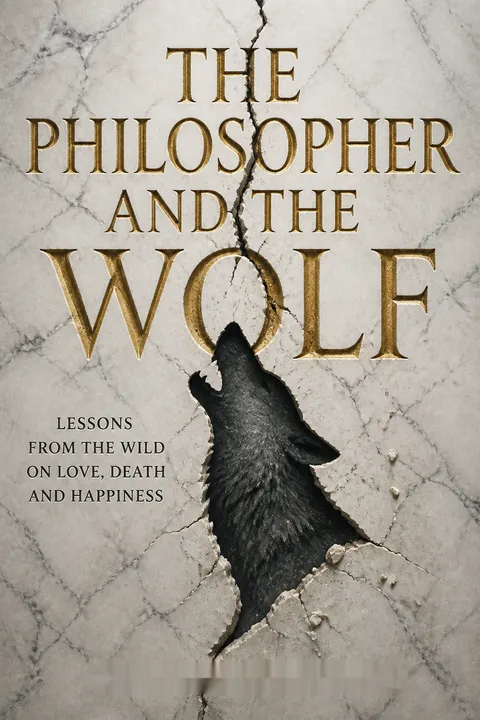
The Philosopher and the Wolf is a philosophical memoir about the author's life with his wolf, Brenin. Reviews are generally positive, praising Rowlands' insights on human nature, animal consciousness, and the meaning of life. Many readers found the book thought-provoking and emotionally moving. Some critics felt the philosophical musings overshadowed the wolf narrative, while others appreciated the balance. The book's unique blend of memoir and philosophy resonated with many readers, though some found Rowlands' misanthropic views challenging.
People Also Read

Glossary
ape
calculating, instrumental tendencyRowlands uses “ape” as a metaphor for the human tendency to treat people and the world as resources, evaluate relationships by advantage, and approach happiness or love as things to calculate. It is not a biological insult or a claim that all human behavior is selfish. The metaphor names a tendency that can operate alongside less calculating forms of attachment.
wolf
loyalty beyond calculationIn the book’s central metaphor, “wolf” represents an older, less instrumental dimension of human life, associated with loyalty, direct engagement, and values that cannot be measured or traded. Brenin is also a real animal, not merely a symbol. Rowlands uses the distinction to question human claims of superiority, while acknowledging that his language about what the wolf knows is often metaphorical.
Machiavellian intelligence hypothesis
social life drives intelligenceThe hypothesis, associated in the book with primatologists Andrew Whiten and Richard Byrne, proposes that the demands of social life helped drive the development of intelligence in apes. Tracking group relationships, forming alliances, deceiving others, and detecting deception create cognitive pressures beyond solving physical problems. Rowlands uses it to suggest that human intelligence has roots in social competition as well as cooperation.
philia
love of family or packAn ancient Greek term Rowlands uses for the love associated with family, friendship, or a pack. He distinguishes it from erotic desire and impersonal love of humanity or God. In his account, philia is not a single warm feeling. It is a bond that can produce many different emotions and is expressed most deeply in a readiness to act for another’s good.
happiness junkies
people pursuing pleasant feelingsRowlands’s label for people who treat happiness primarily as a feeling to acquire and monitor. The pursuit can involve seeking pleasure, novelty, or reassurance that life feels right. He argues that this focus encourages repeated searching for a new emotional “fix” while obscuring the value of demanding activities and relationships that may be important even when they feel unpleasant.
time’s arrow
time as past-to-future lineRowlands’s metaphor for experiencing time as a line moving from past through present to future. Human desires, plans, and projects can point toward imagined futures, but that orientation can also make people dwell on what is gone or fear what is coming. The metaphor contrasts with the book’s image of animal life as more centered on recurring routines and immediate moments.
eternal return
life repeated without endThe idea, discussed through Nietzsche, that a person’s life might recur exactly as it has, endlessly. Rowlands emphasizes its existential use as a test rather than relying on it as a literal account of the universe: would someone affirm their life if every moment, including its pain and routine, had to be lived again? The thought challenges a life organized only around future achievement.
original position
choose rules without knowing your placeA thought experiment developed by John Rawls to test principles of social justice. People choose the rules for society without knowing their own future position, such as their wealth, sex, or abilities, which is meant to discourage self-serving choices. Rowlands argues that fairness may require withholding knowledge of species as well, so that animals and other dependent beings are not excluded in advance.
moral patient
being owed moral considerationA being whose interests and welfare deserve moral consideration, even if it cannot understand moral rules or be held responsible for following them. Rowlands uses the distinction to explain why Brenin could have rights to appropriate treatment without having human-like duties. A moral patient is therefore not necessarily a moral agent, someone capable of understanding and acting on moral obligations.
highest moments
moments of one’s best conductRowlands’s term for moments in which a person acts at their best, especially when circumstances are painful, frightening, or apparently hopeless. These moments need not be pleasurable, and they are not valuable merely because they build toward a future achievement. Their significance lies in the conduct itself, often expressed through courage, care, or defiance in the face of loss.
FAQ
What's The Philosopher and the Wolf about?
- Exploration of Human Nature: The book intertwines Mark Rowlands' life with his wolf, Brenin, to explore themes of love, death, and happiness, questioning what it means to be human.
- Philosophical Reflections: Rowlands uses his experiences to challenge narratives about human uniqueness, suggesting that many traits we attribute to humans are also present in other animals.
- Wolf as a Metaphor: Brenin symbolizes overlooked aspects of human nature, revealing darker sides of humanity and the stories we tell ourselves.
Why should I read The Philosopher and the Wolf?
- Unique Perspective: The book blends personal narrative with philosophical inquiry, making complex ideas accessible and relatable.
- Emotional Depth: Readers will find a profound emotional connection as Rowlands reflects on his bond with Brenin, prompting introspection about their own relationships.
- Challenging Assumptions: It encourages readers to reconsider assumptions about intelligence, morality, and happiness, making it a thought-provoking read.
What are the key takeaways of The Philosopher and the Wolf?
- Human and Animal Connection: Emphasizes deep connections between humans and animals, suggesting these relationships can lead to greater self-awareness.
- Critique of Human Superiority: Argues against human superiority, highlighting shared traits with other species and the stories humans believe about themselves.
- Value of Authenticity: Underscores the importance of authenticity and embracing the "wolf" within us, representing our true selves beyond societal expectations.
What are the best quotes from The Philosopher and the Wolf and what do they mean?
- "Humans are credulous animals.": Reflects the idea that humans often believe the narratives they create, leading to division and misunderstanding.
- "It is only our defiance that redeems us.": Suggests that resisting societal pressures and embracing our true nature gives life meaning.
- "The wolf uncovers what is hidden in the stories we tell about ourselves.": Emphasizes the wolf as a metaphor for self-discovery, revealing truths we often ignore.
How does Mark Rowlands define the relationship between humans and wolves in The Philosopher and the Wolf?
- Mutual Understanding: The relationship is one of mutual respect, where both species can learn from each other.
- Symbol of Strength: The wolf represents strength and authenticity, qualities humans should strive to embody.
- Reflection of Self: The bond with Brenin serves as a mirror for Rowlands, confronting his vulnerabilities and strengths.
What philosophical concepts are explored in The Philosopher and the Wolf?
- Human Uniqueness: Challenges the idea that humans are fundamentally different from other animals, sharing many traits across species.
- Moral Responsibility: Discusses the moral implications of our actions towards animals, reflecting our ethical standards.
- Existential Inquiry: Engages in existential questions about identity, purpose, and happiness, contrasting human experiences with those of wolves.
How does Rowlands critique the social contract theory in The Philosopher and the Wolf?
- Power Dynamics: Argues that social contract theory is about power, where moral obligations are owed only to those who can reciprocate.
- Deception and Morality: Posits that the contract encourages deception, undermining the foundations of morality.
- Exclusion of the Weak: Calls for a broader understanding of morality that includes all beings, regardless of their power.
What does Mark Rowlands say about happiness in The Philosopher and the Wolf?
- Happiness as a State: Argues that happiness should be viewed as a way of being rather than a transient feeling.
- Moments of Joy: Emphasizes recognizing and cherishing moments of joy found in simple, everyday experiences.
- Contrast with Human Pursuits: Critiques the human tendency to chase external markers of success, suggesting true happiness lies in lived moments.
How does the relationship between Rowlands and Brenin evolve throughout The Philosopher and the Wolf?
- Initial Bonding: Begins with a deep bond formed through shared experiences and mutual understanding.
- Struggles and Growth: As Brenin ages, their relationship deepens, highlighting themes of loyalty and sacrifice.
- Legacy of Love: Brenin's death catalyzes Rowlands' personal growth and philosophical insights, influencing his understanding of love and morality.
How does Rowlands use personal anecdotes to illustrate his philosophical points in The Philosopher and the Wolf?
- Real-Life Examples: Shares personal stories about life with Brenin to ground philosophical arguments in relatable experiences.
- Emotional Depth: Personal stories add emotional weight to discussions, allowing deeper connection with the material.
- Illustrating Key Themes: Anecdotes illustrate themes like loyalty, love, and happiness, demonstrating practical implications of his ideas.
What does Mark Rowlands suggest about the nature of love in The Philosopher and the Wolf?
- Philia vs. Eros: Distinguishes between types of love, emphasizing philia (brotherly love) in human-animal relationships.
- Love as Action: Argues that love is an active commitment to others' well-being, challenging conventional notions of love as solely emotional.
- Complexity of Love: Explores complexities of love, particularly in caring for a dying animal, enriching understanding of love.
How does The Philosopher and the Wolf address the concept of death?
- Death as Deprivation: Discusses death as depriving us of future possibilities, challenging readers to consider the significance of those losses.
- Personal Reflections on Grief: Includes reflections on Rowlands' grief after Brenin's death, illustrating the emotional impact of loss.
- Embracing Mortality: Encourages confronting mortality to find meaning in life, suggesting that acknowledging death enriches appreciation of life's beauty.
About the Author
Other books by Mark Rowlands
Download PDF
Download EPUB
.epub digital book format is ideal for reading ebooks on phones, tablets, and e-readers.








