


Key Takeaways
Turn your mental searchlight toward what you want, not who's to blame
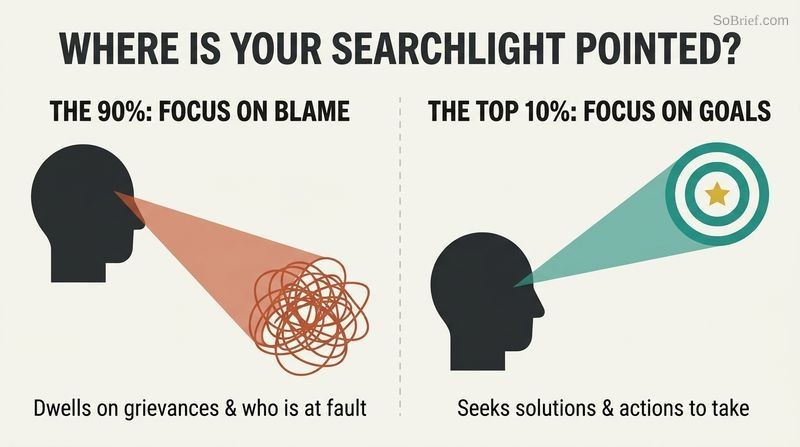
Thoughts are causes; conditions are effects. Tracy's central law is that if you change your thinking, you change your life. He points to a University of Pennsylvania study of 350,000 businesspeople tracked over 22 years: the top 10 percent by income spend their mental energy on what they want and how to get it. Everyone else dwells on what they fear, what went wrong, and who caused it.
The searchlight metaphor is the practical hinge. Attention is a beam you aim. Point it at goals and solutions, and life improves. Point it at grievances and worries, and it stagnates. Tracy himself started as a high-school dropout washing dishes and floors, living in his car, until one top salesman's advice reframed his entire approach.
The claim that attention shapes outcome finds support in cognitive science: the reticular activating system filters perception toward whatever we prioritize, so goal-focus does surface relevant opportunities. Barbara Fredrickson's broaden-and-build research shows positive affect literally widens cognitive range. The caution worth adding is that Tracy's correlational study cannot prove causation. High earners may think about goals because success already gave them stability, not the reverse. Rumination is also clinically distinct from problem-solving; telling depressed people to simply redirect thoughts can backfire. The insight is powerful as a default habit, less reliable as a cure-all for structural or psychological obstacles.
Your self-concept is a thermostat that caps your performance

Three layers govern how you show up. Tracy calls the self-concept the century's greatest psychological discovery and splits it into three parts:
1. Self-ideal: the person you aspire to become, your values and vision.
2. Self-image: how you see yourself in the moment, which drives present performance.
3. Self-esteem: how much you like yourself, the emotional core and energy source.
You don't see the world as it is; you see it as you are. Before any high-stakes moment, replay a past success rather than a past failure, because the subconscious cannot distinguish vivid imagination from reality. Tracy's antidote to inadequacy is the repeated affirmation "I like myself," which he says raises confidence, lowers fear, and even boosts sales, since people buy from those they like.
Tracy's self-concept maps neatly onto Albert Bandura's self-efficacy, the belief in one's capacity to execute, which decades of research link to persistence and achievement. Mental rehearsal is validated too: Olympic athletes use visualization, and brain imaging shows imagined and real actions activate overlapping motor regions. Where the model strains is the affirmation prescription. Studies by Joanne Wood found that repeating "I am lovable" actually worsened mood for people with low self-esteem, because it clashed with existing belief. Self-affirmation works better when tied to genuine values or small evidenced wins. Liking yourself is likely an outcome of competent action as much as a cause of it.
Read one hour daily to earn a practical PhD every year

Excellence is a five-to-seven-year project, so start now. Tracy argues mastery in any field, from neurosurgery to sales, takes that long, and the time passes regardless. The compounding tool is deliberate input:
1. Read 30 to 60 minutes daily in your field, roughly one book a week, 50 a year.
2. Turn commuting into learning by listening to audio programs, converting 500 to 1,000 annual driving hours into university-equivalent study.
3. Attend every relevant course and seminar.
Feed mental protein, not mental candy. He contrasts nourishing morning reading with the empty calories of TV and doom-scrolling. A St. Louis man who borrowed money from his mother to buy Tracy's programs reported earning over $500,000 four years later, crediting the audio habit as the single new variable.
The one-hour-a-day prescription echoes the modern concept of the compounding of knowledge, and the numbers are directionally sound even if "practical PhD" is rhetorical flourish. What Tracy underweights is that passive consumption rarely produces mastery. Anders Ericsson, whose research popularized the ten-thousand-hour idea, stressed deliberate practice with feedback, not mere reading or listening. Fifty books absorbed without application yield familiarity, not skill. The strongest version pairs input with output: read, then implement and measure. His anecdotes also suffer survivorship bias, spotlighting the one who succeeded while ignoring the many who consumed identical material and stayed put.
Get 0.1 percent better daily to grow tenfold in a decade
Tiny gains compound into transformation. Tracy's 1,000 percent formula rests on the law of incremental improvement. Improve just one-tenth of one percent per day, which is trivially easy, and the math cascades: 0.5 percent weekly, 2 percent monthly, 26 percent yearly. Sustain that and you double productivity every 2.7 years, reaching a 1,004 percent increase over ten years.
Seven daily ingredients drive it: rise early and read, rewrite your ten goals each morning, plan every day in advance, set priorities and work the most valuable task, listen to audio programs, debrief every experience with "What did I do right?" and "What would I do differently?", and treat everyone like a million-dollar customer. A man named Chris told Tracy the formula "didn't work": he hit tenfold in seven years, not ten.
This is atomic-habits thinking a generation early, and the compounding logic is arithmetically real. The seductive flaw is treating productivity like guaranteed interest. Personal growth is noisier than a spreadsheet: plateaus, burnout, and diminishing returns are common, and a 26 percent annual gain compounded indefinitely eventually collides with market ceilings and human limits. Notably, Tracy's two debrief questions are the quiet gem here. By forcing attention onto what worked and what to adjust, they mirror the after-action reviews the US Army uses and the growth-mindset framing Carol Dweck champions, reprogramming reflection away from shame toward iteration.
Say "I am responsible" to instantly cancel any negative emotion
All negativity traces back to blame. Tracy spent 4,000 hours studying this and concluded you cannot be angry, resentful, or fearful without blaming someone. The circuit breaker is the phrase "I am responsible," because you cannot accept responsibility and feel like a victim simultaneously. Responsibility, he says, is the dividing line between childhood and adulthood.
Two fears drive most self-sabotage: the fear of failure ("I can't") and the fear of rejection. Both are learned in childhood through criticism and can be unlearned via the law of substitution, since the mind holds only one thought at a time. Replace "I can't" with "I can do it." Tracy runs his company so every employee acts as "president of their own personal services corporation," arriving with problems already paired to proposed solutions.
Radical responsibility is a cornerstone shared by Stephen Covey, Viktor Frankl, and Stoic philosophy: Epictetus taught that events are neutral and only our judgments disturb us, which anticipates Tracy's explanatory-style point by two millennia. The single-thought substitution technique parallels cognitive behavioral therapy's cognitive restructuring. A necessary nuance: responsibility for one's response is empowering, but the rhetoric can slide into victim-blaming when applied to genuine injustice, trauma, or systemic barriers. Frankl chose his attitude in a concentration camp, yet never claimed he caused it. The healthiest reading separates "I am responsible for what I do next" from "I caused everything that happened to me."
Success is goals; all else is commentary
Written goals are the rarest success lever. Tracy cites that only 3 percent of adults have written goals, and they earn roughly ten times the average while everyone else works for them. His ten-step process: idealize with no limits, write goals down, set deadlines, list obstacles, identify needed skills and people, make an action list, organize it by sequence and priority, and visualize daily.
Write in the three P's: positive, personal, present. The subconscious only accepts present-tense first-person commands, so "I earn X by this date," never "I will lose weight." Tracy's own turning point came at 24 when he scribbled ten goals, promptly lost the list, and found most achieved within 30 days. His three-goal method: write your top three in 30 seconds, and they will be as accurate as if you took three hours.
The famous "3 percent with written goals earn ten times more" statistic is beloved in motivational circles but has no verified source; the often-cited Yale 1953 study never happened. That said, Gail Matthews of Dominican University ran a genuine 2015 experiment showing people who wrote goals and sent progress reports to a friend achieved significantly more than those who merely thought about them. So the mechanism is real even if Tracy's figure is folklore. The present-tense affirmation instruction is the shakier part; the durable evidence favors implementation intentions, Peter Gollwitzer's "if-then" plans that specify when, where, and how, not just the desired end-state.
You'll never catch up, so manage yourself instead of time
Time management is really self-management. Drawing on Peter Drucker, Tracy insists you cannot manage time, only yourself, and the only way to gain time is to stop doing certain things. His toolkit:
1. Work from a written list made the night before, which lifts productivity 25 percent immediately.
2. Apply the 80-20 rule: 20 percent of tasks yield 80 percent of results.
3. Use the ABCDE method, ranking each task by consequence, then never touch a B while an A sits undone.
4. Concentrate single-mindedly until a task is 100 percent complete, which can save up to 80 percent of the time.
Creative procrastination is the twist: everyone procrastinates, so deliberately delay the low-consequence tasks while attacking high-value ones.
The insight that you will never reach the bottom of the list is quietly liberating and psychologically accurate. Productivity researchers note that inbox-zero and full completion are moving targets; the goal is prioritization, not exhaustion. The ABCDE method resembles the Eisenhower matrix of urgent versus important. The single-tasking claim is well supported: Sophie Leroy's research on "attention residue" shows switching tasks leaves part of the mind stuck on the previous one, degrading performance. Where Tracy's advice ages slightly is the assumption of total individual control; in collaborative knowledge work, much of the calendar is negotiated with others, making "just stop doing things" harder than it sounds.
Spend less than you earn, then let compound interest do the rest
Frugality, frugality, frugality. Tracy says self-made millionaires think long-term, save 10 to 20 percent, and get pleasure from watching money grow rather than from spending. He measures wealth by survival rate: how many months you could sustain your lifestyle without working. Multiply monthly costs by 240 (20 years) to find your number.
Small sums become fortunes. A poorly dressed young man from a group home who repaired furniture asked Tracy if saving $100 a month could make him a success. Invested at 10 percent from age 20 to 65, that becomes about $1.1 million. Tracy's rules: buy used cars (a new car loses 30 percent driving off the lot), track every expense in a notebook (trackers save 50 percent more), and delay big purchases 30 days, since the urge often evaporates.
This is The Millionaire Next Door distilled, and Thomas Stanley's research corroborates that most American millionaires are frugal first-generation earners, not flashy spenders. The expense-tracking effect is validated by behavioral economics: what gets measured gets managed, and writing purchases down interrupts mindless consumption. Two honest caveats. First, the 10 percent stock return assumption is optimistic; long-run inflation-adjusted equity returns run closer to 7 percent, which still builds wealth but slower. Second, "just save more" is far easier for those with surplus income; for households where expenses already exceed wages, the frontier is earning power, not discipline, which Tracy addresses elsewhere through skill-building and sales.
Sales ability, not luck, produces 79 percent of self-made millionaires
Most wealth comes from starting a business and selling. Tracy breaks down where American self-made millionaires originate: 74 percent are entrepreneurs, 5 percent salespeople, 10 percent executives, 10 percent professionals, and just 1 percent from all glamorous sources combined (writers, movie stars, inventors, lottery winners). Combine entrepreneurs and salespeople and 79 percent got rich through selling.
Courage and skill both arrive after action, not before. You do the thing you fear, and the courage follows; you use the weak skill, and competence follows. Tracy urges starting a business today, even a sole proprietorship named after yourself, since it costs roughly $25 to $50 and 26 hours in the US. Add value faster, cheaper, better, and remember rule one of business: don't lose money.
The elevation of sales as the master skill is underrated advice for a culture that romanticizes invention. Even Steve Wozniak needed Steve Jobs to sell. The statistical breakdown usefully deflates lottery-and-celebrity fantasies of wealth. The "courage follows action" principle aligns with modern exposure therapy and with self-perception theory: we infer our traits from our behavior, so acting bold makes us bolder. The weak spot is the rosy "90 percent of businesses started by experienced people succeed" framing, which understates real base rates; roughly half of new US businesses fail within five years regardless of pedigree. Experience improves odds but does not near-guarantee them.
Self-discipline is doing what you should whether you feel like it or not
The master key to riches. Tracy stacks authorities: Napoleon Hill called self-discipline the master key after interviewing 500 wealthy people, and success researcher Kop Kopmeyer, who catalogued 1,000 principles, named it number one. The definition is doing what you should when you should, felt like it or not. Harvard's Edward Banfield found long-term perspective, thinking 10 to 20 years ahead, was the single best predictor of upward economic mobility.
The payoff is immediate. Every act of discipline releases endorphins and raises self-esteem. Herbert Gray spent 11 years finding the "common denominator of success" and concluded successful people habitually do what unsuccessful people dislike doing, though they dislike it too. Persistence is simply self-discipline sustained across time, and it spirals upward with self-respect.
Banfield's long-time-horizon finding prefigures Walter Mischel's marshmallow experiments and the broader research on delay of gratification predicting life outcomes, though later replications by Tyler Watts tempered those effects, showing much of a child's patience reflected family affluence and stability rather than raw willpower. That nuance matters: discipline is partly a downstream product of environment and security, not purely a chosen virtue. Still, the reframe that disciplined people also dislike the hard task, yet act anyway, is the liberating core. It dismantles the myth that achievers possess special motivation. What they possess is a decision structure that makes feelings optional, closer to a practiced habit than a personality trait.
Every crisis tests your response, which is the only thing you control
Civilizations and people rise by meeting challenges. Tracy borrows Arnold Toynbee's study of 26 civilizations over 3,000 years: each grew by responding well to external threats and declined when it could no longer. The challenge arrives unbidden; only the response is yours. Expect a personal or business crisis every two to three months.
Stay calm, then use the worry buster formula:
1. Define the problem clearly in writing (accurate diagnosis is half the cure).
2. Ask what the worst possible outcome is.
3. Resolve to accept the worst if it happens, which clears the mind.
4. Act immediately to improve on the worst.
Swap loaded words: call a "problem" a "situation," a "challenge," or an "opportunity" to keep the thinking brain online instead of triggering fight-or-flight.
The worry buster formula is lifted in spirit from Dale Carnegie's How to Stop Worrying and Start Living, and the "accept the worst" step is quietly Stoic, echoing Seneca's premeditatio malorum, the deliberate rehearsal of adversity to defang it. Neuroscience backs the word-swapping advice: labeling a threat as a challenge shifts physiology toward a challenge state with better cardiovascular efficiency and cognition, as Alia Crum and Jeremy Jamieson have shown in stress-reappraisal studies. Toynbee's grand theory is contested among historians as overly tidy, but as a personal metaphor it holds: resilience research consistently finds that meaning-making and active coping, not the severity of the blow, predict who bounces back.
Set peace of mind as your highest goal, then prune ruthlessly
Simplify by aligning outer life with inner values. Tracy says stress comes from doing things on the outside that conflict with what matters inside. The clarifying tool is the 20-10 exercise: imagine $20 million in the bank but only 10 years to live, and notice what you would change immediately. Whatever you would do reveals your true priorities.
Four life areas must stay in balance: health and fitness, family and relationships, meaningful well-paid work, and financial independence. Fully 85 percent of happiness comes from relationships, so the law of time applies: quality time at work, quantity time at home, because children spell love T-I-M-E. Use zero-based thinking, asking of any commitment, "Knowing what I now know, would I get into this again?" If no, exit fast. Balance, like a tightrope walker, is maintained continuously, not achieved once.
The pivot from acquisition to peace of mind gives the whole achievement-focused book its ethical ballast, echoing Aristotle's eudaimonia, which Tracy explicitly invokes: flourishing as the point of all activity. The 85-percent-from-relationships claim is directionally confirmed by the Harvard Study of Adult Development, the longest longitudinal study of happiness, which found relationship quality at 50 the best predictor of health and satisfaction at 80. Zero-based thinking mirrors the sunk-cost corrective from behavioral economics: decide based on present reality, not past investment. The "quality at work, quantity at home" formulation is a useful heuristic, though critics note that quantity without presence is hollow; the two dimensions are complements, not substitutes.
Analysis
The Phoenix Transformation is Brian Tracy's 2021 refresh of his 1983 audio classic The Psychology of Achievement, repackaged around the phoenix myth of self-renewal. It belongs squarely to the American success-literature lineage descending from Napoleon Hill, Earl Nightingale, and Dale Carnegie, and it functions less as an argument than as an anthology of twelve loosely themed lists: mindset, potential, motivation, influence, goals, time, wealth, entrepreneurship, discipline, crisis, and simplification. The organizing conviction is Aristotelian causation applied to psychology: thoughts are causes, conditions are effects, so changing the inner world reliably reshapes the outer one.
The book's strength is coverage and memorability. Tracy is a master of the numbered mnemonic (the seven orientations, five A's, four P's, ABCDE, the 1,000 percent formula), and his rags-to-riches biography, dropout to dishwasher to self-made success, lends earned authority. His best material is quietly cognitive-behavioral: the two debrief questions, the single-thought substitution law, word-swapping to keep the neocortex online, and the reframe that disciplined people dislike hard tasks yet act anyway. These anticipate ideas later formalized by James Clear, Carol Dweck, and stress-reappraisal researchers.
The weaknesses are equally clear. Tracy treats correlational studies as causal proof, repeats unsourced folklore (the 3-percent-written-goals statistic has no verifiable origin), and leans on survivorship-biased anecdotes where the one who succeeded stands in for a silent multitude who did not. The relentless individual-responsibility frame, powerful as a default, underweights structural constraints, luck, and the finding that traits like patience partly reflect childhood security. The affirmation prescriptions sit uneasily with evidence that self-statements can backfire for low-self-esteem individuals.
Read critically, the book is a serviceable operating system for personal effectiveness: pair its input habits with deliberate practice, its goals with implementation intentions, and its optimism with a realistic view of base rates and systems. Its final turn, from wealth toward peace of mind and relationships, gives the achievement machinery a humane destination.
Review Summary
Readers found The Phoenix Transformation insightful but repetitive. Many appreciated its practical advice on goal-setting, self-discipline, and personal development. The book's emphasis on positive thinking and taking action resonated with readers. Some found it lacking nuance and resembling typical self-help material. Despite mixed opinions on writing style, most readers felt the book offered valuable life lessons and motivation for self-improvement. Overall, it was well-received, with readers finding it a comprehensive guide to personal and professional growth.
People Also Read









Glossary
Self-concept
Bundle of beliefs about yourselfThe total set of beliefs a person holds about themselves, their abilities, and their world, largely formed in childhood and mostly subjective. Tracy divides it into three parts: the self-ideal (who you aspire to be), the self-image (how you see yourself now), and self-esteem (how much you like yourself). It acts as a mental thermostat that caps performance and filters perception.
1,000 percent formula
Tenfold growth via daily improvementTracy's compounding productivity system based on improving just 0.1 percent per day, which accumulates to roughly 26 percent per year and about 1,004 percent over a decade. It is driven by seven daily habits including early reading, rewriting goals, daily planning, prioritizing, listening to audio programs, debriefing experiences, and treating everyone as a valued customer.
ABCDE method
Task prioritization by consequenceA prioritization system where each task is labeled by its consequences: A tasks must be done (serious consequences), B tasks should be done (mild consequences), C tasks are nice but inconsequential, D tasks should be delegated, and E tasks should be eliminated. The governing rule is never to work on a B or C task while an A task remains undone.
Worry buster formula
Four-step crisis calming methodA four-part process for handling any crisis: define the problem clearly in writing, identify the worst possible outcome, resolve to accept that worst outcome if it occurs (which calms the mind), and then act immediately to improve on the worst. Adapted from Dale Carnegie and rooted in Stoic premeditation of adversity.
Law of three
Your three highest-value tasksA method for identifying where you add the most value. List everything you do, then ask which single activity, if it were the only one all day, would contribute the most, then the second, then the third. In most jobs these three tasks account for 90 percent or more of your total value, so you should focus on them and improve at each.
Survival rate
Months you could stop workingTracy's measure of financial health: the number of months or years you could maintain your current lifestyle if you never earned another dollar. The target is 20 years. To find your number, multiply your monthly living costs by 240 (20 years times 12 months); that figure becomes your lifetime financial goal.
Zero-based thinking
Would I start this againA decision tool for staying flexible: examine any current commitment, product, relationship, or activity and ask, knowing what you now know, whether you would get into it again today. If the answer is no, the follow-up is how to exit and how fast. It counters the sunk-cost bias of clinging to past decisions.
Challenge response theory
Growth comes from meeting threatsAdapted from historian Arnold Toynbee's study of 26 civilizations, this holds that entities grow by responding effectively to external challenges and decline when they can no longer do so. Applied personally, it means crises arrive unbidden and beyond control, but the response is entirely yours, and that response determines survival and growth.
Three P's
Positive, personal, present tenseTracy's rule for writing goals and affirmations so the subconscious accepts them: state them positively ("I am a nonsmoker," not "quit smoking"), personally (using "I" plus an action verb), and in the present tense as if already achieved ("I earn X by this date"). This phrasing is meant to program the subconscious toward the goal.
Creative abandonment
Deliberately dropping low-value commitmentsA term borrowed from Peter Drucker for consciously discontinuing any product, service, activity, or expense that drains time and resources from more valuable work. Tracy applies it both to business (cutting unprofitable offerings) and personal life (dropping tasks and obligations that no longer serve your highest priorities), since starting something new requires stopping something old.
FAQ
What's "The Phoenix Transformation" about?
- Author and Theme: "The Phoenix Transformation" by Brian Tracy focuses on personal and professional development by adopting the qualities of high achievers.
- Core Concept: The book uses the metaphor of the phoenix, a mythical bird that rises from its ashes, to illustrate the process of personal renewal and transformation.
- 12 Qualities: It outlines 12 qualities that high achievers possess, which can help individuals reboot their careers and lives.
- Practical Guidance: The book provides actionable steps and strategies to implement these qualities in everyday life for achieving extraordinary success.
Why should I read "The Phoenix Transformation"?
- Proven Strategies: The book offers well-researched and time-tested strategies for personal and professional growth.
- Comprehensive Approach: It covers a wide range of topics, from goal setting and time management to wealth creation and self-discipline.
- Actionable Advice: Each chapter provides practical steps that can be immediately applied to improve various aspects of life.
- Inspiration and Motivation: The book is designed to inspire readers to take control of their lives and achieve their highest potential.
What are the key takeaways of "The Phoenix Transformation"?
- Mind Power: Understanding and harnessing the power of the mind is crucial for transformation.
- Goal Setting: Clear, written goals are essential for achieving success and should be revisited regularly.
- Self-Discipline: Developing self-discipline is the cornerstone of personal and professional success.
- Continuous Learning: Lifelong learning and skill development are vital for staying competitive and achieving financial independence.
How does Brian Tracy define success in "The Phoenix Transformation"?
- Goal Achievement: Success is defined as the achievement of goals, which requires clear planning and consistent effort.
- Self-Discipline: The ability to make oneself do what should be done, whether one feels like it or not, is key to success.
- Value Addition: Success involves adding value to others, which in turn brings personal and financial rewards.
- Balance and Happiness: True success also includes achieving a balance between work, personal life, and happiness.
What are the 12 qualities of high achievers according to "The Phoenix Transformation"?
- Mind Power: High achievers understand and use the power of the mind.
- Potential Unlocking: They focus on unlocking their peak potential.
- Optimism: They use optimism to motivate themselves to peak performance.
- Influence: They know how to get others to like and respect them.
- Goal Setting: They set goals and work consistently to achieve them.
- Time Management: They organize their time for optimal efficiency.
- Wealth Creation: They know how to create wealth for themselves.
- Financial Independence: They are on track to financial independence.
- Entrepreneurship: They know and use the keys to entrepreneurship.
- Self-Discipline: They have mastered self-discipline.
- Problem-Solving: They have superb problem-solving skills.
- Simplification: They simplify their lives by focusing on what gives them joy.
How does Brian Tracy suggest we change our thinking to change our life?
- Thoughts as Causes: Tracy emphasizes that thoughts are causes, and conditions are effects; changing your thinking changes your life.
- Positive Focus: Focus on what you want and how to get it, rather than on what you don't want.
- Self-Concept: Your self-concept, which includes your self-ideal, self-image, and self-esteem, determines how you see the world.
- Explanatory Style: Change your explanatory style to interpret experiences positively, which influences your emotions and actions.
What is the "Law of Cause and Effect" in "The Phoenix Transformation"?
- Universal Law: The law states that everything happens for a reason, and success is not an accident.
- Thoughts as Causes: Your thoughts are the primary causes of the conditions in your life.
- Action and Results: If you do what successful people do, you will get the same results they get.
- Mindset Shift: Changing your thinking is the first step to changing your life and achieving your goals.
What is the "1,000 Percent Formula" in "The Phoenix Transformation"?
- Incremental Improvement: The formula is based on the law of incremental improvement, suggesting small daily improvements lead to significant long-term gains.
- Daily Focus: Increase productivity by 0.1% each day, which compounds to a 1,000% improvement over ten years.
- Continuous Learning: Engage in daily learning and skill development to enhance productivity and performance.
- Practical Steps: The formula includes specific actions like reading, goal setting, and time management to achieve this growth.
How does Brian Tracy recommend setting and achieving goals?
- Clarity and Writing: Clearly define what you want and write it down in detail.
- Deadlines and Sub-Deadlines: Set deadlines for your goals and break them into smaller, manageable tasks.
- Identify Obstacles: Determine the obstacles you need to overcome and the skills you need to develop.
- Daily Action: Take consistent daily actions toward your goals, reviewing and adjusting as necessary.
What are the best quotes from "The Phoenix Transformation" and what do they mean?
- "Success is goals; all else is commentary." This emphasizes the importance of having clear goals as the foundation of success.
- "You become what you think about most of the time." This highlights the power of focused thinking in shaping your reality.
- "Discipline weighs ounces, but regret weighs tons." This underscores the long-term benefits of self-discipline over the short-term pain of regret.
- "The harder you work, the luckier you get." This suggests that consistent effort and hard work create opportunities for success.
How does "The Phoenix Transformation" address wealth creation?
- Long-Term Thinking: Wealth creation requires thinking over the long term and making sacrifices in the present for future gains.
- Value Addition: Adding value to others is the key to financial success and wealth accumulation.
- Frugality: Practicing frugality and living within your means are essential habits for building wealth.
- Entrepreneurship: Starting your own business is a common path to becoming a self-made millionaire.
What role does self-discipline play in "The Phoenix Transformation"?
- Master Key: Self-discipline is described as the master key to riches and success.
- Habit Formation: It involves making a habit of doing what needs to be done, regardless of feelings.
- Immediate Payoff: Practicing self-discipline leads to immediate increases in self-esteem and self-respect.
- Comprehensive Impact: It strengthens every other positive quality and is essential for achieving long-term goals.
About the Author
Other books by Brian Tracy







Download PDF
Download EPUB
.epub digital book format is ideal for reading ebooks on phones, tablets, and e-readers.








