

Plot Summary
The Fort Calls Penric
At home in Vilnoc, Penric is learning the pleasures of fatherhood with his wife, Nikys, and their infant daughter, Florina. His brother-in-law Adelis, a general, arrives but refuses to enter the house. At the nearby fort, a strange illness has killed ten men, and four more died the previous night.
Penric leaves his family and brings his medical kit, though he has avoided practicing medicine since a disastrous period of overwork. He reaches the hospice too late to help its senior physician, Orides, who has just died. Examining the body with Desdemona, the chaos demon sharing his body, Penric sees widespread internal bleeding beneath the darkened skin. The crisis has begun before anyone knows its cause.
The summons collides with the safety Penric has built: family, home, and work as a scholar. His reluctance is not indifference but memory. He knows that medical need can consume the healer, especially when magic makes him appear capable of more than he can actually do. Orides's death removes the fort's most experienced physician just as the illness arrives, leaving Penric with both a diagnostic puzzle and an institutional vacuum. The episode frames care as a practical obligation with a personal cost, not as a clean heroic calling.
Healing Has a Price
Orides's apprentice, Rede Licata, explains that the illness begins like an ordinary fever, then brings stomach distress, spreading bruises, bleeding, and rapid death. Penric tests his healing magic on the patients, warning Rede that it can only strengthen the body's own recovery in small doses. Each use also burdens Desdemona with disorder that Penric must discharge by killing living creatures.
He starts with flies and crows, then makes exhausting trips between the hospice and the fort's stores to find vermin. New patients keep arriving, and one man dies despite Penric's efforts. Rede studies the sick and begins tracking their cases while Penric continues treating them, neither certain whether the magic is helping nor able to stop.
The magic system turns compassion into a problem of accounting. Penric must judge what each body can absorb, while also managing the cost his own power creates. Killing flies is useful, but its small scale makes visible how inadequate individual effort can be against a crisis affecting dozens. Rede's records complement Penric's supernatural perception with ordinary observation, establishing their collaboration as a meeting of distinct methods. The uncertainty around each patient's outcome also exposes a moral danger: people may mistake a healer's capacity to act for a promise that every life can be saved.
Aunt Yema Knows
Penric walks into Tyno, the village below the fort, and finds sick carters and other households with no obvious connection to one another. He treats them but cannot identify how the illness spreads. He also visits the nearby Rusylli encampment, where prisoners of war live under Adelis's guard.
Its leaders deny knowing the disease, though Penric understands enough of their language to hear their fear of a supposed blue witch. As he leaves, an elderly woman named Yema asks whether Rybi, her young relative whom Penric's household sheltered, is alive.
Penric reassures her, and Yema tells him that western Rusylli have known the illness, sometimes surviving it and shunning those who recover. She has never heard of anyone suffering it twice, but cannot explain its cause.
The epidemic crosses the boundaries that organize local life: fort, village, and captive community. The Rusylli's fear is not evidence of superstition alone; their inherited name preserves an observation whose meaning has been distorted. Yema's encounter also makes medical inquiry relational. Penric gains information because he has previously helped Rybi, and because he recognizes that trust matters as much as authority. Yet the information remains incomplete. The old account offers a pattern of survival, not a transmission mechanism, so cultural memory becomes a clue rather than a convenient answer.
Rede Tests the Fleas
Back at the fort, Rede notices that cases are appearing steadily rather than multiplying rapidly, and wonders whether the disease travels through blood. He suspects fleas after a soldier brings in a sick rat, then lets fleas from it bite his own arm to test the idea. Pen is alarmed, but the bites show no sign of the fever.
Meanwhile, some soldiers refuse Pen's treatments, frightened that his magic is a curse. When word of the illness reaches the Rusylli, many escape the encampment, overpowering guards and fleeing with their families. Adelis rides after them. Pen has no proof that the rat or its fleas matter, and now the general must contain both an outbreak and a dangerous flight across the countryside.
Rede's experiment is an act of courage compromised by desperation: he accepts personal risk because uncertainty feels more intolerable than danger. Pen's anger reveals the difference between principled inquiry and a test with no reliable controls. The soldiers' refusal shows that treatment is not merely a technical process; it depends on consent and trust, both fragile under fear. The Rusylli flight turns that fear into a public hazard, since movement can spread disease even when the fugitives are not its source. Medical uncertainty now has military and political consequences.
Vilnoc Falls Ill
A physician from the Mother's Order, Tolga, brings Penric word of suspected cases inside Vilnoc, so he rides to examine a merchant's clerk and a dismissed servant. Both have the same illness, and neither has a clear link to the fort or village. Tolga asks him to stay, but Penric returns to his growing caseload.
As he explains the limits of his magic, he admits to Rede that years earlier he tried to kill himself rather than continue an impossible medical workload. He recovered and chose another form of service, but the present crisis is recreating the old trap: every failure feels personal, and every new patient seems to demand more than he can give. He sends urgent requests for another sorcerer.
The illness entering Vilnoc changes Penric's fear from professional exhaustion to intimate danger: his family and the life he has made there are now within reach of the epidemic. His confession makes clear that burnout was not a passing inconvenience but a point at which he could no longer imagine a way out. Rede's attention gives Penric a witness who understands medicine without treating self-sacrifice as a virtue. Tolga's plea also underscores a structural truth: one exceptional healer cannot substitute for a functioning network of care.
Maska Joins the Ward
Penric's request brings Learned Dubro, an older former soldier and farmer, to the fort with his demon, Maska, a spirit shaped by the life of Dubro's dog. Penric teaches them the basic healing technique and how to discharge its cost safely, allowing a second sorcerer to treat patients. For a time, the work becomes more effective.
Then Adelis returns from pursuing the Rusylli with wounded soldiers, forty feverish cavalrymen, and sick Rusylli. The hospice fills again, and Penric cannot visit Vilnoc as often as before. Dubro's inexperienced demon grows overwhelmed and withdraws, forcing Penric to limit their work. The extra help has increased their reach, but the returning infected force threatens to erase their progress.
Dubro's arrival offers relief without making the crisis easy. His practical habits as a farmer and his affection for Maska give the new partnership a grounded, caregiving quality, while Penric's instruction converts private expertise into a transferable skill. But Maska's exhaustion establishes that assistance has limits too. The returning cavalry is not simply a plot escalation: it demonstrates how mobile institutions can reintroduce a danger that local treatment had begun to contain. Progress depends not only on healing those already ill but on identifying and stopping the source of new cases.
The Blue Fly's Trail
After a horsefly bites him while he prays in Tyno's temple, Penric notices its vivid blue body and connects it to the Rusylli name for the fever. At the fort's abattoir, he learns that horses have been dying of what soldiers call the bloody staggers. He recognizes the same disease inside a sick horse and finds unusual blue flies feeding on other infected mounts.
Penric rides to the Rusylli camp and asks an elderly woman to identify his specimens; she confirms that western Rusylli call the biting flies blue witches. He returns with proof that infected horses carry the disease in their blood and that the flies transmit it. The scattered cases now have a plausible route between them.
The discovery comes from combining forms of knowledge that had seemed unrelated: a local expression, an animal illness, a personal bite, and the body's symptoms. Penric does not solve the crisis through vision alone; he needs testimony from Rusylli elders and observation of the cavalry's horses. The blue fly transforms the illness from an apparently random contagion into an ecological chain with identifiable links. The revelation also changes the moral problem. Treating patients remains necessary, but leaving infected animals alive may keep generating new victims.
The Horses Must Die
Penric persuades Adelis and the cavalry master that visibly sick horses must be killed and buried, while Dubro helps identify infected mounts and eliminate the blue flies. He warns Nikys to cover Florina's cradle and protect the household from insects. The measures anger soldiers who fear losing their horses; one cavalryman attacks Penric with a lance, cutting his side before guards seize him.
Penric asks that the young man receive a hearing rather than summary punishment. With his permission, a senior sorcerer-physician, Ravana, joins Tolga in Vilnoc, relieving some of the town's burden. Penric and his allies extend fly control through Tyno and the fort, accepting that the necessary response will cost animals, trust, and labor.
The cure at this stage is not a single spell but a set of disruptive public decisions. Horses are livelihood, military capacity, and companions, so culling them turns correct diagnosis into conflict. Penric's wound makes the cost bodily, while his plea for restraint toward his attacker shows that urgency has not erased his judgment of individuals. Ravana's arrival adds institutional capacity, a crucial counterweight to the story's focus on one overextended healer. The intervention succeeds because expertise becomes coordinated action across military, medical, and domestic spaces.
Home After Thirty-Six Days
Once the sick horses are separated and the flies are hunted down, new cases dwindle. Penric, Dubro, Rede, Tolga, and Ravana help patients recover across the fort, Tyno, and Vilnoc; the Rusylli eventually let Penric treat their sick as well. Penric himself develops the fever from the temple fly bite, but Desdemona helps him contain it through the same disciplined use of magic and its necessary outlet.
Thirty-six days after leaving home for what he expected to be a short visit, he returns to Nikys, Idrene, and Florina. He is thinner and exhausted, yet safe. Holding his daughter again, he sees his quiet household not as ordinary shelter but as something he nearly lost.
The resolution does not claim that the disease or its source has vanished from the wider world. Instead, the local chain of transmission has been interrupted, and care has become distributed among more practitioners. Penric's own illness prevents him from occupying the safe distance of the healer who only observes others suffer; his method must withstand the same vulnerability it addresses. His return to his family completes the emotional movement from interrupted domestic peace, through involuntary service, back to a home whose value has been sharpened by absence.
Epilogue
In Penric's study, Rede examines a magically made printing plate for a book on sorcery. Penric plans to add a chapter about the fever and circulate a short medical guide, using the crisis to spread knowledge beyond individual apprentices.
Dubro and Rede then consider a future transfer of Dubro's demon, Maska, to Rede when Dubro dies. Rede agrees to the possibility, though nothing changes immediately. Their tentative arrangement offers Orbas a future sorcerer-physician, while Penric reflects on how a chance act of service once opened an unexpected life for him.
The epilogue shifts the story's measure of success from lives saved in one outbreak to knowledge and skill that may outlast its participants. Penric's printing project answers a recurring problem in the novella: expertise concentrated in one person is fragile, while written instruction can travel. The proposed demon transfer makes the same point through a more intimate inheritance. Rede would not simply receive magical power; he would accept a living accumulation of memory and experience. Both plans depend on preparation rather than certainty, fitting a world where service is shaped by chance but can still be made more durable.
Analysis
The novella treats medicine as a discipline of limits. Penric can see more than an ordinary physician and can strengthen a patient's recovery, but he cannot make every body accept help or divide himself among every person in danger. His central temptation is to interpret the existence of need as proof that he must meet all of it alone. Rede's records, Dubro's assistance, and the arrival of Tolga and Ravana gradually challenge that solitary model. Competence becomes most effective when it is shared, taught, and supported by institutions.
The epidemic also makes knowledge social. The decisive clue does not emerge from magic in isolation. It depends on medical observation, military reports, a patient's environment, and Rusylli memory. The phrase blue witch preserves a real encounter with a biting insect, even after fear has turned the observation into a supernatural story. Penric's willingness to listen across political hostility allows local knowledge to become usable evidence. The disease crosses boundaries regardless of war, captivity, or rank, while its remedy requires people who mistrust one another to cooperate.
The story's religious world does not remove uncertainty. A fly bite may be an answer to prayer, but Penric cannot prove what the god intends. Divine chance supplies neither an easy cure nor a clear moral instruction. Instead, it places human beings where their choices matter. The final emphasis on printing and the possible transfer of Maska's demon carries this ethic beyond the immediate emergency: care can become durable when experience is recorded and responsibility prepared for others. Penric returns home grateful, but not with the illusion that danger has disappeared. He has learned that service is not limitless self-sacrifice. It is the creation of enough shared knowledge and capacity that no single healer has to become a substitute for a god.
Review Summary
The Physicians of Vilnoc receives mostly positive reviews, with readers praising Bujold's storytelling and character development. Set in the World of the Five Gods, the novella follows Penric and his demon Desdemona as they tackle a mysterious plague. Many readers found the story timely and relevant to the current pandemic, appreciating Bujold's exploration of medical challenges and ethical dilemmas. Some felt it lacked the excitement of previous installments but still enjoyed the medical mystery and Penric's growth as a character.
People Also Read


Characters
Penric
Temple healer with a demonPenric is a scholar, divine, sorcerer, husband, and new father whose curiosity is matched by an unusually strong sense of responsibility. Desdemona shares his body and lends him magical abilities, while also challenging his assumptions and recognizing when his drive to help is becoming dangerous. Penric is intelligent and adaptable, but his greatest vulnerability is the tendency to treat his own endurance as another resource others may spend. His past experience in medicine has left him wary of being valued only for what he can do. He prefers teaching, translation, and careful inquiry, yet responds when people need him. His conflict is not whether he cares, but how to care without mistaking limitless need for limitless capacity.
Desdemona
Centuries of borrowed selvesDesdemona is a chaos demon who lives within Penric and speaks through him, carrying impressions from many prior hosts. Her accumulated memories make her a source of medical knowledge, spiritual perception, and practical caution. She is witty, opinionated, and protective, but not merely a voice of reason: she has her own responses, fears, and preferences. The relationship between her and Penric rests on negotiated trust rather than simple mastery. She supports his work while warning him that determination can become self-destruction. Her many inherited perspectives also make her a living record of experience, though the memories within her do not always form a single, tidy identity.
Rede Licata
Physician under pressureRede is a young medical officer whose apprenticeship under the experienced Orides has prepared him for ordinary military medicine, not a mysterious epidemic. He responds to uncertainty by observing, recording, and asking precise questions. His respect for evidence sometimes carries him toward risks he has not fully considered, especially when inaction feels intolerable. Rede is also emotionally perceptive: he notices Penric's exhaustion and understands that a healer's resolve can conceal serious distress. As the crisis strips away the security of being an apprentice, he must take responsibility for decisions affecting patients, colleagues, and the fort. His growing interest in sorcery comes from practical experience, not an abstract desire for power.
Adelis
General and wary kinAdelis, Penric's brother-in-law, commands the fort and its troops. He is a disciplined tactician who values clear authority and is accustomed to solving danger through plans, personnel, and force. A medical crisis tests those instincts because disease ignores rank and cannot be defeated by a military order alone. Adelis trusts Penric enough to bring him into the hospice, while also recognizing that Penric may push himself beyond safe limits. Their family bond lets them speak with unusual bluntness, but it does not erase their differing obligations: Adelis answers to the duke and his soldiers, while Penric serves his religious order and patients. His decisions must balance military stability with human need.
Dubro
Farmer turned sorcererDubro is an older former soldier and farmer who acquired a demon through an unusual chain of animal hosts. He is humble about his learning, but possesses the patience and practical discipline built through years of tending land, livestock, and family. His demon, Maska, is shaped strongly by a beloved dog, giving their partnership a history of loyalty and care. Dubro's willingness to travel when Penric asks for help turns isolated magical ability into useful cooperation. He is cautious without being timid, and his steady manner can reassure patients who distrust Penric's youth or sorcery.
Nikys
Penric's steady homeNikys is Penric's wife and Florina's mother. She has learned to recognize the difference between Penric and Desdemona, treating their shared body as a real partnership rather than a curiosity. Her care for Penric is practical and perceptive: she understands that his decision to leave is serious, and she keeps their household running while he is away. Nikys has her own history of loss and uncertainty, which makes the security she builds with Penric especially meaningful. She does not need to accompany him into the crisis to matter to it; the family life she protects gives his work both a reason and a limit.
Tolga
Town physician in crisisTolga is a senior physician of the Mother's Order in Vilnoc. She recognizes the new fever in her own patients and presses Penric to examine them, even when his obligations at the fort make his help uncertain. Tolga is direct, experienced, and conscious of how quickly a small number of cases can become a larger burden. Her professional frustration comes from responsibility, not rivalry: she needs expertise and practical support for people in her care. She works within an established healing order, but knows that ordinary institutional routines may not be enough when a disease is unfamiliar.
Ravana
Senior sorcerer physicianRavana is an experienced sorcerer-physician serving the Mother's Order at the winter capital. Her knowledge and composure make her a valuable colleague in a crisis where there are too few people capable of treating patients with magic. She asks perceptive questions and quickly understands the practical stakes, while remaining frank about the demands on her own order. Ravana represents a broader network of expertise that Penric cannot create by himself. Her arrival shows the importance of institutions responding to urgent needs, even when travel and existing responsibilities make help slow to come.
Yema
Rusylli elder and witnessYema is an elderly Rusylli woman, kin to Rybi, who approaches Penric despite the suspicion surrounding his visit to the encampment. Her concern for the younger woman reveals a tenderness that the camp's hostile reputation can obscure. Yema has lived long enough to distinguish what she has witnessed from what people merely fear, and she offers Penric a fragment of knowledge carried through her community. She is cautious about the powerful and careful about family loyalties, but willing to speak when she believes someone vulnerable may be helped.
Rybi
Young exile finding shelterRybi is a young Rusylli woman who has found refuge and support beyond her own family. Her experiences bring the consequences of the fort's military and cultural tensions into Penric's household. She is learning a new language and literacy while caring for her child, and her relationship with Penric's family is grounded in practical trust rather than charity alone. Rybi's presence also connects two communities that usually regard each other with suspicion, making her a quiet link across the story's political and cultural boundaries.
Idrene
Warm household matriarchIdrene is Nikys's mother and Florina's grandmother. Her relationship with Nikys is warm and without the rivalry Penric once expected from the complicated history of their household. She offers practical help and affection, and her presence helps make Penric's home a place where different generations and personalities can coexist. Idrene is perceptive about family feeling, but does not demand that people explain every private difficulty before she supports them.
Florina
Penric and Nikys's infantFlorina is the infant daughter of Penric and Nikys. Her arrival has given Penric a new intimacy with ordinary family life and a vivid awareness of what can be lost. She is cared for by both parents and her grandmother, and her safety becomes a practical concern when the illness reaches Vilnoc.
Orides
Veteran physician and mentorOrides is the fort's senior physician, a seasoned practitioner respected by his apprentice, Rede. His careful observations and medical notes give the investigation a foundation even when he is no longer able to guide it. He represents a tradition of practical learning built through years of attending soldiers, and his judgment shapes Rede's habits of inquiry.
Captain Suran
Commander of the cavalryCaptain Suran commands the fort's cavalry and is responsible for the horses whose health becomes a matter of public safety. He understands the practical value of his mounts and therefore faces a difficult conflict when their condition threatens soldiers and civilians alike. His response must reconcile loyalty to the cavalry with the evidence presented by Penric.
Plot Devices
Uphill and downhill magic
Healing with a costPenric's magic can encourage order in a patient's body, helping it repair itself, but it cannot force an instant cure. Each patient can accept only a limited amount, so repeated applications matter. The magic also creates disorder that Penric and Desdemona must discharge through destructive acts, usually killing insects or animals. This mechanism makes every treatment a calculation of capacity, timing, and cost. It prevents magical healing from becoming an unlimited solution and shapes the epidemic's central logistical problem: Penric must care for many people without exhausting himself or Desdemona.
Desdemona's Sight
Seeing beneath symptomsDesdemona can lend Penric a perception of bodies beyond ordinary sight. He uses it to distinguish internal bleeding from surface discoloration, assess how far the illness has progressed, and compare the disease in people and animals. This faculty offers unusually precise observations, but it does not automatically explain what those observations mean. Penric still needs medical reasoning, Rede's records, and information from people who know the local environment. Sight is therefore an instrument of inquiry rather than an all-knowing answer, and its use also reminds Penric that the demon's long experience is part of their shared work.
Blue horseflies
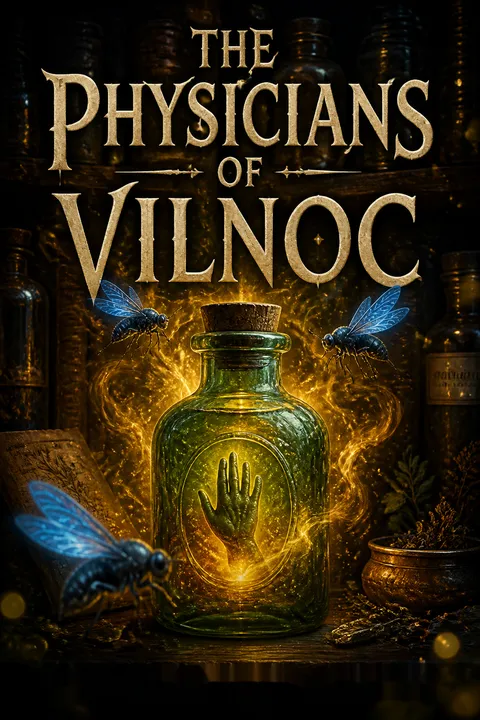
The hidden transmission routeThe blue flies are blood-feeding insects linked to the fever's spread from sick horses to people. Their local name survives in Rusylli memory, though outsiders initially mistake it for a supernatural curse. Penric's bite, the sick mounts, and the insects gathered from them gradually connect the clues. Once their role is understood, the response can shift from treating each new patient to separating infected animals and destroying the flies. This device is central to the resolution and reveals how a disease can travel through an ordinary ecological relationship that military and medical authorities have overlooked.
Orides's case records
Turning symptoms into patternsOrides's observations and Rede's case lists help track who fell ill, when patients arrived, and how the disease progressed. The records reveal that cases are not multiplying in the rapid pattern expected from direct person-to-person transmission. That discrepancy does not solve the mystery by itself, but it redirects attention toward a shared source. The written evidence also gives Penric a way to compare reports across the fort, Tyno, and Vilnoc. In a story full of supernatural perception, careful documentation remains an essential diagnostic tool.
Demon inheritance
Skill carried across livesTemple sorcerers share their bodies with demons whose personalities and abilities are shaped by prior hosts. Desdemona carries impressions from a long succession of people, while Dubro's demon Maska retains traits of the animals through which it passed. This inheritance explains how sorcerous and medical knowledge can accumulate beyond one human lifetime. It also makes training and trust essential: a demon is not a tool detached from its rider, but a developing presence whose capacities can be strained or mishandled. The epilogue extends the idea into a possible future partnership between Maska and Rede.
FAQ
Synopsis & Basic Details
What is The Physicians of Vilnoc about?
- Deadly Fever Spreads: A mysterious and lethal fever breaks out at a military fort, causing rapid deaths and threatening to spread to the nearby town.
- Sorcerer Called to Aid: Penric, a Temple sorcerer and physician, is reluctantly drawn into the crisis by his brother-in-law, a general, despite having retired from medical practice.
- Unraveling the Mystery: Penric, aided by his resident demon Desdemona, must use his unique abilities to identify the source of the disease and find a way to stop its spread, balancing his magical powers with the need to protect his family.
Why should I read The Physicians of Vilnoc?
- Unique Magic System: The novella features a fascinating magic system where a sorcerer must balance their healing abilities with the need to shed chaos, adding a unique layer to the medical mystery.
- Compelling Character Dynamics: The story explores the complex relationship between Penric and his demon, Desdemona, as well as his interactions with his family and other characters, creating a rich emotional landscape.
- Intriguing Medical Mystery: The narrative combines elements of a medical thriller with fantasy, as Penric races against time to understand and combat a deadly disease, making it a compelling read for fans of both genres.
What is the background of The Physicians of Vilnoc?
- Fantasy World Setting: The story is set in the World of the Five Gods, a fantasy world with its own unique cultures, religions, and magic systems, providing a rich and immersive backdrop.
- Temple Sorcerers: The narrative explores the role of Temple sorcerers, who are divinely gifted individuals with the ability to manipulate chaos magic, often used for healing and other purposes.
- Military and Civilian Life: The story contrasts the structured environment of a military fort with the more chaotic life of the nearby town, highlighting the different challenges and perspectives of each.
What are the most memorable quotes in The Physicians of Vilnoc?
- "The gods have no hands in this world but ours. If we fail Them, where then can They turn?": This quote, from another book in the series, sets the tone for the novella, emphasizing the responsibility of humans to act as agents of the divine.
- "I can heal a man. I can't heal an army.": This quote highlights the limitations of Penric's abilities and the difficult choices he must make when faced with a widespread crisis, emphasizing the theme of triage.
- "The first magic my demon ever showed me was how to kill fleas and other insect pests. It turns out that the swiftest, most efficient sink of chaos is killing: the fall from life to death is the steepest slope of order to disorder that exists.": This quote reveals the dark side of Penric's magic and the complex relationship between life, death, and chaos, a key element of the story's magic system.
What writing style, narrative choices, and literary techniques does Lois McMaster Bujold use?
- Character-Driven Narrative: Bujold focuses on the internal thoughts and feelings of her characters, particularly Penric, making the story deeply personal and emotionally resonant.
- Detailed World-Building: The author seamlessly integrates world-building details into the narrative, creating a rich and believable setting without overwhelming the reader with exposition.
- Subtle Humor and Wit: Bujold uses subtle humor and wit, often through the interactions between Penric and Desdemona, to lighten the tone and add depth to the characters and their relationships.
Hidden Details & Subtle Connections
What are some minor details that add significant meaning?
- Idrene's Cordial Relationship: The cordial relationship between Penric's mother-in-law, Idrene, and her husband's first wife, reveals a society with complex family dynamics, and foreshadows Nikys's ability to accept Penric's unique situation.
- Adelis's Averting Gesture: Adelis's refusal to enter Penric's house due to fear of contagion foreshadows the severity of the disease and the lengths people will go to avoid it, highlighting the theme of fear and isolation.
- The Shrine to the Mother of Summer: The presence of a shrine to the Mother of Summer in the hospice courtyard, patroness of healing, contrasts with the fort's military purpose, emphasizing the tension between life and death, and the need for both in the world.
What are some subtle foreshadowing and callbacks?
- Penric's Past Medical Experience: Penric's reluctance to practice medicine again, due to his past experiences in Martensbridge, foreshadows the emotional toll the current crisis will take on him, and the difficult choices he will have to make.
- The Mention of Limnos: The reference to the possibly-poisoned well on Limnos foreshadows the possibility of a non-contagious source of the disease, which is later disproven, highlighting the importance of accurate diagnosis.
- Rybi's Language Lessons: Penric's past language lessons with Rybi, a Rusylli girl, become significant when he is able to understand the Rusylli's conversations, revealing his resourcefulness and the importance of cultural understanding.
What are some unexpected character connections?
- Dubro's Past in the Army: The revelation that Dubro, the older sorcerer, had served in the army at the same fort decades ago, creates an unexpected connection between him and the setting, adding depth to his character and his understanding of the fort's dynamics.
- Yema's Connection to Rybi: The Rusylli woman, Yema, being Rybi's aunt, creates a link between Penric's past and present, and highlights the interconnectedness of the characters and their lives.
- Rede's Understanding of Sorcery: Rede's quick grasp of the principles of sorcery, and his willingness to learn from Penric, creates an unexpected bond between the two men, and highlights the importance of open-mindedness and collaboration.
Who are the most significant supporting characters?
- Master Rede: As the fort's physician, Rede dedication and willingness to learn from Penric make him a crucial ally, and his own struggles with the disease highlight the human cost of the crisis.
- Learned Dubro: Dubro's arrival provides much-needed support, and his unique perspective as an older sorcerer with a dog-like demon adds a new dimension to the story, and highlights the diversity of the Temple's members.
- Idrene: As Penric's mother-in-law, Idrene's wisdom and support for Nikys and Penric, and her past relationship with her husband's first wife, highlight the importance of family and community in the face of adversity.
Psychological, Emotional, & Relational Analysis
What are some unspoken motivations of the characters?
- Penric's Fear of Failure: Penric's reluctance to practice medicine again stems from a deep-seated fear of failure, rooted in his past experiences, which drives his need to control the situation and save as many lives as possible.
- Adelis's Need to Protect: Adelis's urgency in seeking Penric's help is driven by his need to protect his soldiers and his family, highlighting his sense of responsibility and his fear of losing those under his care.
- Rede's Desire for Answers: Rede's willingness to experiment on himself with the flea bites is driven by his desperate need for answers and his desire to understand the disease, highlighting his dedication to his profession and his frustration with the unknown.
What psychological complexities do the characters exhibit?
- Penric's Internal Conflict: Penric struggles with the duality of his nature as both a sorcerer and a physician, torn between his desire to heal and his fear of the chaos within him, highlighting the psychological toll of his unique abilities.
- Desdemona's Shifting Moods: Desdemona's reactions to the crisis, ranging from helpful guidance to irritation and weariness, reveal the complexities of her ancient nature and her emotional connection to Penric, highlighting the challenges of their shared existence.
- Rede's Growing Desperation: Rede's initial confidence as a physician is gradually eroded by the relentless nature of the disease, leading to moments of despair and recklessness, highlighting the psychological impact of the crisis on even the most dedicated professionals.
What are the major emotional turning points?
- Penric's Decision to Help: Penric's initial reluctance to get involved in the medical crisis is overcome by his sense of duty and his fear of the disease spreading to his family, marking a turning point in his emotional journey.
- The Discovery of the Flies: The revelation that the disease is transmitted by blue horseflies brings a sense of hope and relief, but also a renewed sense of urgency, marking a shift in the emotional tone of the narrative.
- Penric's Return Home: Penric's return home to his family after the crisis is a moment of profound emotional release, highlighting the importance of love and connection in the face of adversity, and the relief of finally being safe.
How do relationship dynamics evolve?
- Penric and Desdemona's Partnership: The crisis forces Penric and Desdemona to rely on each other more than ever, deepening their bond and highlighting the complexities of their shared existence, and their mutual respect.
- Penric and Rede's Collaboration: The shared experience of battling the disease forges a strong bond between Penric and Rede, as they learn to trust and respect each other's abilities, and their mutual dedication to healing.
- Penric and Adelis's Mutual Respect: The crisis forces Penric and Adelis to rely on each other's strengths, deepening their mutual respect and highlighting the importance of family and collaboration, despite their different approaches to problem-solving.
Interpretation & Debate
Which parts of the story remain ambiguous or open-ended?
- The Source of the Blue Flies: The origin of the blue horseflies and why they are carrying the disease remains ambiguous, leaving open the possibility of a larger, more complex ecological or magical explanation.
- The Long-Term Effects: The long-term effects of the disease on the survivors, and whether they will be immune or susceptible to reinfection, are left open-ended, highlighting the uncertainty of the future.
- The Nature of Divine Intervention: The exact nature of the divine intervention that leads Penric to the blue flies remains ambiguous, leaving room for interpretation about the role of the gods in the world and their influence on human affairs.
What are some debatable, controversial scenes or moments in The Physicians of Vilnoc?
- The Slaughter of the Horses: The decision to cull the infected horses, while necessary to stop the spread of the disease, is a controversial moment that raises ethical questions about the value of animal life and the difficult choices that must be made in a crisis.
- Penric's Use of Chaos Magic: Penric's use of chaos magic to kill vermin and shed his excess energy, while necessary for his healing abilities, raises questions about the morality of using death as a tool, and the potential for abuse of such power.
- Rede's Self-Experimentation: Rede's decision to deliberately expose himself to the disease through flea bites is a controversial moment that highlights his dedication to his profession, but also raises questions about the ethics of self-experimentation and the limits of human endurance.
The Physicians of Vilnoc Ending Explained: How It Ends & What It Means
- Disease Contained, Not Eradicated: The novella ends with the disease contained, but not eradicated, highlighting the ongoing nature of the struggle against disease and the need for constant vigilance, and the cyclical nature of life and death.
- New Alliances Formed: The crisis leads to the formation of new alliances and partnerships, particularly between Penric, Rede, and Dubro, suggesting that collaboration and mutual respect are essential for overcoming adversity, and the importance of community.
- Hope for the Future: Despite the challenges and losses, the ending offers a sense of hope for the future, as Penric returns home to his family and begins to plan for the next generation of sorcerer-physicians, highlighting the resilience of the human spirit and the enduring power of hope.
World of the Five Gods (Publication) Series
Download PDF
Download EPUB
.epub digital book format is ideal for reading ebooks on phones, tablets, and e-readers.








