

Key Takeaways
Use inquiry, not certainty, to meet a life you cannot control.
Begin where certainty fails. The author opens with rock climbing: when a climber cannot see a way forward, panic tightens the body and narrows attention. Relaxing into the uncertainty can reveal footholds that fear concealed. The same choice appears in ordinary life, whenever the next event cannot be predicted. The Buddha’s search began with a question about suffering and mortality, not a ready-made answer. After exhausting familiar routes, he stayed with the question rather than forcing a conclusion. An open question is sustained curiosity that remains engaged without demanding a final answer. In the book, this is not indecision. It is a way to keep perception alert when reality outgrows the explanations already at hand.
What's striking is the link between uncertainty and perception: panic is not only unpleasant, it can make the available world look smaller. Research on threat and attention supports the general idea that stress can narrow what people notice, while inquiry can reopen alternatives. Still, openness is not automatically wise. Some situations require rapid decisions, and a question cannot substitute for evidence or expertise. The useful distinction is between acting decisively and pretending the action makes uncertainty disappear. An open question can guide attention while practical judgment chooses the next move.
Stop chasing security in things or escaping into a world beyond them.
Reject both escape routes. The young Buddha first saw that wealth, pleasure, and status could not protect him from aging, illness, and death. He then tried severe ascetic practices, including years of near-starvation, hoping liberation might come from denying the physical world. Neither approach answered his question. The Middle Way, the path he discovered, is not a compromise between indulgence and austerity. It questions the assumption that happiness can be secured by acquiring things, as well as the opposite assumption that freedom requires rejecting ordinary experience. The body, emotions, relationships, and uncertainty are not obstacles to practice that can simply be discarded. The task is to meet them without making them permanent guarantees or enemies.
This argument resembles a useful correction to all-or-nothing thinking: consumerism promises rescue through acquisition, while spiritual bypassing can promise rescue through withdrawal. Both can preserve the same wish to avoid vulnerability. Behavioral research on adaptation also suggests that people often return toward familiar emotional baselines after desirable changes, so possessions cannot reliably deliver permanent satisfaction. Yet the critique should not make material security seem trivial. Food, safety, and medical care matter. The point is not to stop improving conditions, but to distinguish real relief from the fantasy that any condition can abolish change.
See the self as relational, not a sealed object.
Look for the boundary. To examine the self, the Buddha investigates both body and mind. Breath moves between inner and outer worlds; food, air, earth, and ancestry help constitute a body. Perception also depends on what is perceived, much as a reflection depends on both an image and a mirror. The argument is not that people do not exist or that everything is one. It is that no person or thing exists entirely on its own, with a self-contained essence. Emptiness is the Buddhist term for this lack of independent, fixed existence. It does not mean nothingness. A person remains distinct enough to have relationships and responsibilities, yet is shaped through connections that cannot be cleanly separated from the world.
The relational account has close parallels with ecology and systems theory, where organisms are understood through exchanges with environments rather than as isolated units. It also resembles embodied cognition, the view that thinking depends partly on bodily activity and surroundings. These connections make interdependence easier to grasp without requiring a mystical leap. A necessary caution is that relational identity must not erase personal boundaries or responsibility. Dependence does not mean sameness, and understanding the conditions behind an action does not make the action harmless. The model is strongest when it loosens rigid self-images while preserving practical distinctions.
Catch your mind turning experience into a threat or a fantasy.
Notice the two exits. The book describes two common ways of avoiding raw experience: exaggeration and denial. During meditation, a small worry can expand into an elaborate disaster story, as when a passing thought about a missed tetanus shot becomes a mental emergency. Denial goes the other direction: unwanted feelings, sensations, or thoughts are pushed out of awareness. Both reactions interrupt contact with what is happening. Objectification is the habit of treating a changing experience as a fixed thing with a definite meaning, such as deciding that a person is nothing but an enemy or that a difficult mood defines the whole day. Practice begins by noticing the reaction and allowing the experience to be present without either inflating or suppressing it.
This account usefully separates an event from the story and avoidance that can grow around it. Acceptance-based therapies similarly train people to notice thoughts without treating every thought as a command or fact. That can create room for more deliberate behavior. But acceptance is not passivity, and not every interpretation is an exaggeration. Danger, injustice, and illness sometimes require direct response. The practical test is whether attention becomes clearer after pausing. If it does, openness can support action. If the pause becomes an excuse to ignore credible risk, the practice has been misunderstood.
Let suffering teach you to accompany life, not merely repair it.
Trade fixing for healing. Fixing, as the author uses the word, tries to restore a past state in which discomfort was absent. Healing means engaging the changing body and circumstances as they are, while still moving toward wellness. It does not promise a cure or a life without pain. The story of Gotami makes the distinction vivid: after her infant dies, the Buddha asks her to find a mustard seed from a household untouched by death. She finds no such home. The search shows her that grief is not hers alone, and her attention widens toward the suffering shared by others. The author does not treat suffering as inherently good. Its possibility lies in meeting it honestly rather than adding isolation and denial.
The distinction echoes contemporary approaches to chronic illness and grief, where adaptation and meaning can matter even when symptoms cannot be eliminated. It also challenges the assumption that a good outcome must restore the exact life that existed before loss. Still, acceptance should never be used to deny people treatment, pain relief, or support. Medical care aims to change conditions when change is possible; contemplative practice can help people relate to what remains. These are complementary tools, not competing moral positions. Gotami's story is powerful because it enlarges connection, not because it makes bereavement easy.
Stay with complexity before reducing people to heroes or villains.
Make room for more evidence. The author argues that certainty can distort when a situation has many causes and conflicting perspectives. In the film Dead Man Walking, families of murder victims disagree about capital punishment, and the condemned man is shown as both responsible for terrible acts and a son within a family. The story does not erase guilt. It lets viewers encounter more than one dimension before deciding what they think. This approach resembles the Middle Way method of questioning claims rather than rushing to a fixed position. Complexity can deepen compassion and discernment, but it does not mean that all accounts are equally accurate or that ethical choices can be postponed forever.
Moral psychology shows how labels can compress a complicated person into a single trait, making punitive or exclusionary responses easier. Resisting that compression can improve judgment by keeping context visible. The limit is equally important: nuance should not dissolve accountability or give equal weight to evidence and misinformation. Complexity is a discipline of seeing more, not a rule that every case ends in a tie. The film's refusal to dictate a verdict can help viewers notice their own assumptions, while real decisions still require standards, evidence, and attention to those harmed.
Make service a practice of widening the self, not fixing everything.
Act without demanding completion. The book does not confuse accepting the world's unfixable nature with doing nothing. It points to Gandhi's efforts for Indian independence while noting that conflict persisted after Partition. The point is not that his work was pointless, but that no individual can secure a final, conflict-free world. Service can be as ordinary as offering a stranger help, or as sustained as supporting people in need. The author recalls imagining how a large lottery prize could support teachers, a hospice, and others in her community; the generous focus left her feeling unusually settled. In this view, serving others loosens self-absorption and makes interdependence concrete, even when the problem cannot be fully solved.
This combines an important psychological insight with an ethical one: helping can connect people, while the wish to control outcomes can exhaust them. Prosocial behavior is often associated with greater connection and well-being, although that does not mean every act of service feels rewarding or should be undertaken without limits. The political implication deserves care. Acceptance of imperfect outcomes must not become resignation to preventable harm. Individual generosity and structural reform operate at different scales. The strongest reading is to act where action can help, while refusing the fantasy that success requires total control.
Test spiritual faith through experience, not obedience or reflexive doubt.
Keep discernment active. The author names two dead ends. Blindism follows teachings or a teacher through a string of unquestioned shoulds. Doubtism assumes the path has already failed, then treats suspicion as proof. The alternative is to bring one's desire for happiness into contact with the teachings and examine the results. The book compares this to learning that fire is hot: someone can explain it, but direct experience makes the knowledge personal. This is not permission to accept every spiritual claim. It is an invitation to investigate whether a practice helps reduce self-absorption and increase clarity, compassion, and freedom. Faith here is confidence developed through engagement, not certainty borrowed from authority.
The book's strongest safeguard is its insistence that practitioners remain participants in their own judgment. That aligns with scientific habits of testing claims against experience, though spiritual outcomes are often harder to define or measure. A further safeguard is needed wherever authority is involved: a teacher's status does not make every instruction sound, and students need the freedom to question, refuse, or seek outside counsel. Discernment is not a failure of devotion. It is what allows trust to stay responsive to evidence, consequences, and basic ethical boundaries.
Create by loosening control, not by forcing every moment into shape.
Leave room for emergence. The teacher's first instruction to the author was not to manipulate thoughts and sensations, but to let them arise and pass. She later connected this approach to painting: the artist watches colors and textures develop without immediately labeling each mark a success or failure. The process continues until preference no longer dictates every stroke. The author calls the resulting state the mark of non-creating, a natural creativity that appears when the maker stops forcing a predetermined result. This is not inactivity. The painter still works, and the meditator still attends. The shift is from controlling every outcome to noticing what the process itself reveals, including possibilities that a fixed plan might exclude.
Creative work often benefits from alternating focused effort with periods in which ideas can recombine outside immediate attention. The book's image of loosening control captures the value of that space, especially for people who over-edit before anything has had time to develop. But non-forcing should not be mistaken for a universal creative method. Skill, revision, deadlines, and deliberate practice remain essential. The insight is more precise: effort can prepare the ground, while excessive attachment to a single outcome can obstruct discovery. Letting go is useful when it improves responsiveness, not when it disguises avoidance.
Let a teacher point toward your own work, not replace it.
Make the relationship mutual. The author uses a traditional image of hook and ring: the teacher offers guidance, but the student must become receptive enough for the guidance to matter. A student can idealize a teacher as a flawless rescuer, or reject the teacher whenever ordinary human traits appear. Both reactions keep the relationship at a distance. The account of Milarepa adds a warning against putting an accomplished practitioner so far above ordinary people that their discipline seems impossible to imitate. A teacher can offer instruction and example, but cannot experience another person's mind or remove their suffering. The relationship becomes meaningful when the student applies the teaching directly, rather than treating reverence or criticism as a substitute for practice.
This is a valuable model of mentorship as a relationship that should increase the learner's agency, not dependency. Similar principles appear in good teaching and psychotherapy: trust matters, but the aim is greater capacity in the person receiving guidance. The book's devotional tradition also carries a real power imbalance, so idealization deserves careful scrutiny. Respect need not require silence, and spiritual language should never excuse coercion or abuse. A teacher's value is best judged not only by charisma or reputation, but by whether the relationship supports clearer perception, ethical conduct, and independent practice.
Analysis
The book's central move is to recast uncertainty from a defect to be repaired into the condition that makes attentive freedom possible. Its narrative begins with a climber suspended without an obvious next move, then follows the Buddha through the parallel dead ends of worldly security and ascetic rejection. The recurring question is not merely how to think about impermanence, but how to remain present when familiar explanations fail. Concepts such as emptiness, karma, and selflessness are translated into ordinary encounters: bodily dependence, meditation distraction, grief, food, creative work, and relationships with teachers.
The strongest contribution is practical and epistemic at once. Objectification narrows perception by turning provisional experiences into fixed identities and outcomes. Open inquiry interrupts that conversion. This helps explain why the book repeatedly joins insight with compassion: if a person is not reducible to one act or trait, response can become more discerning without excusing harm. Likewise, accepting that a problem may not be finally fixable does not require passivity. The standard is engagement without the fantasy of total control.
The approach also has limits. The language of boundarylessness can be misunderstood as denying material reality, while the celebration of acceptance can be misused to minimize treatable illness or injustice. The book usually resists these readings, but readers need to preserve the distinction between ultimate claims about independent existence and ordinary distinctions that guide care, evidence, and responsibility. Its meditative claims are offered through tradition and personal experience, not as experimentally established conclusions. Their value is best assessed through practice, while remaining open to correction.
As a whole, the work is less a systematic manual than a sustained invitation to investigate. Its repeated questions are part of the method: they prevent the teaching from becoming another fixed answer to cling to. The resulting ethic is demanding but humane. Stay curious, include the difficult parts of experience, act where care is possible, and do not mistake a temporary foothold for permanent ground.
Review Summary
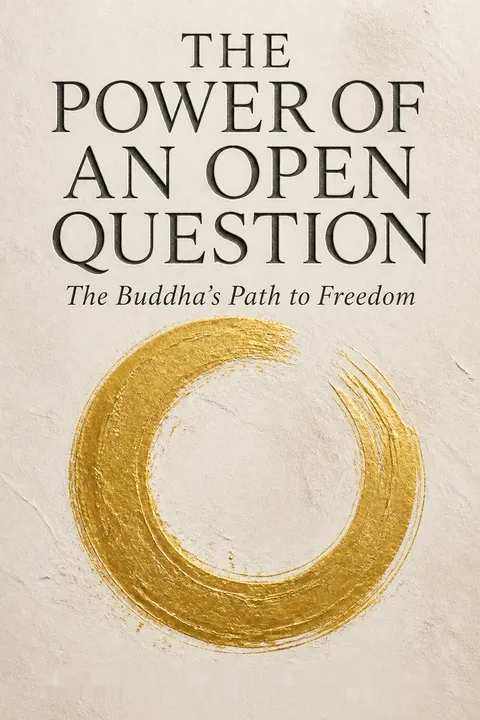
The Power of an Open Question receives mostly positive reviews, with readers appreciating its accessible approach to Buddhism. Many find it insightful and thought-provoking, praising the author's fresh perspective and relatable examples. Some readers note that while the book covers familiar Buddhist concepts, it offers a unique emphasis on remaining open to questions without seeking definitive answers. Critics mention the author's potential bias towards her lineage and the book's scattered presentation of advanced concepts. Overall, readers find it a helpful introduction or refresher on Buddhist teachings.
People Also Read





Glossary
Open question
Inquiry without forced closureA question held as a continuing practice rather than a problem that must yield a final answer. It keeps attention active while loosening the demand for certainty. In the book, the open question is central to facing change, suffering, and the limits of ordinary explanations without either withdrawing or reaching for a premature conclusion.
Middle Way
Inquiry beyond opposing extremesThe Buddhist path that questions both the attempt to secure lasting happiness through worldly things and the attempt to escape experience by rejecting it. It is not simply a moderate compromise. In this book, it means investigating how self and world are experienced without asserting that things exist independently or denying that they appear and function.
Emptiness
Lack of independent existenceThe Buddhist teaching that things do not possess a fixed, self-sufficient essence apart from causes, conditions, parts, and relationships. Emptiness does not mean that nothing exists or that experience has no consequences. The book presents it as the open potential that allows things to arise and change, and as a way to know experience without reducing it to fixed objects.
zopa
Patience with boundarylessnessA Tibetan term translated in several ways, including patience, endurance, or tolerance. The book emphasizes a specialized sense drawn from Patrul Rinpoche: the capacity to bear the truth that things have no independent boundaries. This is not merely putting up with an unpleasant situation. It means staying open to a fuller experience instead of shrinking it through rejection or fixation.
Objectification
Fixing experience into thingsThe habit of drawing conceptual boundaries around changing experience and treating what is inside them as fixed, separate, and fully knowable. A person, feeling, or event then becomes a limited object of attachment, aversion, or judgment. The book argues that objectification narrows perception and helps generate the reactive patterns through which suffering and conflict grow.
Karma
Activity and its consequencesThe book stresses the Sanskrit meaning of karma as activity, rather than a divine system of punishment or reward. It describes the causal movement of experience shaped by actions and conditions. In the author's account, objectifying and grasping reinforce suffering, while actions that open toward interdependence support well-being and insight.
One taste
Equal nature within varied experienceA Vajrayana expression for recognizing that all appearances share the same boundaryless nature, whether pleasant or unpleasant, ordinary or unusual. It does not mean that every experience tastes or functions identically, or that practical discernment disappears. The book illustrates the idea through a ritual feast and the effort to experience food without being governed entirely by preference.
Blindism
Unquestioning spiritual complianceThe unexamined reliance on what a tradition, teacher, or practitioner is supposedly required to do. Blindism replaces personal investigation with accumulated shoulds and can cause a student to distrust their own discernment. The book contrasts it with doubtism and proposes testing teachings through active, thoughtful engagement.
Doubtism
Closed, self-confirming skepticismA settled skepticism that assumes the path, teacher, or practice has already been disproved. Unlike genuine questioning, doubtism stops inquiry by treating suspicion as the final verdict. In the book, it is the opposite pole from blindism, and both prevent a practitioner from combining personal discernment with the guidance of teachings.
Mark of non-creating
Creativity without forced controlThe state of natural creative expression described through painting practice. The artist continues working but does not impose judgments and preferences on every emerging mark. When fixed ideas have loosened, the work can develop without being forced toward a predetermined result. The term also points to a broader way of relating to experience with less manipulation.
FAQ
What is "The Power of an Open Question" by Elizabeth Mattis Namgyel about?
- Exploration of Uncertainty: The book explores how embracing uncertainty and living with open questions is central to the Buddha’s path to freedom.
- Middle Way Philosophy: It presents the Buddhist Middle Way as a method of inquiry that avoids extremes and encourages direct engagement with life’s complexity.
- Personal and Practical: Through personal stories, Buddhist philosophy, and practical advice, Namgyel illustrates how open questioning leads to wisdom, compassion, and liberation.
- Transforming Suffering: The book shows how staying present with life’s unpredictability, rather than seeking fixed answers, can transform suffering into insight and freedom.
Why should I read "The Power of an Open Question" by Elizabeth Mattis Namgyel?
- Accessible Buddhist Wisdom: The book makes profound Buddhist teachings accessible and relevant to modern readers, regardless of their background.
- Practical Application: It offers practical tools for working with uncertainty, suffering, and the challenges of daily life.
- Personal Growth: Readers are encouraged to cultivate curiosity, openness, and resilience, leading to greater self-understanding and compassion.
- Unique Perspective: Namgyel’s approach emphasizes inquiry over dogma, making it valuable for anyone interested in spiritual growth, mindfulness, or philosophical exploration.
What are the key takeaways from "The Power of an Open Question"?
- Embrace Not-Knowing: Openness to uncertainty is not a weakness but a source of creativity, intelligence, and freedom.
- Middle Way Practice: The Middle Way is not about balance between extremes, but about transcending fixed views and engaging life with inquiry.
- Objectification Causes Suffering: Suffering arises when we objectify experiences, people, or ourselves; liberation comes from seeing the boundaryless nature of things.
- Practice of Inclusion: True healing and transformation come from including all experiences—pleasant and unpleasant—rather than rejecting or clinging to them.
How does Elizabeth Mattis Namgyel define and use the concept of "an open question"?
- Active Engagement: An open question is a state of mind that is engaged, curious, and free from the need for absolute answers.
- Path to Wisdom: By living with open questions, we access our deepest intelligence and creativity, as opposed to clinging to fixed conclusions.
- Personal Koan: Namgyel frames her own spiritual journey as a personal koan—an ongoing, living question about how to live a life we cannot hold onto.
- Buddha’s Example: The Buddha’s enlightenment is presented as the result of living with, rather than resolving, the fundamental questions of existence.
What is the Middle Way according to "The Power of an Open Question"?
- Beyond Extremes: The Middle Way is not a compromise between opposites, but a path that transcends both affirmation and denial.
- Inquiry Over Answers: It is a process of inquiry that questions the nature of existence, self, suffering, and happiness without settling on fixed views.
- Dynamic Engagement: The Middle Way encourages dynamic engagement with life’s complexity, rather than retreating into certainty or nihilism.
- Foundation for Freedom: This approach leads to a certitude beyond conclusions, opening the door to genuine freedom and compassion.
How does "The Power of an Open Question" explain suffering and its transformation?
- Suffering as Universal: Suffering is not a personal failing but a universal aspect of existence, arising from the unreliable nature of things.
- From "I am suffering" to "There is suffering": The book encourages shifting perspective from personal identification with suffering to recognizing its universality.
- Inclusion, Not Avoidance: Transformation comes from including suffering in our awareness, rather than trying to fix, avoid, or deny it.
- Gateway to Awakening: By staying present with suffering, we develop bravery, compassion, and insight—the very qualities that lead to liberation.
What does Elizabeth Mattis Namgyel mean by "objectification" and why is it important?
- Defining Objectification: Objectification is the habitual process of drawing boundaries around experiences, people, or things, making them static and separate.
- Root of Suffering: This process leads to attachment, aversion, and confusion, fueling the cycle of suffering (samsara).
- Breaking the Habit: Recognizing and relaxing objectification allows us to experience the boundaryless, interconnected nature of reality.
- Path to Compassion: When we stop objectifying, we naturally feel more tenderness, understanding, and compassion for ourselves and others.
How does "The Power of an Open Question" address the concept of "emptiness"?
- Emptiness as Possibility: Emptiness (the "E" word) is not a void, but the limitless potential and boundaryless nature of all things.
- Central to Buddhism: Emptiness is at the heart of Buddhist wisdom, described as the "Mother of Transcendent Wisdom" (Prajnaparamita).
- Not Nihilism: Realizing emptiness does not mean denying experience, but seeing that things cannot be pinned down or possessed.
- Foundation for Fullness: Paradoxically, emptiness is what allows for a full, rich experience of life, free from clinging and fear.
What practical advice or methods does Elizabeth Mattis Namgyel offer in "The Power of an Open Question"?
- Stay Present: Practice staying present with whatever arises, especially in moments of uncertainty or discomfort.
- Question Assumptions: Regularly question your own beliefs, preferences, and the tendency to objectify experiences.
- Include Everything: Cultivate the ability to include all experiences—pleasant, unpleasant, or neutral—without judgment or avoidance.
- Service and Compassion: Engage in acts of service and generosity, which naturally decentralize the self and foster interdependence.
How does "The Power of an Open Question" relate to meditation and spiritual practice?
- Meditation as Inquiry: Meditation is presented as a laboratory for exploring the mind’s tendencies to exaggerate, deny, or objectify experience.
- Habituating Openness: The goal is to habituate oneself to openness, curiosity, and direct engagement with whatever arises.
- Beyond Techniques: The emphasis is less on specific techniques and more on the attitude of inquiry, inclusion, and non-manipulation.
- Everyday Practice: The principles can be applied in daily life, not just on the meditation cushion, making every moment an opportunity for awakening.
What are the most important concepts or terms explained in "The Power of an Open Question"?
- Open Question/Koan: Living inquiry that resists final answers and keeps the mind engaged and open.
- Middle Way: The path of inquiry that avoids extremes and fixed views.
- Objectification: The process of making things static and separate, leading to suffering.
- Emptiness/Thinglessness: The boundaryless, interdependent nature of all phenomena.
- Zopa (Tolerance): The ability to bear the truth of thinglessness without running away.
- One Taste: The practice of experiencing all phenomena equally, without preference or aversion.
What are the best quotes from "The Power of an Open Question" and what do they mean?
- “Faith is the mind of an open question.” – Faith, in this context, is not blind belief but the courage to live with uncertainty and curiosity.
- “The world is full of answers. If you ask a simple question, you can get a million of them, no problem. But have we ever been able to reach a point of absolute certainty about anything?” – This highlights the futility of seeking final answers and the value of inquiry.
- “When we stop objectifying things, in effect, we have nothing other to react to.” – Letting go of objectification dissolves the boundaries that create suffering and conflict.
- “True enjoyment has nothing to do with pleasure as opposed to pain... It is the experience of including and appreciating the magical and unfindable nature of all appearance.” – Real joy comes from embracing the fullness and mystery of life, not from chasing pleasure or avoiding pain.
- “Can I live my life as an open question?” – This is the central challenge and invitation of the book: to meet each moment with openness, curiosity, and presence.
Download PDF
Download EPUB
.epub digital book format is ideal for reading ebooks on phones, tablets, and e-readers.








