

Key Takeaways
Use meaningful coincidences as prompts toward a fuller, more integrated life.
Flow is a way of living. The book defines flow as life unfolding with a sense of ease, purpose, and growing wholeness. Its proposed doorway is synchronicity: a coincidence between an inner concern and an outside event that feels meaningful to the person experiencing it. The authors do not claim that people can summon these events on demand. They argue that attention, openness, and action make people more able to notice and learn from them.
A move begins with a hunch. Caylor Wadlington woke with the thought that he might move from Austin to Denver. An invitation took him there, a local school offered him work, and an unexpected buyer appeared for his business. He treated the sequence as encouragement to act. The value of the story lies in how he responded, not in proving that the events were arranged for him.
The most useful reading is psychological as well as spiritual: a coincidence can interrupt routine and prompt a person to reconsider what matters. Attention research helps explain why a newly important theme seems to appear everywhere; once something is salient, the mind spots related cues more readily. That does not make the experience worthless. It does mean that felt significance is a reason to reflect, not evidence that the universe has issued an instruction. The distinction lets readers keep the book's sense of wonder while retaining responsibility for their choices.
Interpret a coincidence through context before treating it as guidance.
Meaning needs a setting. The authors suggest first noticing an unlikely event, then considering why it matters in the current circumstances, and finally asking what it might mean for one's life. A chance meeting could be ordinary in a small town but striking abroad; it may matter more if it connects with a question already occupying the mind.
Patterns vary in scale. The book describes a single coincidence, a string of related events, and a cluster of different events that gather around a theme. The authors recommend recording such experiences and looking back for patterns. Their point is not that every repeated number or overheard phrase has a fixed message. Interpretation depends on personal associations, circumstances, and what the person chooses to do with the event.
This method resembles reflective practice: separate observation from interpretation, then ask what action follows. That sequence can reduce impulsive conclusions. A notebook can improve the process if it records ordinary outcomes and missed predictions as well as striking matches. Otherwise, selective memory can make a pattern look more reliable than it is. The framework is strongest when meanings remain provisional: a coincidence may offer a question to investigate, while evidence, practical consequences, and trusted perspectives help decide what to do.
Build the conditions for flow instead of chasing signs.
Character comes before coincidence. From interviews with 50 people they call flowmasters, along with surveys and focus groups, the authors identify recurring qualities that they associate with flow: commitment, honesty, courage, passion, presence, openness, receptivity, positivity, and trust. These qualities describe how people meet life, rather than a formula for producing supernatural events.
Integrity can simplify choices. Ron Chin built a career advising people on feng shui, the arrangement of spaces according to traditional Chinese principles. A period of personal and financial crisis forced him to face facts he had been avoiding, including his sexuality and debt. The authors describe honesty as helping him bring his public work and private life into better alignment. Their practical emphasis is on developing awareness and acting more consistently with one's values.
The nine qualities make an intuitive behavioral model: courage supports action, openness improves attention to options, and honesty reduces the effort spent maintaining a false front. These links are plausible without assuming a cosmic feedback system. The evidence described in the book is primarily interviews and self-reports, which can reveal useful patterns but cannot establish that these qualities cause coincidences. Readers can test the model by asking whether a practice improves decisions, relationships, or resilience, rather than using the number of uncanny events as the score.
Grow from knowing yourself toward serving people beyond yourself.
Growth widens its circle. The book presents transformation in three broad movements: first, recognizing one's values and loosening the grip of other people's expectations; then, becoming more attentive and useful to others; finally, feeling part of a larger whole. The authors stress that people move unevenly between these modes rather than climbing a fixed ladder.
A creek becomes a calling. John Beal, a Vietnam veteran facing serious health problems and emotional distress, began clearing garbage from a polluted stream near his home. His work gave him purpose, drew in volunteers, and expanded from a local cleanup into a broader effort to restore the watershed. His story connects personal recovery with service to a community and place. The book's point is that self-understanding can become more meaningful when it informs a contribution beyond the self.
This arc has a useful resemblance to developmental models that move from identity toward care and civic responsibility. Its strongest feature is that service is not framed as self-sacrifice alone: Beal found purpose through practical work that also helped his neighborhood. Still, the stages should be treated as a map, not a ranking of people. Caring for others can become avoidance or depletion when personal needs and boundaries disappear. A healthy movement outward depends on a self that is known, respected, and capable of saying no.
Quiet the mind, then test intuition against what happens.
Make room to notice. In the book, silence means a settled attention, not simply the absence of sound. Breathing, meditation, prayer, and mindful attention to ordinary details are offered as ways to create that space. The authors describe intuition as knowing without being able to explain the reasoning immediately. They discuss bodily sensations, emotions, sudden mental connections, and spiritual impressions as possible forms of it.
Keep a record of hunches. The practical advice is to notice how intuition arrives, try it first on low-stakes choices, and write down what happened. A sudden urge to call someone is easier to evaluate than a major decision about work or a relationship. Reviewing outcomes can help distinguish useful pattern recognition from fear, wishful thinking, or an old habit dressed up as certainty.
A quiet pause can improve judgment because stress narrows attention and makes familiar reactions feel inevitable. Intuition can also reflect rapid, unconscious pattern recognition, especially in areas where someone has experience. But a strong feeling is not automatically accurate. Anxiety, bias, and incomplete information can produce equally convincing signals. The book's advice to test small hunches is therefore important: it turns intuition from an unquestioned authority into a hypothesis that can be calibrated through experience.
Give a goal your full effort, then release control of results.
Effort and surrender belong together. One central practice is to do everything one currently knows to do, then stop trying to dictate the outcome. The authors present this as a way to stay engaged without becoming consumed by a particular result. Their warning is against using trust as an excuse for passivity: preparation, honest action, and follow-through still belong to the individual.
Preparation can open options. Susan LeTerneau spent a year examining why her relationships had not lasted. She worked with a therapist, reflected on her own patterns, and wrote a detailed list of what she wanted in a partner. Her personal advertisement drew 45 responses, and she met the man she later married. The story illustrates deliberate preparation followed by openness to what arrived, rather than waiting for fate to do the work.
This balance is compatible with a useful distinction in psychology between commitment to a process and rigid attachment to a specific outcome. People can plan, persist, and still adapt when new information arrives. That flexibility often protects motivation and reduces rumination. The story, however, is an anecdote, not proof that surrender attracts desired outcomes. Its practical lesson is more grounded: do the controllable work, then judge success partly by the quality of one's conduct and learning, not only by whether events obey the plan.
Finish or consciously abandon loose ends that keep attention trapped.
Unfinished business takes space. The authors argue that postponed tasks, broken promises, unresolved conversations, clutter, and old resentments can keep attention tied to the past or anxious about the future. Their approach is to choose: make a concrete next move, complete the matter, or consciously decide it is no longer worth doing. A task does not become more manageable simply by staying on a list for months.
Completion can be small. The book suggests trimming a to-do list, clearing out a few unneeded items each day, keeping promises, and handling difficult conversations with care. It also presents forgiveness as a way to reduce the hold of resentment, not as proof that the harm was acceptable. The goal is to free attention for present choices, not to pretend that every conflict can be neatly resolved.
This advice fits with research on cognitive load: unfinished tasks can occupy attention even when a person is trying to focus elsewhere. Turning a vague obligation into a specific next step, or deliberately dropping it, can reduce that mental drag. Yet completion should not be confused with reconciliation. In abusive or unsafe relationships, distance and protection may matter more than a final conversation or forgiveness. The useful principle is agency: decide what deserves action, what needs a boundary, and what can be released.
Take fears apart with small risks, not reckless leaps.
Stretch in manageable steps. The book treats risk as leaving a familiar pattern to make room for growth, not as pursuing danger for its own sake. Instead of confronting a major fear all at once, it recommends taking smaller steps that build confidence and reveal what the fear is actually about.
One step can change the next. Jan Effenberger, married to a verbally abusive partner, began with a music history course. Doing well helped her enter therapy, which strengthened her resolve to leave the marriage. She later took her children on a cross-country trip, an experience that increased her confidence and eventually helped her move to a new city. The story illustrates a sequence of risks that made a larger change possible. The authors also caution that risks should be planned so they do not harm oneself or others.
This is closely aligned with graded exposure, a therapeutic method in which a person approaches a feared situation in manageable increments instead of avoiding it or overwhelming themselves. Each step can provide new evidence about ability and danger. The essential qualifier is safety: discomfort can signal growth, but it can also signal genuine harm, financial strain, or coercion. Risk-taking is most useful when paired with preparation, support, and a clear distinction between fear of uncertainty and evidence of danger.
Turn gratitude into concrete reciprocity, not a private mood.
Gratitude reveals connection. The book treats thankfulness as recognition that daily life depends on many people and things, not merely as a pleasant feeling. It introduces Naikan, a Japanese practice of looking inward through three questions: What did I receive? What did I give? What difficulties did I cause? The questions encourage specific attention to ordinary acts of care.
A meal has many hands. The authors ask readers to consider the work behind something as simple as a restaurant salad, from growing and transporting it to preparing and serving it. This perspective can shift attention from what is missing toward what has been received, and from entitlement toward contribution. The book encourages small acts of service, while warning that generosity should not become manipulation or a demand for repayment.
Gratitude practices are associated with greater well-being and prosocial behavior, in part because they direct attention toward support that routine can make invisible. Naikan adds a distinctive discipline: it includes not only what was received but also what one gave and the burdens one caused. That wider accounting can strengthen humility and repair. Gratitude should not be used to deny exploitation or suffering, though. Appreciating help and naming injustice are compatible; thankfulness is not a substitute for fair treatment.
Treat stalled plans as information, not proof of cosmic rejection.
An ebb can prompt a review. When life feels blocked, the authors recommend checking for avoidable sources of strain: neglected tasks, low physical energy, fear, resentment, dishonesty, or a routine that no longer fits. They also suggest asking whether a goal is genuinely one's own or mainly an attempt to satisfy other people's expectations.
Obstacles need interpretation too. A failed plan might indicate a need to change direction, but it might also be a normal difficulty that calls for patience, skill, or persistence. The book's deeper claim is that challenges can expose habits that have narrowed a person's choices. It advises returning to awareness and taking a step that seems both honest and workable, rather than assuming that hardship means one has lost all connection to flow.
The diagnostic impulse is valuable: setbacks can reveal assumptions, missing skills, or conditions that need to change. The danger lies in reading every obstacle as a coded message from a benevolent universe. Such an interpretation can encourage useful reflection, but it can also rationalize bad luck or imply that people caused their own suffering through insufficient trust. A sounder test is to combine reflection with evidence: examine what can be changed, seek advice where needed, and accept that some events are not meaningful signals.
Use divination to widen perspective, never to outsource responsibility.
Symbols can prompt reflection. The book presents divination as an optional way to explore a question from a fresh angle. Examples include the I Ching, tarot, runes, sacred texts opened at random, and a pendulum. In the authors' account, the value lies less in predicting a fixed future than in noticing a response that surfaces thoughts or possibilities the person had not considered.
Keep your judgment. The authors caution that predictions can change as circumstances and choices change. A reading also reflects the limits and biases of the practitioner, and the book warns against anyone who uses fear, vague claims, or pressure to extract money. Any insight should be compared with one's own knowledge and with the likely consequences of acting on it. Divination is presented as a tool for inquiry, not an authority over a life.
A symbolic tool can help people externalize a dilemma: a card or passage gives the mind something concrete to interpret, sometimes revealing a preference that was difficult to state directly. That benefit does not establish predictive powers. Random outputs are especially easy to fit to a concern after the fact, and a confident reader can shape decisions through suggestion. The book's emphasis on skepticism, practitioner limits, and personal responsibility is therefore crucial. A reading may open a question; it should not close the decision.
Analysis
The book's strongest contribution is its attempt to turn an elusive experience into a repeatable practice. It does not offer a single technique for manufacturing coincidence. Instead, it links attention, self-knowledge, action, and interpretation: notice an event, relate it to an inner concern, and decide whether it suggests a useful next step. The stories make this model vivid, especially the shift from John Beal's private distress to hands-on restoration of a polluted stream. The narrative's emotional force comes from treating ordinary decisions and encounters as part of a larger human pattern.
Its evidence is less strong than its storytelling. The authors draw on interviews with 50 self-identified flowmasters, surveys, focus groups, and selected anecdotes. These sources can reveal how people make meaning, but they cannot show that coincidences are caused by a universal intelligence or that flow reliably produces material support. The book's appeal to quantum physics does not establish those claims. Nor do vivid coincidences provide a comparison group or a record of events that did not fit the pattern.
A careful reader can still use the framework without accepting its metaphysics. Meaning can be personally real and motivational without being proof of an external message. A coincidence may draw attention to a neglected desire, but evidence, ethics, and practical consequences should shape the response. The advice to build honesty, mindfulness, courage, gratitude, and service is often valuable on those ordinary grounds. The strongest version of the book is therefore not that the universe guarantees success to people who trust it. It is that openness and reflective action help people notice options, recover agency, and live with more coherence, even when outcomes remain uncertain.
Review Summary
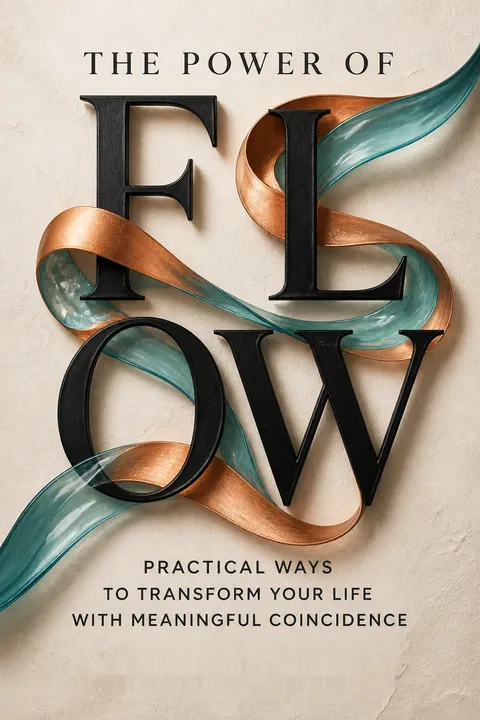
The Power of Flow receives mixed reviews, with ratings ranging from 1 to 5 stars. Some readers find it inspirational and appreciate its insights on intuition and synchronicity. They value the practical exercises and real-life examples provided. However, critics argue that the book lacks scientific rigor and relies heavily on anecdotal evidence. Some readers find it too "woo-woo" or superficial. The book discusses the concept of flow, defined as the natural unfolding of life towards wholeness and harmony, and offers techniques to cultivate it.
People Also Read




Glossary
Flow
Life unfolding toward wholenessThe book uses flow to mean a sense that life is unfolding with relative ease, purpose, and movement toward greater harmony. It is broader than intense absorption in a single activity. The authors present it as a continuing condition strengthened by self-awareness, openness, trust, and meaningful engagement with other people.
Synchronicity
Meaningful inner-outer coincidenceA coincidence between an inner experience, such as a thought, feeling, dream, or concern, and an external event, experienced as meaningful by the observer. The book follows Carl Jung's use of the term and emphasizes that the perceived meaning depends on the person's circumstances and associations. It distinguishes synchronicity from events that have a clear causal explanation.
Fortuitous events
Helpful events with causesUnexpected events that happen to work out especially well for a person's needs, but can still be explained through ordinary cause and effect. The book distinguishes them from synchronicity, which it defines as meaningful coincidence without an apparent causal connection. Both types of event are treated as signs that circumstances are aligning in a helpful way.
Flowmasters
People committed to living in flowThe authors' label for people they interviewed who described themselves as deeply engaged in a life of meaning, openness, and trust. The 50 interviewees came from varied ages, occupations, and communities. Their stories and self-reports informed the book's proposed qualities and practices, but the label does not refer to a clinical category or measured level of ability.
Naikan
Structured reflection on giving and receivingA Japanese practice of self-examination, presented in the book as a way to cultivate gratitude and see one's interdependence with others. Practitioners review specific periods of life by asking what they received from another person, what they gave, and what difficulties they caused. The practice emphasizes concrete memories rather than general judgments.
Clusters of synchronicities
Linked coincidences around a themeA sequence of different meaningful coincidences that gather over time around one issue and suggest several related interpretations. The authors distinguish a cluster from a simple string because a cluster involves multiple kinds of event and layers of meaning. They present clusters as prompts for broader reflection, not as messages with one universally fixed translation.
Download PDF
Download EPUB
.epub digital book format is ideal for reading ebooks on phones, tablets, and e-readers.








