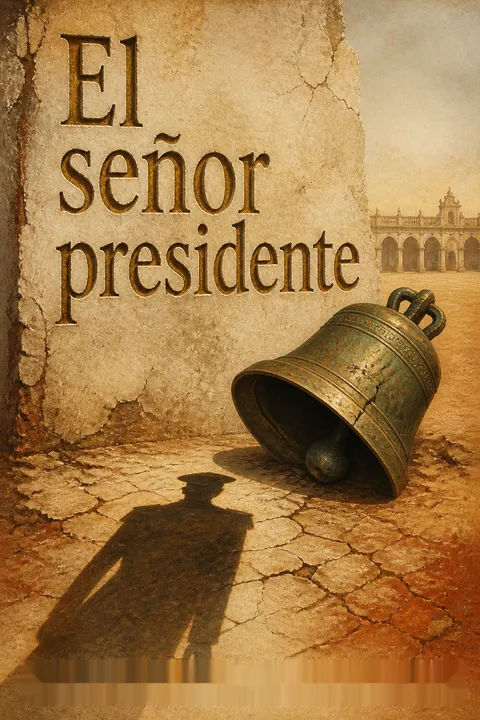


Plot Summary
A Joke Becomes Murder
The Cathedral porch is home to beggars who survive by guarding scraps, trading insults, and sleeping with one eye open. Among them, the Zany is especially vulnerable: people across the city torment him by shouting about his mother, a word that sends him into terror.
One night Colonel José Parrales Sonriente, a powerful officer nicknamed the Man with the Little Mule, finds him asleep and repeats the taunt. The Zany attacks before the colonel can draw a weapon, clawing and biting him until he lies dead. The idiot runs into the darkness, frightened by what he has done. By dawn, his impulsive defense has given the President's government a convenient murder to exploit.
The killing begins with a person treated as less than fully human, then turns his involuntary reaction into a political opportunity. The Zany does not act from ideology or strategy; he responds to cruelty with the only force available to him. That distinction matters because the state will soon replace his actual agency with a fabricated political motive. The opening also makes the porch a miniature of the wider country: people are exposed to violence, yet power belongs to whoever can control the account of what happened.
The Verdict Comes First
Police sweep up the porch beggars and question them about the colonel's death. They identify the Zany, whom they saw attack Parrales, but the Judge Advocate General rejects their answer. Under beatings and suspension by their thumbs, the prisoners are told that General Eusebio Canales and the lawyer Abel Carvajal committed the murder. Most repeat the accusation to stop the pain.
The blind, legless Mosquito refuses to change his account, insisting that the Zany acted alone. The officers whip him until he dies, then dismiss his testimony as worthless. The Judge Advocate carries the dictated story to the President, while the surviving beggars return to the streets knowing that what they witnessed has no standing against power.
The inquiry is not designed to discover a culprit. It is a performance in which the verdict precedes the evidence, and torture supplies the appearance of agreement. The Mosquito's resistance exposes the system's precise moral inversion: the truthful witness is treated as unreliable because he is powerless, while coerced testimony is accepted because it serves authority. The scene also establishes how the President governs at a distance. He need not personally interrogate anyone; institutions anticipate what he wants and manufacture facts that will travel upward as official truth.
The Zany Is Hunted
The Zany runs through the poor districts, pursued by memories of the taunt and by people who have made sport of his fear. He sleeps on a rubbish heap, where vultures attack him; a fall leaves his leg broken and his lip torn. Fever turns his flight into a jumble of childhood memories, imagined journeys, and a mother's tenderness he has rarely known.
A woodcutter discovers him and begins carrying him toward shelter. Miguel Angel Face, the President's elegant confidant, appears and helps the woodcutter lift the wounded man. Before leaving, Angel Face slips money into the Zany's pocket. The rescue gives the fugitive a brief reprieve, but it also places Angel Face near a crime the regime is preparing to weaponize.
The Zany's delirium gives the narrative access to a life that public cruelty has reduced to a spectacle. His visions of his mother are not an explanation that cancels the harm he caused, but a glimpse of the human need beneath his frightening behavior. Angel Face's small act of aid complicates his role: he can recognize suffering even while serving the machinery that produces it. The woodcutter's practical compassion offers a brief alternative to both mob cruelty and state violence, though it cannot protect the injured man for long.
Orders from the Palace
Doctor Luis Barreno reports that contaminated purgative has killed 140 soldiers in the military hospital. The President answers the medical warning as an attack on his government's reputation. A clerk then spills ink on a document and is ordered to receive 200 lashes; he dies, and the President calmly orders the next course at lunch.
Afterward, Angel Face arrives from the rubbish heap, where he helped the wounded Zany. The President tells him that Canales has been blamed for Parrales's death and must flee before arrest, though the authorities are meant to prevent that escape. Angel Face is to make the warning seem personal and help Canales leave. The secret instruction turns a rescue mission into a trap whose real purpose remains hidden.
These incidents show a regime that treats human beings as expendable instruments and reputation as its only public good. Barreno's evidence threatens no abstract principle; it identifies a specific cause of soldiers' deaths, yet the President hears only an injury to his name. The clerk's punishment makes that logic grotesquely literal. Angel Face's assignment adds a subtler danger: even apparent mercy is controlled by the state. When every action can be staged, protection and betrayal become difficult to distinguish.
The Porch Is Silenced
After drinking with his friend Genaro Rodas, the policeman Lucio Vasquez boasts that he has been ordered to kill the Zany, whom the authorities falsely describe as rabid. They find him crawling back to the Cathedral porch, badly wounded and unable to defend himself. Vasquez drags him toward the steps and shoots him twice. Rodas witnesses the killing but does not intervene.
The city soon turns the death into a grotesque puppet show, where children laugh at marionettes that cry and suffer blows. At home, Rodas sees the Zany's dead, glassy eye in a hallucination that will not leave his fingers. His fear grows when he remembers that Vasquez also revealed the planned abduction of Canales's daughter.
The murder converts a victim of public cruelty into a silenced witness, while the puppet show makes violence into entertainment. Rodas's vision of the dead eye is the body's refusal to accept the story he will later tell to save himself. His guilt is not heroic resistance; it is the uneasy knowledge that he watched and remained alive. That compromised witness becomes useful to the state, which can pressure him through fear, ambition, and his attachment to his family.
A Flight Disguised as Theft
Angel Face arranges for Canales to leave his house during a staged burglary. Camila, the general's fifteen-year-old daughter, is instructed to summon the police, drawing them toward the front while her father slips out through the back. But Angel Face has told the President about the plan, and the officers turn the house into a looting ground.
Vasquez and his accomplices strike the old nurse, La Chabelona, and Angel Face carries Camila to the Two-Step Tavern. The scheme lets Canales escape the immediate cordon, but separates him from his daughter and leaves her frightened and displaced. Angel Face refuses to exploit her when he sees her distress, and promises to find her relatives and news of her father.
The apparent rescue is built from incompatible motives. Canales accepts Angel Face's warning because flight offers his only chance of survival; the President permits the escape because it can later be represented as evidence of guilt. Meanwhile, the looters turn a carefully planned diversion into real violence. Angel Face's restraint toward Camila is significant, but it does not erase his role in a plan that has made her vulnerable. The episode shows how authoritarian power absorbs even private loyalties into its own designs.
A Warning Becomes Treason
Fedina de Rodas, Genaro's wife and the mother of a newborn boy, learns that Canales is to be arrested and that Camila may be kidnapped. She hurries to warn the general, but arrives after the household has been ransacked. La Chabelona, injured and delirious, mistakes her search for Camila for a game of hide-and-seek.
Fedina finds Canales's farewell letter and takes it, then soldiers arrest her before she can leave. The Judge Advocate also arrests Abel Carvajal, a lawyer with no part in the killing, and places him in a cell with a student and a sacristan. Fedina's ordinary act of concern is recast as assistance to a political fugitive, giving the authorities leverage over her family.
Fedina's predicament grows from a collision between domestic care and political suspicion. She moves because Camila is in danger, not because she has joined a conspiracy, yet the state treats compassion as evidence of allegiance. The letter she takes becomes a material trace that can be used against her. Carvajal's arrest broadens the pattern: association, proximity, and usefulness matter more than culpability. By making private relationships prosecutable, the government ensures that no household can remain outside politics.
Milk Turns to Lime
The Judge Advocate interrogates Fedina about Canales's escape and demands his hiding place. She knows nothing, but he makes her listen to her hungry baby crying beyond the room, then uses the child's suffering to force a confession. When she still cannot give him the answer he wants, guards make her crush quicklime for hours.
The dust splits her hands and contaminates the milk in her breasts. Her baby refuses to feed and dies in her arms in the cell. The President later orders the case against Fedina dropped, not out of concern for her or her child, but because the inquiry has failed to capture Canales. The order arrives too late to undo what the interrogation has done.
The torture attacks Fedina through the bond that defines her sense of self. The authorities do not merely threaten her body; they turn motherhood into an instrument of interrogation, making her child's cries a measure of their control. Her silence is not a political gesture but an exhausted insistence on facts she cannot supply. The President's eventual intervention exposes the regime's utilitarian mercy: violence stops when it no longer serves the search, not when its victims have been made whole.
Sold for Ten Thousand
The Judge Advocate accepts 10,000 pesos from Dona Chon Gold-Tooth, a brothel proprietor, in exchange for Fedina, whom he falsely presents as a woman fit for the business. Still holding her infant's corpse, Fedina is taken from prison to The Sweet Enchantment. The other women try to feed and comfort her, but she will not open her eyes or release the child.
When the cook finally forces her arms apart, Fedina collapses. She is sent to the hospital, while the brothel workers arrange a wake for the baby and bury him. Later, the Judge Advocate fabricates a claim that Fedina's husband accepted money to compensate for her supposed corruption, using an official document to make exploitation look consensual.
The sale extends state violence beyond the prison walls by turning a captive into property and a bureaucratic transaction. Fedina's refusal to release her child preserves the only relationship the authorities have not yet managed to redefine for her. The brothel's women offer a fragile counter-community, but their kindness cannot undo the state's control of her body or the loss of her infant. The forged compensation document reveals how paperwork can launder coercion into apparent agreement.
No Family Door Opens
While Canales is gone, Angel Face takes Camila to her uncle Juan's house, believing relatives can shelter her. The door stays shut despite her repeated knocking. Angel Face then admits that Juan and the other uncles have rejected her father to protect their standing with the President.
Camila refuses to remain at the tavern as Angel Face's dependent and insists on going elsewhere. Her fear and exhaustion deepen into pneumonia, and she nearly dies under the care of the barkeeper and Angel Face.
The Judge Advocate meanwhile offers Fedina to the brothel and pursues vengeance against anyone who challenges him. For Camila, the closed family door makes political disgrace immediate: she has lost both her home and the protection she expected from kin.
The uncles' refusal makes respectability a form of self-preservation. They do not need to endorse the President openly; they protect themselves by withdrawing hospitality from a relative whose father has become dangerous to know. Camila's insistence on reaching them is not naïveté so much as a child's reliance on the family structure she has always inhabited. Its collapse leaves her dependent on Angel Face, whose care is real but entangled with the power imbalance created by her abduction.
Canales Crosses the Border
Canales rides through the mountains with the help of an Indian who is fleeing after officials stole his land, seized his mules, imprisoned his sons, and left his family ruined. The account unsettles the general's former belief that military honor is enough to justify his service. At a village, three sisters hide him, but a corrupt doctor threatens to take their house over an unpaid bill for their mother's treatment.
Canales shoots the doctor as he leaves with a smuggler, then crosses the frontier. He resolves to lead a revolution against the President's government, promising land, fairer access to water, schools, and accountable public rule. The journey gives his flight a political purpose, though the rebellion will begin without him.
The Indian's story changes Canales by forcing him to see that the army's violence is not an accidental corruption of the nation he serves; it is part of how the nation is being governed. His decision to fight follows a concrete encounter with land theft and official impunity. Yet his killing of the doctor also shows how quickly resistance can reproduce the violence it opposes. The revolutionary program imagines structural remedies, while its first act remains an individual execution.
Carvajal's Court Is Theater
Carvajal is charged with helping Canales murder Parrales and overthrow the President. The indictment rests on statements extracted from the beggars, including people who witnessed the Zany's attack, and invents a conspiracy that never occurred. Given little time to read the charges, Carvajal faces a military tribunal whose members are drunk and whose sentence has already been prepared.
He cannot make the court listen to his defense. His wife tries to reach the President and begs for his life, but soldiers keep her away. Carvajal is executed with other prisoners. An anonymous witness later sends his widow an account of the shooting, but she cannot learn where his body was buried or secure permission to retrieve it.
The trial's formality does not restrain power; it gives violence an official costume. Carvajal is denied the elementary conditions of defense, while the tribunal converts a prewritten outcome into a legal event. His wife's failed petition makes the court's injustice intimate and practical: she cannot even mourn with certainty. The anonymous letters preserve evidence that public institutions suppress, but their secrecy also measures how thoroughly fear has broken civic trust.
Marriage at Death's Door
Doctors give Camila little chance of surviving her pneumonia. Angel Face, who has resisted taking advantage of her, stays beside her as the illness worsens. A neighborhood teacher believes that marriage may give her a reason to live, and the local priest performs the ceremony with Camila barely conscious. Angel Face becomes her husband at the threshold of death.
She recovers slowly, learning to walk again as he cares for her. Their bond grows beyond the coercive beginning of their acquaintance, though neither can undo the abduction or the political danger surrounding them. When Camila regains strength, their private life offers a brief refuge, but the President's attention still governs what they can safely hope for.
The marriage is at once a sincere act of devotion and a desperate intervention against death. Its emotional force is complicated by the conditions under which the relationship began: Angel Face's restraint does not erase the fact that he helped abduct Camila. Her recovery permits a new intimacy to form, but it cannot retroactively make their first encounter equal. The scene resists a simple romantic absolution. Care changes the relationship, while the political structure that made Camila vulnerable remains in place.
A Wedding Used as Propaganda
Once Camila can attend a public gathering, she and Angel Face appear at a celebration honoring the President's supposed survival from an earlier assassination attempt. The event is thick with flattery and staged enthusiasm. The President's newspaper reports that he witnessed the couple's wedding, though he was not present at the ceremony, making their marriage a public token of his favor.
Behind the spectacle, he tells Angel Face to travel to Washington and report on criticism of the regime. Angel Face understands that refusal is dangerous, but accepts the assignment rather than openly challenge the President. The public blessing and the foreign mission disguise a decision to remove a formerly trusted adviser from the capital.
The President absorbs private life into political theater. A marriage becomes evidence of his benevolence because the official account says he witnessed it, regardless of what actually happened. Angel Face's public visibility is therefore both protection and exposure: the regime can display him as loyal while preparing to discard him. The episode's central mechanism is not merely propaganda but compulsory participation. People must inhabit the story the state prints about them.
The Revolution Loses Canales
Canales's followers gather at the frontier, preparing to begin their revolt against the President. Their cause draws on promises to restore stolen land, distribute water fairly, and make public power answerable to the people. Before the troops can move, a rider brings news that Canales has died suddenly after a meal. His supporters suspect poison, though they cannot prove it.
Without their leader, the rebels lose their immediate plan and return to waiting, anger, and uncertainty. Camila learns by telephone that her father is dead, and the caller cruelly claims he died after believing the President had witnessed her wedding. The invented newspaper story thus reaches the family as a weapon after Canales can no longer answer it.
Canales's death removes the rebellion's organizing figure at the moment his followers are ready to act. Suspicion of poisoning is plausible within the regime's established methods, but the lack of proof is itself part of the political condition: violence can be widely understood and still remain officially unprovable. The false wedding story also demonstrates propaganda's afterlife. A fabricated image of presidential approval reaches Camila as personal grief and reaches the rebels as another reason to distrust the state.
The Port Becomes a Trap
The President sends Angel Face toward Washington with travel money and official assurances, but Major Farfan meets him at the port and arrests him before he can board. Soldiers take his passport, cheques, and wedding ring, while another man wearing his likeness leaves with his identity and luggage. Farfan's apparent friendship has only made the deception easier.
Angel Face is beaten and transferred to a prison cell where food and sanitation are instruments of torture. Years later, a planted cellmate, Vich, coaxes him into revealing that he loves Camila, giving the authorities the information they need to break his last source of hope. The prison report records his death as illness, concealing the regime's part in his destruction.
The arrest completes the pattern of false appearances that began with the supposed rescue of Canales. A government mission becomes a removal operation, a friend becomes an agent, and a body can be replaced by a convincing substitute. In prison, the state narrows its attack from political action to memory and attachment. Learning Camila's name allows officials to turn love into another pressure point. The bureaucratic death certificate then performs one final substitution, replacing responsibility with a diagnosis.
Camila Raises a Son Elsewhere
Camila waits for Angel Face's letters, but none arrives. Pregnant and increasingly isolated, she seeks news through officials and learns that he reached New York, though rumors place him elsewhere. The President's government refuses her a passport, blocking her attempt to join him. She consults a spiritualist and is told that her husband is dead, a claim she cannot verify.
After giving birth to a son, whom she names Miguel, she leaves the capital for the countryside. There she raises the child away from the city and never returns. Her life continues, but it is built around an absence she cannot resolve and a government that has decided even travel is beyond her choice.
Camila's ending is neither reunion nor clean closure. She survives by choosing a life beyond the capital, but the choice is made under constraints: denied travel, deprived of reliable news, and left to interpret silence. Her son gives her a future that does not depend on the President's permission, while his name carries the memory of the husband she cannot reach. Leaving the city is a form of agency, though not a remedy for the losses that forced her away.
Epilogue
The student and sacristan meet again outside the Archbishop's Palace, where the Cathedral porch has been demolished. The sacristan wears a cassock because the authorities ordered him to, while prisoners pass through the square under guard. The puppet-master, now mad, sings at a gendarme and cannot accept that the porch is gone.
His wife tries to protect him from arrest. The student and sacristan part, and the student returns home to hear his mother praying for the persecuted. The city continues its ordinary routines around the ruins, as if the destruction of a public place could erase what happened there.
The ending offers no overthrow of the regime and no restoration of the porch. Instead, it leaves the reader with altered people and a damaged landmark: the sacristan has been made to serve the institution that once condemned him, the puppet-master cannot adapt to the disappearance of his world, and the student still recognizes what official accounts conceal. Demolition is both literal erasure and an attempted rewriting of public memory. The mother's prayer preserves a private language of witness, but the prisoners in the square show that persecution remains active.
Analysis
The novel's central political insight is that dictatorship operates not only by force but by controlling the terms in which force can be recognized. A murder witnessed by many becomes a conspiracy attributed to different men; a staged escape becomes proof of guilt; an invented account of a wedding becomes a public fact. The state's paperwork, ceremonies, and rumors do not merely decorate violence. They make violence repeatable and difficult to contest. Asturias sets this machinery against people whose needs remain concrete: the Zany wants safety from torment, Fedina wants to feed her child, Camila wants her family to open its door, and Canales wants to believe military honor has meaning. Their vulnerability is not presented as a single moral weakness. It is the predictable result of a society where officials control food, work, movement, reputation, and the legal record. Even kindness becomes unstable. Angel Face's care for Camila is real, yet it begins in an abduction arranged by the regime and cannot free either of them from its reach.
The novel's shifting voices and dreamlike images make public terror feel internal. The glass eye that haunts Genaro, the darkness of the prison, and the Tohil vision express how political power enters perception itself. Yet the book preserves small acts of testimony: the Mosquito tells the truth, the student speaks of freedom, and anonymous witnesses write what official documents erase. These gestures do not defeat the President. They matter because they prevent the regime's version of reality from becoming the only one that survives.
Review Summary
El Señor Presidente is a powerful critique of dictatorship in Latin America, praised for its poetic language and vivid portrayal of oppression. Readers appreciate Asturias's use of magical realism and surrealism to create a nightmarish atmosphere. The novel's depiction of fear, corruption, and human suffering under tyranny resonates deeply. While some find the narrative challenging, many consider it a masterpiece of Latin American literature. The book's relevance endures, offering insight into the effects of authoritarianism on society and individuals.
People Also Read

Characters
The President
The President's enforcerThe unnamed ruler of the republic governs through surveillance, arbitrary punishment, staged loyalty, and the deliberate distortion of public events. He rarely needs to wield violence himself; officials, soldiers, and informers carry out his wishes while competing to anticipate them. His sensitivity to insult and reputation sits beside a practiced indifference to the lives sacrificed in his name. He understands that fear works best when people cannot tell whether an apparent kindness is genuine or another trap. The President's power depends not only on force but on making citizens repeat the story he has chosen for them.
Miguel Angel Face
The President's beautiful instrumentAngel Face is the President's confidential adviser, admired for his beauty and feared for his capacity to act without hesitation. His position requires him to move between cruelty and charm, and he has learned to read danger in small changes of tone or gesture. Beneath his practiced service lies a capacity for pity that appears when he helps the wounded Zany and later protects Camila from his own desire. He is not a simple convert from villainy to goodness: his care develops inside a relationship begun through coercion, while his work for the President continues to shape what choices remain available to him.
General Eusebio Canales
The army's discarded princeCanales is a decorated general whose military pride has long organized his sense of self. He believes in duty, family, and the dignity of the army, and initially struggles to accept that the President can punish him without regard to guilt or honor. Encounters with people harmed by land theft and official corruption force him to confront what his uniform has helped protect. His attachment to his daughter Camila gives his political disgrace a deeply personal cost. Canales is courageous, but his habits of command can make it difficult for him to see how ordinary people experience the power he has served.
Camila Canales
The general's daughter in flightCamila is a fifteen-year-old girl raised within a protective family circle, impatient with being treated as a child and curious about the world beyond it. Her father's political standing has made home feel secure, so the sudden violence around his disgrace leaves her without familiar protections. She is observant and proud, but not prepared for the choices adults make on her behalf. Her connection with Angel Face is complicated from the beginning by his role in her abduction and by the genuine care he later shows her. Camila's inner life is shaped by the tension between dependence, emerging desire, and the need to build a self beyond family reputation.
Fedina de Rodas
A mother caught in state violenceFedina is a working wife and new mother whose life is centered on her small shop, her husband Genaro, and their infant son. She acts quickly when she believes Camila and Canales are in danger, guided by practical compassion rather than political ambition. Her concern for others makes her vulnerable in a state that treats assistance as conspiracy. Fedina's identity is profoundly bound to motherhood, not as an abstract ideal but through feeding, protecting, and planning for her child. The authorities understand this attachment and use it against her, exposing how the regime reaches into the most intimate parts of ordinary life.
Abel Carvajal
The lawyer who will not bendCarvajal is a lawyer known as a liberal and opponent of clerical influence, but he is not shown plotting against the President. He approaches public life through law and professional responsibility, expecting procedure to retain some meaning even under pressure. His arrest reveals how little protection those principles offer when the state has decided on a result. In prison, he shares the darkness with a student and a sacristan, and his presence gives their conversations a human witness to the machinery of political punishment.
The Judge Advocate General
The regime's legal interrogatorThe Judge Advocate General turns state violence into paperwork, questioning, indictments, and sentences. He uses torture to produce the testimony he needs, and he treats legal authority as a personal instrument for revenge and profit. His appetite, petty resentments, and bureaucratic confidence make him more unsettling than a simple monster: he can inflict cruelty while regarding himself as an ordinary official doing his work. He represents a system in which legal procedure remains visible, but its purpose has shifted from justice to obedience.
Lucio Vasquez
A policeman chasing advancementVasquez is a policeman with a high, affected voice, a violent streak, and a hunger to rise within the Secret Police. He is devoted to the barkeeper La Masacuata, though his desire often turns into harassment and possessiveness. He can be cheerful, boastful, and frighteningly obedient to an order to kill. His friendship with Genaro Rodas makes him a conduit for rumors and official plots, while his blunt admissions reveal how easily state violence can be folded into an ordinary evening of drinking and favors.
Genaro Rodas
A frightened witness turned informerGenaro is Fedina's husband, an uncertain man who wants secure work and believes a position in the Secret Police might offer a way upward. He is more easily led than his wife and has trouble separating friendship from self-interest. His proximity to Vasquez draws him into events he does not control, and fear makes him both a witness and a potential tool for the authorities. Genaro's weakness is not unusual in this city: he wants safety and status, yet each attempt to obtain them leaves him more exposed to people with greater power.
The Zany
The tormented porch beggarKnown as the Zany, he is an intellectually disabled beggar whose terror of the word mother has become public amusement. His vulnerability makes him a target for children, adults, and fellow beggars, though he remains capable of sudden, desperate violence when cornered. His fragmented perceptions bring tenderness and horror into the same moments, especially in visions of the mother he longs for. The Zany is not a symbol stripped of personhood; he is a neglected man whose behavior is shaped by hunger, trauma, and a city that has learned to treat his distress as entertainment.
Colonel José Parrales Sonriente
The colonel with the muleParrales is a colonel close to the President and known by the nickname the Man with the Little Mule. His death becomes the occasion for a political case, while his own reputation includes a history of violence that few citizens can safely discuss. He matters less as a developed presence than as the event around which the government constructs its accusation.
The Mosquito
The blind truthful beggarThe Mosquito is a blind, legless beggar who refuses to change his account of Parrales's death under torture. He is sharp-tongued, proud, and accustomed to being ignored, but he insists that the Zany acted alone. His helplessness does not make him compliant, and his refusal exposes the difference between testimony and truth in the regime's inquiry.
La Chabelona
Camila's devoted old nurseLa Chabelona is Camila's old nurse and a familiar, protective presence in the Canales household. Her affection is expressed through routines and watchfulness, particularly when Camila is frightened or impulsive. She belongs to the domestic world Camila loses when the house is ransacked, and her loyalty makes her a target during the abduction.
La Masacuata
The barkeeper with a conscienceLa Masacuata runs the Two-Step Tavern and has a difficult, affectionate relationship with Vasquez. Her rough speech and hard-edged humor conceal a willingness to help Camila when the girl is suddenly displaced. She gives her shelter, charcoal water, and practical care without pretending that her tavern is safe or respectable. Her hospitality offers a limited form of solidarity in a city where respectable relatives withdraw support as soon as danger appears.
Dona Chon Gold-Tooth
The brothel's calculating ownerDona Chon Gold-Tooth owns The Sweet Enchantment, a brothel whose women live under her authority and depend on its precarious economy. She is shrewd, theatrical, and protective of her money, yet she can also respond to suffering among the women in her care. Her attempt to buy Fedina reveals how commerce and state power meet in the exploitation of the vulnerable.
Major Farfan
The officer who betrays trustMajor Farfan is a military officer whose appetite for drink and women makes him vulnerable to political surveillance. Angel Face once warns him of a plot against his life, creating an apparent debt between them. Farfan's connection to the President's machinery shows how favors can become leverage and how personal gratitude offers little protection when orders change.
Doctor Luis Barreno
The doctor with evidenceBarreno is a military doctor who investigates a deadly hospital outbreak and traces it to contaminated purgative. He believes professional evidence should matter, but he is unprepared for a ruler who treats factual reporting as disloyalty. His encounter with the President shows how expertise becomes dangerous when it contradicts official reputation.
The Woodcutter
A stranger who offers aidThe woodcutter discovers the injured Zany in the rubbish and helps carry him toward shelter. Poor himself, he measures well-being through work, family, and a place to live rather than wealth or status. His practical kindness briefly interrupts the city's pattern of abandonment.
The Indian
The dispossessed guideThe Indian who guides Canales through the countryside has lost land, animals, sons, and wife through official corruption. He explains his desperate acts not as a defense of crime but as the consequence of being robbed of every lawful means to live. His account forces Canales to see the human cost behind military and government order.
The Student
The young voice for freedomThe student is imprisoned alongside the sacristan and later Carvajal. Frail and frightened, he nevertheless imagines resistance and insists that prisoners can still speak about freedom. His hope stands in sharp contrast to the cell's darkness and to the resignation of those who have survived longer under the regime.
The Sacristan
A prisoner of mistaken ordersThe sacristan is jailed after removing a notice he cannot read, mistaking it for another church announcement. He is pious and fearful, inclined to understand suffering as divine will, yet he remains a companion to the other prisoners. His case shows how ignorance, accident, and political paranoia can converge into punishment.
Plot Devices
The fabricated indictment
Truth replaced by testimonyThe Judge Advocate forces the porch beggars to accuse Canales and Carvajal, despite their eyewitness account that the Zany killed Parrales. The resulting statements become evidence for arrests, a military trial, and Carvajal's execution. The device shows how the regime does not merely conceal facts; it manufactures an official record that can be used to punish people who threaten or inconvenience it.
The staged escape
Rescue doubles as a trapThe President secretly orders Angel Face to warn Canales to flee, while the authorities maintain a watch and prepare to treat the escape as proof of guilt. The diversion also enables the abduction of Camila and the looting of the general's house. This plot device makes protection indistinguishable from manipulation, illustrating how the regime turns private loyalty into an instrument of surveillance.
The President's reports
Surveillance through ordinary lifeInformers record visits, overheard remarks, family connections, and even damaged public notices for the President. The mail-bag sequence gathers these reports beside desperate petitions and official requests, making surveillance feel both vast and mundane. The device shows that the state does not need a single dramatic conspiracy to control its citizens; it accumulates ordinary details until every private act can be interpreted as evidence.
Tohil and sacrifice
Myth shadows political violenceThe vision of Tohil, the giver of fire, appears as Angel Face faces the President's power. In the vision, tribes agree to hunt other people in exchange for warmth and survival. The mythic image reframes political violence as an ancient bargain renewed in modern institutions: security is granted to some at the price of making others prey. It also connects the country's indigenous spiritual world to the novel's critique of authoritarian rule.
Download PDF
Download EPUB
.epub digital book format is ideal for reading ebooks on phones, tablets, and e-readers.








