

Key Takeaways
Call it procrastination only when delay knowingly works against your interests
Delay is not enough. Procrastination means voluntarily postponing something despite believing the delay will leave you worse off. Waiting to avoid useless work, respond to an emergency, or choose a better moment can be prudent. A person who compulsively finishes every task immediately may schedule just as poorly as someone who puts everything off.
A common struggle. The author reports that about 95 percent of people admit to procrastinating, with roughly a quarter describing it as chronic. That does not make every postponement harmless, but it does challenge the idea that procrastination is simply laziness. The key question is whether the delay reflects a considered choice or a decision that repeatedly undermines what matters to you.
What's useful here is the distinction between delay and self-defeat. It prevents a productivity ideal from turning every pause into a moral failure. In decision science, waiting can have value when new information is coming or priorities may change. But repeated regret is evidence that a delay is not serving that purpose. The practical test is not whether a task began early, but whether the timing was chosen deliberately and fits the person's real priorities.
Raise confidence and task appeal, then shorten the wait for payoff
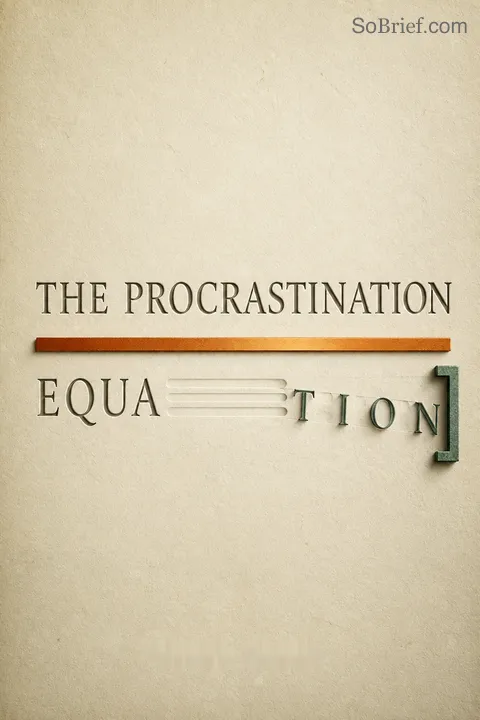
A compact model. The Procrastination Equation describes motivation as rising with expectancy, the belief that effort can succeed, and value, how appealing the task or reward seems. Motivation falls as delay grows, especially for people who are more impulsive and discount distant outcomes. It is a useful map of pressures, not a calculation the brain consciously performs.
Three familiar cases. Eddie loses confidence after repeated sales rejections. Valerie avoids writing because she finds it dull. Tom delays booking a hotel because the vacation is far away and immediate distractions feel better. Their behavior looks similar, but each needs a different fix: strengthen belief in success, improve the task's appeal, or bring consequences closer.
The model's strength is diagnostic: it replaces the unhelpful instruction to try harder with questions about confidence, appeal, delay, and susceptibility to immediate rewards. That resembles behavioral economics, which explains choices through changing incentives and timing rather than perfect rationality. Its limitation is that the terms are not standardized units, so the equation cannot predict an individual's exact start date. Its value is as a practical way to identify which motivational lever is weak.
Treat procrastination as an ancient impulse, not a character flaw
Two competing tendencies. The book describes an immediate-response system associated with emotion and reward, alongside executive functions that support planning and distant goals. This is a simplified account of a complex brain, but it helps explain why a vivid temptation can overpower an intention that once felt sincere. Stress, fatigue, alcohol, and youth can make self-control harder.
A mismatch with modern life. Humans developed in conditions where immediate food and safety mattered. Long projects, retirement plans, and distant deadlines demand patience across timelines our instincts do not naturally favor. In one experiment discussed in the book, pigeons chose to postpone work even when waiting meant doing more work for the same reward. Procrastination is not uniquely human, though humans face especially long-range demands.
This account reduces shame without excusing consequences: an impulse can be understandable and still need managing. It also points toward design, not just character, as a source of change. A task that depends on repeated self-control will be fragile when someone is tired or under pressure. The brain story should remain a metaphor, however, rather than a literal two-part battle. Planning, emotion, and attention involve interacting systems, not a simple rational executive fighting a single inner animal.
Move tempting rewards farther away before they capture your attention
Availability strengthens temptation. Steel's online Risk-style game repeatedly pulled him back because opponents made moves unpredictably. The uncertain timing of rewards kept the game interesting, much as unpredictable wins keep gamblers playing. A nearby distraction can therefore hold attention even when a less immediate task matters more.
A rising bar. Television, games, email, and social networks offer easy, frequent rewards that compete with work whose payoff arrives later. The book reports that the share of people calling procrastination a defining trait rose from about 4 to 5 percent in the 1970s to 20 to 25 percent around the time of writing. The comparison suggests an expanding problem, though it does not by itself prove that technology caused the increase.
The central insight is environmental: a temptation does not need to be irresistible if it is constantly within reach. This is closely related to choice architecture, the way defaults and access shape behavior before deliberate judgment begins. Removing an alert or moving a phone can outperform a vow to ignore it. Still, entertainment is not inherently an enemy, and the historical trend cited here cannot isolate technology from changes in reporting, work, or culture.
Count the cost in missed income, neglected health, and strained closeness
The damage accumulates. In a survey of about 4,000 people, respondents most often described trouble across work or education, personal development, and close relationships. The book connects these areas to wealth, health, and happiness. Procrastination can mean more than a late assignment: it can mean delayed treatment, debt, missed savings, or time withheld from people who matter.
Coleridge's cautionary life. The poet Samuel Taylor Coleridge left major works unfinished or delayed for years, accumulated financial problems, put off medical care, and lost a marriage and friendships. His story is an extreme case, but it reveals how small postponements can spread across a life. Procrastination also strains performance: the book argues that last-minute pressure tends to narrow creative work rather than unlock hidden brilliance.
This broad accounting matters because productivity is often measured only in output. The costs also include anxiety, foregone care, and attention divided during supposedly free time. Yet a survey showing that problems cluster does not establish that procrastination alone causes every financial, health, or relationship difficulty. Income, access to care, caregiving duties, and workplace conditions matter too. The most useful response is to locate the particular domain where delay is costly, rather than treating every unfinished task as equally urgent.
Build confidence with small wins, not grand promises to yourself
Earned optimism. A success spiral occurs when a manageable achievement strengthens confidence, making further effort more likely. A boy who struggled with self-belief kept trying at school after earning a martial arts belt through persistence. The important evidence was not a slogan, but a remembered accomplishment he could attribute to his own effort.
Pair hopes with obstacles. Mental contrasting means imagining a desired outcome, then identifying the real barrier between that future and the present. Positive fantasy alone can feel satisfying without producing action. The book also recommends realistic expectations: people often underestimate how long work will take, a bias called the planning fallacy. Small progress and an honest view of likely setbacks offer sturdier encouragement than promises of instant transformation.
Confidence is most useful when it is calibrated to evidence. Small wins can update a person's sense of capability, while planning for obstacles turns optimism into preparation. This resembles mastery learning, where progress comes from attainable challenges and feedback rather than reassurance alone. The caution is that failure does not always mean insufficient belief or effort. Poor instruction, unequal resources, and unrealistic demands can block success. Confidence-building works best when it improves skills and conditions, not when it teaches people to blame themselves more cheerfully.
Make dull work meaningful, engaging, and matched to your energy
Change the task's value. Boring work is easy to avoid, but its appeal is not always fixed. A routine chore can become a game with a time target or a personal best. Better still, connect it to a goal that matters: a tedious course assignment may be one step toward work that feels more worthwhile. Goals framed around what someone wants to achieve can motivate better than goals defined only by what they fear.
Work with your limits. The book advises tackling demanding tasks when energy is relatively high, protecting focused periods from interruptions, and using sleep and exercise to support attention. When a job is persistently draining, changing its design or finding work better suited to one's interests and abilities may help. Not every bad task can be made fun, and not everyone has the freedom to change jobs.
This section treats motivation as partly a property of the task, not merely a trait of the worker. That aligns with job-design research: autonomy, meaningful contribution, and useful feedback can make work more engaging. Games and personal goals are practical tools, but they should not disguise bad management or unsafe workloads. A person cannot privately gamify away a broken workplace. Where choice is limited, even a small connection between routine effort and a valued purpose may help without pretending the conditions are ideal.
Precommit before your future self starts bargaining for the distraction
Decide before the urge. Precommitment means arranging a choice now to protect a goal from a future change of mind. In Homer's Odyssey, Odysseus has his crew bind him to the ship's mast so he can hear the Sirens without steering toward them. For everyday tasks, the equivalent might be blocking distracting websites, leaving a phone outside the workspace, or making a costly bet against skipping a commitment.
Three ways to prepare. Remove access to the temptation, meet basic needs before they become urgent, or add a consequence for giving in. These strategies work by creating distance between impulse and action. They can fail if made too easy to undo, or become harmful if they prevent reasonable flexibility. A commitment should protect a considered goal, not punish someone for responding to an emergency.
Precommitment recognizes that preferences can shift with context. A plan made calmly may be more trustworthy than a decision made hungry, tired, or surrounded by cues. This is a powerful bridge between intention and action because it changes the choice set before temptation peaks. The ethical question is who controls the constraint. Self-chosen barriers can support autonomy; coercive rules or penalties imposed by others can undermine it. Effective commitment leaves room for genuine exceptions while making routine escape less convenient.
Turn distant ambitions into specific, near-term actions and routines
Give the future a handle. An abstract aim such as improving one's finances is hard to act on. A concrete next step, with a clear time, is easier to picture and begin. Break large work into short milestones, and use a small starter goal when the first few minutes feel hardest. The author points to students who delayed work until deadlines approached, then made sharp bursts of progress, often at a cost to performance.
Make action automatic. Implementation intentions are plans that link a cue to a response: when a particular situation occurs, a named action follows. A stable time and place can turn that plan into a routine, reducing the number of moments when distraction can win. Track progress when helpful, but avoid creating so many milestones that managing the plan becomes another project.
Specific plans reduce the translation burden between wanting a result and knowing what to do next. This is a form of cognitive offloading: the environment and schedule carry part of the memory and decision work. Proximal milestones also make distant consequences feel more immediate. The tradeoff is that measurable steps can narrow attention toward what is easy to count. A useful plan therefore pairs observable actions with a meaningful outcome, and gets revised when the original schedule no longer fits reality.
Protect leisure too; eliminating every impulse can flatten a life
Self-control needs balance. The book warns that trying to eradicate every delay can become its own mistake. Rest, play, and spontaneous time have value, while putting off a task is not automatically irrational if priorities have changed or a more urgent need intervenes. The aim is not to obey every impulse or suppress all of them, but to bring daily choices closer to the life a person actually endorses.
Measure what matters. A finished checklist is not the same as a good life. Someone can become highly efficient while neglecting friendship, recovery, or enjoyment. The book's closing stories about Eddie, Valerie, and Tom emphasize modest improvements, such as protecting time together, sharing household work according to preference, and making work more manageable. Progress means less avoidable regret, not a perfect record of productivity.
This ending prevents the framework from turning into another regime of self-surveillance. A humane account of self-regulation includes recovery and chosen pleasure, not only output. The distinction between procrastination and intentional leisure is especially important for people whose work or care responsibilities already consume their attention. At the same time, calling avoidance a lifestyle choice can conceal fear or exhaustion. The more revealing question is whether the choice feels genuinely restorative and aligned with priorities, or whether it leaves a growing trail of regret.
Analysis
The book's most useful contribution is not a promise that disciplined people can simply overpower temptation. It reframes procrastination as a predictable motivational conflict: tasks feel less worthwhile or achievable, distant rewards lose force, and immediate attractions dominate. That model is memorable because it turns a global self-judgment into a diagnosis with distinct levers. A person who doubts success needs different help from someone bored by a task or repeatedly pulled toward a nearby reward.
Its strongest practical implication is environmental. Specific goals, short milestones, reduced cues, and commitments made in advance lower the number of moments when a person must win an internal argument. This is a sophisticated alternative to treating willpower as the only tool. The book also wisely distinguishes useful delay from irrational postponement and warns that efficiency without meaningful leisure can become another form of misalignment.
The equation should not be mistaken for a literal predictive law. Its variables are concepts rather than calibrated quantities, and the brain is not neatly divided into an impulsive limbic system and a rational executive. Those labels make the story accessible, but contemporary neuroscience depicts decision-making as distributed and context-sensitive. The book's confident language about limited willpower also deserves qualification: the idea that self-control draws down a single finite resource has faced substantial debate and mixed replication. Fatigue still matters, but its mechanisms are more complex than a simple depleted tank.
A further limit is social context. Some delays reflect low confidence or distractibility; others reflect impossible workloads, unstable schedules, inaccessible health care, or work designed without autonomy. A personal strategy cannot fix every structural cause. The equation is most powerful when used as both self-management and task-design guidance: clarify what is controllable, change the environment where possible, and do not mistake institutional friction for a defective character. The book's durable message is compassionate but demanding: human beings are biased toward the immediate, yet practical arrangements can help long-range intentions survive contact with the present.
Review Summary
The Procrastination Equation receives mostly positive reviews, with readers appreciating its scientific approach and humor. Many find the book insightful, offering valuable strategies to combat procrastination. Some criticize the writing style as overly casual or redundant. Readers appreciate the author's explanation of the psychology behind procrastination and its evolutionary roots. While some find the practical advice helpful, others feel it lacks concrete steps. Overall, the book is praised for its unique perspective on a common problem, though opinions vary on its effectiveness.
People Also Read






Glossary
Procrastination Equation
Motivation modelA model of motivation in which expectancy, or belief in success, and value, or task appeal, increase motivation, while delay and impulsiveness reduce it. It explains why distant, unpleasant, or discouraging tasks are often postponed in favor of immediate rewards. The equation is intended as a simplifying guide to behavior, not a literal calculation performed by the brain.
Expectancy
Belief success is possibleIn the book's motivational model, expectancy is a person's belief that effort can produce the desired result. Low expectancy weakens motivation, especially when a task seems difficult or past attempts have failed. A discouraged job seeker or sales worker may avoid starting not because the reward is unimportant, but because success seems unlikely.
Value
Task appealValue is the subjective attractiveness of a task or its outcome. A task that feels interesting, enjoyable, or connected to an important goal has greater value and is easier to begin. Tedious paperwork or disliked writing tends to have low value. The same task can feel more worthwhile when linked to a personally meaningful purpose.
Impulsiveness
Sensitivity to immediate rewardsIn this book, impulsiveness describes a tendency to favor immediate pleasure over delayed benefit and to be strongly affected by distractions. It makes waiting feel costly, so distant deadlines exert little motivational force until they become close. Steel treats impulsiveness as the strongest personality-related contributor to chronic procrastination.
Intention-action gap
Plans that fail at executionThe intention-action gap is the distance between sincerely deciding to do something and actually doing it when the opportunity arrives. A person may make the same plan as a more punctual colleague, then abandon it when an immediate temptation becomes vivid. The Procrastination Equation explains this shift through changes in delay and the appeal of present rewards.
Learned helplessness
Expectation that effort cannot helpLearned helplessness is a pattern in which repeated experiences of having little control lead someone to stop trying, even when a later situation offers a chance to succeed. The book uses it to explain how low confidence can feed procrastination: expecting effort to fail makes starting less likely, which can then reinforce the expectation.
Planning fallacy
Underestimating task timeThe planning fallacy is the tendency to underestimate how long future tasks will take. People remember past work in a compressed form, often overlooking obstacles and effort. The resulting estimates leave less time than expected, making late starts riskier. Procrastinators are especially vulnerable because they already delay acting on their plans.
Success spiral
Achievement builds confidenceA success spiral is a reinforcing sequence in which a manageable achievement increases confidence, prompting further effort and new achievements. The book recommends setting challenges that require effort but remain possible, then noticing progress. The point is to build credible evidence of capability rather than rely on generic encouragement.
Mental contrasting
Compare goal with obstacleMental contrasting is a technique in which someone vividly considers a desired future, then compares it with current reality and identifies what stands in the way. This contrast can turn a pleasant fantasy into motivation and planning. The book argues that positive imagining without attention to present obstacles may feel rewarding without prompting action.
Precommitment
Bind future choicesPrecommitment means arranging a present choice to protect a goal from predictable future temptation. Examples include removing access to distractions, making a commitment with a financial consequence, or scheduling important activities in advance. It works by changing the future choice environment before an impulse becomes intense, though overly rigid commitments can block legitimate flexibility.
Stimulus control
Manage attention cuesStimulus control is the deliberate management of environmental cues that prompt distraction or support a desired action. A person might silence email alerts, remove game shortcuts, clear a desk, or reserve a particular space for work. The aim is to reduce reminders of temptation and make task-related cues easier to notice.
Implementation intentions
Cue-linked action plansImplementation intentions are specific plans that connect a recognizable situation or cue to an intended action. Instead of relying on a broad goal, a person decides what to do when a particular time, place, or event occurs. The book presents these plans as a way to make follow-through more automatic and reduce repeated decisions.
Learned industriousness
Effort gains rewarding associationsLearned industriousness is the idea that effort can become more rewarding when it is repeatedly followed by meaningful reinforcement. Self-praise, a planned treat, or recognition after completing difficult work can help associate the effort itself with positive feelings. Over time, this can make demanding tasks easier to approach.
False Hope Syndrome
Unrealistic change expectationsFalse Hope Syndrome describes the cycle of expecting a major personal change to happen quickly and easily, then feeling defeated when progress is slower or setbacks occur. The book recommends realistic goals and plans for lapses instead of promises of immediate, total transformation. Small, sustained improvements can be more motivating than perfection.
FAQ
What's The Procrastination Equation about?
- Understanding Procrastination: The book delves into the nature of procrastination, describing it as an "irrational delay" where tasks are postponed despite knowing the negative consequences.
- Impact on Individuals and Society: It examines both personal costs, like stress and missed opportunities, and broader societal impacts, such as economic losses.
- Strategies for Change: Piers Steel offers evidence-based strategies to help individuals overcome procrastination and boost productivity.
Why should I read The Procrastination Equation?
- Comprehensive Insights: The book provides a thorough exploration of procrastination's psychology, supported by extensive research.
- Practical Solutions: Readers gain actionable advice to combat procrastination, improving time management and personal fulfillment.
- Relatable Content: Steel uses engaging anecdotes and examples, making the material applicable to everyday life.
What are the key takeaways of The Procrastination Equation?
- Procrastination Equation: The book introduces a formula showing how motivation is influenced by expectancy, value, and delay, with impulsiveness increasing procrastination.
- Self-Understanding: It encourages readers to assess their procrastination tendencies and understand the underlying causes.
- Actionable Strategies: Offers strategies like success spirals and mental contrasting to help overcome procrastination.
What is the Procrastination Equation introduced by Piers Steel?
- Formula Breakdown: Expressed as Motivation = (Expectancy × Value) / Delay × Impulsiveness, illustrating how motivation decreases with delay and impulsiveness.
- Expectancy and Value: Expectancy is the belief in success likelihood, while value is the task's perceived importance or enjoyment.
- Role of Impulsiveness: Impulsiveness amplifies delay effects, making impulsive individuals more prone to procrastination.
How does The Procrastination Equation define procrastination?
- Irrational Delay: Defined as an "irrational delay," where tasks are postponed despite their importance, leading to negative outcomes.
- Not Laziness: Procrastination involves complex psychological factors, not just laziness, including fear of failure and impulsiveness.
- Cultural Phenomenon: It's a widespread issue affecting various demographics and professions.
What are some common causes of procrastination discussed in The Procrastination Equation?
- Low Expectancy: Lack of confidence in success can lead to avoidance of challenging tasks.
- Low Value: Tasks seen as boring or uninteresting are often postponed due to low motivation.
- Impulsiveness: A tendency to prioritize immediate gratification over long-term goals leads to procrastination.
What strategies does The Procrastination Equation suggest for overcoming procrastination?
- Success Spirals: Create small, achievable goals to build confidence and momentum.
- Mental Contrasting: Visualize desired outcomes and current obstacles to enhance motivation.
- Vicarious Victory: Surround yourself with motivated individuals or inspiring stories to encourage action.
How does expectancy influence procrastination in The Procrastination Equation?
- Expectancy Defined: It's the belief in one's ability to succeed, significantly impacting motivation.
- Low Expectancy Leads to Delay: Doubts about capabilities make tasks seem challenging, leading to procrastination.
- Boosting Expectancy: Set achievable goals, seek support, and reflect on past successes to build confidence.
What role does value play in procrastination according to The Procrastination Equation?
- Value Defined: Refers to the task's importance or desirability, varying greatly among individuals.
- High Value Reduces Procrastination: Tasks perceived as valuable are prioritized, reducing procrastination.
- Enhancing Task Value: Connect tasks to personal goals or future rewards to make them more appealing.
What are some practical strategies to overcome procrastination mentioned in The Procrastination Equation?
- Precommitment Techniques: Use deadlines, public commitments, or consequences for failure to enhance accountability.
- Breaking Tasks into Smaller Goals: Divide larger tasks into manageable sub-goals to make them less daunting.
- Managing Distractions: Eliminate environmental cues that lead to procrastination, like turning off notifications.
How does the book address the relationship between procrastination and self-control?
- Self-Control Defined: The ability to regulate impulses and delay gratification, crucial in combating procrastination.
- Impulsiveness Connection: Lower self-control leads to more procrastination, as immediate temptations are harder to resist.
- Improving Self-Control: Techniques like mindfulness, goal setting, and structured routines can enhance self-control.
What is the significance of the "unschedule" method in The Procrastination Equation?
- Definition of Unschedule: Prioritize leisure and personal time in your calendar before work tasks for a balanced approach.
- Boosting Motivation: Scheduling enjoyable activities first can recharge motivation for less appealing tasks.
- Practical Application: Helps individuals feel more in control of their time, reducing procrastination and enhancing satisfaction.
Download PDF
Download EPUB
.epub digital book format is ideal for reading ebooks on phones, tablets, and e-readers.








