


Key Takeaways
Separate necessary delay from the voluntary delay that quietly costs you
Not every delay is avoidance. Procrastination is the needless postponement of an intended action, despite knowing the delay may hurt performance or well-being. A working parent who postpones laundry to care for a sick child is making a necessary choice, not procrastinating. The distinction matters: aim to change avoidant delay, not to punish yourself for adapting to real demands. The book notes that procrastination can be chronic and widespread, affecting as many as one in five people in some research.
This distinction guards against turning productivity into a moral scorecard. A missed plan can reflect competing duties, uncertainty, or limited capacity, not a character flaw. That makes diagnosis more useful: ask whether the delay was chosen to avoid an available action, and whether the alternative served a meaningful priority. The author also links procrastination with lower achievement, distress, health risks, and regrets over unfulfilled intentions. Those associations matter, though they do not mean every delayed task causes harm. The practical test is whether a repeated pattern is displacing something the person genuinely values.
When a task hurts, procrastination offers relief now and trouble later
Relief reinforces avoidance. Pychyl frames procrastination as a failure of self-regulation: a person intends to act, feels unpleasant emotions about the task, and turns away to feel better in the moment. The task may provoke boredom, anxiety, resentment, or self-doubt. Avoiding it brings temporary relief, which makes avoidance more likely next time. The first response is to name the feeling and recognize the urge to escape it. Rather than waiting for discomfort to disappear, remain with the task long enough to make a small attempt.
This account connects procrastination to emotion regulation, not simply poor scheduling. That shift is useful because a calendar cannot resolve dread, confusion, or resentment. It also suggests a compassionate response: discomfort is information, not proof that a person is incapable. Still, not every aversive task deserves persistence. If the task is unnecessary, badly designed, or imposed unfairly, changing the task may be wiser than tolerating it. The key distinction is between escaping a worthwhile task because it feels bad and reconsidering a task that no longer merits effort.
Treat tomorrow's enthusiasm as a guess, not a requirement for action
Future moods are hard to predict. Affective forecasting is the attempt to predict how a person will feel later. The book explains two common errors: focalism, or paying too much attention to the present situation, and presentism, or assuming today's feelings will carry into the future. When someone postpones a report because tomorrow seems more appealing, the promise of future motivation may be wishful thinking. Instead, assume the task may still feel unpleasant tomorrow. Motivation does not have to arrive before action. A runner can go out in unappealing weather, and a worker can begin without feeling eager.
The important move is from mood-dependent action to intention-guided action. It resembles a central insight in behavioral economics: people often make plans in a calm state, then face different temptations and feelings when the moment arrives. Imagining the future vividly can help, but it is not a perfect fix, especially when distant consequences feel abstract. A more reliable safeguard is to remove the false condition that enthusiasm must come first. This does not mean ignoring exhaustion or distress. It means testing the belief that low motivation makes action impossible.
Make your excuses warning lights, not arguments you have to obey
Rationalizations reveal a pattern. Common excuses include believing there is plenty of time, that the task will take only a few hours, or that pressure improves performance. The book connects these thoughts to temporal discounting, the tendency to value immediate rewards more than distant ones, and the planning fallacy, the tendency to underestimate how long work takes. It also describes self-handicapping: delaying so a poor result can be blamed on limited time, while a good result seems especially impressive. An implementation intention is a pre-made if-then plan that links a cue to an action. Treat a familiar excuse as the cue to begin.
Excuses are not merely bad thoughts to suppress. They can expose what a person is protecting: immediate comfort, self-esteem, or relief from uncertainty. That makes them useful diagnostic evidence. A brief reality check can ask what similar tasks have actually required in the past, rather than relying on an optimistic estimate. The self-handicapping idea is especially revealing because delay can serve a psychological purpose even when it damages the work. A cue-based plan helps interrupt the loop, but it is most effective when the chosen action is specific and genuinely connected to a valued goal.
Lower the entry barrier until starting beats imagining the whole task
Beginning changes the task. In the author's experience-sampling research, participants described avoided work as more stressful, difficult, and unpleasant before they began than after they engaged with it. Some later wished they had started sooner. Progress can also improve how people feel about themselves: even incomplete work can create a sense of control and make further effort easier. Choose a concrete first move rather than demanding completion. If a project feels too large, list its parts, select one, and act on it. The list is preparation only if it leads into work, not a more respectable way to delay.
This is a behavioral answer to a motivational problem. Starting generates information that abstract worry cannot provide: the actual difficulty, the next decision, and whether the feared task is as unpleasant as expected. The approach also lowers the psychological cost of action by replacing an overwhelming endpoint with an immediate, manageable behavior. There is a useful caveat: the first step should be real work, not endless organizing. Breaking a task into parts can reduce ambiguity, but planning can become avoidance when it never produces contact with the task itself.
Pre-decide what you'll do when distractions and setbacks appear
Starting is only the opening move. A person can begin a report, feel better, then stop when a friend calls or a difficult section causes frustration. Pychyl recommends reducing predictable distractions before work and making if-then plans for interruptions that cannot be anticipated. For example, decide in advance how to respond to invitations during a work block, or what to do when confusion arises. A useful response to getting stuck might be to write down what is known and identify the specific question that needs help. Commitment alone may not protect attention when a tempting alternative appears.
This is a form of choice architecture: arranging the situation so the desired behavior is easier to resume and the competing behavior less automatic. The approach is stronger than relying on in-the-moment resolve because it moves the decision earlier, when attention is not already divided. Yet a plan should not become brittle. Unexpected responsibilities sometimes deserve priority, and a rigid work rule can create needless stress. The useful design question is not how to eliminate every interruption, but which distractions are predictable, which are genuinely urgent, and what response preserves the main intention.
Protect scarce effort by planning demanding work around your real energy
Self-control has limits. The book describes experiments in which people who first had to regulate their behavior persisted less on a later difficult task than participants who had not faced that demand. Stressful workdays can also leave people less inclined to exercise. Pychyl recommends treating willpower strategically: protect sleep, avoid placing demanding tasks at the end of an exhausting day when possible, and use clear plans that reduce repeated decisions. He also argues that motivation and personal values can help people make an effort despite feeling depleted. A low-energy feeling is real, but it does not always mean action is impossible.
The practical insight survives even as the theory of willpower as a depletable resource remains contested. Fatigue, stress, and repeated decisions can impair persistence, but they do not operate like a simple fuel gauge that always empties in the same way. The book's strongest advice is therefore strategic rather than mechanistic: notice when effort is costly, structure the day accordingly, and make the next action easier to initiate. That also prevents a misleading conclusion that people who struggle merely need more discipline. Workload, sleep, health, and control over one's schedule shape the available capacity.
Use personality as a risk map, not a permanent excuse
Traits influence, but do not decide. The book connects lower procrastination with conscientiousness, including organization and follow-through. Anxiety, impulsiveness, and socially-prescribed perfectionism can increase risk. Socially-prescribed perfectionism means believing that important people expect flawless performance and will judge mistakes harshly. The author offers a self-rating exercise, but notes that its combined score is not scientifically validated. The more useful lesson is to identify personal tendencies and plan around them. Someone who acts impulsively can remove tempting distractions; someone who fears imperfection can challenge the belief that a first attempt must be flawless.
Personality language can clarify recurring patterns, but it can also harden them into identity: a person may mistake a tendency for an unchangeable fact. The book avoids that trap by emphasizing strategic behavior that runs counter to habitual responses. This resembles the distinction between a disposition and a situation: traits influence behavior, while context can make another response easier or harder. The warning about the unvalidated score is important. Self-assessment can prompt reflection, but it should not be treated as diagnosis. A useful personality insight ends in an environmental or behavioral adjustment, not a fixed label.
Put distance between focused work and the internet's instant rewards
A minute can become an evening. In research cited by the author, participants reported spending 47 percent of their time online procrastinating. That finding predates today's social networks, but the mechanism remains recognizable: a quick search or message offers immediate reward and can lead to another click. Online social tools can also satisfy the desire for connection, while notifications repeatedly interrupt attention. Pychyl recommends closing unrelated applications and planning online breaks rather than leaving every distraction available during focused work. Multitasking can create the impression of productivity while attention shifts repeatedly between the task and competing streams.
The digital environment makes the book's emotional account concrete: avoidance is only a tap away, and each small choice can renew the delay. Research on attention switching supports the practical value of limiting interruptions, though the exact productivity cost varies by task and person. The goal is not to condemn technology or demand permanent disconnection. Communication tools serve real needs. Instead, distinguish chosen breaks from automatic checking, and create boundaries that match the work. A notification-free work period is useful only if urgent channels remain accessible when the situation genuinely requires them.
Forgive a lapse quickly, then re-enter the task instead of hiding
Change includes restarting. Pychyl describes self-change as uneven: a productive day can be followed by renewed avoidance. In a study of students who delayed preparing for an exam, those who forgave themselves for the delay were less likely to procrastinate on preparation for the next exam. The proposed explanation is that forgiveness reduces avoidance of the task associated with the lapse. This is not permission to ignore consequences. It is a way to stop shame from becoming another reason to stay away. Choose one or two recurring problems, focus on a practical strategy, and start again when the old pattern returns.
Self-forgiveness works best when paired with accountability. Without accountability, it can become a soothing story that leaves the behavior unchanged; without compassion, guilt can turn a single lapse into an identity and make re-engagement harder. The book's finding suggests a useful sequence: acknowledge what happened, release the self-punishment, and return to the goal with a concrete action. That sequence is relevant to behavior change well beyond procrastination. Sustainable improvement is less like a clean break from the past than repeated recovery from predictable slips.
Analysis
The book's central contribution is to relocate procrastination from the calendar to the emotional moment of choice. The procrastinator usually knows the deadline and may even care deeply about the task. The failure occurs when short-term relief outweighs an intention whose benefits feel distant. This explains why exhortations to become organized often miss the point: a planner can specify what matters, but it cannot by itself make a person willing to experience boredom, anxiety, or uncertainty.
Pychyl's response combines emotional awareness with behavioral design. Naming avoidance makes the moment legible; if-then plans reduce the number of decisions required; starting supplies evidence that the task may be manageable; and controlling digital distractions reduces exposure to immediate rewards. Together, these methods form a practical sequence rather than a single motivational trick. The book is strongest when it recognizes that people differ in their triggers and that a useful strategy must fit the particular pattern.
Some claims deserve careful handling. Procrastination is associated with poor performance, distress, and health problems, but those relationships do not establish that delay alone causes each outcome. Some postponement is wise, necessary, or a response to unreasonable demands. The book's opening distinction helps prevent overgeneralization. Its account of willpower as a limited resource also reflects a contested line of research. A modern reading can retain the practical advice to protect sleep, reduce decision burdens, and plan around fatigue without treating self-control as a tank with a reliably measurable level.
The book's lasting message is neither that motivation is irrelevant nor that every task should be forced. It is that feelings need not dictate the timing of action. When the goal remains worth pursuing, a small, pre-decided step can carry a person through the gap between intention and behavior. The method is deliberately modest: notice the escape, prepare for obstacles, begin, and resume after setbacks.
Review Summary
The Procrastinator's Digest is highly regarded for its concise, practical approach to overcoming procrastination. Readers appreciate its no-nonsense style, research-based insights, and actionable strategies. Many found it helpful in understanding the psychological aspects of procrastination and developing self-awareness. The book's brevity is seen as a strength, making it accessible to all readers. While some wished for more depth in certain areas, most reviewers found it effective in inspiring immediate action and providing valuable tools for long-term habit change.
People Also Read



Glossary
Implementation intention
Cue-linked action planA plan made in advance that links a specific situation or cue to a chosen behavior, often in an if-then form. It supports a broader goal by specifying when, where, or how to act, reducing the need to make a fresh decision when the moment arrives.
Affective forecasting
Predicting future feelingsThe process of estimating how a person will feel in a future situation. The book argues that people often make these predictions poorly, especially when they assume that current feelings will match future feelings. In procrastination, this can create the expectation that a task will feel easier or more appealing tomorrow.
Focalism
Overweighting one situationA bias in predicting future feelings in which attention concentrates too heavily on the event or circumstance being considered. Other events and demands that will also shape the future experience receive too little attention, making a forecast less realistic.
Presentism
Projecting today's feelingsA tendency to rely too strongly on one's current state when imagining a future state. In procrastination, a person may assume that tomorrow's motivation will resemble today's optimistic feeling while planning, or may misread current reluctance as proof that action cannot happen.
Temporal discounting
Devaluing distant rewardsThe tendency to treat rewards or benefits as less valuable when they are farther away in time than rewards available immediately. This can make the short-term comfort of avoiding a task feel more compelling than the distant benefits of completing it.
Planning fallacy
Underestimating task durationThe tendency to underestimate how long a task will take and overestimate how much can be accomplished in a given period. The book links this error to planning based on an optimistic view of the task at hand rather than considering how long similar tasks have actually taken.
Socially-prescribed perfectionism
Perceived external demand for perfectionA form of perfectionism in which a person believes that significant others hold unrealistic standards and will judge performance critically. The fear of failing to meet these assumed expectations can produce anxiety and self-criticism, making it harder to begin a task.
Experience-sampling data
Repeated real-time reportsData collected by prompting participants at intervals during everyday life to report what they are doing, thinking, and feeling. Pychyl describes using electronic pagers to capture task perceptions and moods close to the moment they occurred, rather than relying only on later recollection.
FAQ
What's "The Procrastinator's Digest" about?
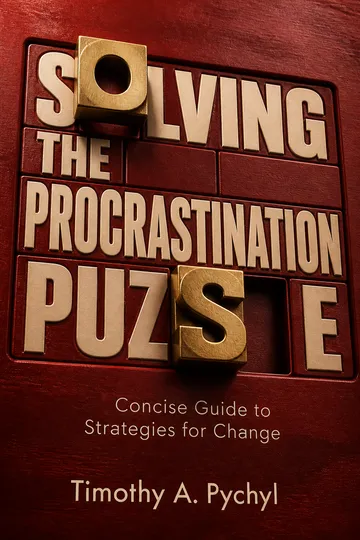
- Concise Guide: "The Procrastinator's Digest" by Timothy A. Pychyl is a concise guide aimed at helping readers understand and solve the procrastination puzzle.
- Research-Based Strategies: The book is grounded in 15 years of research and offers practical, research-based strategies to reduce procrastination.
- Focus on Action: It emphasizes the importance of taking action and provides a digest of key strategies to help readers overcome procrastination in their lives.
Why should I read "The Procrastinator's Digest"?
- Practical Solutions: The book offers practical, no-nonsense solutions to procrastination, making it accessible for those who want to make immediate changes.
- Research-Backed Insights: It provides insights based on extensive research, making the advice credible and effective.
- Short and Focused: The book is intentionally short to ensure readers can finish it quickly and start applying the strategies without delay.
What are the key takeaways of "The Procrastinator's Digest"?
- Understanding Procrastination: Not all delay is procrastination; procrastination is a voluntary delay despite knowing it may harm us.
- Emotional Awareness: Recognizing and managing emotions is crucial, as procrastination often stems from avoiding negative feelings.
- Action-Oriented Strategies: Implementing strategies like "just get started" and using implementation intentions can significantly reduce procrastination.
What is procrastination according to "The Procrastinator's Digest"?
- Voluntary Delay: Procrastination is defined as the voluntary delay of an intended action despite knowing it may harm task performance or self-perception.
- Needless Delay: It is characterized by needless delay, where the individual could act but chooses not to.
- Emotional Avoidance: Often, procrastination is a way to avoid negative emotions associated with a task.
How does "The Procrastinator's Digest" suggest overcoming procrastination?
- Just Get Started: One of the most effective strategies is to simply get started on a task, as this often changes perceptions of the task.
- Implementation Intentions: Use "if-then" plans to pre-decide actions in response to potential distractions or obstacles.
- Emotional Management: Recognize and manage emotions that lead to procrastination, such as fear or anxiety.
What role does willpower play in "The Procrastinator's Digest"?
- Limited Resource: Willpower is described as a limited resource that can be depleted, affecting our ability to self-regulate.
- Strategic Use: The book suggests using willpower strategically, such as by planning tasks for times when willpower is strongest.
- Motivation Boost: Motivation can replenish willpower, so focusing on goals and values can help maintain self-regulation.
How does personality affect procrastination in "The Procrastinator's Digest"?
- Risk and Resilience: Personality traits can either increase the risk of procrastination or provide resilience against it.
- Conscientiousness and Impulsivity: High conscientiousness is negatively related to procrastination, while impulsivity is positively related.
- Self-Awareness: Understanding one's personality traits can help in developing strategies to counteract procrastination tendencies.
What are the costs of procrastination according to "The Procrastinator's Digest"?
- Lower Achievement: Procrastination often results in lower achievement due to less time for thorough work.
- Negative Emotions: It is associated with more negative emotions, including guilt and stress.
- Health Impacts: Chronic procrastination can lead to health issues due to stress and delayed health behaviors.
What are the best quotes from "The Procrastinator's Digest" and what do they mean?
- "Just get started." This quote emphasizes the power of initiating action, as starting a task often changes perceptions and reduces procrastination.
- "I won’t feel more like doing it tomorrow." This highlights the common misconception that motivation will improve later, encouraging immediate action instead.
- "Giving in to feel good." This phrase captures the essence of procrastination as a form of emotional avoidance, urging readers to confront rather than escape negative feelings.
How does "The Procrastinator's Digest" address online procrastination?
- Cyberslacking: The book discusses how the Internet and social media can be major sources of distraction and procrastination.
- Immediate Rewards: Online activities provide immediate rewards, making them particularly addictive and distracting.
- Distraction Management: Strategies include minimizing distractions by shutting off unnecessary online tools and planning "e-breaks."
What is the role of emotional intelligence in "The Procrastinator's Digest"?
- Emotional Awareness: Emotional intelligence involves recognizing and understanding emotions that lead to procrastination.
- Regulating Emotions: It is crucial for regulating emotions to prevent them from derailing task completion.
- Improvement Possible: The book suggests that emotional intelligence can be improved, aiding in better self-regulation.
How does "The Procrastinator's Digest" suggest dealing with setbacks?
- Implementation Intentions: Use predecisions to handle potential distractions and setbacks, maintaining focus on goals.
- Self-Forgiveness: Forgiving oneself for past procrastination can reduce future procrastination by removing avoidance motivation.
- Strategic Perseverance: Emphasizes the importance of being strategic and patient, recognizing that self-change is a gradual process.
About the Author
Other books by Timothy A. Pychyl
Download PDF
Download EPUB
.epub digital book format is ideal for reading ebooks on phones, tablets, and e-readers.








