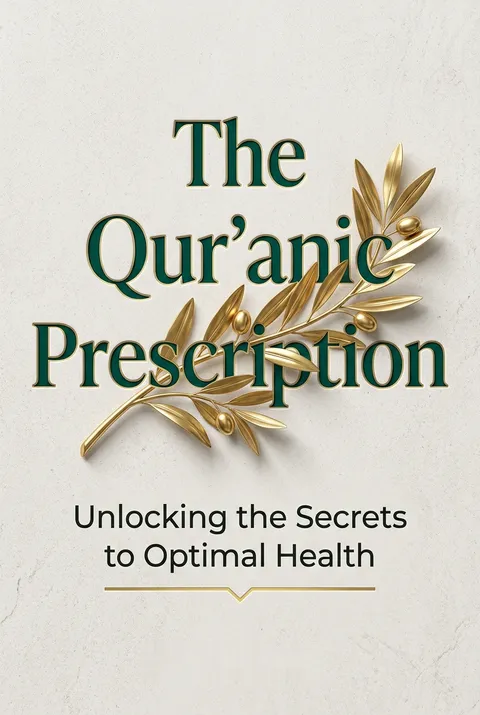


Key Takeaways
Treat your body as an entrusted responsibility, not a machine to neglect
Health as stewardship. Saeed frames health through an Islamic understanding of the body as a trust from God. Caring for it is not vanity or a distraction from worship, but part of living responsibly. Her own story supplies the human stakes: while working as a physician, she faced lupus and a range of persistent symptoms, and a frightening incident in which her infant son nearly suffocated sharpened her resolve to care for her family and herself.
A search for answers. Saeed describes finding gaps in her medical training around nutrition and chronic illness, then studying integrative approaches and connecting them to Qur’anic and Prophetic guidance. The book invites readers to learn, reflect, and make changes, while its disclaimer says it is not a substitute for personal medical care.
What's compelling is the way a religious duty turns self-care from a personal optimization project into an ethic of stewardship. That framing can make routine choices feel connected to family, worship, and responsibility to the wider world. It also resists a narrow view of health as appearance or productivity. The caution is equally important: illness is not proof of moral failure, and a person cannot control every diagnosis through discipline. Stewardship works best as an invitation to care for what can be influenced, without blaming people for disease or dismissing the role of clinical treatment.
Use inflammation as a clue, not a universal explanation for illness
A shared signal. The book presents inflammation as the body's defense response. Short-term inflammation helps respond to injury or infection; the author argues that prolonged activation can contribute to damage and chronic symptoms. She uses a fire metaphor: treating an isolated symptom may quiet the alarm without addressing what keeps setting it off.
Look for contributors. Saeed points readers toward possible influences that interact, including diet, stress, sleep, gut health, infections, and environmental exposures. Her broader point is to ask what conditions may be keeping the body under strain, rather than assuming every symptom is unrelated. She also acknowledges that medication can be needed, especially when symptoms require urgent control, and that patients should work with their physicians.
This systems-level lens is useful because many health problems do involve interacting biological and behavioral factors, and a symptom can be a reason to investigate rather than merely endure. But inflammation is a broad process, not one hidden cause that explains every chronic condition. Symptoms such as fatigue or pain can have many origins, and the same lifestyle change will not suit every patient. The strongest use of the book's model is as a set of questions for a clinical conversation, not as a self-diagnosis or a reason to stop treatment.
Let ṭayyib mean more than halal: choose what is wholesome, too
A wider food ethic. Saeed defines ṭayyib as pure, good, clean, wholesome, and lawful. Halal concerns what is permitted; ṭayyib adds a question about quality and benefit. The contrasting term khabīth describes what the book regards as impure or harmful. Together, the terms extend food choices beyond ingredients to include how people eat, what they consume, and how food production affects animals and the environment.
Faith meets daily choices. Saeed links this ethic to gratitude and restraint, and argues that protecting the body and the earth expresses care for gifts entrusted to people. The concept is meant as a durable guide when nutrition advice and social habits change. It gives readers a values-based starting point for making food decisions rather than following every trend.
The distinction gives Muslim readers a meaningful framework that joins religious practice with questions of nutrition, animal welfare, and environmental responsibility. It can also prompt useful consumer questions: what is this food, how was it made, and what effects does its production have? Yet a spiritual category should not be mistaken for a scientific test. The book sometimes treats broad classes such as genetically modified or processed foods as inherently harmful. Those judgments require evidence about a particular product, exposure, and health outcome, rather than relying on the label alone.
Build meals around varied whole foods, and leave room for moderation
Choose nourishment first. Saeed recommends meals centered on vegetables, quality protein, healthy fats, and fruit when tolerated, with fewer highly processed foods and sugary drinks. She encourages variety, especially among colorful vegetables, and favors foods that supply fiber and nutrients. The book cites an estimate that 78 percent of the world's population falls short of five daily servings of fruits and vegetables, using it to underline how often ordinary diets lack plant variety.
Quantity matters too. Drawing on Prophetic guidance against excess, Saeed recommends eating modestly and mindfully. She presents fasting as both a spiritual practice and a possible support for metabolic health, while warning against turning ifṭār into a feast. The practical idea is not a rigid menu: make nourishing choices more common, pay attention to fullness, and adapt foods to individual tolerance.
The practical strength here is emphasis on patterns rather than a single miracle ingredient. Variety, fiber-rich plants, and less reliance on heavily processed food create a more useful foundation than chasing each new nutrition headline. Moderation also links physical habits to the book's religious emphasis on restraint. The limitations arise when the advice becomes categorical. The book strongly discourages grains and dairy for some readers, although tolerance and nutritional needs vary. A restrictive diet can be difficult to sustain and may need professional guidance, particularly for children, pregnancy, or chronic illness.
Treat gut health as influential, not a master switch for every disease
The gut as a crossroads. The book describes the digestive system as a barrier, a site of immune activity, and a home for the microbiome, the community of microorganisms living in and on the body. Saeed emphasizes communication between the gut and brain, and argues that food and stress can influence digestion, mood, and other aspects of health. She uses the term leaky gut for increased intestinal permeability, while presenting it as one possible part of a wider imbalance.
A staged approach. For people seeking a structured dietary trial, the book outlines five actions: remove foods that may be troublesome, replenish with nourishing foods, repopulate beneficial microbes, repair the gut lining, and rebalance through wider lifestyle changes. It then recommends reintroducing excluded foods one at a time and observing symptoms, rather than assuming every person needs the same permanent restrictions.
The gut-brain connection is a valuable way to think about how bodily systems communicate, and it helps explain why digestive health can affect more than digestion. The staged plan also has a practical logic: change a limited set of inputs, observe what happens, and adjust. The book's claims become less secure when leaky gut is treated as an explanation for a very wide range of conditions. A plausible mechanism does not establish that it causes a given illness. Persistent symptoms deserve medical evaluation, not an assumption that gut repair alone is the answer.
Practice the Four S’s: stress, sleep, social connection, and spiritual life
A broader prescription. Saeed's Four S’s framework expands health beyond diet: stress, sleep, social support, and spiritual health all matter. For stress, she suggests practices such as breathing exercises, time in nature, prayer, supplication, mindfulness, and remembrance of God. For sleep, she emphasizes regular routines and reducing late-night stimulation. For social health, she encourages supportive relationships, kindness, and care for family and community. Spiritual health includes gratitude, forgiveness, worship, and finding purpose.
Make it repeatable. These practices are meant to be part of ordinary life, not reserved for a crisis. A short breathing practice, an on-time prayer, a calmer bedtime, or a conversation with someone supportive can become concrete ways to restore balance. The framework is especially useful because it acknowledges that food is only one part of a person's health environment.
The Four S’s bring together domains that health advice often separates. Sleep, emotional regulation, relationships, and spiritual practices can shape how people experience illness and sustain daily routines. The religious practices are not generic relaxation tools; they carry meaning within the life of a Muslim reader, which may make them more resonant and consistent. At the same time, prayer and gratitude should not be presented as cures for depression, trauma, or other serious conditions. They can provide support alongside appropriate mental health care, medication, and community resources.
Reduce avoidable exposures without turning every household object into a threat
Start with the surroundings. Saeed argues that air, water, food packaging, personal care products, cleaning supplies, and household materials can add to environmental exposures. Her practical suggestions include improving ventilation, filtering water, reducing unnecessary plastic contact with food, choosing simpler cleaning products, and limiting screen use before bed. She also connects food choices to farming practices, arguing that soil health, biodiversity, animal welfare, and food waste belong in a serious discussion of health.
Change what is manageable. The book's message is not that every hazard can be eliminated, but that readers can make gradual changes in their homes and purchasing habits. It suggests prioritizing the places where exposure is frequent and easy to reduce. The author's broader vision is that a more wholesome personal diet and a less damaging food system can support both human and planetary health.
The strongest part of this environmental argument is its recognition that health is shaped by systems of production, housing, and consumption, not only individual willpower. It also offers achievable steps rather than demanding a perfectly controlled life. But the book's discussion sometimes places well-established concerns and more speculative claims side by side, especially around electromagnetic fields and detoxification. Readers benefit from distinguishing evidence-based exposure reduction from alarming claims that may increase anxiety or expense. Prioritizing clear risks and practical protections keeps environmental care from becoming another source of stress.
Make healing personal, gradual, and medically supervised rather than cure-driven
No single root cause. Saeed stresses that different people may be affected by different combinations of food, stress, sleep, environment, infection, or nutrient deficiencies. She suggests tracking symptoms, making manageable changes, and seeking a qualified clinician when testing or treatment is needed. The book also discusses supplements and restrictive diets, but its own disclaimer says the material is for reference and is not a replacement for a physician's advice.
Hope without guarantees. Patient stories, including accounts of dramatic improvement, give the book its emotional force. They illustrate why the author believes lifestyle changes can matter, but individual stories cannot establish that a particular protocol will cure a disease or allow someone to stop medication. The safer takeaway is to treat progress as personal, keep a clinician involved, and use conventional treatment when medically indicated.
This is where the book's hope is most valuable when paired with restraint. Its emphasis on learning, observing one's own responses, and collaborating with a clinician can help patients become active participants in care. Its weaker moments are the sweeping promises that chronic diseases can be reversed or that one method can address many conditions at once. Anecdotes can generate hypotheses, but they cannot predict another person's outcome. A sound plan preserves hope while setting realistic expectations, protecting against nutritional harm, and never withdrawing medication without the prescriber's guidance.
Analysis
The book's central achievement is its translation of an Islamic moral vocabulary into a practical health ethic. Ṭayyib becomes more than a dietary label: it links food quality, restraint, gratitude, relationships, worship, and care for the earth. This gives the book a distinctive audience and a coherent narrative. Saeed writes as both a physician who felt poorly equipped to address chronic illness and a patient searching for explanations. Her personal account establishes urgency, while patient stories make lifestyle change feel imaginable rather than abstract.
The most useful synthesis is its refusal to isolate diet from the rest of life. The Four S’s framework places stress, sleep, social ties, and spirituality alongside digestive health and the home environment. Readers can use this as a broad inventory of habits and conditions worth discussing with clinicians. The book also makes a credible ethical point that personal health choices are entangled with food production, animal welfare, and ecological damage.
Its main weakness is not the value of lifestyle care, but the scale of some causal claims. Inflammation, microbiome imbalance, intestinal permeability, toxins, and gene expression are sometimes offered as explanations for an unusually broad range of symptoms and diseases. The text also includes strong claims about particular foods, supplements, detox practices, and rapid recovery. The presence of research citations does not make every cited relationship causal, nor does a patient's improvement prove which part of a complex protocol produced it. The book's disclaimer and reminders to consult physicians are therefore important, not incidental.
A careful reader can retain the framework while separating its layers: religious teachings provide meaning and obligation; lifestyle advice offers possible ways to support health; clinical claims require condition-specific evidence and professional judgment. That distinction preserves the book's strongest contribution, a motivating vision of health as stewardship, while limiting the risk that hope becomes false certainty or that medical care is treated as an obstacle to faith.
Review Summary
Readers praise The Qur'anic Prescription for its comprehensive approach to health, aligning Islamic teachings with functional medicine principles. They appreciate the focus on addressing root causes of diseases, emphasizing nutrient-dense foods and lifestyle changes. The book is lauded for its clear writing style and practical advice, though some note it can be dense with research. Reviewers recommend it for those seeking better health, especially those with chronic illnesses. While implementation may be challenging, readers find the book's holistic approach valuable, combining physical, mental, and emotional aspects of well-being.
People Also Read






Glossary
ṭayyib
wholesome and pureA Qur’anic term that Saeed interprets as pure, good, clean, wholesome, excellent, and lawful. In the book, it broadens food choices beyond whether something is halal to include its quality and its effects on the body and environment. Saeed applies the idea to a wider way of living, including thoughts, relationships, and surroundings.
khabīth
impure or harmfulThe term Saeed uses as the opposite of ṭayyib. She applies it to what she considers impure or harmful, including many artificial or highly processed foods, some environmental exposures, and unhealthy habits. The book uses khabīth as both a religious contrast and a practical category, though its classifications of particular products are the author's interpretations.
The Four S’s
four dimensions of well-beingSaeed's framework for the non-dietary pillars of a ṭayyib lifestyle: stress, sleep, social health, and spiritual health. It treats emotional regulation, rest, supportive relationships, and religious practice as connected to physical well-being. Suggested practices include breathing exercises, regular sleep routines, gratitude, prayer, remembrance of God, time in nature, and nurturing relationships.
Gut Prescription
five steps for gut supportThe book's staged approach to digestive health: remove potentially troublesome foods and other triggers, replenish with nourishing foods and digestive support, repopulate the gut with beneficial microbes, repair the intestinal lining, and rebalance through broader lifestyle changes. The author recommends personalizing food reintroduction and working with a qualified clinician rather than assuming the same plan suits everyone.
Gut and Psychology Syndrome (GAPS) diet
a staged elimination dietA named dietary program by Natasha Campbell-McBride that Saeed discusses in her appendix and recommends for some readers with significant symptoms. It excludes grains, sugar, many processed foods, and some legumes, and introduces foods in stages. Saeed advises initially avoiding dairy for people who may not tolerate it. It is a restrictive program and should not be treated as a substitute for medical care.
murāqabah
mindful awareness of GodAn Islamic spiritual concept that Saeed relates to mindfulness. In the book, murāqabah involves awareness of God's presence alongside attention to one's inner and outer state. The author connects this reflective practice with prayer, remembrance, and breathing, presenting it as a way to become more attentive, less reactive, and more spiritually grounded.
Download PDF
Download EPUB
.epub digital book format is ideal for reading ebooks on phones, tablets, and e-readers.








