

Key Takeaways
Return to familiar places with beginner's eyes, not a list of grievances
A journey begins with bewilderment. A blow to the head from a parking barrier in France leaves Bryson newly grateful for ordinary pleasures. His wife’s map points to Bognor Regis, and a conversation with his publisher turns that accidental clue into a route across Britain. The trip will run loosely from Bognor to Cape Wrath, following a straight line Bryson has traced across the map.
Familiarity can go stale. Bryson first arrived in Britain as a young American, unable to decipher everyday words, food, or customs. Decades later, he feels baffled by modern life again. Rather than revisiting only the places he remembers, he seeks unfamiliar towns and overlooked corners. His comic frustration is part of the method: surprise returns when certainty loosens.
What's striking is how travel works here as a practice of defamiliarization. A familiar place becomes legible again when the traveler stops treating prior knowledge as complete. This resembles the anthropological idea of making the ordinary strange, a way to expose assumptions that everyday routine hides. The comic narrator helps readers notice small details without requiring specialist expertise. There is a limit, however: fresh attention does not guarantee impartial judgment. Nostalgia and irritation shape what gets noticed, so curiosity is a starting point for understanding, not proof that the resulting portrait is objective.
Treat Britain's small scale as a civic advantage, not a geographic footnote
Smallness connects stories. Britain is only about seven hundred miles from end to end, and no point on the mainland is more than roughly seventy miles from the coast. Bryson argues that this compactness gives the country an unusual intimacy: a striking event anywhere can become national news. He contrasts that with the United States, where the scale of the country can keep a local tragedy local.
Attention has a tradeoff. British newspapers report rare incidents such as fatal cow attacks, making them feel common to readers. Bryson recalls four fatal tramplings in an eight-week period in 2009, then asks friends how likely an attack seems. They confidently say it happens often. A tightly connected public sphere can spread knowledge quickly, but it can also make unusual dangers feel routine.
The useful distinction is between the frequency of an event and its visibility. Media systems shape perceived risk, a pattern also studied in the psychology of availability: vivid, repeated examples can feel more common than they are. A small national conversation can make shared problems easier to recognize, while also encouraging disproportionate fear. The book’s comparison is suggestive rather than a controlled comparison of countries. Still, it offers a practical question for readers: is a danger common, or simply easy to recall because its stories travel widely?
Treat Britain's countryside as civic infrastructure, not scenery
Access is an achievement. England and Wales have about 130,000 miles of public footpaths, enabling walkers to cross farmland and reach landscapes that would be private property in many places. On the South Downs, Bryson finds broad chalk cliffs, green hills, and a path kept safe by generous distances from unstable edges. The landscape is not merely wild nature; it is a shared environment shaped by land use, maintenance, and public rights.
Beauty needs protection. Bryson warns that the familiar countryside is not self-preserving. He points to coastal erosion at Birling Gap, development pressure around Staines Moor, and the Metropolitan Green Belt, which limits urban sprawl. Farming contributes only a small share of national economic output, but farms, hedgerows, paths, and villages help create the landscape people value. Economic measures can overlook those public benefits.
Calling landscape infrastructure changes the policy question. Roads and hospitals are recognized as assets because they provide services; open land also supports recreation, habitat, food production, and cleaner air, even when markets do not price those benefits. This connects to environmental economics, where costs imposed on the public are often absent from private development decisions. The case for protection is not a case against all building. Housing need is real, and preservation can constrain supply. The sharper question is whether development uses land well and accounts for what its loss costs everyone.
A faster train is no progress if it leaves places poorer
Speed is a narrow measure. Bryson questions the case for HS2, the proposed high-speed railway from London to Birmingham and beyond. He doubts that passengers will turn saved minutes into productive work, noting that many people on trains are watching screens or resting. He also worries about a costly line that cuts through countryside without serving every destination directly. His argument is not that travel time never matters, but that speed alone cannot establish public value.
The wider ledger matters. The book contrasts grand infrastructure promises with the loss of local services and public amenities. In Birmingham, announced cuts of £338 million over four years amounted to about £1.40 per resident each week, while libraries, parks, and services faced reductions. A city can save money on paper while becoming less useful and less pleasant to live in.
The strongest version of this argument is about opportunity cost: public money spent on one project cannot be spent on maintenance, schools, or local transport. Cost-benefit analysis should count those alternatives, as well as environmental damage and who receives the benefits. Yet the book risks treating passengers’ unproductive-looking travel time as evidence against faster rail. A faster network can improve access to jobs and services even if no one works on board. The relevant standard is not whether speed is virtuous, but whether the whole transport system produces enough shared benefit to justify its costs.
Make heritage accessible, not merely protected behind a ticket desk
Preservation is more than survival. Bryson finds excellent and disappointing examples of heritage care. Stonehenge’s new visitor centre explains the monument far better than the old facilities, while the nearby stones remain protected from damage. At Avebury, however, he struggles to orient himself and pays separately for parking, the manor, the museum, and a map before he can understand the site. A place can be physically preserved yet poorly served as a public experience.
Stewardship can be imaginative. Calke Abbey, a decaying country house, is kept in its unsettled state rather than polished into a conventional grand home. That choice lets visitors encounter the evidence of a family’s withdrawal and decline. These contrasting visits show why conservation needs careful interpretation, reasonable access, and attention to the meaning of a place, not simply ownership or restoration.
Heritage institutions do two kinds of work: they protect physical objects, and they help the public make sense of them. Interpretation is not decorative packaging. It determines whether visitors can connect a stone circle, house, or museum object to the people and decisions behind it. The comparison between Avebury and Calke Abbey also shows that there is no single ideal presentation. Some sites need practical orientation; others gain meaning by retaining signs of neglect. The tension is financial as well as curatorial: admissions and retail can fund preservation, but excessive charges may make shared inheritance feel like a sequence of purchases.
History is shaped by chance, then credited to whoever holds power
Lives turn on accidents. In Wraysbury, Bryson visits the site of a cottage destroyed by a German bomb during the Second World War. His future father-in-law survived because the family was away, and the displacement helped set in motion the relationships that eventually led to Bryson’s own family. A random event became part of a private family history, though no one could have predicted the chain of consequences.
Recognition is not always fair. At Sutton Hoo, self-taught excavator Basil Brown identified the ship burial and uncovered its extraordinary treasure, but professional archaeologists later pushed him aside. The inventor Oliver Heaviside developed a way to strengthen telephone signals, while AT&T secured the patent and reaped commercial rewards. Together, these stories show how chance creates openings, while status and ownership influence who receives credit and benefit.
These episodes illuminate path dependence: small events can redirect lives, while the consequences become visible only in hindsight. They also distinguish discovery from appropriation. An idea may originate with one person, but institutions with legal, financial, or professional power often determine who profits and whose name survives. The book’s examples invite a more careful history of innovation, one that includes technicians, local experts, and informal labor. At the same time, individual stories cannot establish how representative these patterns are. Their value is to make familiar assumptions about genius and credit harder to accept unexamined.
Let harmless enthusiasms make public life more human
Small interests build community. Bryson delights in Britain’s dedicated societies and volunteers: steam railways are run by about 18,500 volunteers, while other groups study roundabouts, old signs, clay pipes, and wildlife. Such pursuits may look eccentric from outside, but they preserve skills, places, and shared traditions. A volunteer railway can turn an obsolete form of transport into a treasured local experience.
Service can be quietly heroic. On the Cornish coast, Bryson learns about the Royal National Lifeboat Institution, a volunteer organization supported by public donations. It operates 233 stations around Britain and averages about twenty-two call-outs a day. The story of the Penlee lifeboat crew, who died attempting to rescue people in a storm, gives the book’s fondness for local institutions a serious edge. Some community commitments entertain; others put volunteers in danger to help strangers.
A society is not held together only by formal institutions. Voluntary associations create social ties, transmit practical knowledge, and give people a reason to care for places beyond their private homes. This resembles the idea of social capital: networks of trust can support collective action when emergencies arise. The range matters, from hobby groups to lifeboat crews, because community life need not be solemn to be valuable. Still, praise for volunteerism should not obscure the risk of relying on unpaid effort where stable public funding is needed. Civic enthusiasm enriches institutions; it should not become an excuse to abandon them.
Make room for people who choose a country, not just inherit one
Belonging can be learned. Bryson’s journey begins as he prepares for Britain’s citizenship test, an ironic task for someone who has lived there for decades but is once again bewildered by the country. The test asks for facts ranging from parliamentary history to the identity of the tower commonly called Big Ben. Passing it certifies knowledge, but the book suggests that belonging also grows through work, marriage, friendships, and years of attention.
Immigration is more than a count. Bryson points to people such as cancer researcher Josef Vormoor and cosmologist Carlos Frenk, both immigrants who contribute to British life. He argues that treating every departure as a demographic gain ignores expertise, relationships, and civic work. His own affection for Britain rests partly on becoming a citizen while retaining his American identity: attachment to one country need not cancel attachment to another.
This section offers a civic account of belonging: membership can arise through participation and commitment, not only ancestry. That perspective is useful in debates where immigration is reduced to population totals, because it asks what people contribute and what communities lose when they leave. The examples are personal and favorable, not a complete policy analysis. They do not resolve questions about housing, public-service capacity, or labor conditions. Their force is more focused: a person cannot be evaluated as a net gain or loss by counting bodies alone, without considering skills, relationships, and the life built around them.
Treat Britain as inexhaustible: its smallest lanes still hide whole histories
No itinerary can finish the story. At Glenelg, Bryson encounters brochs, ancient Scottish stone towers whose purpose remains uncertain. A researcher he reads about has catalogued 1,502 standing stones at 1,068 locations, while Britain contains hundreds of thousands of known archaeological sites. The abundance is not just a collection of famous landmarks; it is a dense accumulation of places whose meaning is partial, disputed, or still unknown.
Continuity takes work. The White Horse of Uffington has been cut into an Oxfordshire hillside for about three thousand years. Its survival depends on people periodically clearing vegetation from the chalk figure. That image becomes a fitting close to the journey: Britain’s beauty and history are not simply inherited. They endure because people keep noticing, maintaining, and protecting them.
The book’s deepest claim is not that Britain is flawless, but that it rewards sustained attention. Archaeological uncertainty keeps the past open to new evidence, while living maintenance connects present communities to distant predecessors. This is a useful corrective to the idea that heritage is a finished product displayed for tourists. It is also a reminder that attention has limits: no visitor can see everything, and preservation requires choices about what receives resources. The practical lesson is not to attempt total knowledge, but to recognize that the landscape around any one destination may contain histories worth returning for.
Analysis
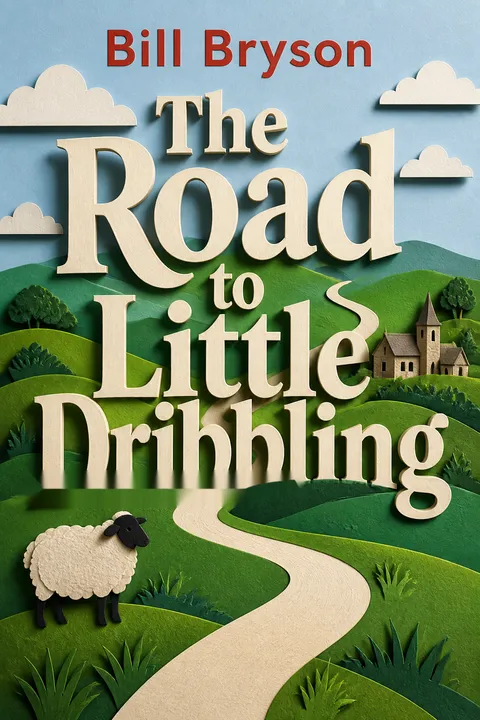
The Road to Little Dribbling is a comic travel memoir whose route gives structure to a wider argument about belonging, public life, and the stewardship of place. The journey from Bognor Regis toward Cape Wrath is not a strict itinerary so much as a device for encountering unfamiliar towns, revisiting personal history, and moving between landscapes and institutions. Bryson’s persona supplies narrative momentum: he is curious, frequently wrong-footed, impatient with incompetence, and alert to beauty that other people pass without noticing.
The book’s central tension is between affection and alarm. Bryson admires Britain’s footpaths, historic buildings, volunteer organizations, and humane scale, while describing local decline, intrusive development, deteriorating public services, and the loss of ordinary shops and gardens. These are not separate concerns. A path, a village shop, or an old pier becomes evidence of how a society values shared life beyond immediate economic return. His strongest passages connect a specific place to the decisions that made it vulnerable or kept it alive.
The humor is both method and limitation. It lowers the barrier to historical and policy material, turning railway numbering, museum curation, and local planning into memorable scenes. But the same voice can slip from criticism of institutions into sweeping judgments about residents, visitors, or modern culture. The narrative is selective, and its nostalgia sometimes treats remembered Britain as more coherent than it may have been for everyone. Its numerical claims and policy judgments are best read as arguments to examine, not as a comprehensive audit.
The book ultimately proposes attention as a form of care. Britain appears inexhaustible because history is layered into ordinary landscapes, and because those landscapes depend on continued human choices. The lasting question is not whether change can be stopped, but which forms of change preserve the conditions that make a place distinctive, accessible, and worth inhabiting.
Review Summary
The Road to Little Dribbling received mixed reviews. Many readers found it entertaining and hilarious, praising Bryson's wit and observations about Britain. However, some felt it was overly grumpy and negative compared to his earlier works. The book covers Bryson's travels across Britain, offering historical tidbits, social commentary, and personal anecdotes. While some appreciated his critiques of modern society, others found them excessive. Overall, fans of Bryson's writing style generally enjoyed the book, while others felt it didn't live up to his previous travel memoirs.
Glossary
Bryson Line
A loose cross-country routeBryson’s name for the longest straight line he could trace across mainland Britain without crossing salt water. It runs from Cape Wrath in Scotland to Bognor Regis on England’s south coast. Rather than follow it literally through homes, fields, and obstacles, he uses its endpoints and occasional proximity as a guide for his journey.
Green Belt
Protected land limiting urban sprawlA planning designation that preserves open land around London and other towns and cities, restricting development to limit outward expansion. In the book, the Green Belt is valued not as unused land but as countryside that supports wildlife, farming, recreation, and a clear boundary between urban areas. Bryson argues that its public benefits are often missing from arguments focused only on housing or growth.
Mass Trespass
A 1932 access protestA protest walk on 24 April 1932, when hundreds of working people crossed the Duke of Devonshire’s grouse moors on Kinder Scout in Derbyshire. The landowner’s gamekeepers confronted the walkers, and several leaders were imprisoned for trespass. The protest became a landmark in the campaign for public access to the countryside and contributed to the development of national parks.
Dunning-Kruger Effect
Skill gaps distort self-assessmentA psychological effect described in a 1999 study by David Dunning and Justin Kruger. People with limited ability in a particular task may also lack the skill needed to recognize their mistakes, causing them to overestimate their performance. Bryson uses the concept humorously to consider whether people can recognize their own declining judgment, while acknowledging that he does not fully understand every technical detail of the research.
Reflex loathings
Dislikes needing no defenseBryson’s playful name for personal dislikes that are immediate and need not be justified to others. His examples range from certain clothing and phrases to particular television programs. The term captures a comic feature of the book’s voice: strong opinions are treated as part of ordinary personality, though they are not presented as universal truths or serious policy positions.
Notes from a Small Island Series
About the Author
Other books by Bill Bryson






Download PDF
Download EPUB
.epub digital book format is ideal for reading ebooks on phones, tablets, and e-readers.








