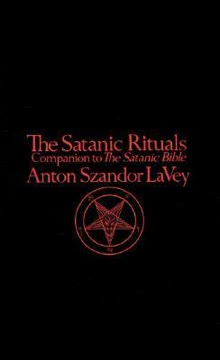
Key Takeaways
1. Satanism: The Inversion of Values and Catalyst for Change
On the altar of the Devil up is down, pleasure is pain, darkness is light, slavery is freedom, and madness is sanity.
Inverting norms. Satanism fundamentally redefines traditional moral and societal values, presenting an inverted perspective where conventional "good" is questioned and often reversed. This philosophical stance serves as a potent catalyst, challenging established norms and prompting a re-evaluation of what is considered righteous or evil. It's a deliberate act of defiance against the status quo, aiming to disrupt stagnant thought patterns.
Challenging authority. This inversion isn't merely for blasphemy; it's a mechanism to demonstrate that no standard is absolute or inherently divine. By flipping concepts like pleasure and pain, or freedom and slavery, Satanism encourages individuals to critically examine the foundations of their beliefs rather than passively accepting them. This intellectual rebellion is designed to foster independent thought and personal sovereignty.
Age of Satan. The text posits that humanity is entering an "Age of Satan," where the anti-hero is exalted, and rebellion for its own sake often takes precedence. This period of chaos, though dire, is seen as necessary for long-range development and the eventual return of stability, as what truly needs changing will be transformed. Satan, as the "opposite," emerges as the magical child of accelerated human development.
2. Ritual as Personal Psychodrama for Self-Actualization
The Satanic ritual chamber is die ideal setting for the entertainment of unspoken thoughts or a veritable palace of perversity.
Individual empowerment. Satanic rituals are not designed to control practitioners but to serve their individual goals, utilizing fantasy as a "magic weapon" for personal empowerment. Unlike other faiths that use ritual to hold celebrants in thrall, Satanism focuses on objectively entering a subjective state to harness emotional intensity for success. This makes the ritual a tool for the individual's will.
Purging guilt. The Black Mass, for instance, is presented as a valid Satanic ceremony primarily for those who need to purge themselves of inhibiting guilts imposed by Christian dogma. It acts as a psychodrama, a therapeutic rebellion against past indoctrination and a vehicle for retaliation against perceived injustices perpetrated in the name of Christianity. The ritual provides a stage for expressing unpopular thoughts and elevating the self.
Beyond blasphemy. While often associated with blasphemy, the inversion of liturgy in rituals like the Black Mass serves a deeper purpose: to reinforce heretical thought and act as a catalyst for change. The ultimate goal is to reduce or negate stigma, allowing individuals to shed self-righteous mantles and embrace a freedom from guilt, leading to gratifying personal feelings and a path of no return.
3. Embracing the Carnal, Pride, and Earthly Dominion
Renouncing the spiritual paradise of the weak and lowly, we place our trust in Thee, the God of the Flesh, looking to the satisfaction of all our desires, and petitioning all fulfillment in the land of the living.
Rejection of asceticism. Satanism explicitly rejects the self-denial and spiritual asceticism often preached by traditional religions, instead championing the satisfaction of carnal desires and the pursuit of earthly fulfillment. This philosophy is evident in rituals like "The Ceremony of the Stifling Air," which celebrates the reawakening of the flesh and a rejection of past self-denials, attaining symbolic rebirth through a contrived entombment.
Glorifying pride. Pride, often considered a sin in other faiths, is glorified within Satanism. The Yezidis, for example, used the peacock (Melek Taus) as a symbol of Satan, representing pride and dominion. This emphasis on self-worth and personal power is a core tenet, encouraging individuals to embrace their desires and strive for greatness in the material world.
Life over death. Rituals like "L'Air Epais" are statements of rebirth and the delights of life, directly opposing the negation of death. They allow for the exorcism of unconscious death motivations, transforming death's accouterments into instruments of lust and life. This focus on vitality and indulgence is a direct challenge to doctrines that promise spiritual rewards in an afterlife at the expense of present existence.
4. Man as God: The Ultimate Authority and Creator
The old belief that a supreme being created man and man's thinking brain will be recognized as an illogical sham.
Self-deification. A central tenet of Satanism is the belief that man is his own God, rejecting the notion of a supreme external creator. This philosophy, reinforced in rituals like "Das Tierdrama," asserts that all religions are human inventions and that the world is man's kingdom. It empowers individuals to recognize their inherent divinity and creative potential.
Human heritage. "Das Tierdrama" emphasizes admitting one's "quadruped heritage" and willingly regressing to an animal level to assume attributes of honesty, purity, and heightened sensory perception. This identification with the beast is seen as a prerequisite to becoming a "God-man," a lesson often neglected by "civilized" man. It highlights the raw, untamed power within humanity.
Source of wisdom. The human skull, used as an artifact in "Die elektrischen Vorspiele," symbolizes the material, flesh-and-bone godhead that is man, rather than mortality. It represents the "vault of wisdom" from which all human ideas and developments emerge, the "temple of invention," both material and "spiritual." This reinforces the idea that all power and knowledge reside within humanity itself.
5. The Primacy of Logic, Self-Awareness, and Applied Will
The Satanist can easily invent fairy tales to match anything contained in holy writ, for his background is the very childhood of fiction-the myths immemorial of all peoples and all nations. And he admits they are fairy tales. The Christian cannot-no, dares not-admit that his heritage is fairy tales, yet he depends on them for his pious sustenance.
Logic as a weapon. Satanism champions logic and reason as its primary weapon against the "feeble and insipid mournings of the pulpit pounders." Unlike traditional faiths that rely on unquestioning belief in "fairy tales," Satanists acknowledge the mythical origins of their narratives, using them as tools for psychological and emotional impact rather than literal truths. This intellectual honesty allows for greater self-awareness.
Self-awareness. The essence of Satanic ritual involves objectively entering a subjective state, requiring conscious striving for self-awareness. Since human behavior is largely driven by subjective impulse, and man can lie to himself, self-awareness is crucial for understanding one's true desires and motivations. This objective introspection prevents manipulation from external systems.
Study, not worship. A fundamental "commandment" of Satanism is "Satanism demands study—not worship!" This underscores the importance of intellectual engagement, critical thinking, and continuous learning over blind adoration. It encourages practitioners to understand the principles and applications of magic and philosophy, rather than simply following dogma.
6. Ancient Roots and Diverse Occult Influences
Satanic Ritual is a blend of Gnostic, Cabbalistic, Hermetic, and Masonic elements, incorporating nomenclature and vibratory words of power from virtually every mythos.
Syncretic tradition. Satanic rituals are not monolithic but a rich tapestry woven from diverse historical and occult traditions, including Gnostic, Cabbalistic, Hermetic, and Masonic elements. This syncretic approach allows for the incorporation of powerful nomenclature and vibratory words from various mythologies, adapting ancient wisdom to modern Satanic practice.
Cultural adaptations. The rituals presented in the book, such as the French "Le Messe Noir," German "Das Tierdrama" and "Die elektrischen Vorspiele," and Russian "Homage to Tchort," demonstrate how Satanic themes manifest across different cultures. Each adaptation reflects the unique historical and social contexts, drawing from local folklore, literature, and magical traditions to create relevant and emotionally resonant experiences for practitioners.
Lovecraftian metaphysics. The "Metaphysics of Lovecraft" section highlights the influence of H.P. Lovecraft's "Cthulhu mythos," which, despite being fiction, is seen as embodying Satanic principles. Lovecraft's creatures, vacillating between beneficence and cruelty, respect knowledge and challenge conventional good/evil stereotypes. His "nameless rites" are interpreted as reflections of actual ceremonial procedures, suggesting a deep, perhaps unconscious, connection to real occult sources.
7. The Necessity of Polarity and the "Other Side"
Wherever this polarity of opposites exists, there is balance, life, and evolution. Where it is lacking, disintegration, extinction and decay ensue.
Balance through opposition. Satanism posits that vitality, balance, and evolution are dependent on the existence of opposites. The concept of an "other side" is not merely a theological construct but a fundamental principle of the universe, where action and reaction, cause and effect, drive all phenomena. Without this polarity, stagnation and decay are inevitable.
The adversary's role. Historically, a "bad guy" has been necessary for those who are "right" to flourish, making Satan the church's "best friend." Modern Satanism realistically accepts this polarity, especially within the ritual chamber, where it can serve as a space for unspoken thoughts or perversity. This acceptance acknowledges the inherent dualism in human nature and the cosmos.
Challenging "good." The persistent condemnation of anything "opposite" as "evil" is challenged, despite common adages like "variety is the spice of life." Satanism embraces the role of the adversary, recognizing that opposition is crucial for growth and change. This perspective encourages a re-evaluation of what is truly beneficial versus what is merely comfortable or conventional.
8. Magic as a Tool for Energy Manipulation and Desire Fulfillment
Magic, like any other tool, requires a skilled hand.
Applied principles. Magic, within Satanism, is presented as a practical tool requiring a skilled hand and the application of learned principles, not just the collection of esoteric data. It's compared to writing a blank check for a desired amount, where one must have "sufficient funds (magical qualities)" to cover it. This emphasizes personal power and responsibility in manifesting desires.
Emotional intensity. Ritual magic's success is directly dependent on emotional intensity, necessitating the use of "emotion producing devices" in its practice. The basic ingredients for casting a spell are desire, timing, imagery, direction, and balance. These elements are channeled to "push" a desired result within a specific time and space, followed by a "pull" of detachment.
Electrical preludes. "Die elektrischen Vorspiele" exemplifies this by utilizing electrical and magnetic energy to effect magical ends. The ritual aims to "charge" the chamber, allowing the celebrant to "draw" energy while adding their own strength of will. This involves stroboscopic effects, electrostatic generators, and specific sound frequencies to stimulate the celebrant's intensity and project their will through reflective planes.
9. Rejection of Christian Dogma and Its Hypocrisies
Vanish into nothingness, thou fool of fools, thou vile and abhorred pretender to the majesty of Satan! Vanish into the void of thy empty Heaven, for thou wert never, not shalt thou ever be.
Direct denunciation. Satanic rituals often include direct repudiation and denunciation of Christian dogma, figures, and institutions. The Black Mass, for example, features a powerful litany that curses Christ, accusing him of failing his engagements and belied promises, and condemning him to "perpetual anguish" in the Pit. This is a profound act of psychological and spiritual rebellion.
Exposing historical wrongs. The text highlights historical instances where the Christian Church, particularly during the Inquisition, created "witches" and persecuted those who challenged its authority, such as Galileo and da Vinci. It points out the hypocrisy of "Christian Satanists" who adopt Christian standards of evil, and the countless deaths caused in the name of Christ, contrasting them with the "unborn baby offered up 'in the name of Satan'" in LaVoisin's rites.
Challenging moral authority. The "Ceremony of the Stifling Air" includes Jacques de Molay's curse against King Philip IV and Pope Clement V, directly challenging their moral and temporal authority. This ritual serves to weaken the collective structure of the organization they represent, introducing an element of the Black Mass by overtly expressing anti-Christian sentiments and rejecting life-denying spirituality.
10. The Celebration of Life, Freedom, and Unbefouled Development
Instead of cleansing the infant of "original sin" and preparing him for a life of blind devotion to an existing faith, the Satanic "baptism" pays homage to the miracle of the child's creation, his capacity for unbefouled development and his freedom from hypocrisy.
Honoring creation. Satanic "baptisms" for infants are not about cleansing "original sin" but celebrating the miracle of the child's creation, their inherent capacity for unbefouled development, and their freedom from hypocrisy. This contrasts sharply with traditional Christian baptisms, which focus on purification and indoctrination into a specific faith. It's a dedication to the child's natural, uncorrupted self.
Adult affirmation. For adults, the "baptismal" rite signifies a conscious rejection of obsolete precepts and a subsequent adherence to Satanic ethics. It's a solemnization of their newly acknowledged dedication to Satanic principles, performed at the legal age of consent to ensure individual choice and responsibility. This ceremony marks a personal liberation from imposed moralities and a commitment to self-realization.
Joy and power. The adult rite involves symbolic acts like casting off a "white robe of lies," walking through the "Black Flame of Satan" to awaken senses, and anointing with earth and sea water to connect with primal forces. The initiate takes an oath to be true to Satanic principles, culminating in a blessing to "live thy life in joy and power." This emphasizes a life lived with dignity, self-respect, and the pursuit of personal fulfillment.
Last updated:
Review Summary
The Satanic Rituals receives mixed reviews, averaging 3.55 out of 5 stars. Critics cite borrowed content from H.P. Lovecraft and H.G. Wells, calling the rituals "cheesy" and "boring." Some appreciate it as cultural theater and psychodrama, noting multilingual elements and cross-cultural content. Reviewers question LaVey's credibility and inconsistencies with The Satanic Bible. Positive reviews value it as a companion text showcasing creative Church of Satan history. Many find it less compelling than its predecessor, though some appreciate its rebellious philosophy and theatrical approach to ritual.