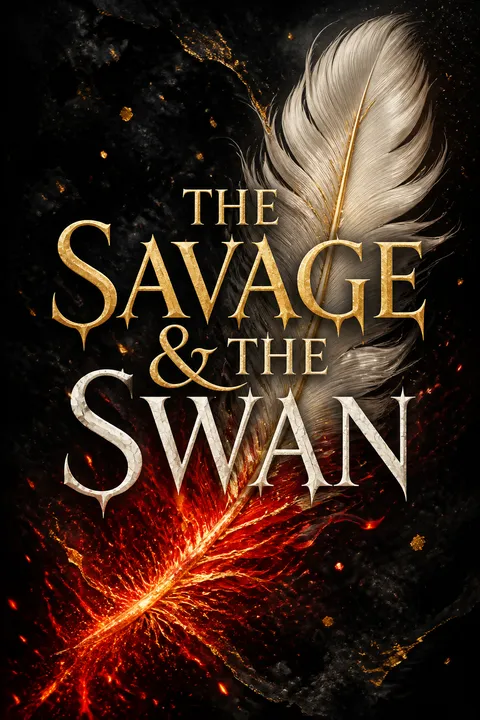


Plot Summary
The Betrothal Escape
Opal Gracewood, only heir to the beleaguered kingdom of Sinshell, overhears her parents planning to marry her to human Prince Bron for protection and an heir. She flees through familiar woods to a hollow tree spanning the ravine between Sinshell and Vordane. A crimson guard appears there, calls her a sheltered princess, and questions her plans.
Though she distrusts him as one of the enemy, Opal admits she fears the marriage. The guard warns that Bron's court may use her rather than welcome her, then presses a sword into her hands and demands she prove she can defend herself. His challenge gives Opal a first taste of agency, but she leaves without learning his name.
Opal's escape begins as an attempt to avoid being assigned a political function, but the encounter immediately complicates her picture of the enemy. The guard's bluntness is not kindness, yet it offers something her parents have withheld: an expectation that she can act. Her fear is real, but so is her capacity to respond. The hollow tree makes the political divide physically traversable, suggesting that inherited borders are maintained by stories as much as by geography. Opal's first step toward self-determination comes from a person she has been taught to regard as irredeemable.
A Sword in the Hollow
Opal returns to the tree, and the guard returns too, now offering a dagger and training her in close combat. When she freezes at the weapon's bloody history, he pushes her to convert fear into controlled anger and teaches her where to strike an armored opponent.
She begins carrying a blade and meeting him in secret, though his identity remains hidden. Meanwhile, refugees arrive after attacks on Sinshell's villages, and a soldier named Deandra kills a fawn before Opal can protect it.
Seeking answers about her future, Opal visits the serpent sorceress Silver, who says someone else has already claimed the fate Opal came to ask about. Her meetings with the guard feel increasingly charged, even as each new atrocity confirms the danger of trusting him.
The training is both a literal skill-building sequence and a countereducation. Opal has been taught to wait for protection; the guard insists that survival requires practice, judgment, and the ability to act while afraid. Yet the lessons arrive from a man whose people are responsible for the violence she witnesses. The fawn's death sharpens the distinction between compassion and power: Opal's instinct to protect cannot succeed on feeling alone. Silver's cryptic reading introduces fate as another political force, one that claims people without asking their consent, paralleling the marriage arrangement Opal fled.
The Swan Sees Dade
Prince Bron arrives in Sinshell, and Opal's parents press ahead with the alliance. When she mends his torn cloak, her concealed gift unexpectedly stitches gold into the fabric, exposing a power her parents had forbidden her to reveal. Her father sends Bron and his surviving men home under escort. At the ravine, Opal sees blood in the river and flies toward the sounds of battle in her secret swan form.
She arrives too late to save her father, Althon, whom the crimson guard has seized and killed. The guard shifts back into a man before her, and Opal recognizes him as King Dade Volkahn, ruler of Vordane. She escapes unseen, carrying the knowledge that the person who taught her to fight has murdered her father.
This revelation collapses Opal's private refuge and public catastrophe into one scene. The guard's lessons were genuine, but they did not make him safe; the intimacy of their meetings now deepens the betrayal rather than softening it. Opal's goldworking and swan shape are not simply extraordinary gifts. They are powers kept secret because her family fears the consequences of her becoming visible. Her first flight toward danger is an act of choice, but it cannot undo the inherited violence that meets her there. The story makes knowledge painful: Opal finally learns who Dade is at the instant she loses the person she hoped to protect.
Gold for a Cage
After Althon's death, Opal's grieving mother, Nikaya, sends her alone to human Castle Errin, hoping the royal family will shelter her. Queen Sabrina instead confines Opal and demands gold-threaded clothing in exchange for discussing marriage.
Opal cannot summon the gift at will, until Dade secretly visits and helps her discover that his presence lets her magic flow. When Bron later assaults her in her locked room, Opal blasts him away with a burst of thorned air. Dade appears and transports her to Shadow Keep, claiming he has rescued her.
Earlier, Opal had learned from Silver that her fate was already entangled with someone else's. Now, trapped in Dade's stronghold, she cannot tell whether he is protecting her, claiming her, or simply extending the war into a more intimate space.
The two courts treat Opal's gift as a resource, but the consequences differ: Sabrina makes it the price of conditional safety, while Dade helps it emerge without granting Opal freedom. Her violent response to Bron is an important reversal. She is not merely a bargaining token; when cornered, she can use her own power. Yet Dade's rescue also removes her from any choice about where to go. The novel refuses to equate protection with consent. Opal's situation improves in immediate physical terms, but her autonomy remains contested by rulers who each believe they know what her survival requires.
The Keep's Living Maze
At Shadow Keep, Opal finds a maze whose animated roots trap her and whose paths lead to a hidden community of elves. They welcome her with tea rather than treating her as a threat, and their ordinary warmth unsettles the tales she has heard about Vordane.
Dade retrieves her, then takes her through the palace grounds and shows her the river city beyond. He gives her a sapphire dagger and explains that his parents died in the first war, blaming Opal's family for their deaths.
Opal cannot reconcile his account with what she knows, but she sees how completely grief has shaped him. Later, she enters his room with the dagger and tries to kill him in his sleep. Dade calls her his mate; the encounter turns into their first consensual intimacy, leaving Opal more entangled than before.
Vordane becomes more than the landscape of Dade's violence when Opal meets its elves and sees a functioning city. The encounter challenges propaganda without absolving its ruler. Dade's account of his parents supplies a history that Opal's family has not given her, and his grief makes his cruelty legible without making it just. Her attempt to kill him is both retaliation and a test of whether she can act against the bond she feels. Its failure exposes the conflict at the center of their relationship: desire is real, but it cannot by itself settle the moral debt between them.
Bron Behind the Chains
Dade takes Opal into Vordane's city, where she meets Olivianna, a dressmaker raising her child while running her own shop. The visit reveals a lived-in kingdom, not merely an army, and Opal grows jealous when Dade jokes about other women.
Their attraction deepens, but Opal still resists trusting him. Dade lures Bron to a meeting and captures him, then tortures him in Shadow Keep's dungeon. Opal discovers the battered prince and secretly releases him, directing him toward the hidden crossing and sending a gold-transformed twig to prove her message to Nikaya.
Dade confronts her in the woods, admitting that he anticipated her choice and allowed it to happen. Opal has saved Bron, but her decision confirms that she will oppose Dade whenever his vengeance threatens another life.
Opal's compassion is not indiscriminate forgiveness: Bron has harmed her, yet she refuses to let Dade's torture become justice by default. That choice costs her trust with Dade, who has deliberately made the escape a test. His test reveals a disturbing mix of intimacy and control: he wants to know whether Opal will choose him, but arranges circumstances in which her moral obligations are certain to conflict with his wishes. Olivianna's independence also offers Opal a small model of a life built through skill rather than royal duty. The story places ordinary agency beside grand political power and finds the former more humane.
Feathers for a Threat
After seeing Dade's warriors gambling and having sex at a palace gathering, Opal leaves rather than conceal how much the scene hurts her. Dade's uncle and adviser, Serrin, knocks her unconscious and chains her in the dungeon. He forces her into swan form, plucks her feathers, and pins her wings to the floor so he can send them, soaked in her blood, as a threat to Nikaya.
Dade returns, finds her injured, and hurls Serrin into a wall hard enough to break his neck, though Serrin survives. Dade stays beside Opal in wolf form as she heals, and she gradually allows him close again. When he takes her to the city and an art gallery, she sees both the damage his war has caused and the lives continuing inside Vordane.
Serrin's violence exposes the instability inside Dade's own regime: the king's authority cannot protect Opal when his adviser believes political ends justify mutilation. Dade's response is protective, but it is also an act of force within the same system that produced the danger. Opal's healing and renewed closeness with him do not erase what happened. Instead, the trauma changes the terms of intimacy, making care meaningful only when paired with accountability. The art gallery extends that moral reckoning. Vordane's beauty and community are real, as are the injuries Dade's campaigns have inflicted on Sinshell.
Terms for a Wedding
In Vordane, Opal encounters citizens who earn wages and build lives, including workers from Sinshell who chose surrender over battle. She is not persuaded that this makes the conquests harmless, and at the gallery she challenges Dade to end the bloodshed.
Dade agrees that the attacks will stop if she marries him. Opal accepts, framing the union as a contract rather than forgiveness, while Dade privately hopes it can become a real marriage. He visits Silver and receives a prophecy connecting a feather with fire and the ending of vengeance.
Nikaya consents to a private wedding at Castle Gracewood. Before they leave, Opal and Dade share a night together, and she begins to see the boy shaped by grief beneath the king's practiced brutality. Still, she fears what her mother may do when they arrive.
Opal's demand transforms romantic leverage into a concrete political condition. She does not ask Dade to feel differently; she asks him to stop ordering deaths. His agreement gives the marriage a public purpose, but their private motives remain unequal: she seeks an end to violence, while he wants the relationship to outlast its bargain. The prophecy provides a symbolic frame, not an ethical solution. Dade's painful history can explain his path, but only a choice to abandon it can change its consequences. Opal's growing tenderness therefore coexists with suspicion, making love a risk she consciously takes rather than a moral pardon.
Vows Beneath the Trap
Opal and Dade reach Castle Gracewood in secret, and she chooses a simple gown for the ceremony rather than the elaborate dress her mother selected. Silver officiates while Nikaya watches, and Dade vows himself to Opal, confessing that he loves her.
Before they can leave together, Nikaya's soldiers seize Dade and chain him. Opal realizes her mother has used the wedding to capture the king who killed Althon. She is locked in her parents' rooms, but grows vines over the door and uses her magic to weaken the iron bars at a window.
Outside, Dade fights the soldiers in the market square. Opal flies to him, and together they break Silver's enchanted orb, a prison Nikaya commissioned to hold the wolf king. Their escape is immediately followed by the arrival of Dade's warriors.
The wedding briefly converts a long history of hostility into an intimate promise, but Nikaya's trap shows that private vows cannot insulate the couple from political grief. Opal's use of vines and gold to escape is crucial: the same gift once hidden to protect her now becomes a means of action. The orb makes the conflict tangible, enclosing the king inside an apparently perfect solution to a problem that cannot be solved by containment. Yet breaking it releases more than Dade. His troops arrive, and the violence the marriage was meant to end resumes before Opal can decide whether the alliance has changed anything.
The War's First Wound
When Dade's warriors begin fighting in Gracewood, Opal demands that he call them off. He orders his forces to withdraw, but the damage and his earlier concealment convince her that he has lied about ending the war. She remains behind as he leaves with his troops.
Nikaya then admits that human rulers have brought an army to attack Vordane, hoping to exploit Dade's absence from the Keep. She also reveals that the first war began when her father killed Dade's parents after a failed attempt to force them into submission; the fearsome prophecy helped justify a murder that was never meant to happen.
Opal flies toward Vordane, where human soldiers burn villages and herd families into pens. She diverts the attackers long enough for villagers and elves to escape into the woods.
Nikaya's confession replaces the clean moral story of an evil invasion with a cycle of fear, political calculation, and retaliatory violence. This history does not excuse Dade's campaigns, but it shows that Sinshell's ruling family helped create the catastrophe it later suffered. Opal's departure from Gracewood marks a break with inherited loyalty: she goes to defend people on both sides of the border, rather than simply serve her own court. Her rescue of villagers and elves is practical, not symbolic. She uses flight, fire, and knowledge of the hidden community to interrupt the machinery of war one vulnerable group at a time.
Bron's Last Ambush
At the battle outside Vordane's city, Opal finds Dade fighting Bron and the human army. Bron uses her as leverage, but she escapes and returns to the fighting. Dade is wounded repeatedly while refusing to abandon his warriors, and Opal fights through the soldiers to reach him. When Bron drives his sword into Dade, Opal stabs the prince through the back of the neck.
Dade falls with a mortal wound of his own. Opal presses against his chest and begs him to return, finally admitting that she forgives him and loves him. Her grief unleashes a power she has never controlled: she glows, and the wound begins to close. Opal collapses from the effort. Dade survives, but she remains unconscious for four days while healers tend them both.
The battle forces Opal to act without the shelter of either court's interpretation of justice. She kills Bron to stop him, not to complete Dade's revenge, and her violence carries the cost of its own moral seriousness. Dade's refusal to surrender protects his people but brings him to the edge of death. Opal's healing power emerges through grief and attachment, suggesting that her gift cannot be separated from what she values. Her confession arrives when she believes it may be too late, making forgiveness less a reward for Dade than a decision about the relationship she wants to keep choosing.
The Heart Returns
Opal wakes in Dade's room after four days and finds him alive beside her, recovering from his wound. Nikaya embraces her, and the two women begin to face the damage their choices have caused rather than hide behind royal duty. Linka tends Opal and admits that seeing Dade's fear for her has changed her judgment of him.
When Dade returns, Opal tells him she loves him, while he credits her with showing him that he can become more than the weapon his uncle raised. Their reconciliation does not erase the dead or settle every political question, but it changes what they can attempt together. Dade and Opal turn toward rebuilding, with Opal now acting as queen and partner rather than a hidden heir held apart from the decisions shaping her realm.
The recovery scene makes survival relational: Opal wakes not to a restored world, but to people willing to acknowledge that their old loyalties have failed them. Nikaya's embrace does not erase her betrayal, and Linka's revised view of Dade does not absolve his history. These relationships begin again through recognition rather than denial. Dade's claim that Opal showed him another possible self reverses the story's opening assumption that identity is fixed by blood, title, and training. The conclusion remains ethically unfinished, but the characters now have a basis for repair: shared responsibility instead of inherited certainty.
Epilogue
Three weeks later, Dade and Opal share authority while reviewing the aftermath of the human attack and planning reconstruction. Dade assigns Serrin, now recovering from his injuries, to lead restoration work in Sinshell alongside Nikaya.
The choice turns punishment into responsibility, though it does not restore the trust Serrin broke. Opal joins the council and asks why human forces from across the sea are suddenly interested in driving the Fae from Nodoya. No one has a convincing answer, and the threat remains unresolved.
Away from the war room, Dade has transformed Opal's former chambers into a library, perfumery, and sewing room, giving her space for the work she once had to hide. Their life together begins in a damaged kingdom, with peace still requiring active protection.
The epilogue refuses to equate marriage with a finished peace. The couple's shared rule gives the story a hopeful domestic image, but the unanswered question about foreign armies keeps political danger present. Dade's appointment of Serrin is especially consequential: rather than merely replicating his uncle's old methods of control, he makes the man answer for repair. Opal's studio is not decorative compensation; it restores access to the practices that let her exercise identity beyond royal utility. The ending's optimism is therefore conditional and laborious. Love changes what the characters can imagine, while rebuilding determines whether that imagination can survive public life.
Analysis
The novel's central conflict is not simply whether Opal can love Dade, but whether love can interrupt a political order that keeps turning people into instruments. Opal is treated as an heir, a source of gold, a marriage alliance, and finally a means of leverage. Dade is treated as the weapon through which Vordane will avenge its dead. Their attraction matters because it exposes the limits of those roles, but it never makes their actions morally interchangeable. Dade's grief explains the origin of his violence; it does not excuse the bodies left by it. Opal's compassion resists revenge, yet her willingness to risk herself for everyone can become another form of self-erasure.
The two kingdoms mirror one another more closely than their propaganda admits. Sinshell's royal family hid Opal's gifts and arranged her marriage for dynastic survival. Errin's rulers confine and exploit her goldworking. Vordane's king wages a brutal campaign, while his own soldiers and citizens reveal a society more complex than an enemy caricature. The story's retrospective account of the first war makes fear itself a political actor: a prophecy interpreted as threat leads rulers to commit the violence they hoped to prevent. History is not an excuse but an inheritance that must be examined before it can be changed.
The romance develops through repeated conflicts between protection and possession. Dade often acts first and explains later, assuming that his desire to keep Opal safe gives him authority over her. Opal's challenges force him to confront the difference between being devoted to someone and respecting her decisions. Her demand that he end the war is the clearest test of that change, while his failures show that emotional growth cannot be measured only by private tenderness. The ending offers no clean erasure of harm. Instead, it imagines repair as shared governance, restored creative life, and work imposed on those who once helped perpetuate the damage. Love opens a possible future; it does not build that future by itself.
Review Summary
The Savage and the Swan received mixed reviews, with some readers praising its engaging enemies-to-lovers romance and intriguing fantasy elements, while others found the worldbuilding lacking and the plot convoluted. Many enjoyed the chemistry between the main characters, Dade and Opal, and the book's blend of fairy tale inspirations. However, some readers criticized the underdeveloped side characters and inconsistent pacing. Despite these issues, many reviewers found the book entertaining and compared it favorably to popular fantasy romance series like ACOTAR and From Blood and Ash.
Characters
Opal Gracewood
The guarded golden heirOpal is the only surviving heir of Sinshell's royal family, raised amid war and treated as a future political asset. She is observant, creative, and compassionate, with a habit of noticing the lives that rulers reduce to numbers. Her instinct to protect others can become self-erasure, especially when family duty makes her feel responsible for every loss. She loves making perfumes, mending clothes, reading, and exploring, but has been taught to keep many abilities and desires private. Opal's central tension is not simply between two lovers or kingdoms. It is between the safety others prescribe for her and the agency she must claim, even when her choices expose her to grief and moral uncertainty.
Dade Volkahn
The weapon turned kingDade rules Vordane and leads its wolf-shifting warriors. He is disciplined, physically formidable, and accustomed to treating violence as the clearest answer to danger. The losses and political history surrounding his childhood have left him guarded, while the people closest to him recognize a capacity for loyalty beneath his severity. Dade can be playful and attentive, but his possessiveness and certainty often make care feel like control. He is not softened by affection alone; he must learn to recognize that protection without consent repeats the coercion he claims to oppose. His relationship with Opal tests whether a leader shaped by vengeance can choose a different use for power.
Nikaya
The grieving queenNikaya is Opal's mother and queen of Sinshell, a healer and political leader whose grief often competes with her judgment. She loves her daughter fiercely but has long translated that love into protection, secrecy, and decisions made on Opal's behalf. Her marriage to Althon shaped her understanding of partnership and loss, while the war forces her to govern through fear and dwindling resources. Nikaya is neither a passive widow nor a simple antagonist to her daughter's choices. She carries the burden of a royal history that she has not fully explained, and her struggle reflects how grief can make even a loving parent treat control as the only remaining form of care.
Prince Bron
The human princeBron is the heir to the human kingdom of Errin, handsome, curious, and accustomed to having his appetites indulged. He arrives in Sinshell amid a political marriage proposal, but his charm obscures a self-serving view of Opal and the power she represents. Bron is shaped by a court that treats alliances as transactions and tolerates his impulsiveness until it becomes dangerous. His presence gives Opal an alternative to Dade's claim, but not a simple path to freedom. He embodies a polished form of entitlement that contrasts with Dade's overt brutality.
Serrin
The king's hard mentorSerrin is Dade's uncle, adviser, and former military mentor. He helped raise the young king after the deaths in his family, teaching him discipline through harsh training and a relentless focus on revenge. Serrin is strategic and loyal to Vordane as he understands it, but his methods blur protection with domination. He represents the older generation's conviction that cruelty is necessary for survival. His relationship with Dade is intimate and coercive at once, built from family attachment, shared loss, and the damaging belief that a child can be forged into a ruler through pain.
Fanerin, called Fang
Dade's sharp-tongued friendFanerin, known as Fang, is one of Dade's trusted warriors and closest companions. He is irreverent, perceptive, and more comfortable teasing the king than most people would dare to be. Fang offers practical counsel about Opal and recognizes that Dade's possessiveness is not the same as understanding her. His humor gives the war council a less rigid atmosphere, while his loyalty is grounded in years of shared danger rather than unquestioning obedience.
Scythe
The one-eyed commanderScythe is a scarred warrior and commander in Dade's forces. Blunt, suspicious, and battle-seasoned, he judges people by what they do when loyalty becomes costly. His missing eye and hard manner mark a life shaped by violence, but he is not merely an instrument of it. Scythe's candid challenges force Dade to hear doubts that friendlier advisers might soften. He remains loyal to Vordane while retaining his own judgment about the king's choices.
Silver
The serpent sorceressSilver is a powerful sorceress known for dealing in blood, riddles, and glimpses of fate. Her manner is theatrical and amused, but she is careful about what she promises and what a favor will cost. Silver knows the royal families and their history more intimately than she initially lets on. She functions as a threshold figure, revealing that the characters' private choices are caught within larger forces without explaining those forces in simple terms.
Linka
Opal's steadfast attendantLinka is a pixie who has served Opal since childhood and knows her habits well enough to notice when she is hiding the truth. Practical, affectionate, and outspoken, she often acts as Opal's emotional anchor inside the castle. Linka is loyal to the royal household but not blind to its failures. Her care is personal rather than ceremonial, and her willingness to challenge powerful people makes her one of the few relationships in which Opal is treated as a person before she is treated as an heir.
Merelda
The fearless head cookMerelda runs Shadow Keep's kitchens with authority earned over a lifetime of work. She is direct, observant, and unimpressed by royal posturing, including Dade's. Her care tends to arrive in practical forms, such as food, warnings, and plain assessments of danger. Merelda understands that Dade's history has shaped him without assuming that history excuses him. She offers Opal a perspective from inside Vordane's household that is neither court flattery nor enemy propaganda.
Elhn
Sinshell's veteran captainElhn is an experienced soldier who serves Sinshell's royal family and has trained Opal at different points in her life. He is dutiful, restrained, and accustomed to following commands in a kingdom where military resources are shrinking. His loyalty can make him an instrument of decisions he may not personally endorse. Elhn's presence connects Opal's private life in the castle to the public machinery of guard duty, strategy, and royal security.
Deandra
The battle-hardened soldierDeandra is a Sinshell soldier who returns from battle with blood on her armor and little patience for softness. Her casual treatment of a fawn shocks Opal and exposes the emotional hardening that war has demanded from those who fight on the ground. She is a brief but sharp contrast to Opal's instinctive tenderness.
Edwan
Nikaya's devoted attendantEdwan is Nikaya's servant and close friend, deeply concerned by the queen's withdrawal after her loss. His loyalty leads him to remain beside her even when it strains his own life and relationship. Through Edwan, Opal sees that grief harms not only the person who suffers it but also the people who quietly keep watch.
Olivianna
Vordane's independent dressmakerOlivianna runs a clothing shop in Vordane and raises her young son while building a livelihood from her craft. She is warm, candid, and self-reliant, having turned an accidental repair into a business of her own. Her life gives Opal a glimpse of a woman's identity beyond court, marriage, or inheritance, and her easy familiarity with Dade complicates Opal's assumptions about his relationships.
Beshal
The elf who offers teaBeshal is an elf who welcomes Opal into the hidden woodland community. Generous and hospitable, she offers tea even after recognizing that Opal is entangled with the dangerous king. Beshal's warmth and clear-eyed judgment make her a small but memorable example of the ordinary life that persists beneath the war.
Harro
The elves' watchful hostHarro is Beshal's spouse and an elder among the elves. He is jovial when welcoming guests but protective of his family and wary of the powerful forces gathering around Opal. His questions reveal the community's concern about the king's attention without diminishing its hospitality.
Fink
The curious elf childFink is Beshal and Harro's inquisitive young daughter. She is fascinated by Opal's rare presence and asks questions that adults avoid. Her directness and delight give the hidden elf community a lively, child-centered dimension, rather than making it merely a refuge for the plot.
Queen Sabrina
Errin's calculating queenSabrina is Bron's mother and the queen of Errin. Courteous in public, she is politically pragmatic and quick to understand how Opal's goldworking could benefit her kingdom. She treats hospitality as conditional and evaluates marriage through its strategic usefulness. Sabrina's polished manner contrasts with the direct violence of Vordane, but her actions reveal that exploitation can wear the language of diplomacy.
King Eldrid
Errin's cautious kingEldrid is Bron's father and king of Errin. He is wary of committing his kingdom to the Fae conflict and relies on court calculation rather than personal attachment. His caution helps shape the human court's response to Opal, although his son often acts beyond the limits he would prefer.
Joon
The lost Gracewood heirJoon was Opal's older brother, remembered by his parents as a beloved child. His absence hangs over Opal's position as the family's sole surviving heir and helps explain why her parents focus so heavily on dynastic survival. He is less a present actor than a private measure of the losses that shaped the Gracewood household.
Althon
Opal's late fatherAlthon was Sinshell's king, Nikaya's mate, and Opal's father. He believed that preserving the Gracewood line required arranging Opal's future and restricting the use of her unusual gifts. His choices are shaped by a ruler's fear for a failing kingdom, but they also leave his daughter isolated and burdened by expectations.
Vern Volkahn
Dade's remembered fatherVern was Dade's father and a ruler of Vordane, remembered through accounts that describe him as quiet, observant, and capable of fierce anger. Dade's limited knowledge of him comes through other people's memories, leaving Vern both a parent and a powerful absence.
Maya Volkahn
Dade's remembered motherMaya was Dade's mother, remembered as politically engaged, spirited, and willing to challenge her husband. She died before Dade could know her, so her character reaches him through stories and portraits. Her absence helps shape his longing for a family history that belongs to him rather than to the people who raised him.
Plot Devices
The Mating Bond
Desire with consequencesThe bond links Opal and Dade in a way neither can simply dismiss. It intensifies their attraction and makes each acutely responsive to the other's presence, but it does not create trust or erase political responsibility. The bond complicates Opal's efforts to resist Dade and Dade's tendency to mistake attachment for entitlement. It becomes meaningful only as the characters make choices beyond instinct, especially when Opal demands an end to the war and Dade must decide whether love can coexist with the power he wields.
The Black Swan
A hidden form of powerOpal can transform into a black swan, a rare ability feared and misunderstood even within her own family. Flight lets her cross borders, witness events from above, and reach people inaccessible by road. The form also makes her vulnerable to capture, as Serrin can chain and injure her while she is shifted. The swan is therefore not simply an escape mechanism. It represents a capacity Opal has been taught to suppress, which she gradually uses to choose where she goes and whom she protects.
Goldworking
A gift turned currencyOpal can weave gold into fabric and other material, though the ability first emerges involuntarily and remains difficult for her to control. The human court treats it as a source of wealth and military resources, making it a tool of political coercion. Dade's presence helps Opal access the gift, but it is ultimately tied to her own emotions and choices. Its use in the climax extends beyond profit: the same power that makes her valuable to rulers helps her resist confinement and act on her own behalf.
The Prophecy
Fear made politicalA prophecy concerning the Gracewood line and the Volkahn heir helps fuel the first war and shapes both families' choices. Its ambiguity is dangerous: rulers interpret it as permission to strike first, turning fear of a possible future into a cause of present violence. Silver later gives Dade a more personal prophecy linking feather, fire, and the end of vengeance. Rather than offering an easy solution, the prophecies expose how people can use fate to justify actions they have already chosen.
The Hollow Tree
A secret border crossingA hollowed tree spanning the ravine is the last remnant of an old connection between Sinshell and Vordane. Opal uses it as a private refuge, and it becomes the place where she first meets Dade under his borrowed identity. The crossing later gives Bron a route out of Shadow Keep and offers a physical image of the kingdoms' former connection. Its secrecy allows personal encounters across a militarized boundary, while its precarious position reminds both characters how easily passage can become exposure.
About the Author

Download PDF
Download EPUB
.epub digital book format is ideal for reading ebooks on phones, tablets, and e-readers.








