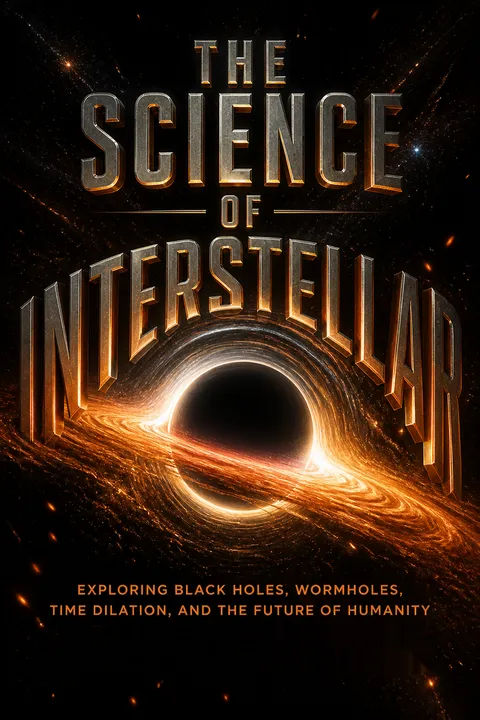


Key Takeaways
Use science fiction to explore the frontier, not disguise it as fact
Build stories on real rules. Kip Thorne joined the making of Interstellar to help ground its spectacle in physics. His guideposts were simple: established laws should not be contradicted, and speculation should grow from ideas scientists take seriously. That allowed the film to use black holes, wormholes, and extra dimensions without pretending every plot device was established science. Thorne also explains where the film bends the rules for clarity or drama, such as reducing Gargantua’s spin in some visual effects. His account is both a tour of physics and a record of scientists, screenwriters, and artists testing ideas together.
Keep the labels visible. The film’s most important scientific achievement is not that every scene is literally possible. It is that its inventions invite curiosity about what is known and what remains open.
What's striking is the use of constraints as creative fuel. A writer who knows what gravity permits can make a fictional danger feel more consequential than one rescued by arbitrary magic. This resembles engineering design, where limits force inventive solutions. The approach also supports scientific literacy by making uncertainty part of the entertainment. Still, plausible foundations do not make a whole scenario probable: a story can combine several individually conceivable events into a chain that nature is unlikely to assemble. The distinction between scientific possibility and realistic prediction is therefore central, not a footnote.
Treat scientific certainty as a spectrum, not a switch
Sort claims by evidence. Thorne distinguishes established knowledge, educated guesses, and speculation. Neutron stars count as established: physical theory predicts them, astronomers observe pulsars with matching properties, and supernova remnants provide a plausible origin. A crop blight that attacks many plant species is conceivable, but its emergence and spread remain uncertain. A traversable wormhole is more speculative still, since physics has not established that one can remain open.
Expect status to change. Newton’s gravity once seemed complete. A tiny mismatch in Mercury’s orbit resisted explanation, and Einstein’s relativity eventually accounted for it. In Thorne’s framework, scientific confidence grows through theory and observation, but even trusted laws can be revised when evidence demands it.
This is a practical form of epistemic calibration: confidence should track the strength and independence of evidence. It resembles Bayesian reasoning, in which new observations update the plausibility of competing explanations rather than instantly proving one. The categories also resist two common errors, treating every uncertainty as ignorance, or treating every elegant theory as fact. Their limitation is that labels can blur at the edges, and expert communities may disagree about where a claim belongs. That is a reason to explain the evidence behind a label, not to abandon the exercise.
Gravity changes clock rates, and GPS has to account for it
Clocks reveal gravity. Einstein’s account links gravity to warped time: clocks nearer a massive body tick more slowly than clocks farther away. In a 1959 Harvard experiment, researchers compared clocks at the top and bottom of a 73-foot tower. The lower clock lost about 210 trillionths of a second per day, in agreement with relativity. The effect is small on Earth, but not imaginary.
Technology makes it practical. GPS satellites orbit about 20,000 kilometers above Earth, where their clocks run faster than ground clocks by about 40 microseconds each day. Their timing must be corrected or location estimates fail. The same principle, intensified near a black hole, supplies Interstellar’s extreme contrast between Cooper’s time and his daughter’s.
The GPS example gives abstract relativity an unusually concrete test: a theory developed to describe gravity also has to be accounted for in everyday navigation. It shows how foundational science can become invisible infrastructure. The time-warp picture is powerful, but it is not the whole modern account of gravity; the geometry of space matters too, especially around black holes. Used as an entry point rather than a complete definition, the clock comparison makes a difficult theory accessible without reducing it to metaphor.
A black hole's shadow is a lensing effect, not a glowing surface
See the influence, not the hole. A black hole emits no light. Its event horizon is the boundary beyond which signals cannot escape, while the black shadow seen from outside is created by light that fails to reach the observer. Gravity bends light from the surrounding stars, rearranging their apparent positions. Near the shadow, temporarily trapped light can form a thin bright edge.
Spin reshapes the view. A rotating black hole drags nearby space into a whirl, altering the shadow and the paths of light. Hot gas in an accretion disk can shine intensely; magnetic fields can also help drive jets of material outward. Interstellar’s effects team used equations for these light paths to create its black-hole images, including a disk lensed above and below the shadow.
The visual effects turn a mathematical prediction into a legible image. That matters because a picture can communicate how an object changes its surroundings, not merely what it looks like. The same principle applies across science visualization, where good graphics reveal relationships that are difficult to express in prose. Yet an image is still a model, shaped by viewing position, assumptions, and artistic choices. Its beauty is not evidence by itself. The book’s account is strongest when it explains how equations, code, and visual judgment each contribute to the final result.
Miller's seven-year time gap requires a nearly maximally spinning Gargantua
The plot has a physical price. In the film, one hour on Miller’s planet corresponds to seven years far away. Thorne’s calculations require a black hole with about 100 million solar masses spinning within roughly one part in 100 trillion of its theoretical maximum. Its immense size also matters: a smaller black hole would produce tidal forces strong enough to tear the planet apart.
The waves need more than a dramatic backdrop. Thorne proposes that Gargantua’s tides deform and gently rock the planet, sloshing its oceans or triggering enormous quakes and tsunamis. The proposed explanation is a scientific interpretation, not something observed. Nolan also chose less extreme spin for some images, because the authentic distortions would distract a general audience.
This is a striking example of a story detail acting as a constraint on the entire physical setting. A chosen time difference determines the black hole’s spin, while survival requires enough mass to soften tidal damage. That chain makes the world feel designed rather than assembled from unrelated effects. It also shows why scientific accuracy in film is negotiated: one image can be more accurate in isolation but less useful to the larger story. The useful question is not whether every frame is exact, but whether the compromises are understood and disclosed.
Use gravitational slingshots where rockets cannot supply the speed
Borrow motion from massive bodies. A gravitational slingshot changes a spacecraft’s speed and direction by sending it past a moving planet or other massive object. NASA has used planetary flybys to extend missions such as Cassini. Those solar-system maneuvers are modest compared with the velocity changes needed near Gargantua: Thorne estimates roughly 100,000 kilometers per second, far beyond human spacecraft capability.
Black holes make the fictional route possible. Thorne imagines using smaller black holes to redirect craft near Gargantua. He notes that the neutron star mentioned in the film would expose nearby people to destructive tidal forces; a sufficiently large intermediate-mass black hole would be more plausible. Nolan kept the neutron star to avoid adding another black hole to an already crowded story.
A slingshot is a useful reminder that travel is not only about engines. A craft can exchange momentum with a moving body, much as a ball rebounds from a moving surface, though the source body’s motion and mass determine what is available. Near a black hole, that exchange becomes extreme, but so do navigation risks and tidal forces. The film’s compromise shows a recurring tension in science communication: simplifying the cast of concepts may improve comprehension while quietly weakening one technical detail.
A traversable wormhole needs exotic negative energy, and may not exist
A shortcut must stay open. A wormhole would connect distant regions through a shorter route, like a tunnel through an apple rather than a walk across its surface. But the simplest wormhole solutions collapse too quickly for anything to cross. Thorne’s analysis showed that a traversable wormhole would need material with negative energy, which he calls exotic matter, to hold it open.
Possibility is not capability. Quantum physics allows tiny negative-energy effects in laboratories, but researchers do not know whether enough could be gathered to stabilize a wormhole. Thorne considers the possibility that the laws of physics forbid usable wormholes. In his interpretation, the film’s wormhole works because advanced beings can build it and supply whatever holds it open.
The wormhole is a good case of a mathematical permission not amounting to an engineering recipe. A theory may contain a solution while nature offers no practical way to create or stabilize it. That distinction appears throughout technology: knowing that a process is allowed in principle does not show that its materials, energy, or control mechanisms are available. Quantum effects make negative energy a genuine subject rather than pure fantasy, but scaling a tiny effect to an astronomical structure is an enormous unresolved leap.
Anomalies become revolutions only when measurements survive scrutiny
A mismatch starts the work. Mercury’s orbit advanced slightly more than Newton’s laws predicted. An unseen planet called Vulcan was proposed, but searches found no such body. Einstein’s relativity later explained the discrepancy. In a different case, galaxies in the Coma cluster moved too quickly to be held together by visible matter, helping motivate the idea of dark matter. Later observations, including gravitational lensing, strengthened that case.
One odd result is not a new law. The accelerating expansion of the universe also began as a surprising observation and gained credibility through independent methods. In Interstellar, unexplained changes in gravity are fictional. Thorne uses real historical examples to show why researchers need repeatable measurements and competing explanations before declaring a revolution.
The history clarifies that an anomaly is a relationship between data and a model, not simply an event that looks strange. The same observation can initially support several explanations, as the search for Vulcan illustrates. Independent measurements help discriminate among them, while improved instruments can make an apparent discrepancy disappear. The book’s examples also caution against assuming that every anomaly demands new physics: sometimes the problem lies in missing matter, incomplete measurement, or an incorrect auxiliary assumption.
Singularities expose the missing bridge between relativity and quantum physics
Current theories reach a boundary. General relativity describes gravity and spacetime remarkably well, while quantum physics describes the very small. Their predictions conflict in extreme settings such as a black hole’s core. A singularity marks a region where spacetime warping becomes so extreme that relativity alone cannot describe what happens. Thorne compares it to a breaking ocean wave: the smooth form gives way to turbulent motion that needs different rules.
The movie supplies an imagined answer. Some mathematical models predict violent, chaotic singularities; other interior singularities may produce finite total stretching even as the forces rise without bound. Thorne treats Cooper’s survival and TARS’s recovery of quantum data as speculation, not established physics. Professor Brand’s equation is likewise a proposed route from unknown bulk fields to controllable gravity.
The singularity is valuable because it identifies not merely an unknown object, but a failure point in a successful theory. In philosophy of science, such boundaries matter: they show where a model stops earning trust and where a deeper account is needed. The ocean-wave analogy makes this intuitive, though the mathematical situation is more precise than a metaphor of turbulence. The story’s leap from a black-hole interior to usable data is imaginative, but the book carefully separates that leap from what relativity actually predicts.
Treat the tesseract's time messages as a carefully bounded speculation
A higher dimension changes the viewpoint. A tesseract is a cube extended through a fourth space dimension, just as moving a square through a third dimension produces a cube. Thorne uses the flat-world thought experiment from Edwin Abbott’s Flatland: a two-dimensional creature would see changing cross-sections of a sphere passing through its world. The analogy helps explain how a being from a higher-dimensional bulk might interact with our universe.
Interstellar adds its own rules. The film’s tesseract lets Cooper view different moments in Murph’s bedroom and send information through gravity, while ordinary matter and light cannot travel backward in time. Thorne interprets this as a speculative use of a fifth dimension and bulk gravity, not a demonstrated mechanism.
The Flatland analogy teaches a powerful habit of thought: a phenomenon that looks like creation or disappearance from one perspective may be an ordinary cross-section of a larger object. It makes extra dimensions easier to imagine without proving they exist. The film’s time rules also serve a narrative purpose, restricting easy escape while allowing a narrow channel for communication. That internal consistency is intellectually satisfying, but consistency within a story should not be confused with empirical support for its underlying physics.
Separate a plausible crop blight from the film's unlikely oxygen collapse
Food-system failure is conceivable. Plant diseases already damage crops, and the book’s biologists considered whether a pathogen could spread across many species. A pathogen that attacks chloroplasts, the structures plants use for photosynthesis, could in principle threaten both land plants and algae. The experts judged such a catastrophe possible but very unlikely.
The oxygen claim is weaker. If photosynthesis stopped, decay would consume only about 1 percent of atmospheric oxygen over roughly 30 years, according to Thorne’s estimate. That would not suffocate humanity. A far larger store of organic matter on the ocean floor, combined with an extreme ocean overturn, might produce a dangerous result, but both conditions are uncertain. The book therefore treats the crop threat and the oxygen threat as different levels of plausibility.
This distinction is useful for risk communication: a frightening scenario can contain one credible vulnerability and another much weaker link. Food supply depends on interconnected crops, distribution, and human decisions, so a biological shock could have consequences beyond the pathogen itself. But possibility alone does not make a scenario a forecast. The chapter’s expert consultation and rough oxygen accounting model a responsible way to ask what a disaster story gets right, where its assumptions are strained, and which uncertainties matter most.
Analysis
The Science of Interstellar is a hybrid: part accessible physics primer, part account of collaborative filmmaking, and part guided tour of scientific uncertainty. Its organizing device is not a single theory but a repeated distinction among established results, informed conjecture, and speculation. That distinction matters because the book moves rapidly from GPS timing and black-hole lensing, where evidence is strong, to wormholes and gravitational control, where the scientific footing is far less secure.
Thorne’s most effective teaching move is to make abstract physics answer concrete questions posed by the film. Why does time differ near Gargantua? Why does a black hole bend the background sky? What would an observer actually see? The answers link theory to images and engineering decisions, giving readers an unusually clear account of how scientific equations become visual effects. The collaboration also reveals that accuracy is not absolute in a movie: an image may be altered for pacing or comprehension, and Thorne makes many such compromises explicit.
The book’s central caution is that mathematical possibility is not evidence of existence. A solution to equations may require conditions nature never supplies, while a plausible mechanism may remain impossible to test with current instruments. This is especially important for the bulk, the tesseract, and the film’s backward-in-time gravitational messages. Those ideas are fertile thought experiments, not discoveries.
The 2014 publication date also makes the book a snapshot of science in motion. Its caution about the reported BICEP2 signal from primordial gravitational waves proved apt: subsequent analysis found that galactic dust could account for the claimed signal. That episode reinforces the book’s best lesson. Scientific authority is not certainty of tone; it is the discipline of stating what a measurement supports, what it does not, and what evidence could change the conclusion. The result is less a decoding key for every movie scene than a model of how to think when knowledge meets imagination.
Review Summary
The Science of Interstellar receives mostly positive reviews, praised for its accessible explanations of complex physics concepts related to the film. Readers appreciate Thorne's clarity in distinguishing between established science, educated guesses, and speculation. Many find the book enhances their understanding and appreciation of the movie. Some readers struggle with the more technical sections, but overall, the book is commended for its scientific rigor and engaging content. Several reviewers note that it changed their perspective on the film and sparked greater curiosity about the universe.
People Also Read



Glossary
Einstein's law of time warps
Gravity alters clock ratesThorne's explanatory name for the relativistic connection between gravity and the rate at which time passes. Clocks closer to a massive body tick more slowly than clocks farther away. In this account, differences in clock rates help explain gravitational pull, and the effect becomes extreme near a black hole.
tendex lines
Lines depicting tidal gravityA way to visualize the stretching and squeezing effects produced by warped spacetime. Red tendex lines represent stretching in one direction, while blue lines represent squeezing in another. The concept helps describe ordinary ocean tides, the forces near black holes, and the distortions associated with gravitational waves.
shell of fire
Region of temporarily trapped lightThorne's name for the region around a black hole where light can orbit temporarily before escaping or falling through the event horizon. The region is especially shaped by a spinning black hole's dragged, whirling space. Escaping light from these paths helps define the observed edge of the black hole's shadow.
exotic matter
Negative-energy wormhole supportMaterial with negative energy, as measured by an observer or light beam moving through a wormhole. Thorne argues that a traversable wormhole would need such matter to counter the tendency to collapse. Quantum physics permits tiny negative-energy effects, but whether enough could be assembled to hold open a usable wormhole remains unknown.
brane
Our universe's higher-dimensional membraneA term used in higher-dimensional physics for a lower-dimensional space embedded in a larger-dimensional setting. In the book's picture, our universe is a four-dimensional spacetime structure with three space dimensions and one time dimension, situated within a higher-dimensional bulk. The idea is motivated by theoretical physics, not direct observation of an exterior space.
bulk
Space beyond our braneThe higher-dimensional setting in which a brane may be embedded. In Interstellar's imagined physics, the bulk contains an additional spatial dimension and may contain fields that influence gravity in our universe. The book stresses that the bulk's existence and its role in the film's events are speculative.
BKL singularity
Chaotic black-hole interior singularityA type of singularity named for physicists Belinsky, Khalatnikov, and Lifshitz. Their work predicts that spacetime near this singularity undergoes chaotic, increasingly violent stretching and squeezing. It is a prediction of general relativity, though the precise behavior inside real black holes remains uncertain because quantum gravity is not understood.
critical orbit
Unstable boundary orbitAn orbit near a black hole where gravitational attraction and outward centrifugal effects balance. The balance is unstable: a slight change can send an object inward toward the horizon or outward away from the hole. In Thorne's interpretation of Interstellar, the Endurance uses this orbit as a precarious position for a controlled launch.
chronology protection conjecture
Physics prevents backward time travelStephen Hawking's conjecture that the laws of physics prevent the creation of situations that permit travel into the past. One proposed concern is that quantum fluctuations could grow catastrophically as a wormhole becomes a time machine. The book presents the conjecture as unresolved, pending a reliable theory of quantum gravity.
geometrodynamics
Changing geometry of spacetimeJohn Wheeler's term for the dynamic behavior of space and time, especially when their geometry changes rapidly. Colliding black holes provide an example: they produce intense distortions that travel outward as gravitational waves. Studying such events can test general relativity in conditions unlike the comparatively calm spacetime near Earth.
FAQ
What's The Science of Interstellar about?
- Exploration of scientific concepts: The book delves into the scientific principles behind the film Interstellar, covering topics like black holes, wormholes, and gravitational waves.
- Collaboration with filmmakers: Kip S. Thorne, a renowned physicist, worked closely with director Christopher Nolan to ensure the film's science was both accurate and engaging.
- Accessible to all readers: Thorne aims to make complex scientific ideas understandable to a general audience, encouraging curiosity about the universe.
Why should I read The Science of Interstellar?
- Unique perspective on science: The book offers insights from a leading physicist who contributed to a major Hollywood film, blending entertainment with education.
- Inspires interest in science: Thorne's passion for science is infectious, motivating readers to explore scientific concepts and their implications for humanity.
- Deepens understanding of the film: Readers gain a richer appreciation of Interstellar by learning the real science behind its plot and visuals.
What are the key takeaways of The Science of Interstellar?
- Understanding black holes: The book explains how black holes are formed, their properties, and their role in the universe, emphasizing their nature as "warped space and warped time."
- Concept of wormholes: Thorne discusses the theoretical existence of wormholes, their potential for interstellar travel, and the need for "exotic matter" to keep them open.
- Impact of gravity on time: The relationship between gravity and time is explored, particularly how "time slows near Gargantua," affecting the characters' experiences in the film.
What are the best quotes from The Science of Interstellar and what do they mean?
- "Accident is the first building block of evolution.": This quote reflects the unpredictability of life and evolution, suggesting that chance events can lead to significant changes in species and environments.
- "A wormhole isn’t a naturally occurring phenomenon.": Thorne emphasizes that traversable wormholes, if they exist, are likely artificial constructs rather than naturally occurring entities in the universe.
- "The last people to starve will be the first to suffocate.": This quote highlights the dire consequences of environmental collapse, illustrating the interconnectedness of food supply and breathable air in a deteriorating ecosystem.
How does The Science of Interstellar explain black holes?
- Black holes as warping spacetime: Thorne describes black holes as regions where spacetime is warped so severely that nothing, not even light, can escape their gravitational pull.
- Gargantua's properties: The book details the characteristics of Gargantua, the black hole in Interstellar, including its mass, spin, and the effects of its tidal gravity on nearby objects.
- Visualizing black holes: Thorne discusses how the film visually represents black holes and their accretion disks, using scientific principles to create a realistic portrayal.
What scientific principles are explained in The Science of Interstellar?
- Black holes and their properties: The book details how black holes warp space and time, affecting nearby objects and light, and discusses their formation from dying stars.
- Wormholes as shortcuts: Thorne explains the concept of wormholes as theoretical passages through space-time that could allow for faster-than-light travel, contingent on the existence of exotic matter.
- Gravitational waves: The text covers the detection of gravitational waves and their significance in understanding cosmic events, such as black hole collisions.
How does The Science of Interstellar address the concept of time?
- Time as a fourth dimension: Thorne emphasizes that time is treated as a fourth dimension in the universe, fundamentally different from the three spatial dimensions we experience.
- Time dilation near black holes: The book explains how time slows down in strong gravitational fields, such as those near black holes, affecting the experiences of characters in the film.
- Interplay of time and gravity: Thorne discusses how gravity influences the flow of time, a key theme in both the film and the scientific principles it explores.
What is the significance of gravitational anomalies in The Science of Interstellar?
- Key to understanding gravity: Gravitational anomalies are presented as phenomena that could provide insights into the fundamental nature of gravity and its effects on space-time.
- Potential for new discoveries: Thorne suggests that studying these anomalies could lead to breakthroughs in our understanding of the universe and the laws of physics.
- Plot device in the film: In Interstellar, these anomalies drive the narrative, influencing the characters' decisions and the quest for survival.
How does The Science of Interstellar explain the role of gravity?
- Gravity as a fundamental force: Thorne emphasizes that gravity is one of the four fundamental forces of nature, governing the interactions of matter and the structure of the universe.
- Gravitational waves: The book discusses the significance of gravitational waves, ripples in spacetime caused by massive objects, and their role in the film's narrative and scientific foundation.
- Harnessing gravity for survival: Thorne explores the idea that understanding and manipulating gravity could be key to humanity's survival, a central theme in Interstellar.
What is the significance of the tesseract in The Science of Interstellar?
- Representation of higher dimensions: The tesseract symbolizes a four-dimensional space that allows Cooper to interact with different moments in time, showcasing the film's exploration of time as a physical dimension.
- Communication across time: Inside the tesseract, Cooper can send gravitational signals to his daughter Murph, illustrating the book's theme of using scientific principles to transcend traditional limitations of time.
- Complexity of the tesseract: Thorne explains how the tesseract is not just a simple hypercube but is modified to enhance the narrative, allowing for a rich visual and conceptual experience.
What challenges did Kip Thorne face while writing The Science of Interstellar?
- Balancing science and storytelling: Thorne had to ensure that complex scientific ideas were presented in an engaging way that would resonate with a general audience.
- Collaborating with filmmakers: He navigated the creative process with directors and screenwriters, balancing scientific integrity with the demands of cinematic storytelling.
- Explaining advanced concepts: Thorne aimed to make difficult topics like quantum gravity and relativistic physics accessible, which required careful thought and clear explanations.
What role does Kip Thorne hope The Science of Interstellar will play for readers?
- Encouraging scientific curiosity: Thorne aims to inspire readers to explore scientific concepts and engage with the wonders of the universe.
- Bridging science and fiction: The book serves as a bridge between the realms of science and storytelling, demonstrating how scientific principles can inform and enhance narrative experiences.
- Educating the public: Thorne hopes to make complex scientific ideas accessible, fostering a greater understanding of the universe and the importance of scientific inquiry.
Download PDF
Download EPUB
.epub digital book format is ideal for reading ebooks on phones, tablets, and e-readers.








