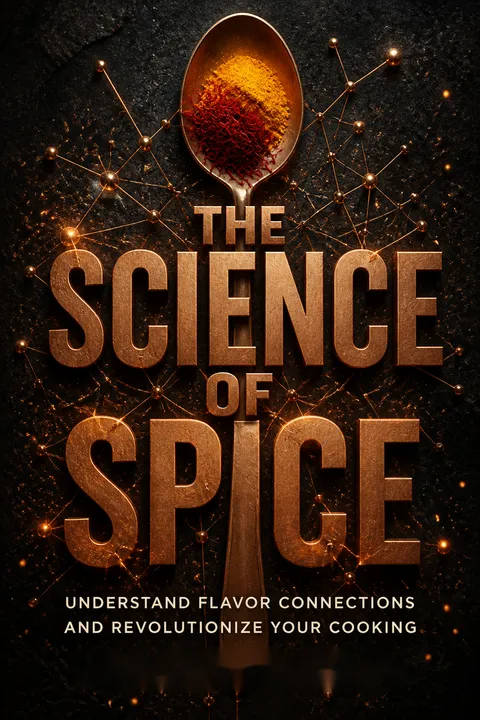


Key Takeaways
Treat spices as concentrated plant chemistry, not pantry decoration.
Spices store flavor. A spice can come from a seed, fruit, root, bark, flower, or other plant part. Plants make many of their flavor molecules for defense or reproduction. Humans prize them because the same chemicals smell and taste appealing in food. Most are held in tiny oil-filled compartments, which break open when a spice is crushed, ground, or heated. Once exposed to air, some compounds evaporate quickly, so a forgotten jar can become little more than colored dust.
Flavor travels through aroma. Many molecules reach the nose as vapor from the mouth, creating the impression that flavor comes from the tongue. This is why a spice's aroma compounds matter as much as its basic taste. Farrimond's central invitation is to understand those compounds well enough to use spices creatively, rather than keeping them captive to familiar recipes.
What's striking is how the scientific lens makes an ordinary cupboard feel legible. A spice is no longer just a name on a jar, but a plant material with a particular store of compounds and a particular way of releasing them. That view helps explain why freshness and handling matter. It also puts a useful limit on the science: chemistry can suggest what might work, but flavor is experienced in a whole dish, by a particular eater. The molecule map is a tool for curiosity, not a substitute for tasting.
Pair spices by shared aroma molecules, even across culinary borders.
Look for chemical bridges. The book's blending method begins with compounds that spices have in common. Allspice and clove, for example, both contain eugenol, a warming, woody compound. Cinnamon and allspice also share eugenol, while galangal and other spices connect through cineole, an eucalyptus-like aroma. Such overlaps help explain why pairings can feel harmonious even when they come from different food traditions.
Use links as clues. A cook can choose a main flavor, then look for a second spice with a shared compound that adds a new accent. Coriander's floral linalool can link otherwise different spices, while ginger can add citrusy pungency. The point is not to memorize a list of approved combinations. It is to use shared chemistry to make more informed experiments, including combinations not found in a standard recipe.
This is the book's most generative idea: compatibility becomes something a cook can investigate rather than inherit as a rule. It resembles design by shared components, where a common element helps distinct parts cohere. The method is especially useful when a recipe needs a new direction without losing its center. Still, a shared molecule cannot guarantee a successful dish. Proportion, freshness, cooking time, and the surrounding ingredients all influence what reaches the palate. Chemistry narrows the search; tasting makes the decision.
Match each spice's preparation to how its flavor molecules behave.
Choose the right carrier. Many spice aromas dissolve more readily in oil or alcohol than in water. Frying spices in oil can spread their compounds through a dish, while a water-only preparation may give a weaker aroma. Saffron is an exception in useful ways: its key flavor and color compounds dissolve in water, but need time, so steeping the strands before adding them helps. Some compounds also require fat to disperse well.
Manage time and heat. Grinding breaks open flavor stores, but exposes volatile aromas to rapid loss. Whole spices often suit slow cooking, while freshly ground spices can deliver a sharper hit. Toasting can create roasted, nutty pyrazines, but excessive heat burns delicate spices. Buy whole where practical, grind close to use, and store spices sealed, cool, and dark.
The practical strength here is that technique follows ingredient behavior instead of habit. A cook can ask three useful questions: what releases the aroma, what carries it through the dish, and what will destroy it? That turns grinding, blooming, steeping, and timing into purposeful choices. The advice also implies that a spice is not a fixed flavor: the same seed can taste different toasted, fried, or simmered. These are powerful controls, though they are not mechanical guarantees. A pan's heat and a dish's moisture can vary, so observation remains essential.
Treat chili heat as a bodily sensation, not simply another flavor.
Heat is not aroma. Compounds such as capsaicin in chili and piperine in black pepper stimulate pain or temperature-sensing nerves, producing a burning sensation rather than a conventional flavor. Sichuan pepper creates a different tingling, numbing effect through sanshools. These sensations can dominate a dish, obscuring its more subtle aromas, so pungent spices should be chosen and measured separately from fragrant ones.
Shape the intensity. The book suggests combining spices with different kinds of pungency for a more rounded effect, and using fat to disperse many heat-producing compounds. Removing a chili's inner pale tissue reduces heat more effectively than simply removing seeds. Dried chilis can be hotter than fresh ones because their pungency becomes concentrated as they lose water. Add heat carefully, then taste before increasing it.
Separating heat from flavor is a useful correction to everyday language. A dish can be intensely hot yet aromatically simple, or mild yet layered with fragrance. Thinking of pungency as a sensation helps cooks control those dimensions independently, rather than assuming more heat means more flavor. This also explains why two diners can judge the same dish differently: tolerance changes the experience of the nerve signal. The book's practical advice is strongest when it treats chili as one adjustable ingredient, not a test of culinary toughness.
Use flavor families to give a blend a clear center.
Start with a direction. Farrimond organizes spices into 12 flavor groups, based on their most important flavor compounds. The groups cover warm, sweet phenols; several kinds of terpenes; sweet-sour acids; fruity aldehydes; toasty pyrazines; sulfurous and pungent compounds; and distinctive compounds that do not fit elsewhere. The book's Periodic Table of Spices places individual spices in these groups as a quick reference.
Build from the center outward. Decide whether a dish should lean earthy, citrusy, warm, or smoky, then select one or two spices to establish that identity. Add another spice for a complementary note, using shared compounds to connect the blend. The book's example links allspice and star anise for warmth, galangal for another dimension, and coriander for floral lift. More spices can add complexity, but each should have a purpose.
The classification is useful because it gives cooks a vocabulary for intention. Instead of tossing in a little of everything, a cook can describe the desired effect and build toward it. The table is less a scientific periodic system than a practical map, since each spice contains many compounds and may cross several categories. That limitation is a feature as much as a flaw: the categories orient exploration without pretending to capture every nuance. A blend still needs a dominant idea, or added complexity can become indistinct.
Read regional spice palettes as histories, not culinary rules.
Trade left fingerprints. The book's regional survey shows that spice traditions formed through movement, exchange, and adaptation. Arab merchants carried Asian spices across trade routes; the Silk Road brought ingredients and new influences across Eurasia. European competition for spices shaped colonial expansion, while migration and local ingredients transformed what arrived. Chilis, originally from the Americas, became central to cuisines across Asia and Africa after their introduction through trade.
Tradition is varied, not frozen. A blend such as Lebanese baharat or Yemeni hawaij offers a recognizable foundation, but recipes and household preferences differ. In the Philippines, adobo centers on vinegar, garlic, bay, and pepper, while an Indonesian bumbu often combines fresh roots, aromatics, and other spices. Regional palettes are invitations to understand a cuisine's ingredients and history, not rules that every cook must follow.
The historical view resists the idea that cuisines are sealed, timeless packages. It shows how a local food identity can emerge from repeated acts of borrowing and adaptation. That perspective can make experimentation more respectful: learning where a blend comes from is different from treating it as a bag of interchangeable flavors. Regional summaries inevitably simplify large and diverse populations, however. They work best as orientation, not as a claim that one spice list represents every household, community, or generation.
Balance sour spices against sweetness, fat, and aromatic intensity.
Sourness has different forms. Amchoor, made from dried unripe mango, gives tartness without adding much moisture. Sumac contributes a dry, sharp acidity, while tamarind brings a fruitier, sweet-sour quality. Anardana, made from dried pomegranate pulp and seeds, combines acidity with sugars and tannins. These ingredients can brighten a rich dish, but their character changes with other ingredients and cooking time.
Use contrast deliberately. The book notes that sugars can amplify fruitiness and soften strong sourness. Its date and tamarind granita puts sweet fruit against tartness, ginger, chili, cumin, and garam masala. That combination shows how a dish can be built from opposing sensations rather than a single dominant note. Fat also affects how aromas spread, so balance is not just a matter of taste: the dish's texture and cooking medium shape the result.
This principle makes sour spices more than substitutes for lemon. Their dried, concentrated flavors bring distinct textures and aromas, while sweetness can soften sharp edges without erasing them. The granita is a particularly clear demonstration because it treats seasoning as composition: cold, sour, sweet, hot, and aromatic notes meet in one small dish. The balance is subjective, and no fixed ratio can suit every ingredient or diner. The most reliable method is incremental tasting, especially when working with concentrated dried fruit or acids.
Borrow a traditional blend, then change one flavor at a time.
Begin with a tested base. The book presents blends such as za'atar, dukkah, garam masala, and five-spice powder as foundations for cooking, not prescriptions. A familiar blend can season vegetables, meat, fish, or even desserts, while recipes demonstrate how traditional combinations work in complete dishes. For instance, a Lebanese seven-spice blend gives a biryani a warm, smoky profile, and the book adapts harissa with dill and black lime for a different balance.
Experiment with control. Change a single element at a time: trade one sweet spice for an earthy one, alter the chili, or add a citrus note. That makes the result easier to understand than changing the entire mixture at once. Keep a record of the proportions and cooking method, then taste the blend in the food it is meant to season. The goal is a repeatable personal variation, not novelty for its own sake.
This approach preserves the accumulated knowledge inside traditional blends while making room for individual taste. It also borrows a basic principle of experimentation: isolate a variable so the outcome teaches something. The book's many recipes make the science tangible, because readers can taste a proposed pairing rather than merely accept a chemical explanation. A blend tested in isolation may behave differently in a specific dish, though. Ingredient moisture, cooking method, and quantity matter, so the final test belongs in the meal, not just in the spice jar.
Analysis
The book is both a reference guide and a practical argument: cooks can use the chemistry of spices to move beyond rote recipe-following. Its structure supports that aim. A short scientific primer introduces plant parts, flavor molecules, and a 12-group classification; a global survey shows how cuisines use spice; individual profiles then connect particular compounds to practical handling and pairings. Recipes make those links edible rather than merely theoretical.
Its most useful contribution is not the claim that molecules dictate taste, but that chemical overlap can generate promising questions. Why might two spices harmonize? What does toasting add? Why does oil help some aromas travel? These questions give an improvising cook a method. The method is deliberately heuristic: a molecule shared by two spices suggests a bridge, but cannot calculate a finished dish. Flavor also depends on concentration, freshness, temperature, texture, and the other ingredients in the pan. The book's practical emphasis on tasting and adjusting is therefore essential, not an afterthought.
The global perspective deepens the culinary lesson. Spice combinations are not isolated inventions; trade and migration repeatedly altered local kitchens. Treating regional blends as starting points honors their histories while avoiding the false idea that a cuisine has one immutable flavor profile. At the same time, a compact regional survey necessarily compresses variation within countries and communities. Readers should treat its palettes as maps of common patterns, not exhaustive definitions.
The larger implication is that culinary creativity benefits from both structure and play. The flavor groups provide a vocabulary, molecular links offer hypotheses, and cooking supplies the test. Beginners gain a way to make sense of unfamiliar jars; experienced cooks gain a framework for deliberate variation. The book is most convincing when science opens possibilities rather than claiming to replace tradition or sensory judgment. Its lasting lesson is practical: understand what a spice contributes, learn how to release it, and then taste the dish closely enough to decide what it needs.
Review Summary
The Science of Spice receives mostly positive reviews, with readers praising its comprehensive information, beautiful design, and scientific approach to spices. Many find it useful for expanding their culinary knowledge and improving their cooking. Some criticize its oversimplification of certain cuisines and cultural insensitivity. The book's layout can be challenging on e-readers. Overall, readers appreciate the in-depth exploration of spice history, chemistry, and usage, though some find it too technical or basic depending on their existing knowledge.
People Also Read

Glossary
flavor compounds
molecules that shape flavorFlavor compounds are chemical molecules responsible for much of a spice's distinctive aroma and taste. Many are stored in plant tissues and released when the spice is damaged, ground, or heated. Their volatility and solubility affect how they behave in cooking: some evaporate quickly, while others disperse more readily in oil, alcohol, or water.
Periodic Table of Spices
a map of spice familiesThe Periodic Table of Spices is Farrimond's chart arranging featured spices into 12 groups according to the compounds most important to their flavor profiles. Its color-coded layout helps cooks find spices with related characteristics and use the profiles to explore possible pairings. It is a practical classification tool, not a claim that each spice has only one flavor.
flavor groups
12 families of spice flavorsFlavor groups are the book's categories for organizing spices by their dominant flavor compounds and sensory qualities. The 12 groups include sweet warming phenols, several terpene families, sweet-sour acids, fruity aldehydes, toasty pyrazines, sulfurous compounds, pungent compounds, and unique compounds. The categories help cooks choose a flavor direction and identify possible links between spices.
pyrazines
roasted, nutty flavor compoundsPyrazines are a family of compounds associated in the book with roasted, nutty, caramel-like, and sometimes smoky or meaty flavors. They can form when spices are toasted or fried, as heat causes components in the food to react. Toasting can add depth, but excessive heat can produce burned, bitter flavors.
pungent compounds
chemicals that trigger heatPungent compounds create sensations such as burning, sharp heat, or tingling by stimulating nerves rather than acting as ordinary aroma flavors. Capsaicin gives chili much of its heat, piperine gives black pepper its bite, and compounds in Sichuan pepper produce a numbing tingle. Their intensity and behavior differ, so pungency is best managed separately from fragrance.
Scoville Heat Index
a measure of chili pungencyThe Scoville Heat Index is a scale devised by pharmacologist William Scoville in 1912 to measure the pungency of chili peppers. It became a familiar way to compare chili heat, although the book notes that more accurate laboratory-based measures are replacing it. The scale concerns pungency, not the full flavor or aroma of a chili.
FAQ
What’s [Science of Spice] by Stuart Farrimond about?
- Comprehensive spice science: The book explores the chemistry, history, and culinary uses of spices, explaining their flavor compounds and how to blend them for maximum impact.
- Global culinary journey: It covers spice trade routes, regional spice palettes, and the influence of spices on cuisines worldwide.
- Practical applications: Readers get detailed spice profiles, recipes, and a unique Periodic Table of Spices to guide creative cooking.
- Scientific and cultural insights: The book combines food science with cultural stories, showing how spices have shaped global cuisines.
Why should I read [Science of Spice] by Stuart Farrimond?
- Unlock flavor potential: Learn science-based methods to release and enhance spice flavors, moving beyond guesswork in the kitchen.
- Blend with confidence: The book demystifies spice blending, making it accessible for both beginners and experienced cooks.
- Global inspiration: Discover new flavor combinations and traditional blends from around the world, broadening your culinary repertoire.
- Practical and empowering: It provides actionable advice and scientific principles to help you experiment and innovate with spices.
What are the key takeaways from [Science of Spice] by Stuart Farrimond?
- Flavor compound understanding: Spices are grouped by dominant flavor compounds, which determine their taste and how they interact in blends.
- Blending made simple: The Periodic Table of Spices and blending science help readers create harmonious and balanced spice mixes.
- Cooking techniques matter: Methods like toasting, grinding, and timing of spice addition are crucial for maximizing flavor.
- Cultural context: The book highlights how history, geography, and trade have shaped regional spice traditions and blends.
How does [Science of Spice] by Stuart Farrimond explain the science behind spice flavors?
- Flavor compound groups: Spices contain compounds like phenols, terpenes, aldehydes, acids, and sulfurous or pungent chemicals, each contributing unique flavors.
- Chemical roles in plants: These compounds evolved for plant defense or reproduction, but humans use them for their aromatic and flavorful properties.
- Flavor release mechanisms: Grinding, bruising, or heating spices releases volatile, oil-soluble compounds, with stability affected by cooking methods.
- Flavor mapping: The book’s Periodic Table of Spices visually categorizes spices by their dominant compounds for easy understanding.
What is the "Periodic Table of Spices" in [Science of Spice] by Stuart Farrimond?
- Visual flavor mapping: The Periodic Table of Spices categorizes spices by their dominant flavor compounds and groups.
- Blending tool: It helps identify which spices share similar chemical profiles and can be blended harmoniously.
- Practical guidance: Cooks can use it to create balanced spice mixes and understand complementary or contrasting flavors.
- Educational resource: It demystifies the science of spice pairing, making blending more accessible.
How does [Science of Spice] by Stuart Farrimond advise creating spice blends and pairings?
- Start with flavor groups: Select desired flavor profiles using the Periodic Table of Spices, such as spicy, earthy, or citrusy.
- Check for shared compounds: Pair spices with similar or complementary flavor compounds for harmonious blends.
- Build complexity: Add spices from additional groups that share compounds with your base spices to enrich the blend.
- Adjust for cooking method: Consider how spices behave in oil, water, or heat, and adjust blend composition accordingly.
What are the main flavor compound groups in [Science of Spice] by Stuart Farrimond, and what are their characteristics?
- Sweet Warming Phenols: Spices like clove and cinnamon, with sweet, aromatic, and warming flavors from phenol compounds.
- Warming Terpenes: Spices such as cumin and nutmeg, offering woody, peppery, and warm notes.
- Sulfurous Compounds: Garlic and mustard provide pungent, oniony, and meaty flavors due to sulfur compounds.
- Citrus Terpenes: Lemongrass and lemon myrtle deliver tangy, refreshing, lemony flavors from citrus-scented terpenes.
- Pungent Compounds: Chili and black pepper create spicy heat and tingling sensations by activating pain receptors.
How does [Science of Spice] by Stuart Farrimond explain the process of releasing spice flavors in cooking?
- Grinding and toasting: Grinding breaks open flavor capsules, while toasting in a dry pan releases oils and creates new flavor compounds.
- Cooking medium matters: Most flavor compounds dissolve better in fats and alcohol, so cooking spices in oil or butter maximizes extraction.
- Timing and temperature: Adding spices early allows flavors to infuse, but delicate compounds may require late addition to prevent loss.
- Avoid overheating: Overcooking spices can cause bitterness or aroma loss, so careful temperature control is important.
How does [Science of Spice] by Stuart Farrimond describe the role of spices in global cuisines?
- Historical trade influence: The book traces ancient spice trade routes and their impact on regional cuisines.
- Regional spice palettes: It details characteristic spices and blends from the Middle East, Africa, South Asia, Southeast Asia, East Asia, the Americas, and Europe.
- Cultural fusion: Many cuisines reflect centuries of exchange, colonization, and migration, resulting in diverse spice uses and signature blends.
- Local adaptations: The book highlights how local ingredients and traditions shape unique spice applications.
What practical advice does [Science of Spice] by Stuart Farrimond give for buying, storing, and using spices?
- Buy whole, grind fresh: Whole spices retain flavor longer; grind just before use for maximum aroma and potency.
- Use proper cooking methods: Toast, fry, or infuse spices as appropriate to release their best flavors.
- Balance flavors: Combine spices with shared compounds for harmony, and balance pungency, sweetness, bitterness, and acidity.
- Store correctly: Keep spices in airtight containers away from light, heat, and moisture to preserve their shelf life.
What are some classic spice blends and recipes featured in [Science of Spice] by Stuart Farrimond?
- Classic blends: Includes Arabic Baharat, Garam Masala, Za’atar, and Harissa, each with unique regional profiles.
- Diverse recipes: Features dishes like Chinese Steamed Salmon with Chili and Star Anise, Chicken and Eggplant Biryani, and West African Peanut Curry.
- Spice-focused cooking: Each recipe highlights specific spice blends or profiles, teaching effective spice use.
- Flavor release tips: Recipes incorporate advice on when and how to add spices for maximum aroma and taste.
What are the best quotes from [Science of Spice] by Stuart Farrimond and what do they mean?
- Empowering cooks: “This book serves up easy-to-follow, science-based principles that will transform the way you use spices.” — Encourages readers to innovate confidently with spices.
- Value of complexity: “Complexity increases with each extra spice, and so will pleasure—research shows that the greater the range of flavors and mouth sensations in a dish, the tastier it will be.” — Highlights the benefits of layering flavors.
- Creative freedom: “No one should be shackled by recipes from chefs, internet ‘gurus,’ or family tradition.” — Advocates for experimentation and personal expression in spice use.
- Scientific insights: Quotes like “Cineole’s cooling effect stimulates cold receptor TRPM8…” and “Citral is unstable and breaks down over time…” explain the sensory science behind spice flavors.
Download PDF
Download EPUB
.epub digital book format is ideal for reading ebooks on phones, tablets, and e-readers.








