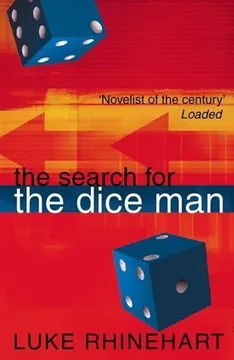


Plot Summary
Rain Misses the Wheat
Larry Rhinehart has built his reputation as a brilliant futures trader by turning the 1987 market crash into a promotion. Now, after months of losing money, he bets heavily on rain damaging the Midwest wheat crop. The rain falls elsewhere, wheat prices plunge, and his clients lose two million dollars.
His engagement to Honoria Battle, daughter of his powerful employer, and his standing at Blair, Battle and Pike suddenly feel less secure. Then two men claiming to be FBI agents arrive at his office. They ask whether Larry’s estranged father, Luke Rhinehart, is alive and where he might be. Larry has not seen Luke in fifteen years, but the question makes the past he has tried to bury feel suddenly active.
Larry treats prediction as a form of self-authorship: if he can read markets correctly, he can control his standing, his future marriage, and his distance from his father. The failed wheat bet punctures that bargain with a literal misreading of the weather. The FBI’s questions then make coincidence feel personal. The novel begins by placing Larry’s professional faith in calculation beside the one uncertainty he has never resolved: whether Luke is alive, and what his disappearance means.
The Father in Headlines
At the Battle family estate, Larry meets Kim Castelli, Honoria’s irreverent cousin, and learns that a tabloid has revived sensational claims about Luke’s old dice communes. The story describes brainwashing, sexual exploitation, and a leader still sought by federal agents.
Honoria fears the scandal could derail their marriage, while her father, William Battle, wants Luke kept officially dead. Larry has spent years defining himself against the man who abandoned him, even rejecting Luke’s offer to take him in after Larry’s mother died.
Yet the newspaper and FBI visit make silence feel dangerous. Angry at being threatened by a father he has not seen, Larry decides to find Luke himself, both to confront him and to protect the life he has built.
The quest begins with mixed motives rather than filial longing. Larry wants to control the consequences of Luke’s reputation, preserve his engagement, and finally confront the wound of abandonment. His father’s absence has become a hidden organizing principle: Larry’s devotion to order is not simply a temperament but a counter-identity. Kim’s arrival matters because she unsettles the polished world Larry is trying to defend. The tabloid’s distortions also establish a central problem: every account of Luke may contain truth, invention, or both.
Clues Point South
Larry sends his secretary, Miss Claybell, through old newspaper files, then follows two leads. A retired detective recalls Luke’s talent for confessing and retracting crimes according to the dice, while FBI agent Nathaniel Putt admits the bureau has an inactive file and mentions a surviving community called Lukedom.
A tabloid reporter offers little beyond a confused former commune member’s story. Putt points Larry toward Arlene Ecstein, once close to Luke and married to his colleague Jake.
Arlene appears to be a harmless grandmother who remembers little, but gives Larry a sketch map Jake sent her. After the visitors leave, she removes her wig and transforms into a younger, boldly dressed woman. Her disguise makes clear that in Luke’s world, even a witness’s identity may be a performance.
The investigation does not produce a reliable chain of evidence. Instead, each source exposes how easily identity, memory, and testimony can be manipulated. Larry’s financial habits make him want clean data and dependable witnesses, but the people connected to Luke offer neither. Arlene’s transformation is more than a comic trick: it demonstrates that a fixed public self can be put on and taken off. The clue to Lukedom therefore comes bundled with a warning. To find his father, Larry will have to enter a world where conventional tests of credibility cannot be trusted.
The Password Keeps Moving
Larry and Honoria follow Arlene’s rough directions through Virginia’s mountains until a guard at a remote gate challenges them with a password that changes between guesses. They reach Lukedom, a self-contained settlement of farms, shops, costumes, and people assigned temporary roles.
Larry demands access to Jake Ecstein, Luke’s former colleague, but Jake refuses to reveal anything unless Larry stays a week and trains with a dice guide. Honoria resists the rules, while Larry refuses to let Luke dictate how he searches.
Their Mercedes disappears almost immediately, stolen by a resident who treats car theft as a temporary experiment. The local police promise it will be returned, leaving the couple stranded in a town where ordinary rights and ordinary consequences have been rearranged.
Lukedom turns Larry’s desire for a direct answer into a test of participation. Its moving password and temporary roles make procedure unstable, while the stolen car shows that the community’s playfulness can impose real costs on outsiders. Larry reads these customs as an attack on reason and property, but his continued search means he cannot simply dismiss them. The settlement is not a fantasy outside society; it is a deliberately designed social experiment with rules, institutions, and loopholes. That tension between freedom and consequence will shape Larry’s experience of it.
Honoria Takes the Plane
While Larry explores Lukedom, Honoria seeks help from Michael Way, a charismatic trainer who guides her through an exercise in expressing love and hatred toward people chosen by dice.
The exercise exposes how little warmth she can summon for Larry, then pushes her into a frightening display of rage when Way takes the role of her father. Honoria leaves the room shaken and decides she has had enough. Larry refuses to abandon his search, so she breaks their engagement and leaves with Rick, the teenage car thief who has been pursuing her.
Rick recovers Larry’s Mercedes and gets Honoria onto a small plane. He flies it himself, narrowly clearing the airport and later landing near a highway, while Honoria returns to New York convinced she has escaped a madhouse.
Honoria’s flight is not simply a rejection of Lukedom. Way’s exercise strips away the social composure that protects her, revealing a capacity for anger and a difficulty with unguarded affection. Her response is to restore control by leaving, while Larry chooses the opposite response and stays. The scene sharpens their incompatibility: Honoria wants stability and clear boundaries; Larry is becoming absorbed by the very disorder he claims to oppose. Rick’s reckless flight turns that emotional break into a physical escape, though his audacity also shows why Lukedom’s experiments cannot be treated as harmless games.
Larry Enters the Training Room
Left alone in Lukedom, Larry attends a dice-guided training session led by Kathy Kalb. She challenges him to undress and to give her two thousand dollars, asking what he fears losing. Larry tries to let the dice decide, but their results simply protect him from embarrassment.
Kathy offers him money to undress herself, demonstrating that an unconventional act need not destroy a person’s dignity. After resisting, Larry finally follows her instruction and discovers that his certainty about what counts as foolishness is less solid than he thought.
The lesson unsettles him, but he remains focused on finding Luke. Meanwhile, he calls Jeff Cannister at the trading desk, where Jeff urges a risky oil position based on supposed information from a government contact.
Kathy’s exercise targets Larry’s dependence on external judgment. He treats dignity as a fixed asset to defend, much as he treats capital, but the exercise makes him examine who sets its price. His eventual compliance is not a conversion to dice-living; it is a brief loss of his usual evaluative posture. The parallel with Jeff’s trading is pointed. Jeff, like Larry, wants a method that will make uncertainty manageable, but his secret reliance on privileged information carries a different risk: not self-exposure, but a betrayal disguised as expertise.
A Father in the Woods
In another training exercise, a bald participant plays Luke while Larry confronts him on a walk through the woods. Larry accuses his father of choosing the dice over his family and of disappearing when his mother and children needed him. The pretend Luke reminds him that, after Larry’s mother died, he did try to take Larry and his sister in, but Larry rejected him in grief and anger.
Larry admits he had wanted to go, though he could not accept the offer from a father who had vanished for years. The exercise leaves him crying beside a stream. An FBI agent, James Macavoy, has followed them and recognizes the man playing Luke as a promising lead, then tracks him through Lukedom.
The staged encounter releases a truth Larry has kept outside his conscious account: his rejection of Luke was real, but it was not free of longing. The scene refuses to turn either father or son into a simple villain. Luke’s earlier abandonment remains damaging, while Larry’s refusal after his mother’s death becomes understandable rather than definitive. The exercise also gives the FBI a misleadingly concrete clue. In Lukedom, a performed identity can look like evidence to an observer who assumes people are stable and recognizable.
The Mountain Has a Runway
Larry and Kim climb a mountain above Lukedom, where their training exercise gives way to physical competition, shared exhilaration, and a kiss at the summit. Looking down the far slope, they spot a concealed airstrip cut into the mountainside.
Earlier, they had seen a suited man disappear near an abandoned mine entrance, suggesting a hidden passage through the mountain. The runway makes Lukedom seem more organized and secretive than its casual administrators admit. That evening, Kim urges Larry to prove he can use the dice rather than reject them out of fear.
He agrees to a game about what they will do together, and the die chooses for Kim to become his sexual servant. Larry follows the choice, beginning a relationship that scrambles his loyalties and his self-image.
The mountain joins two discoveries: intimacy with Kim and the possibility that Lukedom conceals a larger operation. Larry’s attraction is no longer an abstract threat to his engagement; it has become an experience that challenges the life he has carefully arranged. The hidden runway likewise complicates the settlement’s apparent simplicity. Both discoveries reward attention to what lies beneath the surface, but they do not yet explain what is there. Larry’s first serious dice choice is partly an experiment and partly an excuse to follow desire, a distinction he will struggle to maintain.
Three Dice Men Arrested
Jake gives Larry a mahogany box containing two green dice, a bronze die, and a letter, claiming the bronze die holds Luke’s ashes. Before Larry can make sense of the gift, Rick reports that agents have arrested Luke. At the Hazard Inn, however, FBI agent Putt finds several men claiming the name, including the local police chief.
Macavoy cannot identify the man he followed, and the arrest turns into farce. Larry leaves Lukedom believing the box’s contents mean his father is dead. He returns to New York with Kim, but at the airport she chooses to ride back with Rick while Larry boards a plane alone. The search appears over, yet the separation leaves him with no comfort from the life he had come to reclaim.
The failed raid exposes the limits of institutional certainty. The FBI has watched, questioned, and pursued, yet Lukedom’s shifting identities make its evidence collapse at the moment of arrest. Jake’s box offers Larry a more intimate but equally unverifiable conclusion: his father’s death. The apparent answer does not resolve the emotional problem; it deepens Larry’s isolation. His departure with Kim is also temporary. She does not yet choose him, and he has not chosen a new life so much as retreated from a place where his old identity could no longer command recognition.
The Bronze Die Lies
Back at Blair, Battle and Pike, Larry is losing money and estranging Honoria when Arlene appears as a potential client. She says she spoke with Luke only months earlier and dismisses the story that the bronze die contains his ashes as an old Lukedom trick. She gives Larry two hundred thousand dollars to speculate with, insisting that he take real risks rather than hide behind the language of investment.
After she leaves, Larry saws into the bronze die and finds a note from Luke telling him to begin using chance. The discovery breaks through his anger. For the first time, Larry allows that his father may care about him, even if Luke’s message offers no apology and demands a response on Luke’s own terms.
Arlene changes the meaning of the box from memorial to provocation. The secret note turns a supposed relic into an instrument of contact, though Luke still controls when and how he speaks. Larry’s tears reveal how much he has wanted acknowledgment beneath his contempt. Arlene’s money makes the philosophical challenge material: she asks him to risk capital, the very instrument through which he has built his identity. The scene does not prove that chance is wise. It shows that Larry’s refusal to engage it has become another rigid rule protecting him from emotional exposure.
Chance Enters the Trading Room
Larry begins letting dice settle trades where his technical indicators offer no clear direction, and a winning day encourages him to continue. Jeff reveals that his bond and market tips came from an insider he could not contact directly.
The supposed peace initiative that led them to bet against oil instead preceded a major troop deployment, costing the fund heavily. When the insider later supplies another tip, Larry and Jeff plan to outrun it with a fabricated report that President Bush has HIV.
They arrange for an actor posing as a doctor to announce the claim to reporters. The market plunges, then recovers when the clinic exposes the imposture. Their fund makes a record profit, but Larry has crossed from speculation into deliberate deception.
The trading plot makes chance a question of power, not merely randomness. Larry’s dice choices sometimes loosen his habitual control, but his counterattack against the insider is an act of calculated manipulation. He answers deception with a more elaborate deception and profits because the market reacts faster than it can verify. Jeff’s betrayal by his source does not make the pair more ethical; it makes revenge seem justified. The episode satirizes financial expertise as a performance sustained by confidence, rumor, and unequal access to information, while leaving the moral cost of Larry’s success visible.
Larry's Saintly Trading Day
A dice choice sends Larry into a day of attempted sainthood. He urges traders to care less about profit, sells stocks he judges harmful, and gives away cash on the streets until the people he helps strip off his robe and clothes. His unexpected trades prove profitable, so Blair, Battle and Pike applauds him rather than questioning his judgment.
That evening Honoria comes to him and reveals that her earlier claim of not being pregnant was a lie: she is carrying their child and plans to keep it. She has also put on her engagement ring again. In his saintly state, Larry admits his affair with Kim. Honoria agrees to marry him for the child’s sake, but demands that he end the affair.
The saintly role makes Larry’s values visible by exaggerating them. He gives money away, but the institution still judges him by whether his choices produce profit. His confession to Honoria is an ethical act that threatens the order he has been trying to preserve. Honoria’s pregnancy makes their bond consequential beyond status or romance, while her willingness to marry him is tied to responsibility rather than renewed trust. Larry’s temporary moral clarity therefore does not solve his divided desires. It makes their consequences harder to evade.
The Battle Party Explodes
At William Battle’s party celebrating the war and a possible Japanese investment, a newspaper reports that federal agents have raided Lukedom and links Larry’s firm to its funding. Larry stops denying his connection to Luke. He tells the guests that he uses dice in trading, while Jeff backs him, and Arlene and Kim spread the games through the house.
The formal gathering unravels into role-playing and sexual chaos. When Honoria asks Larry to leave with her, he says that life with him must include Kim and uncertainty. Honoria walks out. Larry finds Kim and asks her to marry him; she agrees to consider it but requires him to ask again on three Saturdays. The scandal costs Larry his job and engagement, while Jeff inherits his trading post.
The party converts Larry’s private experimentation into public identity. He can no longer keep dice-playing as a controlled tool for profits while preserving the respectable persona that made those profits valuable. His choice of Kim is both an act of desire and a refusal of the life organized around Honoria’s family. Yet Kim does not reward his declaration with instant certainty; her condition preserves her independence and makes commitment a repeated practice. The financial world responds pragmatically: it condemns Larry once his behavior threatens reputation, then promotes Jeff, whose own dice faith is easier to accommodate.
The Founder in Kyoto
Unemployed and traveling with Kim, Larry follows the initials DI to Ditonics, a Japanese software company funded by the same circle that supported Lukedom. An executive explains that its founder adapted Luke’s interest in chance into design software that generates unconventional products. The company’s work leads Larry and Kim to a Zen monastery near Kyoto.
There they find Luke, now a monk who says he stopped using dice years ago. Larry accuses him of abandoning his own discoveries and asks why he never contacted him; Luke explains that he believed Larry was doing well. The two men embrace, and Larry forgives him for leaving. Then Larry turns the old roles around, insisting that Luke has become trapped in a routine and needs rescuing.
The reunion refuses the fantasy that finding Luke will restore the father Larry remembers. Luke is neither the vanished counterculture legend nor the monster Larry has carried in his mind; he is an older man who has chosen a quiet discipline. Larry’s forgiveness is real but incomplete, because he immediately judges Luke’s present life through the very framework Luke once imposed on him. The reversal gives the son a chance to act rather than merely accuse. Their renewed bond begins not in agreement about chance, but in mutual recognition and a willingness to keep walking together.
Epilogue
In a Tokyo cemetery, FBI agents Putt and Macavoy struggle through heavy rain while searching from a map. They find a grave marked with Luke Rhinehart’s name and the years 1932 to 1989.
The stone appears to settle the question of Luke’s death, though the story has already shown how readily appearances can be manufactured. The agents stand before it in the downpour, left with a grave that may be evidence, another performance, or both.
The grave turns the novel’s final certainty into another unstable sign. Its dates contradict the reunion Larry has just experienced, but the book has repeatedly shown that names, bodies, and records can be staged. Putt’s solemnity cannot restore the authority of evidence after Lukedom has made identity a game. The closing image leaves the reader in the same position as the agents: forced to interpret a physical object without knowing whether it records a fact or completes a performance. The uncertainty is not a puzzle to solve so much as the story’s final refusal of a single fixed version of Luke.
Analysis
The novel makes chance concrete by attaching it to decisions with recognizable costs: a bad wheat bet, a lost engagement, a rigged market panic, a stolen car, an unexpected romance. Its philosophical claims are tested not in abstract debate but through consequences. Dice can interrupt a familiar response, but they cannot decide whether a person should accept responsibility for what follows. Larry’s early insistence that skill can master uncertainty is exposed as another kind of faith. When he begins using dice, he discovers that surrendering choice can itself become a strategy for avoiding ownership.
The family conflict gives this experiment its emotional weight. Larry believes he has escaped Luke by choosing control, but his career, his relationships, and even his rejection of dice are organized around the father he resents. Their eventual meeting cannot restore the lost years or make Luke’s choices harmless. It does, however, let Larry recognize the man behind his inherited image of a monster. Forgiveness begins when he stops demanding that the past produce a clean verdict.
The satire of Wall Street sharpens the same argument. Traders present speculation as expertise, though markets turn on unpredictable events, incomplete information, and rumor. Larry’s fabricated report succeeds because the financial world is already primed to believe dramatic claims. His colleagues condemn disorder only when it threatens their position, then applaud whatever makes money. Lukedom is not offered as a flawless alternative: its games can become coercive, self-indulgent, or dangerous. The book’s challenge is therefore not simply to choose chance over order. It is to notice when a chosen system has become a cage, and to accept that freedom without responsibility is only another performance.
Review Summary
The Search for the Dice Man received mixed reviews, with an average rating of 3.30 out of 5. Many readers found it less engaging than the original "Dice Man" novel, citing a lack of originality and weaker character development. Some appreciated the continuation of the story and the exploration of dice-living philosophy, while others felt it was tedious and dated. The book follows Larry Rhinehart's quest to find his father, the original Dice Man, and his eventual embrace of chance-based decision-making. Despite its flaws, some readers found it entertaining and thought-provoking.
People Also Read




Characters
Larry Rhinehart
Control-seeking futures traderLarry is a successful young trader whose confidence rests on analysis, discipline, and the belief that risk can be intelligently contained. He is also the son of Luke Rhinehart, a father whose disappearance has shaped Larry’s commitment to order. Larry wants wealth, professional recognition, and a secure marriage, yet he is drawn to danger and unsettled by the limits of his own systems. His humor often disguises fear, especially when his status or emotional loyalties are threatened. The search for Luke forces him to confront how much of his supposedly independent identity is a reaction against his father.
Luke Rhinehart
Vanished dice-life theoristLuke is Larry’s estranged father and a former psychiatrist who developed dice-living as a way to disrupt habitual identities. He believes people become trapped by the need to remain consistent, and that chance can open space for new roles and behavior. His devotion to experimentation damaged his family and brought him into conflict with authorities. Luke is charismatic, elusive, and difficult to separate from the myths told about him. His son experiences him less as a fully known person than as the source of a lifelong argument about freedom, responsibility, and the cost of refusing ordinary roles.
Kim Castelli
Restless Battle-family outsiderKim is Honoria’s cousin, a free-spirited woman who moves uneasily between wealthy family life and the cheaper, less conventional worlds she prefers. She is curious about spiritual experiments but distrusts institutions that prescribe spontaneity. Her humor and sexual confidence unsettle Larry, whose attraction to her exposes the gap between his desires and his carefully planned future. Kim is not simply a symbol of chaos: she recognizes her own dependence on the Battles and wrestles with what kind of life she can sustain. She values affection, independence, and direct experience, while resisting the expectation that she should become a polished version of her family.
Honoria Battle
Polished heiress under pressureHonoria is Larry’s fiancée and the daughter of William Battle, the powerful head of his firm. She prizes competence, social polish, and predictable plans, and she has learned to express rebellion through brief, carefully managed eccentricities. Her composure can look cold, but she is intelligent and capable of confronting what others would rather keep unspoken. Lukedom’s role-playing challenges her sense of control, while her relationship with Larry makes her question whether a secure partnership can survive his growing appetite for uncertainty. Her bond with Kim combines affection, exasperation, and the privileges of a shared family world.
Jeff Cannister
Larry's anxious trading partnerJeff is Larry’s associate trader, a competent but chronically nervous man who experiences every market movement as a possible catastrophe. His fear of uncertainty leads him first toward secret insider information and later toward the comfort of letting dice decide. He is loyal to Larry, though his choices help produce a damaging trading loss. Jeff’s changing relationship with risk mirrors the novel’s wider question: whether surrendering control brings freedom, merely another form of dependence, or both.
Jake Ecstein
Luke's wily former colleagueJake is a former psychiatrist, Luke’s friend and rival, and a leading figure in Lukedom. He once pursued fame and money, but the dice movement altered the life he had built. Jake is comic, shrewd, and fond of managing access to information through rules and delays. He treats Larry’s search as an opportunity for training rather than a request that should be answered directly. His mixture of affection and manipulation makes him both a guide to Luke’s world and a reminder that its leaders can enjoy power even while preaching freedom.
Arlene Ecstein
Disguised dice-life veteranArlene is Jake’s former wife and one of the early people drawn into Luke’s experiments. She can present herself as a gentle grandmother or a bold, provocative woman, treating appearance as one more role to change. Her playful manner conceals a keen understanding of how others judge credibility. Arlene helps Larry by supplying a route into Lukedom and later by treating his money as material for genuine risk. Her behavior makes her an unreliable witness in the conventional sense, but an unusually perceptive observer of how people use performance to protect themselves.
William Battle
Larry's status-minded employerWilliam Battle is Honoria’s father and the head of Blair, Battle and Pike. He values wealth, appearance, social standing, and the orderly continuation of the firm. He sees Larry as both a promising trader and a possible son-in-law, so professional setbacks quickly become family concerns. Battle’s polished authority rests on a belief that nearly every problem can be handled through reputation management. His response to Lukedom exposes how much his own world depends on performance, even as he insists that its rules are more respectable.
Michael Way
Charismatic Lukedom trainerMichael Way is an English trainer at Lukedom, a former scholar and athlete whose ease in the community gives him considerable authority. He uses role-playing exercises to provoke emotional responses, believing people must loosen their attachment to a fixed self. His methods can be perceptive but also coercive, especially when Honoria feels pushed beyond her willingness to participate. Kim is attracted to his intelligence yet questions whether his apparent spontaneity hides a large ego.
Rick
Reckless teenage car thiefRick is a young Lukedom resident who steals cars as a way to test his abilities and break through his shyness. He treats danger as an invitation to experiment, a habit that makes him both charming and alarming. Rick takes Larry’s Mercedes, courts Honoria, and later pilots a small plane with far more confidence than experience. His actions show how an experiment in personal freedom can spill into other people’s lives, particularly when the person experimenting assumes that everyone shares his appetite for risk.
Kathy Kalb
Larry's uncompromising dice guideKathy Kalb is a dice guide who introduces newcomers to Lukedom’s basic principles. She is direct, unsentimental, and more interested in challenging a participant’s assumptions than winning approval. With Larry, she uses questions about money and dignity to expose how strongly he depends on outside evaluation. Her approach is forceful, but it gives him an early experience of acting without his usual assurances about how he will appear.
Nathaniel Putt
Obsession-driven FBI agentPutt is an FBI agent who spent years pursuing Luke and resents the way the case damaged his career. He approaches Lukedom convinced that its followers threaten social order, and he hopes Larry’s search will finally lead him to Luke. His determination is matched by a rigid view of evidence and authority, both of which prove vulnerable in a community built on shifting identities. Putt’s pursuit supplies the story’s law-enforcement subplot and its recurring collision between official certainty and performed reality.
James Macavoy
FBI agent on the trailMacavoy is a younger FBI agent assigned to follow Larry and use him to locate Luke. Serious and diligent, he tries to blend into Lukedom while remaining committed to the bureau’s mission. The community’s games repeatedly disrupt his attempts to gather reliable information. Macavoy’s pursuit shows how easily an observer can mistake a role for a fact, especially when he assumes that people can be identified once and for all.
Akito
Japanese bank negotiatorAkito is a senior Japanese banker interested in Larry’s apparent trading skill and in a possible investment in Blair, Battle and Pike. He is athletic, direct, and more willing than his colleagues to challenge Larry’s claims about technical expertise. His attention gives Larry a tempting prospect of greater wealth and recognition, while his questions expose how little Larry can explain about the source of his success.
Mr. Mora
Ditonics corporate guideMr. Mora is an elderly Ditonics executive who explains how the company uses random variation in its software designs. His calm manner and careful answers help Larry and Kim connect the Japanese corporation to Luke’s ideas. He treats the company’s unusual history as practical business rather than counterculture, showing how a theory of chance can be absorbed into a disciplined institution.
Evie Rhinehart
Larry's distant sisterEvie is Larry’s sister, who lives apart from him and appears mainly through his memories. Their different circumstances and emotional distance remind Larry that Luke’s disappearance affected more than one child. She represents a family connection Larry has not repaired, even as he focuses his anger on his father.
Plot Devices
Dice-living
Chance as chosen actionCharacters create a list of possible actions or roles, then use dice to select among them. In Lukedom, the practice ranges from choosing a meal or job to expressing an emotion or adopting a temporary identity. It is presented as a way to loosen habits and explore contradictions, but the story also shows its dangers: a choice can affect lovers, finances, and bystanders. Larry first resists the method, then adopts it as a tool for trading and personal change. The dice do not supply wisdom; their force comes from the human decision to obey them.
Lukedom's role system
A town built for instabilityLukedom is a privately owned settlement where jobs, rooms, rules, and social identities may be assigned or altered through chance. Its changing passwords, unusual prices, costumes, and themed rooms make routine difficult and turn daily life into an experiment. The system offers residents room to try different ways of being, but it also creates confusion and allows people to treat disruptive acts as harmless play. For Larry, Lukedom is both a community built from his father’s theories and a practical obstacle to the direct answers he seeks.
The bronze die
A false ending becomes a messageJake presents Larry with a bronze die supposedly containing Luke’s ashes, accompanied by a letter from his father. Larry initially treats the box as proof that his search has ended. Arlene later tells him that Luke is alive, and Larry cuts into the die to find a concealed note urging him to begin using chance. The object converts a claim of death into a delayed form of communication, while preserving Luke’s habit of making Larry work for information.
Ditonics design software
Chance made corporate methodDitonics uses random variables in design programs to produce results that conventional, purpose-driven software might never generate. Its founder adapted the idea from Luke’s writing and his interest in chance, applying it to cars, architecture, fashion, and other products. The company’s method gives Larry a concrete example of randomness being used within a highly organized institution. It also leads him from the hidden funding of Lukedom to Luke’s whereabouts in Japan.
About the Author

Download PDF
Download EPUB
.epub digital book format is ideal for reading ebooks on phones, tablets, and e-readers.








