Key Takeaways
1. America's Purpose: A Universal Plan for Global Democracy
Years of research among the records of olden peoples available in libraries, museums, and shrines of ancient culture has convinced me that there exists in the world today, and has existed for thousands of years, a body of enlightened humans united in what might be termed, an Order of the Quest.
A grand design. The American nation's existence is not a mere accident of history but part of a profound "Universal Plan" for human society. This plan, conceived millennia ago, aims to guide humanity from autocracy to an enlightened democracy and freedom, reflecting an inevitable unfolding of human potential. Those who resist this natural progression ultimately destroy themselves, while cooperation ensures survival and advancement.
The Order of the Quest. For thousands of years, an "Order of the Quest" – a body of enlightened individuals – has secretly worked to advance this destiny. These priest-philosophers, from ancient Egypt, Greece, and India, recognized that true peace depends on releasing human ideals through disciplined minds. They formed secret confraternities to instruct and direct rulers, preserving knowledge not yet ready for the masses.
America's unique role. This Western Hemisphere was specifically chosen by these ancient mystical orders to be the site of a "philosophic empire." This decision, made even before Plato's time, set the stage for a great human experiment: a democratic commonwealth. America's challenge is to lead mankind towards a better way of life, ensuring its own survival and earning the gratitude of future generations by establishing a new order of world ethics.
2. Ancient Philosophers Envisioned Ideal Governance
World democracy was the secret dream of the great classical philosophers.
Plato's ideal state. The concept of world democracy was a cherished ideal among classical philosophers, notably Plato. His account of Atlantis, often interpreted as a political fable, describes a benevolent league of ten philosopher-kings ruling over continents and islands, bound by divine laws to ensure peace and prosperity. This "philosophic democracy" recognized wisdom as the only true aristocracy, where all men could become wise through self-discipline.
Solon's reforms. Six hundred years before Christ, Solon of Athens initiated groundbreaking democratic reforms, freeing debt slaves, instituting jury selection by lot, and granting voting rights to all taxpayers. His journey to Egypt exposed him to ancient laws for governing nations, derived from "Eternal Nature," which he later sought to incorporate into Greek society. These laws, inscribed on mysterious columns, spoke of an enduring empire built on divine principles.
The fall of Atlantis. Plato's narrative of Atlantis's destruction serves as a cautionary tale: the ideal government broke down when the divine consciousness of its rulers faded, replaced by material ambition and a desire for conquest. This led to war and the eventual cataclysm, symbolizing humanity's departure from a perfect pattern of conduct. The lesson is clear: ignoring universal laws leads to self-destruction, while adherence to wisdom ensures lasting peace.
3. Pre-Columbian Civilizations as Democratic Archetypes
The Mayan nation was a collective commonwealth living under an advanced form of socialized order.
Mayan golden age. A thousand years before Columbus, the Mayan civilization in Mesoamerica was among the most advanced on Earth, characterized by massive public buildings, observatories, and paved highways connecting over a hundred cities. Their rulers were elected, not hereditary, and they enjoyed an unprecedented five hundred years of peace, partly attributed to their lack of a monetary system. This collective commonwealth embodied principles of human equality, cooperation, and freedom of worship.
Quetzalcoatl's teachings. Mayan culture was profoundly influenced by Quetzalcoatl, the "Feathered Snake," a mysterious old man who arrived from the sea, bringing knowledge of agriculture, architecture, medicine, science, and statesmanship. He taught a monotheistic religion, condemned human sacrifice, and advocated peace and brotherhood. His legend, paralleling the "dying god" myths of other ancient cultures, suggests an initiate-philosopher who established esoteric mysteries.
Indigenous democratic traditions. Beyond the Mayas, other American Indian tribes, though less culturally advanced, also lived by democratic traditions. They cared for the aged, widowed, and fatherless, and their tribal governments were councils of the wise. The Iroquois League, a "League of Nations" among the Great Lakes Indians, demonstrated that arbitration, not strife, led to longer, safer, and happier lives. The Incas of Peru also built cooperative, socialized communities, further illustrating the continent's inherent capacity for enlightened governance.
4. Christopher Columbus: An Agent of Ancient Knowledge
The importance of Columbus in the larger scheme of things is to be estimated from his relationship to the pattern of his own time.
Beyond common narratives. The traditional story of Christopher Columbus as an uneducated Genoese sailor is a deliberate obfuscation. Early historians and state documents suggest he was a Greek Prince, Nikolaos Ypsilantis, with an excellent classical education, well-versed in Plato and ancient navigation records. His voyages were not merely accidental discoveries but a "rediscovery" guided by ancient knowledge of the Western Hemisphere.
An agent of the Quest. Columbus's cryptic signature, his deep mystical inclinations, and his belief in divine guidance hint at his association with secret societies. He was likely an agent of the "society of unknown philosophers," tasked with initiating the exploration program when Europe was emerging from the medieval period. His mission was to open a "new world for a new idea," aligning with the democratic ideals asserting themselves against decadent aristocracy.
Global impact. Columbus's voyages, followed by two centuries of exploration, expanded geographic knowledge and broke Europe's "Mediterranean fixation." This led to "global thinking," fostering the realization of Earth as a gigantic unity. His journey, inspired by philosophically charted worlds, symbolizes humanity's ongoing quest for a better world, urging each individual to embark on a journey of self-discovery.
5. Sir Francis Bacon's Vision for a "New Atlantis" in America
Everything indicates that it was Bacon’s dream that the college of the six days should be erected in America, an area peculiarly set aside by Nature for the perfection of philosophy and the sciences.
The philosophic empire. Sir Francis Bacon, a leading intellectual and head of a secret society, saw America as the ideal environment for his "great dream": the establishment of a philosophic empire, a "New Atlantis." His unfinished fable, The New Atlantis, describes Bensalem, a land of peace whose merchandise was the "Light of Truth," trading with Atlantis (America). This vision was a model for a college dedicated to interpreting nature and producing "great and marvelous works for the benefit of men."
Solomon's House. The "college of the six days work," or Solomon's House, was Bacon's concept of a secret school where all arts and sciences would be taught from a divine perspective. It would house laboratories, observatories, and institutions for studying nature and human senses, all dedicated to the "knowledge of causes, and secret motions of things; and the enlarging of the bounds of human empire, to the effecting of all things possible." This institution was intended to be built in America.
Colonization and concealment. Bacon's secret society, with members across Europe, orchestrated the colonization of America, indoctrinating colonists with principles of religious tolerance, political democracy, and social equality. The "Hog Money" coinage for the Bermudas, bearing Bacon's crest, subtly marked the project. This elaborate plan required concealment from Spanish spies and an uneasy English government, ensuring the "New Atlantis" could develop unhindered by Old World tyrannies.
6. Secret Societies Guided America's Founding Principles
Most of the patriots who achieved American independence belonged to these societies, and derived their inspiration, courage, and high purpose from the ancient teaching.
Roots in brotherhoods. The democratic ideals that fueled the American Revolution were nurtured and advanced by secret societies established in the colonies long before the war. These brotherhoods, branches of European esoteric orders, quietly conditioned America for its destiny as a leader in a free world. They provided a forum for discussing radical ideas under the cloak of secrecy, fostering a shared commitment to liberty, equality, and fraternity.
Benjamin Franklin's influence. Benjamin Franklin, often called the "First American Gentleman," wielded enormous psychological influence in colonial politics, not merely as a statesman but as an appointed spokesman for these "unknown philosophers." His membership in Freemasonry and his connections with European liberal circles, such as the French Lodge of the Nine Sisters, allowed him to act as a crucial link between Old World esoteric traditions and the American democratic experiment. His words, though not laws, became law.
Masonic patriots. Many key figures in the American Revolution and the drafting of the Constitution were Freemasons, including George Washington, John Hancock, and Paul Revere. These individuals drew inspiration from Masonic principles of virtue, public prosperity, and the pursuit of human enlightenment. The Lodge rooms served as council chambers where revolutionary ideas could be freely discussed, demonstrating the profound, albeit often unacknowledged, role of these societies in shaping the nation's destiny.
7. The Great Seal: Esoteric Symbols of a Secret Destiny
The combination of the Phoenix, the pyramid, and the all-seeing eye is more than chance or coincidence.
A Phoenix reborn. The selection of the American eagle for the Great Seal of the United States is often misinterpreted. The original design, particularly the bird's features, strongly suggests the Phoenix, an ancient symbol of immortality, resurrection, and rebirth in wisdom. This fabulous bird, common to many ancient cultures, signifies the "twice-born" initiate and the aspiration towards universal good, marking America as a nation reborn in philosophical ideals.
The unfinished pyramid. The reverse side of the Great Seal features the Great Pyramid of Giza, an ancient symbol of universal wisdom, with its capstone missing. This unfinished pyramid, composed of thirteen rows of masonry, represents human society itself—imperfect and incomplete, yet aspiring towards a higher state. The seventy-two stones symbolize the "Shemhamforesh," the divine laws and energies that guide human perfection.
The All-Seeing Eye. Hovering above the pyramid is the radiant triangle containing the All-Seeing Eye, an emblem of the Great Architect of the Universe. This symbol, deeply rooted in esoteric orders, signifies divine providence and the guiding intelligence behind the universal plan. The combination of these three symbols—Phoenix, unfinished pyramid, and All-Seeing Eye—is not coincidental but a deliberate inscription by the "Society of Unknown Philosophers," sealing the new nation with ancient and eternal emblems of its purpose.
8. Prophetic Insights Foretold America's Role in World Affairs
It is reasonably conceivable that in secrecy and anonymity well-ordered aid has been given to the struggle for human equity and justice that has been America’s destiny through the past to our present time.
Nostradamus's foresight. Michel Nostradamus, the 16th-century French seer, accurately predicted the rise of a great civilization in the Western Hemisphere, referring to it as the "Blessed Isles of the West" and "the Land Which Keeps the Thursday" (Thanksgiving). He foresaw its independence, prosperity, and eventual leadership in world peace, even describing a conflict with the Orient. His prophecies, possibly informed by his membership in the "Order of the Quest," align precisely with the Platonic tradition of America's destiny.
Sir William Hope's Cabalistic prediction. In 1724, Sir William Hope, Deputy Governor of Edinburgh Castle, penned an extraordinary prophecy, dated 1732, foretelling America's destiny. Using Cabalistic forms, he named George Washington, predicted the year of the Declaration of Independence (1776), and even alluded to Abraham Lincoln and Benjamin Harrison. This document, preserved in the Library of Congress, stands as a genuine example of foreknowledge regarding the United States' future.
General McClellan's vision. During the American Civil War, General McClellan experienced a profound dream where George Washington appeared, revealing enemy troop movements and warning of future struggles. Washington prophesied that America, after its "second great struggle," would face a "third and last great struggle for existence" against "oppressors of the whole earth" before becoming a "Universal Republic." These visions, whether divine or a manifestation of heightened consciousness, underscore the belief in a guiding hand in America's destiny.
9. Latin American Liberators Shared the Quest for Freedom
The Mystery Schools of antiquity were represented in the Americas by institutions identical in principle and in purpose with those of Asia and the Mediterranean countries.
Bolívar's European connections. Simon Bolívar, the "Liberator" of several South American nations, was deeply influenced by European Secret Societies during his travels. His exposure to liberal ideals and his initiation into Freemasonry, including the Lodge of the Nine Sisters in Paris, solidified his commitment to republican systems and the emancipation of the human mind. His vow in Rome to break the shackles of Spain reflects the profound impact of these philosophical brotherhoods on his revolutionary spirit.
Hidalgo's fight for justice. Miguel Hidalgo, the "Father of Mexican Independence," a priest and intellectual, championed the rights of Indians and mestizos, drawing inspiration from French rationalists like Rousseau and Voltaire. His involvement in "social and literary clubs," which served as disguised political organizations, allowed him to advance the cause of social justice despite persecution by the Inquisition. His Masonic affiliations, though discreet, link him to the broader movement for liberty, equality, and fraternity.
Juárez and indigenous traditions. Benito Juárez, the Zapotecan Indian emancipator of Mexico, became a Mason in his youth and later a high official in Mexican Freemasonry. His policies, though seen as agnostic by some, were a rebellion against oppressive theological institutions, driven by a deep conviction in freedom. The persistence of secret traditions among indigenous tribes, with their mystical and philosophical overtones, suggests a mingling of aspirations between European and pre-Columbian esoteric doctrines, fostering mutual support for liberation.
10. The Enduring Quest for a Global Democratic Commonwealth
The plan, which was devised in secrecy long ago, and in far places, shall be fulfilled openly … as the greatest wonder born out of time.
Perfection of man. The ultimate goal of the "Great Work" is not merely societal reform but the perfection of man himself. True progress stems from education that instills basic truths about conduct and its consequences, moving beyond mere economic survival to cultivate right motivation and ethical use of privileges. Only enlightened individuals can sustain enlightened leadership, and a democratic state's survival depends on the intelligent cooperation of its people.
Unity of learning. Ancient wisdom recognized that religion, philosophy, and science are the three inseparable parts of essential learning. Separated, they lead to tyranny; united, they form the "three-fold truth" that is the foundation of the philosophic empire. This unity of knowledge, pursued by the "Orders of the Quest," aims to build an ideal university—the "college of the six days work"—where all learning is consecrated to the supreme end of human enlightenment.
America's unfolding destiny. Humanity stands at a crossroads, facing the choice between repeating old mistakes or making a heroic effort to set things right. The "secret empire of the poets," the "Order of the Unknown Philosophers," and the "Brotherhood of the Quest" continue their silent work, resolved that the dream of a global democratic commonwealth will be perfected in daily life. America, uniquely set apart, is destined to be the site where this plan, long devised in secrecy, will be openly fulfilled, becoming a guide to nations and a shrine to Universal Truth.
Last updated:
Review Summary
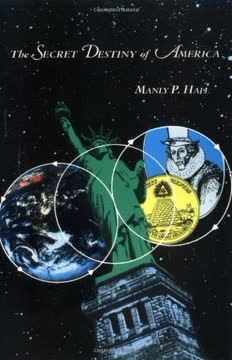
The Secret Destiny of America by Manly P. Hall receives mixed reviews averaging 4.12/5 stars. Readers appreciate the alternative historical perspective connecting Freemasonry, secret societies, and America's founding, though many criticize the lack of citations and sources. Some view it as fascinating conspiracy theory exploring how America was envisioned as the "New Atlantis," while skeptics see it as speculative propaganda promoting New World Order ideology. Critics note dated, problematic content including racist claims about civilizations. Supporters praise Hall's esoteric insights and inspirational vision of democracy's mystical origins.