

Key Takeaways
Treat the desert as a hidden water map, not an empty expanse
Look beneath appearances. Childs grew up with a spring in his family story, then spent 37 days mapping water holes in Arizona's Cabeza Prieta refuge. Across 860,000 acres there was only one spring, yet he recorded 52 pools containing about 5,500 gallons. Many were tiny, temporary, and invisible from a distance. One bee-filled crevice held 22.5 gallons, enough to sustain insects and extend his route.
Maps are survival tools. The Jesuit Eusebio Kino mapped desert water sources in the early 1700s; a later U.S. Geological Survey crew marked hundreds more. Their records matter because travelers who mistake dry-looking terrain for lifeless terrain may miss the routes that make crossing possible. The desert is not waterless. Its water is unevenly distributed, hidden, and costly to find.
The map here is more than a navigational aid. It is a compact record of where observation, memory, and survival meet. Environmental science often depends on precisely this kind of long-term place-based knowledge, while remote sensing can miss small pools that vanish between surveys. What's compelling is that Childs's field notes join measurements with sensory details, including rock shape and animal traces. That combination also has limits: a record of where water appeared once does not guarantee that it will be there again. In a changing climate, maps of water need dates, uncertainty, and local knowledge alongside coordinates.
Follow terrain clues and inherited routes before crossing dry country
Read the land's shape. A tinaja, a natural basin in rock that stores rainwater, may be easier to recognize by its smooth, scooped shape than by surrounding vegetation. Childs learned to look toward steep, shadowed canyons, where water might collect, rather than assuming the low ground would be safer. Father Kino traveled through the mountains to reach water, even when a route around them looked easier.
Routes preserve knowledge. Childs calls the ancient footpaths leading to pools waterlines. Their worn surfaces, converging near water, record repeated travel. Pottery fragments and shell pieces along the routes hint at journeys extending hundreds of miles. In the same desert, Kino's maps and Indigenous knowledge helped travelers find sources that later outsiders overlooked. Survival depended not on boldness alone, but on knowing where to go and how little to take.
This section treats landscape literacy as a form of accumulated expertise. It resembles a navigation system built through repeated use, except its signs are erosion, shade, tracks, and remembered routes. Such knowledge is easy to underestimate because it may not resemble formal science, yet it can encode seasonal patterns and practical constraints that a single survey cannot capture. The account also invites care: an old path is evidence of travel, not an invitation to trespass or extract. Knowledge becomes most useful when it includes the obligations attached to a place, not just instructions for reaching it.
Remember, a dry pool can keep life waiting through long droughts
Dry does not mean dead. Childs finds hundreds of sandstone waterpockets in Thousand Wells, some supporting Triops, fairy shrimp, and clam shrimp. These basins form as rainwater slowly erodes sandstone. When they dry, some organisms survive as eggs or cysts through anhydrobiosis, a state of extreme dehydration in which activity becomes undetectable. Protective molecules help preserve cell structures until water returns.
Life uses different clocks. Many pool dwellers develop faster when their habitat is drying quickly, a capacity called phenotypic plasticity: an organism changes its development in response to environmental conditions. Some desert shrimp eggs can remain dormant for decades, and researchers have found many previously undocumented crustacean species in temporary pools. The pools are isolated islands of habitat, and each one can hold a distinctive community that disappears when its water and eggs are lost.
Temporary pools challenge the assumption that ecological importance tracks permanence. Their inhabitants survive by matching their life cycles to instability, a strategy that resembles a biological pause button rather than conventional toughness. The account also connects small habitats to large conservation questions: species confined to one pool can be lost before science has named them. Still, dormancy is not invulnerability. Eggs cannot hatch without suitable conditions, and a pool destroyed or contaminated may erase its community. Resilience describes a capacity to endure particular stresses, not a promise that organisms can withstand every disturbance.
Study how water moves, not only where it gathers
Follow the source. A seep releases water so slowly that filling a bottle may take a day; a spring produces it much faster. In a Grand Canyon alcove, Childs timed one seep dripping every 4.5 seconds with striking regularity. Its small volume seemed less important than its movement through moss, soil, and rock, carrying water onward rather than simply storing it.
Underground routes matter. Childs and a companion eventually enter a powerful spring cave behind a waterfall. Water emerges through a hidden network beneath the canyon, but its precise underground path remains difficult to trace. The Grand Canyon receives about 400 million gallons of spring water daily, yet the surface shows only fragments of the system. These encounters shift the question from how much water exists to how it travels, where it emerges, and what life gathers around it.
The contrast between a measured drip and a roaring spring makes scale tangible without pretending that one scale explains the other. Hydrology studies connections among surface water, groundwater, and geological structure; the book makes those connections legible through bodily experience. Its attention to sound and timing also shows how observation can begin before a formal model is available. But fascination with a source should not be confused with full knowledge of an aquifer. The cave reveals an opening, not the entire underground system. Careful humility is part of the method: visible emergence is evidence, not omniscience.
Let floods explain desert renewal as well as destruction
Streams expand and contract. In some Arizona canyons, water flows at night and dwindles by day as trees draw heavily from the shallow water table. These streams support unusual concentrations of plants and animals, including species that reach their northern limit in a single cool, wet canyon. The creek is both a corridor and a refuge in a landscape that would otherwise block movement.
Floods can replenish life. Winter floods spread seeds, nutrients, and water into the ground. The underground layer of water and sediment can shelter organisms when the surface dries or is scoured, then help life recolonize. Yet the balance is fragile. Childs reports that 81 percent of Arizona's native fish species were classified or proposed as threatened or endangered. Introduced sport fish, groundwater depletion, and damaged riparian habitat compound the pressure on species adapted to these streams.
The ecological picture resists a tidy opposition between stability and disturbance. Floods can kill individual organisms while refreshing the conditions that support a stream community over time. Ecologists often describe this as resilience: the capacity of a system to absorb disruption and reorganize without losing its basic functions. The crucial phrase is without losing its functions. A flood may be part of a stream's natural cycle, while groundwater pumping or introduced predators can push the same system beyond recovery. Calling an ecosystem resilient should not become an excuse to overlook preventable damage.
Assume a dry canyon can become lethal before weather seems serious
Storms are local and fast. A chubasco is a brief, intense convective thunderstorm, capable of dumping heavy rain on one drainage while nearby ground remains dry. A canyon's branching channels collect runoff from a wide area and funnel it into a narrow passage. The resulting flood can arrive quickly, carrying mud, trees, and boulders rather than clear water.
Experience does not eliminate risk. Childs once became trapped while trying to climb out of a flooded slot canyon, then later watched a much larger flood surge through a Grand Canyon drainage. In Haunted Canyon, a couple hiking near waterfalls had almost no warning before a flood swept them away; the wife's body was found 48 miles downstream. The book's blunt lesson is not that every canyon is always dangerous, but that clear skies overhead do not prove the drainage above is safe.
The narrative exposes a familiar failure in risk judgment: people assess the conditions immediately around them and miss hazards generated far upstream. This is a problem in many systems, from flash floods to infrastructure failures, where causes are spatially distant and consequences arrive with little warning. Childs's close observation offers vivid detail, but it cannot turn a flood into a predictable event. Scientific understanding can identify patterns and hazards without producing reliable minute-by-minute forecasts. Respect for uncertainty is not timidity; it is a recognition that local confidence may be poorly matched to a watershed's scale.
Read canyon shapes as records of water's force and history
Water leaves structure behind. Floods carve basins and ledges, sort rocks downstream, and leave debris high on canyon walls. A hydraulic jump is a turbulent transition in which flowing water loses energy in a plunge pool before continuing downstream. Repeated jumps create the stepped pattern of many narrow canyons. The shape is not random damage: it records how water negotiated rock, slope, and obstacles.
The record includes human traces. After a storm in the Grand Canyon, Childs finds pottery fragments and an arrowhead swept from an old settlement toward lower channels. In Kanab, historic floods deepened the creek channel by more than 50 feet and widened it by hundreds of feet. Floods erase evidence, but they also move it, joining human artifacts and geological materials in the same downstream story.
A canyon can be read as a physical archive, though never as a perfectly complete one. Sediment and erosion preserve traces while also destroying, rearranging, or burying them. That tension links geomorphology with archaeology: both disciplines infer past events from material patterns whose original context may be missing. The book's strongest insight is that water is not merely a force acting on a finished landscape. Its repeated movement helps build the landscape's form. Yet every interpretation remains provisional, since the same feature may reflect multiple floods, rock types, and periods of change.
Treat local stories as ecological memory, not merely folklore
A story can carry fear. On the Tohono O'odham reservation, Childs visits a shrine connected to a story of water bursting from the ground and threatening villages. In one version, four children are sacrificed to stop it. The shrine's ocotillo branches mark four entrances, while toys and other carefully chosen gifts honor the children. This is a story about catastrophic water, not simply a celebration of scarce rain.
Ritual keeps grief present. The shrine is tended across generations, and its offerings include gifts for both children and the adults who made the terrible decision in the story. Childs leaves a fossil shell there in memory of a young friend who drowned. The scene shows how communities may hold danger and loss through place, ritual, and narrative, even when outsiders cannot establish every historical detail behind a story.
The shrine makes a crucial distinction between information and knowledge. A hydrological account may describe where water moves; a ritual can preserve what that movement means to a community, including grief, restraint, and responsibility. Treating a sacred story only as a coded scientific report would flatten its cultural life. At the same time, outsiders should avoid claiming certainty about historical events when the evidence is limited. Childs's personal offering acknowledges that he is a visitor and a mourner, not an authority on the shrine's meaning. That position is ethically stronger than turning the place into a curiosity.
Read hidden water as the force shaping desert land and longing
Scarcity is not emptiness. Childs's journey moves from tiny rain-filled holes to underground springs, living creeks, and catastrophic floods. Each form changes what the desert can support and how people move through it. The water may be stored for months, appear briefly at night, or rush past in a day. Its absence from view does not mean absence from the system.
Desire has consequences. The book begins with water bound to family memory and ends with the author following a stream that dries, then unexpectedly floods. Between those scenes, he sees ancient pools, endangered fish, and aquifers under pressure from wells. The desert's hidden water draws people toward it, but water is neither an unlimited supply nor a possession without obligations. To understand the desert is to recognize how deeply thirst shapes both the landscape and the people who seek it.
The title's central idea becomes persuasive because desire is shown as both a way of paying attention and a potential source of overreach. Thirst makes a small pool visible, but human demand can also drain groundwater and simplify complex ecosystems into supplies for cities or livestock. This tension connects intimate experience with political ecology, the study of how power and resource use shape environments. The book's emotional language invites reverence, while its evidence asks for practical restraint. Reverence alone cannot govern aquifers, but it can help readers see why water management is never only an engineering problem.
Analysis
The book's structure imitates the hydrology it describes. It begins with hidden, stationary water, moves into springs and streams, then confronts floods that refuse the author's desire to observe from a safe distance. That progression gives the science a narrative engine: each new form of water changes not only the landscape but also the terms of the inquiry. Measurement works well for pools, where a person can record depth and location. In moving water, knowledge becomes less possessable, requiring attention to timing, sound, geology, and risk.
Childs's central achievement is to combine field natural history with a personal narrative without treating either as sufficient on its own. He uses precise facts, such as the seasonal behavior of desert creeks and the development of aquatic organisms, to ground intense experiences that might otherwise sound mystical. His metaphors of water as voice or intention are literary instruments, not scientific claims. Their value lies in making readers feel the agency of physical processes, while the empirical details keep that language from floating free of evidence.
The book also makes a quiet argument about what counts as knowledge. Kino's maps, Indigenous routes, archaeological traces, scientific papers, and an individual observer's sensory record all preserve different parts of the water story. None offers total mastery. This is especially important in the account of floods: the author learns to read patterns, yet the timing and consequences remain uncertain. Knowledge can improve attention and judgment without making a powerful system controllable.
A productive tension runs through the narrative. Water is celebrated as the source of life and treated as a force capable of killing, while human communities need it and can damage the systems that supply it. The book does not solve that tension with a policy program. Instead, it reframes the desert as a place where apparent scarcity conceals intricate, vulnerable abundance. Its lasting challenge is to replace the fantasy of easy supply with a more demanding ethic of place, limits, and attention.
Review Summary
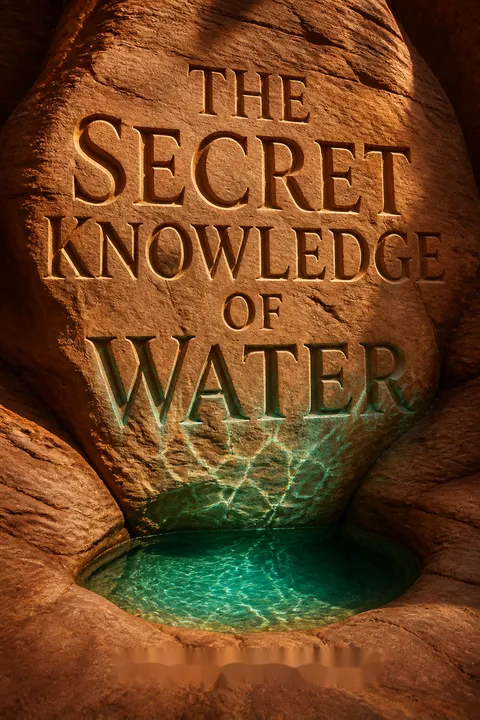
The Secret Knowledge of Water receives overwhelmingly positive reviews for its lyrical prose, scientific insights, and vivid descriptions of desert landscapes. Readers praise Childs' ability to blend adventure, nature writing, and poetic observations about water's role in shaping arid environments. Many find the book captivating and eye-opening, appreciating Childs' unique perspective on desert ecology. Some reviewers note occasional pretentiousness or recklessness in the author's adventures. Overall, the book is highly recommended for those interested in nature, the American Southwest, and the hidden complexities of desert ecosystems.
People Also Read

Glossary
tinaja
rock basin holding rainwaterA tinaja is a natural basin, usually eroded into rock, that collects and stores rainwater in arid country. The Spanish word suggests an earthen jar. Tinajas can vary greatly in size and duration, from tiny pools to sources holding thousands of gallons, and may provide essential water for wildlife and travelers.
waterlines
paths leading people to waterChilds uses waterlines for the worn routes created by repeated travel toward desert water sources. Unlike canals, which carry water toward people, these paths guide people to fixed pools and springs. Their convergence near tinajas, along with pottery and other traces, makes them a record of long-term movement and practical knowledge of the landscape.
anhydrobiosis
survival through extreme dehydrationAnhydrobiosis is a state in which an organism loses nearly all its water and becomes inactive, sometimes with no detectable metabolic activity. Certain aquatic invertebrates survive dry periods in this condition, often as eggs or cysts. When water returns, some can resume development. It is a specialized adaptation to habitats that repeatedly fill and dry.
phenotypic plasticity
development responsive to conditionsPhenotypic plasticity is the capacity of an organism to alter its physical development in response to environmental conditions. In temporary desert pools, some animals adjust their growth rate as water disappears. Faster-drying habitat can lead to faster development and smaller adults, allowing organisms to reproduce or leave before their aquatic environment vanishes.
phreatophytes
plants drawing on shallow groundwaterPhreatophytes are plants with roots that reach groundwater or the saturated zone beneath the surface. Along desert streams, trees such as cottonwoods and willows can draw heavily on shallow water and release it through their leaves. Their presence can indicate nearby groundwater, while a falling water table can threaten the vegetation that depends on it.
chubasco
intense localized thunderstormA chubasco is a brief, powerful convective thunderstorm common in the Southwest. It can bring intense rain and wind to a small area while nearby places remain dry. Because desert channels rapidly collect runoff from surrounding slopes, a chubasco can generate a flash flood with little warning.
hydraulic jump
turbulence that dissipates flow energyA hydraulic jump is a turbulent transition where fast-moving water loses energy, often in a plunge pool or basin. In steep desert canyons, repeated jumps help form a sequence of drops and pools. They are part of the way floodwater manages its energy as it moves through a confined channel.
Download PDF
Download EPUB
.epub digital book format is ideal for reading ebooks on phones, tablets, and e-readers.








