Key Takeaways
1. The Seventh Sense: Normal, Not Paranormal
In this book, I argue that unexplained human abilities such as telepathy, the sense of being stared at, and premonition are not paranormal but normal, part of our biological nature.
Challenging dogma. For generations, scientific prejudices rooted in 17th- and 18th-century philosophy have stifled research into unexplained human and animal abilities like telepathy, the sense of being stared at, and premonition. These phenomena are often dismissed as "paranormal" or "supernatural," implying they defy scientific understanding. However, this book posits that they are, in fact, normal and natural aspects of our biological heritage, widely distributed across the animal kingdom.
Expanding scientific understanding. The dismissal of these common experiences as mere "anecdotes" is unscientific, as science is founded on observation and experience. Just as meteorites were once dismissed as impossible by 18th-century scientists, phenomena that don't fit prevailing models are often ignored until science expands to include them. Recognizing these abilities would revolutionize our understanding of minds, brains, and the invisible connections linking us to the world.
A new phase of exploration. Simple experiments can yield significant insights into these neglected aspects of our nature. By investigating, rather than denying, these abilities, we can gain new knowledge about the biological nature of humans and animals. This approach treats these "unexplained powers" as part of our evolutionary heritage, suggesting we may have partly lost or neglected them.
2. The Mind Extends Beyond the Brain
Instead of thinking of minds as confined to brains, I suggest they involve extended fields of influence that stretch out far beyond brains and bodies.
Beyond the skull. The conventional scientific view, often called the "Astonishing Hypothesis," asserts that the mind is solely the activity of the brain, confined within the skull. This theory struggles to explain subjective experience, such as why we perceive images outside our heads, or how consciousness arises from mere neural activity. This book proposes a radical yet intuitive alternative: our minds are not confined to our brains but extend through fields of influence.
Fields of influence. Just as magnetic fields extend beyond a magnet or gravitational fields beyond a planet, mental fields are proposed to stretch out beyond our physical bodies. These invisible fields are centered in our brains but reach out into the world, connecting us to our environment and to each other. This concept offers a framework for understanding how mental activity can have effects at a distance.
Challenging materialism. The idea of an extended mind directly contradicts the materialist philosophy that dominates institutional science, which views consciousness as an "epiphenomenon" or identical to brain activity. By suggesting that minds are literally stretched out, this theory provides a biological and scientific basis for phenomena that materialism deems impossible, opening the door to a broader understanding of reality.
3. Telepathy: Distant Feelings and Intentions
Telepathy comes from the Greek tele, "distant," as in telephone and television, and pathe, "feeling," as in empathy and sympathy.
Connecting across distance. Telepathy, meaning "distant feeling," manifests in two main ways: thought transference between nearby, interacting individuals, and the detection of calls, intentions, or distress signals from a distance. These experiences are remarkably common, with surveys indicating that 45-92% of people report having experienced telepathy, particularly in connection with telephone calls.
Evidence from daily life and experiments. Many pet owners observe their animals responding to unspoken intentions, such as knowing when a trip to the vet is planned or when a walk is imminent. Experiments with a language-using parrot, N'kisi, showed it could pick up its owner's thoughts significantly more often than chance. Laboratory studies, including dream telepathy and ganzfeld experiments, have also yielded statistically significant results, demonstrating that information can be transferred between minds beyond known sensory channels.
Unconscious and emotional links. Telepathy often occurs unconsciously, as shown by experiments where subjects' physiological arousal (skin resistance) changed when a distant sender focused attention on them, even if they weren't consciously aware of it. This "unconscious telepathy" highlights that telepathy is often rooted in emotional bonds, such as those between family members, lovers, or close friends, rather than just conscious thought.
4. The Sense of Being Stared At: A Direct Connection
I suggest that through our attention, we create fields of perception that stretch out around us, connecting us to what we are looking at.
Feeling the gaze. The experience of sensing someone looking at you from behind, even without any sensory cues, is widely reported, with 70-90% of adults and over 90% of children claiming to have felt it. This "sense of being stared at" is often directional, allowing individuals to pinpoint the source of the gaze. It's not merely a passive reception but an active interaction, where the act of looking can cause the observed person to turn or show signs of discomfort.
Surveillance and martial arts insights. Professionals in surveillance, such as police officers and security guards, often observe that some individuals, particularly criminals, are unusually "surveillance conscious" and can detect when they are being watched, even through hidden cameras or from a distance. Similarly, practitioners of martial arts emphasize the projection of "life energy" or "chi" through intention and gaze, with some able to sense an opponent's intent even when blindfolded.
Beyond sensory explanation. This phenomenon challenges the conventional understanding of vision, which assumes a one-way inward flow of light. Instead, it suggests an outward projection of attention that interacts with the observed. Experiments have shown that this sense operates even when subjects are blindfolded, separated by windows, or observed via closed-circuit television, ruling out subtle sensory cues and coincidence as sole explanations.
5. Animals Possess a Richer Seventh Sense
Although we ourselves are generally less sensitive, we share these abilities with many other species.
Widespread in the animal kingdom. The seventh sense is not exclusive to humans; many animal species exhibit remarkable sensitivities to distant intentions, distress, and even future events. Domesticated animals like dogs, cats, horses, and parrots frequently demonstrate telepathic abilities, often surpassing human sensitivity. This suggests that these abilities are deeply rooted in our shared biological and evolutionary heritage.
Survival advantage. For animals, the seventh sense offers a crucial survival advantage. Prey animals that can detect a predator's gaze or hostile intentions from a distance are more likely to escape. Hunters and wildlife photographers often observe animals reacting to their focused attention or intentions, even when concealed, indicating a sensitivity that transcends normal sensory detection.
Social cohesion. Beyond predator-prey dynamics, telepathy and other aspects of the seventh sense likely play a vital role in the cohesion and coordination of animal social groups. From wolves knowing the location of their pack members to birds in a flock changing direction in near-unison, these phenomena suggest an underlying field of connection that facilitates communication and collective behavior, even across distances.
6. Premonitions and Precognition: Sensing the Future
A premonition is literally a warning in advance (from Latin pre = before + monitio = warned).
Warnings of impending events. Many animals, and some people, exhibit premonitions—feelings or intuitions about future events, particularly dangers or disasters. Animals are famously reported to anticipate earthquakes, avalanches, and even man-made catastrophes like air raids or dam collapses, often hours or days in advance. This ability, while mysterious, would offer a clear evolutionary advantage for survival.
Human forebodings. Humans also experience premonitions, often concerning dangers, deaths, or disasters. These can manifest as vivid dreams, intense feelings of dread, or sudden, "irrational" urges to alter plans, sometimes saving lives. Notable examples include forebodings before the Aberfan disaster and the sinking of the Titanic, where many individuals reported pre-event intuitions.
Unconscious detection of future arousal. Modern parapsychological research has explored "presentiment," the unconscious physiological anticipation of future emotional events. Experiments show that subjects exhibit measurable emotional arousal (e.g., changes in skin resistance) seconds before a randomly selected emotional image appears on a screen, even though they are consciously unaware of what is coming. This suggests that our bodies can react to the future before our minds consciously register it.
7. Experimental Evidence Supports the Seventh Sense
But despite an impressive accumulation of evidence, psychic research has never been accepted within institutional science.
Rigorous testing. Despite historical skepticism and institutional resistance, extensive experimental research has accumulated compelling evidence for the reality of the seventh sense. Pioneers in psychic research, starting in the 1880s, developed rigorous statistical methods and "blind" experimental techniques, long before they became standard in other scientific fields.
Repeatable results. Experiments on telepathy, such as card-guessing tests and ganzfeld studies, have been replicated by dozens of independent investigators worldwide, yielding statistically significant results far beyond chance. For instance, combined results from millions of card-guessing trials show astronomical odds against chance, and ganzfeld studies consistently demonstrate hit rates significantly above random guessing. Similarly, the sense of being stared at has been confirmed in numerous experiments, including those using blindfolds, closed windows, and even closed-circuit television, where subjects show unconscious physiological responses to being watched.
Challenging the "Astonishing Hypothesis." The consistent positive outcomes from these controlled experiments directly challenge the materialist "Astonishing Hypothesis" that the mind is solely the brain. The evidence suggests that mental phenomena can occur at a distance and even precede events, implying that current scientific understanding of fundamental principles is incomplete and needs to expand to include these "anomalies."
8. The "Evil Eye" and Rationalism's Blind Spot
No scientifically-minded psychologist believes in telepathy. At the same time, the disproof of it in a particular case may start a student upon the straight scientific path, and the time spent may thus be repaid to science a hundredfold.
Ancient beliefs, modern dismissal. The belief in the "evil eye"—the idea that negative intentions or envy transmitted through a gaze can cause harm—is ancient and widespread across many traditional societies. This concept, often linked to "fascination" or casting a spell, implies an outward projection of mental influence. However, with the rise of rationalism and mechanistic science, such beliefs were systematically dismissed as mere superstition, particularly in Western intellectual circles.
The taboo against inquiry. The historical rejection of phenomena like the evil eye, witchcraft, and psychic powers created a powerful intellectual taboo. This taboo has inhibited scientific inquiry into the sense of being stared at and telepathy, as engaging with such topics risks intellectual marginalization. Early psychological studies, like Titchener's, claimed to "disprove" these phenomena without providing adequate data, reinforcing the skeptical stance for decades.
Rationalism vs. experience. While rationalism has freed many from fears of malice and superstition, it has also created a blind spot, leading to the uncritical acceptance of theories that contradict direct human experience. The persistence of beliefs in the evil eye in cultures like modern Greece, even among educated individuals, highlights the gap between intellectual dogma and lived reality, suggesting that these phenomena warrant genuine scientific investigation rather than outright dismissal.
9. Vision: An Outward Projection, Not Just Inward Reception
Your image of this book is just where it seems to be, in front of your eyes, not inside your brain.
Revisiting ancient theories. For centuries, the nature of vision has been debated, with two main theories: "intromission" (light and images enter the eye) and "extramission" (invisible rays or attention project outward from the eye). While Kepler's 17th-century theory of the retinal image solidified the intromission view as scientific orthodoxy, it left a crucial mystery unsolved: how the inverted retinal image translates into our upright, external experience of the world.
The paradox of perception. The conventional scientific model insists that all perceptions, including the images we see, are processed and experienced inside the brain. Yet, our direct experience tells us that the book we read or the mountain we gaze at appears outside our bodies, in the external world. This fundamental conflict between theory and experience is rarely questioned in scientific discourse, despite its paradoxical nature.
An extended perceptual field. This book proposes that vision is a two-way process: light enters the eye, but our minds also actively project images outward. This outward projection occurs within "perceptual fields" that extend beyond our brains and bodies, linking us directly to what we perceive. This "reflexive model" aligns with our intuitive experience, suggesting that our minds literally reach out to touch what we see, and provides a framework for understanding how the act of staring can be detected by others.
10. Morphic Fields: The Mechanism of Extended Minds
I suggest that our mental activity depends on invisible fields that can also bring about effects at a distance.
Organizing principles of life. The concept of "morphic fields" is introduced as a new kind of field, beyond gravitational, electrical, magnetic, and quantum matter fields, that organizes living systems. These fields, including morphogenetic fields (shaping development), behavioral fields (organizing instincts), and social fields (coordinating groups), contain inherent memory through "morphic resonance," allowing past patterns to influence present ones.
Minds as extended fields. Mental fields are a specific type of morphic field that underlies perception, thought, and other mental processes. These fields are rooted in brain activity but extend beyond the physical brain through attention and intention. This "amoeba-like" metaphor suggests that our minds send out "pseudopodia" of attention and intention that reach out to connect with distant objects, places, or other minds.
Explaining the seventh sense. This framework provides a coherent explanation for the phenomena of the seventh sense:
- Sense of being stared at: An interaction between the starer's projected visual field and the field surrounding the observed person.
- Telepathy: Communication through the "stretched" social fields that link individuals with strong emotional bonds.
- Remote viewing: Mental pseudopodia reaching out to distant places or objects.
- Precognition: Intentions projecting into the future, where they can be affected by future events and "sensed" backward in time.
This theory offers a biological and field-based understanding of the mind, liberating it from the confines of the skull and opening new avenues for scientific exploration into the interconnectedness of life.
Last updated:
Review Summary
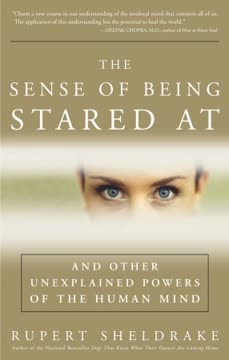
The Sense of Being Stared at by Rupert Sheldrake explores telepathy, the power of attention, remote viewing, and what the author calls the "seventh sense." Reviews are mixed (3.79/5): supporters praise the scientific approach to phenomena like sensing being watched and animal telepathy, citing interesting anecdotes and research. Critics find it boring, overly reliant on anecdotes without scientific rigor, too long and rambling, or frustratingly tangential. Several readers appreciate Sheldrake's attempt to bridge scientific and lay audiences, though some question the validity of his data and conclusions.