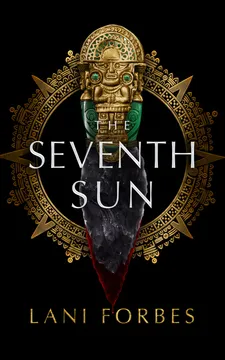


Plot Summary
The Sun Prince Ascends
Prince Ahkin is studying the stars when a servant tells him his father, Emperor Acatl, has died. Before dawn, Ahkin’s mother follows the codex and takes her own life so she can accompany her husband to the underworld. Grieving, Ahkin must still climb the Sun Temple and perform the blood ritual that brings the Seventh Sun into the sky.
He becomes the empire’s ruler in all but name, since the codex says he cannot be crowned until he has an empress. A blood-red comet and the sun’s early descent trouble his calculations. Ahkin orders noble families to send daughters to Tollan, while the high priest warns that the signs may mean another apocalypse is coming.
Ahkin’s first lesson in power is that public duty can demand action before grief has time to become legible. His mother’s death is both a private wound and a demonstration of the law he is expected to uphold. The sunrise ritual then makes his inheritance physical: he bleeds, and the sun appears. Yet the comet and the fading light undermine the comforting certainty of that exchange. The codex gives Ahkin procedures, not understanding. His reliance on rules is less simple piety than a strategy for managing fear, and the new emperor begins his reign already suspecting that obedience may not be enough.
Mayana Cannot Kill
In Atl, Mayana, daughter of its lord and descendant of the water goddess Atlacoya, performs her family’s bloodletting ritual but dreads the animal sacrifice still to come. When news arrives that Emperor Acatl has died, her father explains that each city-state must send a noble daughter to compete for Ahkin’s hand. The winner becomes empress; the other five will be sacrificed to bless his reign.
Mayana’s father insists the custom protects the empire, but she sees no justice in killing the girls. Her brother Chimalli gives her a finely made obsidian dagger before she leaves. Her father, usually stern, tells her that her compassion can be a strength, though neither of them knows whether it will keep her alive.
Mayana’s conflict is not a rejection of her people so much as a refusal to let inherited rules overrule the suffering she can see. Her father’s argument rests on collective memory of disaster, even though neither has lived through an apocalypse. Mayana’s objection comes from lived grief and empathy, especially her memory of losing her mother. The selection ritual converts political marriage into a survival contest, forcing the girls to treat one another as threats. Chimalli’s dagger is practical protection, but it also marks a transition: Mayana leaves home carrying both her family’s love and the means to act on her own judgment.
Water Against the Jaguar
On the jungle road to Tollan, Mayana secretly cuts her hand and uses her water-goddess blood to give the exhausted servants drinking water. A jaguar then attacks her beside a stream. When she falls and scrapes both palms, a surge of water slams the animal away, revealing far more power than she knew she possessed.
At Tollan, the royal healer Coatl treats her wounds with a teasing familiarity that unsettles her. In the princesses’ quarters, Mayana meets Yemania of Pahtia, another girl who expects to die. Mayana promises they will face their fate together. The other candidates arrive with striking displays of confidence, while Mayana’s muddy arrival and unexpected escape have already drawn attention.
The jaguar encounter gives Mayana’s compassion a consequence beyond private feeling: her instinct to survive releases power she did not know she had. The force is protective, but also frightening, because it emerges without a measured plan. Her kindness to the servants offers a quieter model of power, one based on care rather than spectacle. Yemania’s vulnerability creates an alliance inside a contest designed to prevent solidarity. Mayana’s promise that they will die together is sincere, but it binds her to a future she does not yet understand. Her first steps in Tollan therefore establish both her capacity to act and the emotional obligations that will complicate every choice.
Rainbows at the Selection
At the candidates’ presentation, Teniza grows corn from a few drops of blood, Yoli handles fire, and Zorrah commands the same jaguar that attacked Mayana on the road. Zorrah pushes the animal toward the sacrificial pit. Mayana cuts her palm and floods the flames before the jaguar is burned.
She disguises her protest as concern for the ritual calendar, then turns a bowl of water into mist and asks Ahkin to shine sunlight through it. Rainbows spread across the hall, delighting the crowd and catching the prince’s attention. Itza helps clear the smoke with wind, while Yemania heals Mayana’s hand. The meal that follows includes another animal sacrifice, and Mayana’s visible distress gives Zorrah a new way to threaten her.
Mayana’s intervention exposes the gap between the ceremony’s language of reverence and its willingness to make pain into entertainment. Her calendar excuse lets her challenge Zorrah without openly declaring her beliefs, a tactical compromise that protects her while concealing her. The rainbow demonstration gives Ahkin a glimpse of her imagination, not just her power. Yet success sharpens the danger: the same act that wins his notice reveals her aversion to sacrifice to a rival. The scene also establishes that the candidates’ gifts are not isolated performances. Each demonstration is a political test, and each girl’s response to power tells the others how she might behave under pressure.
A Doll for the Emperor
For the next task, each princess receives only ten cacao beans to buy Ahkin a wedding gift. Zorrah’s trained monkey steals Mayana’s beans, and an old dollmaker named Yoco offers her a worry doll in exchange for a future favor. Mayana chooses it because she recognizes that the burdened prince needs comfort more than another ornament.
Yemania offers aloe, while the other girls present more showy gifts. Ahkin is moved by Mayana’s understanding of his worries. That evening he dances with his twin sister, Metzi, and then asks Mayana to dance. Their closeness unsettles Yemania and enrages Zorrah, who has begun to see Mayana as the chief obstacle to her own survival.
The gift trial distinguishes value from price, and Mayana succeeds by reading a need that the court’s display culture tends to hide. The doll is small, but it recognizes Ahkin as a grieving young man rather than only as a source of dynastic power. Her insight attracts him because it answers his loneliness, though that very intimacy carries risk: he may be responding to an ideal of shared devotion as much as to the person herself. Yemania’s distress complicates Mayana’s happiness. In a system where one girl’s success can determine another’s death, tenderness is never uncomplicated, and even an innocent dance acquires the weight of a verdict.
The Prince Sees Her
Mayana retreats to Tollan’s gardens, where Ahkin finds her bathing and asks her name. When she speaks of losing her mother, he admits that no one has asked whether he misses his parents. Their shared grief draws them together. Later, Ahkin seeks her out for a night walk; they kiss beside the gardens’ underworld gateway, then swim together and stop before breaking the codex’s rules.
Mayana likes him, but knows he believes she is more devout than she is. Their closeness grows through talk of family, stars, and the duties ahead. Ahkin hints that he plans to make an announcement, while Mayana fears that telling him what she believes could cost her his choice.
Their intimacy begins with recognition rather than attraction alone: each sees the other’s grief beneath ceremonial roles. But Mayana’s silence turns that closeness into an unstable bargain. Ahkin reads her rescue of the jaguar as proof of religious devotion, while she allows the misunderstanding because being chosen is necessary for survival. She is not inventing her compassion, yet she withholds the belief that gives it meaning. The romance therefore grows in the space between authentic feeling and strategic concealment. Ahkin’s longing for a partner who can lighten his burdens makes him especially receptive to the version of Mayana he hopes to find, while Mayana’s fear makes correction feel more dangerous with every passing day.
Poison in the Bedroom
After Mayana and Ahkin spend the night together without consummating their relationship, Yemania discovers them and feels betrayed by Mayana’s promise that they would face death together. Before they can reconcile, a scorpion stings Mayana three times.
She crawls toward her door, but collapses from the spreading poison. Yemania hears her cries and heals the wound, though the poison remains in Mayana’s body. Coatl draws it out while Ahkin keeps vigil. During her delirium, Mayana glimpses Coatl and Metzi together before they sedate her.
When she wakes, she admits to Yemania that she questions whether the ritual codices were written by the gods. They climb the Sun Temple and compare the older creation stories with the newer ritual instructions.
The scorpion attack makes the cost of Mayana’s secrecy immediate: she has hurt Yemania, yet Yemania still chooses to save her. That act gives their relationship a moral depth beyond the competition, and makes Mayana’s earlier promise impossible to dismiss as mere comfort. The codex comparison turns private doubt into evidence. Mayana notices that the creation accounts and the prescriptive ritual sheets differ in age and form, suggesting that human institutions may have presented their own rules as divine commands. The possibility remains unproven, but the distinction matters psychologically: Mayana’s resistance is no longer only an instinctive response to cruelty. It becomes a question about who authored the authority governing her life.
The Battle at Millacatl
While Mayana recovers, Ahkin learns that Miquitz raiders are abducting farmers and soldiers near Millacatl. He leads a force to stop them, leaving Mayana behind. The Chicome warriors defeat many raiders, but the Miquitz escape with their captives. Their high priest, Tzom, appears and possesses Yaotl, Ahkin’s mentor, using him to restrain the prince.
The lord of Millacatl holds Tzom with vines long enough for Ahkin and the survivors to withdraw. They return with three captives, but no rescued peasants. The failure deepens Ahkin’s fear that he is too young to rule. He returns to Tollan still believing Mayana may become his empress, while Mayana has learned that the sun’s early setting may have a human cause.
The battle tests Ahkin’s public identity at the same time his private life is becoming unstable. He can fight with skill, but military courage cannot guarantee the safety of the people he meant to rescue. Tzom’s possession of Yaotl makes the Miquitz threat intimate: an enemy can turn a trusted body into a weapon. Ahkin’s failure feeds his existing belief that he is inadequate, preparing him to accept an extreme sacrifice as a solution. Meanwhile, Mayana’s discovery about the codices has begun to connect religious authority with political danger. Their separate crises converge around the same question: whether the empire’s inherited explanations can still be trusted.
The Dog at the Feast
At the selection feast, Ahkin brings Mayana’s father and brothers to witness his choice, then names Mayana as his future empress. The high priest Toani has arranged a final test: Mayana must sacrifice a dog on the day dedicated to dogs. When she cannot cut its throat, Toani exposes her doubts about the rituals. Mayana confirms that she believes the codex’s rules were written by people, not gods.
Ahkin feels deceived and rejects her, especially because he has been struggling with the necessity of his mother’s death. Mayana’s family leaves without meeting her eyes. She runs to find Ahkin, but instead overhears Metzi and Coatl discussing their dealings with the Miquitz and the injury Metzi must have healed.
The dog makes Mayana’s moral conflict impossible to disguise. Her refusal is not an abstract debate: it is a decision made with a living animal beneath her hand and her family watching. Toani weaponizes the moment as a test, while Ahkin experiences her revelation through the wound of his mother’s death. His rejection is therefore both personal betrayal and defensive grief. Mayana loses the protection of the match and the approval she has long wanted from her family. Yet the scene also gives her an opening to pursue truth elsewhere. As Ahkin withdraws, her attention shifts from saving the romance to uncovering what Metzi and Coatl are hiding.
Metzi’s Secret in the Garden
Mayana hears Metzi tell Coatl that their agreement with the Miquitz priest is already in place and that he must heal her hand later. She realizes Metzi has been lowering the sun herself, making the Seventh Sun appear to weaken, and suspects Coatl helped bring about Emperor Acatl’s death. Before she can reach Ahkin, Zorrah arrives in her room to taunt her.
Mayana unleashes her water power, while Zorrah attacks with birds and snakes. Yoli shields Mayana from the snakes with fire, Teniza binds her with vines, and Itza stops the escalating fight with a violent wind. Yaotl confines the princesses to their rooms and orders the guards not to tell Ahkin. Mayana now knows the sun may not be dying, but she cannot warn the prince.
The overheard exchange transforms the fading sun from an omen into a political instrument. Mayana sees that supernatural signs can be manufactured by people who understand how deeply their society fears disaster. Yet knowledge alone does not grant her power: the guards and the prince’s broken trust keep her from delivering the warning. The fight in her room shows how the selection ritual has turned the candidates into a volatile court faction, each girl carrying her own desperation and abilities. Itza’s intervention briefly interrupts their violence, but the order to conceal the incident preserves the same culture of managed appearances that allowed Metzi’s scheme to grow.
Ahkin Chooses the Abyss
At the arena, a captured Miquitz warrior warns that the Seventh Sun is dying and claims the Miquitz lured Ahkin into battle because his divine blood is needed to save it. Ahkin concludes that he must repeat his ancestor’s sacrifice and offers himself to the underworld. He does not know that Metzi has been lowering the sun.
At Xibalba’s entrance, Mayana tries to tell him the truth, but Toani and the crowd prevent her from reaching him. Ahkin stabs himself and falls into the abyss. Mayana follows, cutting her own hand to summon the water below. She finds Ahkin alive in the Sea of the Dead, draws water from his lungs, and keeps his bleeding body afloat as they search for shore.
Ahkin’s decision is built from real love for his people, but also from a private conviction that he is not enough. The captive’s warning gives that self-doubt the shape of a religious duty, and Toani’s agreement closes off other interpretations. Mayana’s failed attempt to stop him repeats the helplessness she felt when her mother and the animal victims were placed under ritual authority. This time, however, she acts rather than accepts the outcome. By leaping after Ahkin, she rejects both the expected sacrifice and the idea that saving him must be his choice alone. Her water power becomes an intervention against a fatal story already treated as settled.
The Sea of the Dead
In Xibalba, Mayana uses water currents to pull Ahkin toward a volcanic shore while the enormous guardian Cipactli pursues them. When the beast closes in, she forms a sphere of water around them and lifts them above its reach, spending more of her blood to keep it aloft. They crash onto the beach and survive, though Ahkin is furious that she followed him.
Mayana tells him what she heard about Metzi and Coatl, but he refuses to believe her. A strange old woman named Yoco appears, revealing herself as Ometeotl, creator and Mother of the gods. She restores their strength through Ona, Mayana’s sacrificed childhood dog, and gives them an amulet, a shield, a worm, food, and a five-day deadline to leave Xibalba.
Mayana’s rescue converts her familiar gift into a new scale of action. She does not defeat Cipactli by force; she observes its limits and changes the medium of the struggle, carrying herself and Ahkin above the water. The achievement costs blood, but it also disproves the assumption that her compassion makes her weak. Ona’s return gives her a personal grief a different meaning, though the gift cannot undo the violence that took him from her. Ometeotl’s arrival confirms that the lovers’ arguments about ritual have reached the divine itself. Still, the goddess does not offer an easy rescue. She gives them tools, a task, and a deadline.
A Debt to the Mother
Ometeotl explains that the gods do not want the Chicome people to repay their sacrifices with more death. The rituals, she says, have made the people trust rules and human control instead of divine love. Mayana’s doubts were right, but she too must learn not to mistake her own judgment for the gods’ will.
The creator reveals that Ahkin was deceived about the sun and that Metzi has betrayed him. She orders Mayana and Ahkin to retrieve the bones of her son Quetzalcoatl from Cizin, lord of the dead, before the Nemontemi ends in five days. Ometeotl leaves them to make their own choices. Ahkin and Mayana, injured but alive, join hands and prepare to cross Xibalba together.
The goddess’s revelation resolves the central argument without making Mayana simply right about everything. The people’s sacrifices are not required, but Mayana’s conviction that she can decide what is best also needs limits. Ometeotl distinguishes faith from compliance: love cannot be reduced to a payment schedule, yet trust is not the same as personal certainty. Ahkin must confront how his obedience made him vulnerable to political manipulation, while Mayana must act without assuming that compassion automatically guarantees wisdom. Their partnership is now less a romantic promise than a demanding practice of mutual correction. The ending leaves the political crisis unresolved and replaces the selection contest with a perilous, time-limited journey through the realm of the dead.
Analysis
The novel builds its central conflict around a society that treats ritual as both spiritual practice and disaster insurance. The Chicome people have inherited a history in which divine blood repeatedly saves humanity, so their sacrifices feel less like arbitrary cruelty than a debt owed to the cosmos. That belief offers structure in a world where the next apocalypse is always imaginable. Yet structure can become its own authority: the codex’s rules are obeyed even when they injure individuals, and the characters often confuse compliance with faith.
Mayana’s resistance begins in concrete encounters with suffering. She cannot kill a bird, remembers her dog Ona, and refuses to accept the deaths of the princesses as an abstract price. Her empathy becomes a form of perception, allowing her to notice both the emotional needs Ahkin hides and the difference between creation stories and later instructions. But the story does not equate feeling with infallibility. Mayana conceals her beliefs to secure Ahkin’s choice, and her desire to protect Yemania can become an attempt to dictate what Yemania should believe. Her challenge is not merely to rebel, but to act honestly without claiming complete knowledge.
Ahkin’s corresponding flaw is a reliance on rules as shelter. His scholarship and discipline are genuine strengths, yet grief makes him especially susceptible to explanations that promise control. He accepts self-sacrifice as the logical answer to the fading sun because that answer fits the empire’s inherited theology and his own fear that he is inadequate. Mayana’s rescue forces him into a world where the old categories no longer suffice. Their romance is compelling because each embodies a needed correction: heart and mind, care and duty, improvisation and structure.
The underworld journey begins before the book can resolve its political crises. Metzi’s scheme, the Miquitz threat, and the coming apocalypse remain entangled, while Ometeotl’s demand gives Mayana and Ahkin a new, urgent purpose. The novel’s deepest distinction is between sacrifice as payment and sacrifice as freely given love. Its ending does not abolish danger; it asks whether the characters can trust one another, and the divine, without surrendering their judgment.
Review Summary
The Seventh Sun receives mixed reviews, averaging 3.82/5. Positive reviewers praise its unique Mesoamerican-inspired world-building, blood-based magic system, compelling romance between Mayana and Ahkin, and its surprising ending. Critics highlight concerns about cultural appropriation, noting the author is not from Mesoamerican descent, while pointing out issues including a Mary-Sue protagonist, insta-love, girl-on-girl animosity, and the imposition of Christian-adjacent morality onto indigenous culture. Several reviewers recommend seeking own-voices authors for authentic representation of these cultures.
People Also Read

Characters
Mayana
Water-hearted challengerMayana is the daughter of Atl’s lord and a descendant of the water goddess Atlacoya. She is observant, emotionally responsive, and uneasy with rules that require her to harm living creatures. Her compassion is not passive: when danger comes, she acts with startling force, even before she knows the full extent of her abilities. Mayana wants her family’s approval and fears disappointing her father, but she also trusts what she sees and feels more than inherited explanations. Her tension between belonging and dissent shapes her relationships, especially with Ahkin and Yemania. She is learning that empathy can be a source of courage, while also confronting the danger of keeping painful truths hidden to secure affection or safety.
Ahkin
Grieving sun heirAhkin is the young heir to Tollan, descended from the sun god and responsible for raising the sun through blood ritual. A scholar of stars and religious texts, he seeks certainty in patterns, rules, and carefully calculated plans. His parents’ deaths thrust him into power before he feels ready, and his devotion to duty is mixed with grief and fear of inadequacy. Ahkin is also a trained warrior, though his confidence in battle does not erase his doubts as a ruler. He is drawn to Mayana’s warmth and perception because she notices the person beneath his title. His central struggle is learning whether responsible leadership means obeying inherited systems or questioning them when they fail the people they are meant to protect.
Yemania
Healer with a tender spineYemania is a princess of Pahtia and a descendant of the healing god Ixtlilton. Gentle and self-conscious, she expects others to overlook her and is painfully aware that her family may consider her expendable. Her healing gift gives her purpose, though she often lacks confidence in its value. Yemania believes the rituals protect the empire, but she is not untouched by fear or grief; her faith requires her to act despite both. Her friendship with Mayana begins in shared terror and develops through disagreement, hurt, and difficult loyalty. She provides a counterpoint to Mayana’s instinct to challenge custom, showing that obedience can also demand courage, while insisting that friendship must survive the consequences of each woman’s choices.
Metzi
The emperor’s twinMetzi is Ahkin’s twin sister and a royal descendant of the sun god. Beautiful, playful, and socially assured, she shares a deep bond with Ahkin and understands the expectations placed on the royal family. Her approaching political marriage to the heir of Ehecatl weighs on her, even when she hides discomfort behind teasing humor. Metzi is accustomed to being watched and evaluated, and she knows how to command a room without appearing to try. Her relationship with Ahkin blends affection with sibling rivalry, while her position makes her an important figure in the empire’s fragile political balance.
Coatl
The palace healerCoatl is Tollan’s high healer, a gifted descendant of Pahtia’s healing god and a longtime friend of Ahkin. His charm and confidence often tip into arrogance, especially when he boasts of the importance of healers. He is Yemania’s older brother and has a strained relationship with their father, whose expectations and beliefs he resists. Coatl’s skill makes him indispensable to the royal household, but his pride can alienate those who once trusted him. His friendship with Ahkin carries the intimacy of shared childhood, even as changing loyalties and ambitions place pressure on it.
Zorrah
Predator in the contestZorrah is the princess of Ocelotl, trained in a culture that prizes strength and commands animal spirits. She presents herself as fearless, competitive, and contemptuous of weakness. Her confidence is sharpened by a life in which status must be defended, and she treats the empress selection as another contest she cannot afford to lose. Zorrah reads hesitation as vulnerability and uses intimidation to unsettle her rivals. Her hostility toward Mayana grows from the threat she perceives in Mayana’s unexpected influence over Ahkin, making her both a political competitor and a source of physical danger.
Yoli
Volcanic truth-tellerYoli is the princess of Papatlaca, a descendant of the fire god, and a young woman who meets fear with dark humor. She is blunt, provocative, and fascinated by danger, but her apparent indifference to survival masks a fierce dislike of people who use power to dominate others. Yoli’s fire abilities make her formidable, while her willingness to speak plainly cuts through the court’s careful manners. She is initially difficult to read, but her sharp wit and independent judgment make her an unexpected ally to Mayana.
Itza
Storm-born observerItza is the small, formidable princess of Ehecatl, descended from the wind aspect of Quetzalcoatl. She is intensely devout and speaks sparingly, often appearing absorbed in prayer or private thought. Her quietness conceals a keen understanding of political tensions and the other princesses’ motives. Itza’s wind magic can become overwhelming when she chooses to act, and her presence suggests that Ehecatl’s religious beliefs differ from Tollan’s. She values restraint, but she is not afraid to intervene when conflict threatens to overwhelm judgment.
Teniza
Wealthy garden princessTeniza is the princess of Millacatl, a descendant of the goddess of maize and a member of the empire’s wealthiest royal family. Her family’s abundance gives her confidence and political influence, and her plant-growing abilities make her demonstrations impressive. Beneath her polished presentation, Teniza carries private loyalties and fears about the marriage contest. She can be sharp toward other girls, especially when she feels threatened, but she is not simply a display of privilege. Her struggle reflects the pressure to convert family status into personal security.
Oztoc
Mayana’s demanding fatherOztoc is Mayana’s father, the lord and high priest of Atl. He believes exact observance of the codex protects his people from drought and catastrophe, and he expects his children to place communal duty above personal feeling. His sternness can make Mayana feel inadequate, but it is rooted in a desire to keep his family and city safe. He rarely expresses affection easily, which makes his moments of tenderness especially meaningful. His relationship with Mayana is shaped by grief, discipline, and a profound disagreement about what faith requires.
Toani
Keeper of the codexToani is Tollan’s high priest and the empire’s most authoritative interpreter of the codex. He is learned, disciplined, and deeply invested in the rituals that structure public life. Toani advises Ahkin during the succession crisis and treats religious continuity as essential to political stability. His certainty contrasts with Ahkin’s growing doubts, and his authority gives him considerable influence over the selection ceremony. He believes that a ruler’s choices can endanger the entire empire, so he is willing to pressure the prince in the name of collective safety.
Yaotl
Ahkin’s warrior mentorYaotl leads Tollan’s elite Jaguar warriors and has trained Ahkin since childhood. Massive, disciplined, and blunt, he measures trust through competence and expects the prince to meet the demands of leadership. Yaotl’s military experience makes him a practical counselor, but his loyalty also has a protective edge: he wants Ahkin to survive the pressures of battle and rule. He speaks little about emotion, yet his attention to Ahkin’s behavior reveals a deep understanding of his former pupil.
Acatl
Ahkin’s late fatherAcatl is the former emperor of Tollan and father of Ahkin and Metzi. Remembered as a kind and respected ruler, he leaves behind a political system built on ritual obligation and dynastic alliances. His sudden death forces Ahkin to assume leadership before he feels prepared, and his absence becomes a measure against which the young prince judges himself. Acatl’s legacy is both comforting and burdensome: Ahkin wants to honor his father, but must determine whether inherited practices can answer the crises now facing the empire.
Chimalli
Mayana’s protective brotherChimalli is Mayana’s eldest brother, teasing and direct but deeply protective of her. He understands how often she clashes with their father over ritual duties, even when he thinks she should conform. Before she leaves for Tollan, he gives her a fine obsidian dagger as both a family keepsake and a practical tool. His humor helps Mayana endure fear, while his inability to control her fate reveals the limits of sibling protection.
Tenoch
Mayana’s youngest brotherTenoch is Mayana’s youngest brother, energetic and affectionate. He looks up to her and struggles with the prospect of her departure, even when he tries to hide his sadness. Mayana’s small handmade gift to him captures their playful bond and her wish to leave him a happy memory.
Atanzah
The royal matchmakerAtanzah is an elderly matchmaker and a longtime friend of Ahkin and Metzi’s mother. Warm, theatrical, and experienced in courtship customs, she organizes the selection tasks and reads character through the candidates’ choices. Her affection for Ahkin sometimes makes her more candid than protocol allows. Atanzah wants the prince to find a partner who can bring joy as well as fulfill political duties, though she must also manage a process shaped by rigid traditions.
Xol
Mayana’s Tollan escortXol is a commoner from Millacatl serving the royal household in Tollan. Cheerful and talkative, he describes the capital with the enthusiasm of someone who still sees its beauty as extraordinary. His kindness during Mayana’s journey helps her feel less alone, and his gratitude when she uses her water power reveals how rarely ordinary people witness the abilities of the royal descendants.
Yoco
The mysterious dollmakerYoco is an eccentric old woman who makes worry dolls and runs a small shop in Tollan. Her appearance is frail, but her manner is knowing and her bargains are difficult to refuse. She recognizes Mayana and offers a gift suited to the worries surrounding her. Yoco’s stories connect ordinary handmade objects with old legends, making her seem at once practical and uncanny.
Ometeotl
Creator of the godsOmeteotl is the creator deity, embodying both feminine and masculine aspects, creation and destruction, joy and pain. The Chicome people tell stories of her divine children sacrificing themselves to create successive suns and restore humanity. She is worshipped through codices and rituals whose authority shapes daily life. As a figure of duality, Ometeotl represents a religious world in which opposing forces must coexist, though the people’s practices may not always reflect the creator’s intentions.
Ona
Mayana’s beloved dogOna is the black dog Mayana loved as a child. Gentle and loyal, he became her closest companion when she felt lonely among her brothers. His memory remains tied to Mayana’s first profound encounter with ritual sacrifice and the questions that followed.
Tzom
Miquitz death priestTzom is the high priest of Miquitz, an empire whose religious practices center on the underworld and the spirits of the dead. His painted skull-like face and calm manner make him a disturbing presence on the battlefield. Tzom wields spirit magic capable of controlling the living, making him a threat unlike the warriors Ahkin has trained to fight.
Plot Devices
The Codex
Law mistaken for divine willThe codex records the empire’s ritual calendar, sacrifices, and rules for royal succession. It gives people a way to understand danger and maintain a sense of order, but it also determines who must bleed, who may rule, and who is expected to die. Mayana’s comparison of older creation accounts with newer ritual instructions raises the possibility that human authority has been presented as divine command. The codex therefore functions both as a source of communal identity and as a political instrument, shaping the characters’ moral choices long before they question its origins.
Bloodline Powers
Blood makes divine gifts usableThe descendants of the gods draw supernatural abilities from exposed blood. Mayana controls water, Ahkin bends light and raises the sun, Zorrah commands animals, Yoli shapes fire, Itza calls wind, Teniza grows plants, and Yemania heals. Bloodletting enables these gifts, but it also carries a physical cost and reinforces the empire’s belief that blood must be offered to protect the world. The same mechanism can express care, defense, spectacle, or coercion, depending on the wielder’s purpose. Its rules are essential to the plot’s contests, battles, rescues, and the characters’ changing understanding of sacrifice.
The Fading Sun
A false omen drives successionThe Seventh Sun begins setting earlier than expected, while a blood-red comet appears in the sky. The signs feed fears of apocalypse and put pressure on Ahkin to secure his reign through marriage and sacrifice. Priests interpret the changes as warnings, and the Miquitz exploit the danger to draw Ahkin into conflict. The sun’s behavior becomes a mystery that joins religious anxiety to political ambition. Its apparent decline gives the characters reason to fear a cosmic disaster, even as Mayana discovers that the explanation they trust may be incomplete.
The Worry Doll
A small gift carries trustMayana buys Ahkin a worry doll after her cacao beans are stolen. Rather than choosing an expensive ornament, she gives him an object meant to comfort someone carrying too many burdens. Ahkin keeps it with him, including during battle, where its unexpected presence distracts an enemy long enough to help save his life. The doll connects Mayana’s emotional insight to a practical consequence and later becomes part of the divine gifts that accompany the couple in Xibalba. Its changing importance illustrates how a modest act of care can travel further than its giver intended.
The Entrance to Xibalba
A gateway turns duty into ordealThe sinkhole near Tollan’s palace is a passage into Xibalba, the underworld through which the dead must travel. It is introduced during Mayana and Ahkin’s garden walk, then becomes the site of Ahkin’s proposed sacrifice and Mayana’s leap after him. The underworld is not a simple grave but a dangerous realm with its own geography, guardians, and deadlines. Ometeotl’s command sends the pair deeper into it to retrieve Quetzalcoatl’s bones. The gateway transforms the lovers’ disagreements about death and duty into a physical journey from which neither can easily retreat.
Download PDF
Download EPUB
.epub digital book format is ideal for reading ebooks on phones, tablets, and e-readers.








